2024-07-15 05:43
The weekend attack on pro-crypto presidential candidate Trump should galvanize bids for cryptocurrencies, one observer said. BTC tops $62,000 as Trump shooting boosts odds of election victory. Yuan and Mexican peso trade weak, while Treasury futures point to higher yields. Assets linked to U.S. Republican candidate Donald Trump's probability of winning the Nov. 4 elections are seeing renewed volatility following an attempted assassination of the former president on Saturday. Bitcoin (BTC) has rallied 7% to $62,500 since the weekend attack, which has boosted the pro-crypto candidate's probability of winning the elections to 70% on Polymarket. The leading cryptocurrency by market value has surpassed the crucial 200-day simple moving average (SMA), a widely-tracked gauge of long-term trends and a trendline characterizing the downtrend from early June highs in a positive sign for momentum traders, CoinDesk data show. Trump-themed Polifi tokens, marking the intersection of politics and finance, have surged as well. In recent months, Trump has reversed course and embraced crypto to outflank his rival, Joe Biden, and win over the supposedly single-issue crypto community, which is seeking a friendlier regulatory environment for the industry. As such, bitcoin and the broader crypto market have become bets on Trump's victory. The former president is committed to speaking at the Bitcoin 2024 conference in Nashville, Tennessee, on July 27. "The biggest fundamental news over the weekend was the Trump assassination attempt. Absolutely insane. This has improved the odds of a Trump presidency. Trump being the pro-crypto president should help galvanize the cryptocurrency bids," Greg Magadini, director of derivatives at Amberdata, said in an email. Elsewhere, the Chinese yuan (CNY) traded lower against the U.S. dollar as a potential Trump victory could mean higher trade tariffs. Early this year, Trump suggested revoking China's "most favored nation" status for U.S. trade and imposing tariffs of more than 60% on Chinese goods. The Mexican peso (MXN) also slipped due to Trump's terse relations with the Latin American nation during his previous Presidential reign. Prices for futures tied to the 10-year Treasury note fell, hinting at higher yields as Trump's return to the White House would mean more spending, tax cuts, and higher budget deficits. Several investment banks are betting that potential Trump victory would steepen the presently inverted yield curve in the coming months. Historically, sharp steepening has led to broad-based risk aversion in financial markets. Futures tied to the S&P 500 traded 0.18% higher as of writing, signaling a positive open on Monday even as Asian stocks dipped on the back of disappointing economic growth figures in China. The dollar index, which tracked the greenback's value against major fiat currencies, traded 0.10% higher at 104.19, according to TradingView. https://www.coindesk.com/markets/2024/07/15/bitcoin-retakes-200-day-average-as-trump-trades-back-in-vogue-after-weekend-attack/
2024-07-14 01:05
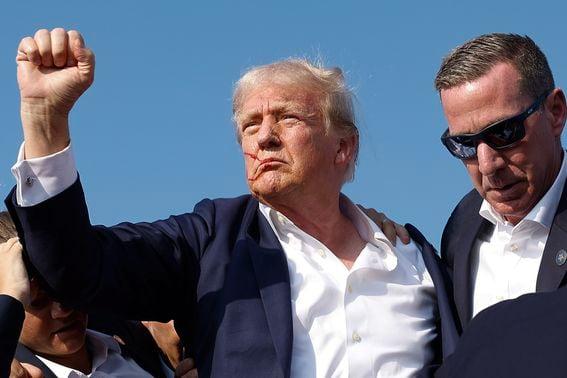
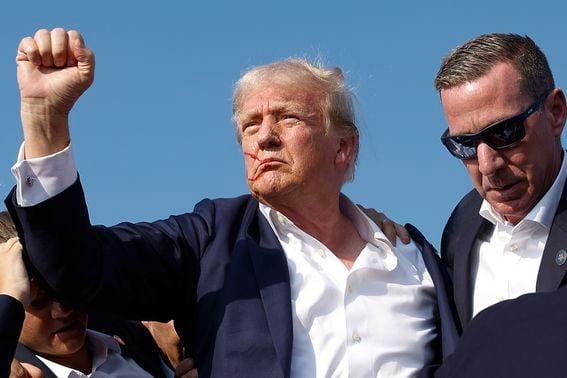
The former president, who was injured at a rally in Pennsylvania on Saturday, now has a 70% chance of retaking the White House, according to traders on the crypto-based prediction market. Trump-themed Polifi tokens and crypto broadly also rose. Former U.S. president Donald Trump's probability of retaking the White House jumped to an all-time high Saturday after he was injured from a shooting at a rally in Pennsylvania, according to traders on Polymarket. A Secret Service spokesman said the Republican presidential candidate was "safe" after the shooting, according to The New York Times. A suspected gunman was killed, and a spectator died as well, the newspaper said. Photos and video footage of a defiant Trump with blood on his face pumping his fist in the air circulated on social media, following two weeks in which the national conversation had focused on the frailty and gaffes of his opponent, incumbent President Joe Biden. "Yes" shares in Polymarket's contract on whether Trump will win the presidency climbed ten cents after the incident, to 70 cents, meaning the market now sees a 70% chance he will prevail in November. Each share pays out $1 if the prediction comes true, and zero if not. Bets are programmed into a smart contract on the Polygon blockchain and settled in USDC, a stablecoin, or cryptocurrency that trades 1:1 for dollars. "PoliFi" meme tokens named after Trump also surged after the shooting. MAGA, for example, was up 34% on a 24-hour basis to $8.38, according to CoinGecko data, and the satirical TREMP had climbed 67% to $0.6471. BODEN, a joke asset named after Biden, slipped about 15% over 24 hours to $0.0333115. These meme coins have become a sort of "de facto betting market on the election," as one proponent described them this year, although unlike prediction markets, PoliFi tokens do not pay anything out to holders if the associated candidate wins. As noted by the writer Noah Kumin in the Mars Review of Books, the shooting also inspired (if that's the right word for it) a crop of new meme coins, many of them in poor taste, on the Solana token creation site Pump.fun. "Resurrection of Trump" (ticker: ROT) and "Hero Trump" (HERO) were two relatively innocuous examples. The CoinDesk 20 index, a proxy for the overall cryptocurrency market, is up 3.31% on a 24-hour basis. Bitcoin, the oldest and largest cryptocurrency by market cap, is up 3.26% to $59,735.17. Trump has expressed wholehearted support for crypto on the campaign trail – he is set to speak at a bitcoin conference in Nashville this month – and the Republican platform vows to halt the Biden administration's "crackdown" on the industry. Polymarket, founded four years ago by Shayne Coplan, has seen boffo trading volumes in 2024 amid enthusiasm for political betting ahead of the U.S. election. The U.S. presidential winner contract has a total of $252 million in bets placed, a record for the company and for all crypto-based prediction markets, if not all prediction markets. PredictIt, a more traditional betting site where wagers are settled in fiat, showed a similar trend, with Trump shares climbing from 59 cents before the shooting to 66 cents before leveling off at 65 cents. Prediction markets are often called a more reliable gauge of sentiment and superior method of forecasting than polls or pundits because the people making predictions are putting money on the line, and are therefore incentivized to do thorough research and express their honest opinions. https://www.coindesk.com/markets/2024/07/14/trumps-odds-of-victory-hit-all-time-high-on-polymarket-after-shooting/
2024-07-12 18:19
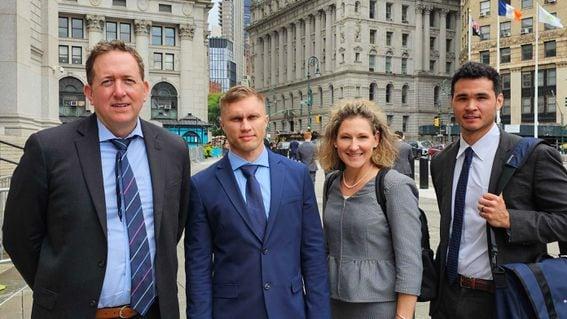
Prosecutors and Roman Storm's attorneys met in court Friday to argue over motions to dismiss the charges against the developer and address evidentiary questions. The core question at the heart of the U.S. Department of Justice's case against Tornado Cash developer Roman Storm is whether he created software or controlled a service. Storm's attorneys sparred with prosecutors Friday during a three-hour-long hearing on his motion to dismiss the government's case against him, with Judge Katherine Polk Failla of the Southern District of New York questioning both teams about their arguments on this central question. The DOJ charged Storm – and fellow developer Roman Semenov – with conspiring to commit money laundering, conspiring to operate an unlicensed money transmitting business and conspiring to violate the International Economic Emergency Powers Act (in other words, conspiring to violate sanctions regulations) last August. Storm pleaded not guilty to the charges and moved to dismiss the case against him in March. Among the DOJ's charges are allegations that Storm and his fellow developers knew that the Democratic People's Republic of Korea (DPRK) and other malicious actors were laundering funds through the mixer, which prosecutors described as a business offering a service. The defense has argued that Storm merely developed privacy software for financial transactions that he released to the world for anyone to use. In Friday's hearing, defense attorney Brian Klein, of Waymaker LLP, argued that Storm had no control of Tornado Cash after May 2020 – the time period in which the DOJ alleged Storm broke the law through his operating the decentralized mixer. Keri Axel, also of Waymaker, added that Tornado Cash's user interface did not in itself control the transactions that users sent around. "They're not connected to those transactions," she said, later adding, "I don't think we're anywhere close to wilfully providing service to the DPRK." This was a theme during the hearing, with the defense repeatedly emphasizing that Storm didn't have control of Tornado Cash's pools, which were immutable, and therefore Storm couldn't be criminally liable for how people used the mixer. “This is the only [money laundering] case ever where the defendant didn’t have control over the funds. Period," he said. Liability and control Prosecutor Thane Rehn argued that “any legitimate business” that becomes aware of criminal activity is required to take steps to stop it. “That’s a lot. I’m not sure what you expected Mr. Storm and his colleagues to do. Should they have shut down Tornado Cash?” Failla asked the prosecution. “How do you saddle him with liability?” Failla mused on what the tipping point, as she called it, should be for when a service should shut down when it becomes aware that criminals are using it in the process of bad actions Rehn said “a single transaction” has been known to be enough evidence – Storm, sitting at the defense table, shook his head at this. If Storm didn’t make a profit, would he have been prosecuted, the judge asked. No, prosecutors said, there would still be a case: “We could imagine a philanthropic money launderer.” WhatsApp hypothetical As Failla considered arguments about whether Storm could be held criminally liable for activity on the software he helped to create, she asked prosecutors whether another software used by criminals – encrypted messaging application WhatsApp – could similarly be blamed for what users did with its technology. Because WhatsApp is encrypted, it “must know” that one of its major selling points is that criminals can use it without their communications being spied on. “I don’t see you charging WhatsApp,” Failla said, asking prosecutors what the difference is between the two softwares that makes one liable for criminal activity and another not. The encryption, Rehn said, means that WhatsApp doesn’t have specific knowledge about what's happening and can’t separate the wheat from the chaff – the criminal from the non-criminal activity. Failla countered, asking Rehn whether that would change if the Attorney General were to write to WhatsApp, informing them that criminals were using it to evade law enforcement – surely then, she asked, WhatsApp would be “on notice”? Rehn ultimately argued that activity on WhatsApp – communication – is protected by the First Amendment, whereas it is “certainly constitutional” for the government to make certain requirements of financial institutions. Document production The first half of the hearing focused on two other defense motions: a motion to compel the DOJ to produce evidence from other U.S. government agencies and foreign governments, and a motion to suppress the DOJ from seizing certain cryptocurrencies. The defense wanted the DOJ to produce documents tied to mutual legal assistance in criminal matters treaties (MLAT) from the Dutch government, which recently prosecuted a third Tornado Cash developer, Alexey Pertsev. The defense also wanted the DOJ to ask the U.S. Treasury Department's Office of Foreign Asset Control (OFAC) and Financial Crimes Enforcement Network (FinCEN) to produce any material they might have. Klein said the standard for the MLAT material is if the defense has a "strong sense" that the material may be helpful, conceding that the team did not necessarily know if the communications would be relevant. "It doesn't have to be an actual exhibit, just something that can help us uncover [further evidence]," he said. The DOJ argued that communications with a foreign government might have diplomatic sensitivities, and couldn't be shared. "The defense's request is entirely speculative," said prosecutor Ben Arad. Klein said he would be happy with redacted documents that omitted any of the diplomatic concerns. He also asked the judge if she could review the materials herself if she was inclined to refuse the defense request. The DOJ similarly pushed back against the request to have OFAC and FinCEN turn over any materials, saying those agencies are not part of the prosecution. The judge also seemed skeptical of the defense argument, saying the request seemed to want her to order an end-round against existing case law, which protects agencies not part of prosecutions. Klein said the DOJ had already turned over a FinCEN report, which he said was tied to the request. The judge did not make any decisions on Friday, saying she would rule "promptly" on the various motions. She also pushed Storm's trial, currently scheduled for September, to Dec. 2. Rehn said he anticipated a roughly two-week trial. While Judge Failla did not indicate how she would rule, she seemed open to arguments from both parties. “You might look at this and say it's a very noble message. I might look at it and say it's a haven for criminals,” Failla said. “And we’d both be right.” https://www.coindesk.com/policy/2024/07/12/conduct-versus-code-may-be-the-defining-question-in-roman-storm-prosecution/
2024-07-12 18:09
Thursday’s CPI report showed that prices declined on a monthly basis for the first time since March 2020, spurring hope that the Fed will finally cut rates. Thursday's CPI report showed further signs of cooling prices although inflation is far from the Fed's 2% goal. However, the Fed might be more focused on the labor market, which could become a threat if it slows down significantly more. Odds for a rate cut in September have increased to nearly 95%. Markets, including crypto, briefly rose after Thursday’s Consumer Price Index (CPI) report which showed that prices cooled more than expected in June, spurring hope among traders that the Federal Reserve could indeed cut interest rates this year. Even though Friday’s less-closely watched Producer Price Index (PPI) data came in hotter than expected, traders remained confident that the central bank will cut rates in September. Odds for that are currently just under 95%, according to CME’s Fed Watch tool. The Fed has a dual mandate – to keep prices stable while also promoting maximum employment. A weakening labor market might thus force the Fed to begin easing monetary policy well before inflation returns to its 2% target (June's CPI data showed inflation rising at a 3% year-over-year pace). The U.S. unemployment rate has increased for three consecutive months to 4.1% in June from 3.8% in March. “I do believe the labor market is going to be the bigger risk to the economy going forward,” said John Leer, head of economic intelligence at Morning Consult. “While it shows signs of cooling, it remains very strong by historical standards," he added. "It would be a historical anomaly if the Fed manages to successfully engineer a soft landing, i.e., tame inflation without triggering a recession.” Fed Chair Jerome Powell acknowledged the slowdown in the labor market at an appearance on Capitol Hill earlier this week, saying that it is no longer “a source of broad inflationary pressures for the economy." “The Fed will be worried that the negative trend may be a turning point for additional weakness in the labor market down the road,” said Olu Sonola, Fitch Ratings' head of U.S. economic research. “Chair Powell did signal earlier this week that the balance of risk between the unemployment rate and inflation is now two-sided and the labor market is now back in balance. This gives them an incentive to start cutting rates sooner than later, now that inflation seems to be back on that path down to 2%.” Even if the Fed starts to cut rates, this might not be as bullish of a signal as some traders think, 10x Research’s Markus Thielen said, given that investors in a weakening economy might choose to pull money out of risk assets – crypto included – in order to allocate it to safer investments. https://www.coindesk.com/markets/2024/07/12/fed-might-focus-on-weakening-labor-market-rather-than-inflation-as-it-mulls-rate-cuts-economists/

2024-07-12 16:43
MakerDAO's competition to allocate funds will open next month, and would give a big boost for the $1.8 billion tokenized real-world asset space. MakerDAO announced on Thursday an open competition to invest $1 billion in tokenized U.S. Treasury offerings. Top issuers such as BlackRock with Securitize, Ondo Finance and Superstate are planning to apply, they told CoinDesk. Maker's governance token (MKR) jumped 5% on the news. Crypto lending platform MakerDAO, the protocol behind the $5 billion stablecoin DAI, is planning to invest $1 billion of its reserves in tokenized U.S. Treasury products. Top players in the space including BlackRock's BUIDL, Superstate and Ondo Finance are lining up to apply for the proposal. "We think this is a very good move from MakerDAO and we are excited to participate with Blackrock's BUIDL," Carlos Domingo, CEO of tokenization platform Securitize, BlackRock's issuance partner, said in an email to CoinDesk. "As the leading tokenized treasury issuer, we will certainly apply.” "Superstate's USTB is an ideal partner for MakerDAO," Robert Leshner, founder of Superstate, told CoinDesk. "We're excited that MakerDAO is creating an open process where we can introduce USTB to the community." Ondo Finance (ONDO), the $550 million RWA platform, also plans to participate. "It's a natural fit in our mission of bringing institutional-grade financial products and services to everyone," Nathan Allman, founder of Ondo Finance, said in a Telegram message. "We look forward to participating." Maker's governance token (MKR) jumped 5% on the news about those issuers' interest in the proposal. MakerDAO's plan means a significant reshuffle of its reserve strategy as the protocol, one of the first players in decentralized finance (DeFi), ushers into a next era under founder Rune Christensen's Endgame Plan. The protocol has spearheaded crypto's real-world asset (RWA) trend, backing its decentralized stablecoin in part by U.S. government bonds and bills held off-chain with a range of partners. The open competition called "Spark Tokenization Grand Prix" to allocate $1 billion to tokenized offerings was announced on Thursday at ETHCC in Brussels, Belgium and also outlined in a Spark SubDAO governance post. Spark Protocol is a lending platform build on top of Maker, and is "poised to become the central hub for RWAs on Maker and Ethereum," the announcement said. It's led by the Spark SubDAO, a smaller decentralized autonomous organization within MakerDAO. Applications will open on August 12 with more details about the competition coming in the next weeks, the post said. The investment will be funded from redirecting reserves from the Clydesdale facility managed by Monetalis and the Andromeda facility by BlockTower, Sebastien Derivaux, co-founder of Steakhouse Financial, a DeFi consulting firm that was also the author of the tokenized treasury proposal. Monetalis will offboard from MakerDAO after community backlash for failing to present adequate reporting about the reserves in a timely manner. Big boost for tokenized treasuries MakerDAO's investment would mean a huge boost for the tokenized real-world asset protocols due to its sheer size. U.S. Treasuries have been at the forefront of tokenization efforts of digital asset firms and traditional financial institutions alike. These products are attractive for protocol treasuries as a low-risk instrument where they can park their blockchain-based cash and earn a stable yield without leaving the blockchain ecosystem. The market for these products tripled in a year to $1.85 billion, according to data provider rwa.xyz. MakerDAO's allocation would mean another 55% growth. This is not the first similar action, though. ArbitrumDAO, an ecosystem development organization of Ethereum layer-2 Arbitrum, finalized a similar contest called STEP on Thursday to allocate the equivalent of 35 million of Arbitrum's native tokens (ARB) – roughly $27 million worth – in tokenized offerings. https://www.coindesk.com/business/2024/07/12/makerdaos-1b-tokenized-treasury-investment-plan-draws-interest-from-blackrocks-buidl-ondo-superstate/
2024-07-12 15:31
The crypto tracing company's latest report shines a light on potential money laundering. Crypto criminals may not be the only ones trying to hide their illicit fund movements across blockchains. According to analytics company Chainalysis, traditional money launderers – criminals working outside crypto – may be moving their cash on-chain too. Released Thursday, Chainalysis' latest report on crypto money-laundering shines a light on an apparently flourishing world of on-chain money transfers that aren't definitively illicit but nevertheless share the characteristics of transactions that would raise eyebrows in banks. Traditional money launderers are starting to utilize crypto networks to create "large-scale money laundering infrastructure" to clean cash that originated outside of crypto, Chainalysis Head of Research Kim Grauer told CoinDesk. These transfers don't originate from the crypto scams, thefts and ransomware attacks that Chainalysis is famous for flagging on the blockchain, the transparent digital ledger of all crypto transactions. Their software and labeling systems help crypto exchanges and other entities avoid accepting funds from criminal activity and assist government investigators in tracking suspects down. By contrast, this more opaque class of transaction comes from wallets that aren't known to be illicit. And yet they flow across blockchains and into exchanges following strategies that traditional financial compliance departments would likely flag. For example: splitting into rounded tranches sized just below know-your-customer reporting thresholds, and then sticking them back together later on. Grauer said most on-chain investigators won't be surprised that this kind of thing has been a potential trouble spot for years. Still, she said the July report is Chainalysis' first attempt to document how big the trend is across the entire blockchain. The company found it was orders of magnitude larger than even the known illicit transaction base. Indeed, Chainalysis found a glut of transactions valued just below the $10,000 mark – at which point additional know-your-customer rules kick in – when analyzing all transfers sent to exchanges in 2024. It's worth noting that just because a crypto transaction to an exchange is, say, $1 below the $10,000 threshold, it isn't definitively illicit. But banks and money services businesses in the traditional financial sector have long used heuristics like that to track down criminal activity. "Our investigators take many things into consideration when they're determining whether something is suspicious, and this would be one thing – but definitely not enough" to prove wrongdoing, Grauer said. Far more telling are transactions that flow to over-the-counter brokers who advertise their willingness to turn criminal crypto into dollars, no questions asked. "This is trying to advance the conversation about how we in crypto think about compliance techniques to mirror what was developed in traditional banking," Grauer said. https://www.coindesk.com/business/2024/07/12/traditional-money-launderers-appear-to-be-using-crypto-chainalysis-says/