2024-06-26 11:42
The confusion around the correct deadline may be a matter of interpretation, even though a specific clarification has been made by the regulator. Crypto entities may have misinterpreted MiCa's deadline to make sustainability disclosures, despite a clarification, according to Crypto Risk Metrics. Crypto's environmental impact, particularly through mining operations, has been a major concern surrounding the industry. Several crypto asset service providers (CASPS) in the European Union (EU) may not know the correct deadline to make sustainability disclosures reflecting their environmental footprint despite a clarification made by the bloc's securities regulator, the European Securities and Markets Authority (ESMA). In general “we have the feeling that more than 80% of crypto asset service providers are not yet aware they need to report ESG-data (environmental, social and governance-related data) from January 1st, 2025," said Tim Zölitz, chief risk officer at Crypto Risk Metrics. On Wednesday, Zölitz's Crypto Risk Metrics inked a Memorandum of Understanding (MoU) to collaborate on displaying ESG-related data with The Digital Token Identifier (DTI) Foundation, the EU's proposed crypto-asset identifier for transparency reporting. The EU's crypto asset regulation, known as Markets in Crypto Assets regulation (MiCA), became a law in 2023. MiCA set up licensing requirements for crypto issuers and service providers including exchange platforms. Stablecoin rules came into effect in June. However, issuers of asset-referenced tokens (ARTs) and electronic money tokens (EMTs) are required to make sustainability disclosures from June 30, 2024, and crypto asset service providers are required to start making disclosure requirements by the end of the year, explained Rowan Varrall, Associate Director at DTI Foundation. Part of the rules are the reporting requirements for ESG-data. The confusion around the correct deadline may be a matter of interpretation, even though a specific clarification has been made by the regulator. The adopted MiCa law said that any adverse impacts on the environment need to be adequately identified and disclosed. But it also said that "That information may be obtained from the crypto-asset white papers.” This may have been interpreted as requiring disclosures only when the white paper is published, the timeline for which is end-2027. "This might stem from the wording in the adopted MiCA regulation text, which was later clarified in the consultation paper number two," Zölitz from Crypto Risk Metrics said. MiCA's "disclosure requirements" related to "environment-related adverse impacts of the consensus mechanism used to issue the crypto-asset, as part of the white papers....," said that "These disclosure requirements apply to persons drawing up the crypto-asset white paper..." and that "operators of trading platforms shall ensure by 31 December 2027 that a crypto-asset white paper is drawn up, notified, and published...." In the second of three consultation papers, which in effect refine the understanding of the MiCA law, ESMA added that crypto entities need to make such "information available in a prominent place on their website for all the crypto-assets in relation to which they provide services, regardless of whether the information can be obtained from white-papers." "Here, the wording does not leave any room for interpretation, as it reads that Crypto Asset Service Providers have to display ESG-data, regardless if they can be obtained from white-papers," Zölitz said. Crypto's environmental impact, particularly through mining operations, has been a major concern surrounding the industry, potentially deterring general adoption and involvement of big institutional investors. ESMA didn't immediately respond to a CoinDesk request for comment. Read More: Here’s How EU Nations Are Preparing to Enforce MiCA https://www.coindesk.com/policy/2024/06/26/many-eu-crypto-entities-may-not-know-the-correct-deadline-for-sustinability-disclosures-under-mica-risk-analyst/

2024-06-26 10:24
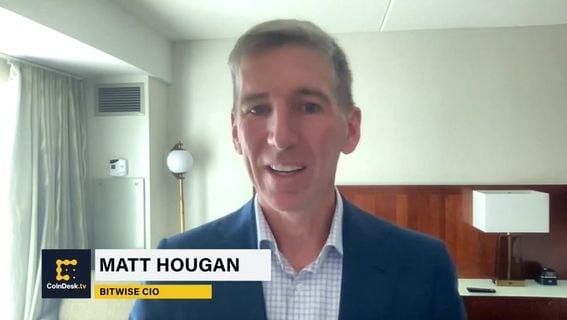
Investors are likely to allocate funds to ETFs in proportion to the relative market caps of bitcoin and ether, the report said. Ether spot ETFs are likely to attract $15 billion of net inflows in the first 18 months, Bitwise CIO Matt Hougan wrote. Potential inflows can be estimated by comparing the relative market caps of bitcoin and ether, the report said. Bitcoin benefits from first-mover advantage, which may reduce the inflows into spot ether ETFs. Ether (ETH) spot exchange-traded funds (ETFs), which are expected to be approved for trading in the U.S. in coming months, are likely to attract $15 billion of net inflows in their first 18 months, Bitwise chief investment officer Matt Hougan wrote in a report on Monday. One way to estimate potential inflows is to consider the relative market caps of bitcoin (BTC) and ether, the report said. Bitcoin is currently 74% of the combined market value, the report noted. Investors will probably allocate to bitcoin and ether ETFs in the same proportions. U.S. investors have invested $56 billion in spot bitcoin ETFs since their introduction in January, a number that is expected to grow to $100 billion or more by the end of 2025 as large wirehouses approve the products for trading on their platforms, the asset manager said. “Using this $100 billion figure as a reference, spot ether ETPs would need to attract $35 billion in assets to reach parity, a process I expect will take about 18 months,” Hougan wrote. The Grayscale Ethereum Trust (ETHE), with $10 billion in assets under management (AUM), is expected to convert to a spot ETF, leaving $25 billion of inflows to reach parity. In Canada, however, ether ETPs account for only 22%-23% of total AUM “slightly underperforming their absolute market cap weight,” the report noted. The discrepancy can be linked to bitcoin’s first-mover advantage, Hougan wrote. “Some investors may have bought a bitcoin ETP and stopped there, thinking their crypto exposure was covered,” the report said, adding that this dynamic may be true in the U.S. also. Assuming ether ETFs only capture 22% of the market, as in Canada, cuts the estimate of net new inflows to $18 billion, and other factors chop off another $3 billion. https://www.coindesk.com/markets/2024/06/26/ether-spot-etfs-to-attract-15b-of-net-inflows-in-first-18-months-bitwise/
2024-06-26 07:11
Over 25% of options are set to expire "in the money," Deribit's Luuk Strijers told CoinDesk. The size of the impending BTC, ETH options expiry represents over 40% of total notional options open interest on Deribit. Over 25% of options are set to expire "in the money." Traders anticipate a renewed bullish shift in bitcoin and ether next month. It's that time again when discussions about activity in the crypto derivatives take precedence. On Friday at 08:00 UTC, bitcoin (BTC) options worth $6.68 billion and ether (ETH) options worth $3.5 billion are set to expire on the leading crypto derivatives exchange Deribit. The impending expiry, which represents over 40% of the current cumulative open interest of over $23 billion, could trigger a surge in market volatility. Large quarterly expiries often lead to increased volatility, making prices more unpredictable due to higher trading volumes and the closing/rollover of positions. "As we approach Friday's large quarterly expiry, potentially influenced by 'quadruple witching' and related volatility in U.S. stock markets, over 25% of Deribit open interest is set to expire in-the-money, equating to over $2.7 billion. The total notional size of the expiry is over $10 billion," Luuk Strijers, chief executive officer at Deribit, told Coindesk in an interview. Options are derivative contracts that give the holder the right but not the obligation to buy or sell the underlying asset at a predetermined price on or before a specific date. A call gives the right to buy, while a put offers the right to sell. On Deribit, one options contract represents one BTC or ETH. Having more than 25% of open interest set to expire in the money means a significant number of derivative contracts are expected to be profitable for their holders at expirations. Bitcoin, the leading cryptocurrency by market value, has dropped nearly 9% this month, testing bargain hunters below $60,000 at one point. As usual, the sell-off has weighed over the broader market, pulling ether down by almost 10%. "The recent price drop was caused by miner sales, some pressure from German-seized BTC, and, of course, the imminent transfer of Mt. Gox coins expected in early July," Strijers said. Still, call-put skews show investors are willing to pay a higher premium for near-term and long-term calls offering asymmetric upside than puts, according to data tracked by Amberdata. "While short-term bearish sentiment is evident, traders anticipate a positive shift for bitcoin by July 12 and ETH by July 5, looking at options skew. Trading in the ETH ETF is expected to start in the first week of July," Strijers noted. https://www.coindesk.com/markets/2024/06/26/renewed-bullishness-expected-after-bitcoin-ethers-10b-options-expiry-on-friday/

2024-06-26 07:00
The Series A round was led by Illuminate Financial and DRW Venture Capital. Crossover Markets is waving the flag as one of the only ultra-low-latency electronic communication networks (ECN) in crypto. Illuminate founder Mark Beeston will join Crossover’s board of directors. Crossover Markets, a superfast execution-only trading platform for cryptocurrencies, has raised a $12 million Series A led by Illuminate Financial and DRW Venture Capital. Crypto trading is evolving such that it can cater to both those players who want the simplicity of a vertically integrated model, as well as those institutions further up the ladder who want to choose their custodian, or expect a choice of venues and counterparties that they're allowed to trade with. Crossover Markets, which last month partnered with prime broker Hidden Road, is waving the flag as one of the only ultra-low-latency electronic communication networks (ECNs) in crypto, according to the firm’s CEO Brandon Mulvihill. In contrast to an ECN model, crypto exchanges use a central limit order book execution model, which means it doesn't matter if the exchange has one client or a million clients, there's only ever one pool of liquidity and one market data session, Mulvihill said. “If we onboard 50 takers of liquidity, we can have up to 50 independent market data sessions and 50 pools of liquidity,” Mulvihill said in an interview. “What our model does is provide value to both the maker and the taker and that’s reflected in our rate card. We charge one basis point to the maker and we charge one basis point to the taker.” Crossover Markets handled over $3.15 billion in notional trading value in the first quarter of this year, the company said in a press release. Illuminate Financial founder Mark Beeston will join Crossover’s board of directors. Existing investors include Flow Traders, Laser Digital, Two Sigma, Wintermute, as well as retail brokers such as Exness, Gate.io, GMO, Pepperstone, Trademax, and Think Markets. https://www.coindesk.com/business/2024/06/26/crypto-execution-only-platform-crossover-markets-raises-12m/

2024-06-26 06:17
No downtime was observed as a Cardano developer managed to attack the attacker and take back some funds. The Cardano blockchain successfully mitigated a DDoS attack that attempted to steal staked tokens, with no significant impact on the network's operation. The attack involved transactions executing numerous smart contracts and was halted after a Cardano developer's post revealed a vulnerability, leading to the attacker's funds being taken. The Cardano blockchain was hit by a distributed denial of service (DDoS) attack late Tuesday. However, the attack was unsuccessful and mitigated before any damage was caused, and the network continued to operate as usual. DDoS is a common attack vector in which the attacker floods a server (or a blockchain) with spam traffic to prevent users from accessing connected online services and sites. Fluid Token chief technology officer @ElRaulito_cnft said on X that the attack began on block 10,487,530, each transaction executing 194 smart contracts. The attacker spent 0.9 ADA per transaction and filled each block with several transactions – attempting to stress the network. Philip Disarro, founder of Cardano development firm Anastasia, said the DDoS could be stopped immediately by deregistering the stake credential used by the attacker. The attack was stopped shortly after Disarro’s post. “DDOSer halted his attack after reading my tweet in an effort to protect his funds. Alas, they were too late and the pillaging of their funds is already in progress,” he said. A Cardano developer later clarified that the DDoS attack was aimed at disrupting the system and not to steal staked tokens. ADA was up 0.4% in the past 24 hours, trading at 38 cents in Asian morning hours. https://www.coindesk.com/tech/2024/06/26/cardano-unfazed-by-failed-ddos-attack-targeting-staked-ada/

2024-06-25 11:19
Many PoliFi tokens fell more than 10% after claims emerged that the Trump campaign was behind the DJT token. PoliFi tokens are back in the green after no credible evidence emerged that the Trump campaign or his family is involved with the DJT token. Martin Shkreli continues to claim there was involvement. So-called PoliFi tokens such as TRUMP, TREMP and Boden have recouped their losses after a slate of denials from people in Donald Trump's orbit – but not the campaign itself – regarding any official connection between the DJT token and the Republican presidential hopeful. CoinGecko data shows that TRUMP, the first major token in the sector that matches financial instruments with political themes, has gained 24% in the past 24 hours, while its Solana counterpart TREMP added 20%, and the Joe Biden-themed BODEN is well in the green climbing over 45%. The entire PoliFi sector has risen 14%, market data indicate. The increases likely result from a market consensus that the DJT token does not have a connection to the former president's campaign nor to his family. A Polymarket contract asking if DJT "is real" resolved to No, but that outcome is currently being disputed. Other contracts asking if Trump's son Barron Trump had some involvement also resolved to No, but they are going through that same dispute process. Despite this, the DJT token added more than 30% in the last 24 hours. An investigation by ZachXBT concluded that Martin “Pharma Bro” Shkreli, a convicted felon, was behind the token, which Shkreli confirmed – though he continues to claim that Barron Trump also participated in the project. While the Trump campaign has not officially commented on the DJT token, DL News reported that insiders say there is no official involvement. Roger Stone, a Republican political consultant and ally of Trump, also said there was no official involvement, and that Barron was also not involved. https://www.coindesk.com/markets/2024/06/25/polifi-tokens-return-to-business-after-proof-of-djt-trump-link-fails-to-materialize/