2024-06-19 14:37
Arkham previously identified the address as belonging to the German Federal Criminal Police Office (BKA), which had seized almost 50,000 BTC from a piracy site. A German government agency appears to have transferred $425 million in bitcoin to another wallet, returning some to the original wallet and sending a portion to crypto exchange deposit wallets. Transactional data shows deposits worth $32 million each to Kraken and Bitstamp, which may indicate intentions to sell. A German government agency today moved $425 million in bitcoin (BTC) to another wallet address, Arkham data appears to show, sending some on to crypto exchange deposit wallets and returning some to the starting point. The wallet address, previously identified as belonging to the German Federal Criminal Police Office (BKA) by Arkham, moved 6,500 BTC to the address “bc1q0unygz3ddt8x0v33s6ztxkrnw0s0tl7zk4yxwd” and then back to itself. Transactional data shows that a tranche of $32 million worth of bitcoin was deposited on crypto exchange Kraken and a similar amount on Bitstamp. Arkham CEO Miguel More told CoinDesk over Telegram that the entity appeared to have moved $130 million in BTC to “service wallets,” which generally indicates an “intention to sell in the near future.” Mantle blockchain strategist @Defi_Maestro flagged the movements on X earlier. BKA seized almost 50,000 BTC, worth over $2 billion at the time, from the operators of Movie2k.to, a film piracy website that was active in 2013. The BKA received the bitcoin in mid-January after a "voluntary transfer" from the suspects, according to Arkham. https://www.coindesk.com/markets/2024/06/19/german-government-agency-moves-425m-bitcoin-some-to-crypto-exchanges/

2024-06-19 12:06
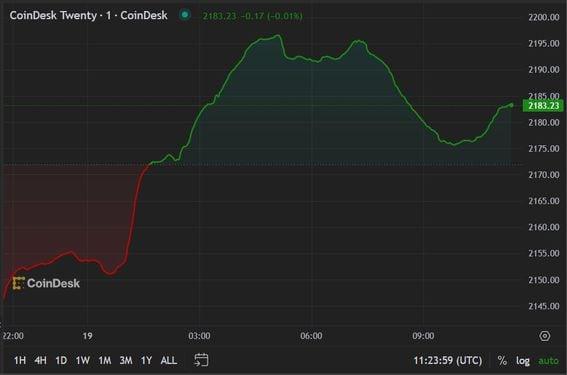
The latest price moves in crypto markets in context for June 19, 2024. Latest Prices Top Stories The digital asset market ticked upward during the European morning with ether reclaiming $3,500. ETH has climbed over 4% in the last 24 hours, trading at $3,540 at the time of writing. The CoinDesk 20 Index (CD20) added around 1.6%. DOGE is nearly 3.5% higher following its slump on Tuesday, while fellow meme coin SHIB is also up over 3%. Bitcoin remains subdued, trading around $65,400, a lift of 0.2% from 24 hours ago. Spot bitcoin ETFs in the U.S. experienced a further $152.4 million worth of outflows on Tuesday. Wallets tracked by CryptoQuant show whales sold over $1.2 billion worth of BTC in the past two weeks. These long-term bitcoin holders are displaying few signs of renewed demand, indicating an ongoing absence of upside for the world's largest cryptocurrency. “Traders are still not increasing their bitcoin holdings and large holders’ demand growth is still missing strength,” analysts wrote. Market observers say crypto miners may be increasingly looking at the booming AI sector instead of bitcoin to ply their trade, prompting a sale of their bitcoin rewards instead of holding. Both sectors rely extensively on powerful computing chips to generate and maintain data. Bitcoin and crypto-linked stocks are underrated and ripe for institutional adoption, according to broker Bernstein. While BTC and bitcoin ETFs may have shown promise before disappointing in recent months, Bernstein predicts ETF approval by major wirehouses and large private bank platforms in the second half of the year. Bitcoin ETF inflows are expected to accelerate in the third and fourth quarters, the report said, and the next leg of adoption will be driven by large advisers approving ETFs and allocation headroom from existing portfolios. Bernstein has outperform ratings for bitcoin-adjacent publicly traded firms like MicroStrategy, Robinhood and miners Riot Platforms and CleanSpark. Chart of the Day Cumulative open interest in bitcoin perpetual futures trading on major exchanges has declined from $6.07 billion to $5.10 billion in two weeks. It means the recent bitcoin price pullback is mainly driven by unwinding of bullish bets or profit taking rather than renewed bearish bets. Source: VeloData - Omkar Godbole Trending Posts SEC Ends Probe Into Consensys, Won't Sue Over Ethereum Elevated Ether Volatility Expectations May Be Unfounded National Australia Bank’s Venture Arm Invests in Crypto-Focused Zodia Custody https://www.coindesk.com/markets/2024/06/19/first-mover-americas-ether-meme-coins-lead-recovery-while-bitcoin-remains-subdued/
2024-06-19 11:19
The selling coincides with net outflows from U.S.-listed bitcoin ETFs in the same period, data shows. Long-term bitcoin holders and miners have been significant sellers of the cryptocurrency in the past two weeks with little indication of renewed buying interest. This trend has been observed through a decrease in UTXO age bands, indicating increased selling activity. Some opine miners are shifting their focus to the booming AI sector due to the diminishing mining rewards post-halving, which may have increased selling activity. Long-term bitcoin holders and miners were among the biggest sellers of the asset in the past two weeks and show few signs of renewed demand, on-chain analysis firm CryptoQuant said in a Wednesday report shared with CoinDesk. Wallets tracked by CryptoQuant show whales – a colloquial term for large holders of any token – sold over $1.2 billion worth of BTC in the past two weeks, likely using brokers instead of on the open market. “Traders are still not increasing their Bitcoin holdings and large holders’ (whales) demand growth is still missing strength,” analysts wrote. “Stablecoin liquidity has continued to slow down, growing at the slowest pace since November 2023.” These traders have decreased their holdings since BTC prices traded over $70,000 in late May, declining UTXO age bands tracked by CryptoQuant show. Unspent output from bitcoin transactions, or UTXO, are created in every Bitcoin transaction is used by traders to track buying and selling patterns in the previous, current and upcoming market cycles. A drop in UTXO age usually indicates an increase in Bitcoin activity, and thus selling. A rise suggests more holding in the market. Market observers say miners may be increasingly looking at the booming artificial intelligence (AI) sector instead of bitcoin to ply their trade, leading to selling their bitcoin rewards instead of holding. Both sectors extensively rely on powerful computing chips to generate and maintain data—a resource that miners already possess. "One of the biggest trends since Bitcoin halving this year is that miners are increasingly diverting to AI business," shared Lucy Hu, senior analyst at crypto wealth management company Metalpha in a Telegram message. "The fall of the mining rewards prompted miners to seek other channels to boost revenue. With AI firms demanding energy-intensive data centers, Bitcoin miners are gradually growing revenue from the sales with AI firms." Since June 5, BTC prices have fallen from $71,000 to just over $65,000 as of Wednesday on a strong dollar, a flight away from riskier assets, and growth in traditional stock indices. Meanwhile, U.S.-listed exchange-traded funds (ETFs) tracking the asset recorded net outflows of over $600 million last week—their worst performance since late April. Some traders have warned of a move to as low as $60,000 in the absence of growth catalysts. BTC is down 0.6% in the past 24 hours, CoinDesk data shows. The broad-based CoinDesk 20 (CD20), an index of the largest tokens, is up 1.2%. https://www.coindesk.com/markets/2024/06/19/bitcoin-whales-sold-over-1b-btc-in-past-two-weeks-cryptoquant/

2024-06-19 11:12
The excitement surrounding the impending debut of spot ether ETFs in the U.S. has investors anticipating higher ether price swings relative to bitcoin. The spread between ether and bitcoin implied volatility indexes has widened, reflecting excitement about the potential debut of spot ETH ETFs in the U.S. Volatility pricing may be off the mark because institutions might use the spot ETFs to set up non-directional basis trades, as they have been reportedly doing in BTC. Demand for ether ETFs may be tepid. Spot ether exchange-traded funds (ETFs) are expected to begin trading in the U.S. this year. The highly anticipated debut has investors positioning for higher volatility in the ether (ETH) price relative to bitcoin (BTC). There's a possibility that the excitement about spot ether ETFs may be unfounded, one observer suggested. The spread between the forward-looking, 30-day implied volatility indexes for ether (ETH DVOL) and bitcoin (BTC DVOL) flipped positive in April on dominant crypto options exchange Deribit. Since then, it has risen to 17%, according to data tracked by Amberdata. Implied volatility estimates the degree of future price swings based on options prices. In other words, ether's implied volatility has been consistently greater than bitcoin's for over two months. This richness may not persist, according to Greg Magadini, director of derivatives at Amberdata. "I continue to remain skeptical that this relative volatility premium remains persistent. A lot of cold water was splashed on the BTC ETF Inflows narrative, given the speculation that funds are merely trading the BTC basis as opposed to taking outright ETF exposure," Magadini said in the weekly newsletter. Much of the excitement over spot ether ETFs probably stems from the fact that bitcoin ETFs have drawn nearly $15 billion in investor money since their debut in January. Initially, BTC's price surged alongside ETF inflows. That rally has now stalled, with industry experts attributing most ETF inflows to a non-directional arbitrage strategy – the cash and carry, or basis, trade – instead of outright bullish bets. That has toned down the bullish spot ETF narrative. After all, institutions might use spot ether ETFs to set up basis trades. "If this is true, does the ETH ETF truly react aggressively to the start of an ETF trading? Especially by such a large margin across the board in the term structure," Magadini wrote. Term structure is a graphical representation of implied volatility for different maturities and is usually upward-sloping: greater volatility is expected in the longer term. Ether's term structure is significantly higher than bitcoin's, indicating heightened expectations for volatility across all time frames. There's another sign the market might be a little too excited about spot ether ETFs: Open interest in ether futures listed on the Chicago Mercantile Exchange is significantly less than bitcoin futures. The figure for ether futures is $1.6 billion compared with almost $10 billion in bitcoin futures, according to Velo Data. The discrepancy shows ether has yet to find the institutional acceptance of bitcoin, and inflows into the impending ether ETFs could be tepid compared with the larger cryptocurrency. Investment banking giant JPMorgan warned last month that ether ETFs may amass just $3 billion in net inflows this year. "The true resolution to this question [about persistent of ether vol premium] comes when we see the actual ETF inflows and volume. If this looks anything like the CME OI between BTC futures and ETH futures, I think ETH still doesn’t have the mainstream enthusiasm that BTC has seen," Magadini said. "Longterm I still love ETH, but there seems to be a trading opportunity around the 'immediate' ETH relative vol pricing today," Magadini added. Volatility trading involves betting on the degree of price swings. Investors typically sell options or volatility futures when anticipating a slide in the implied volatility. https://www.coindesk.com/markets/2024/06/19/elevated-ether-volatility-expectations-may-be-unfounded/

2024-06-19 10:16
Zodia Custody established operations in Australia in late 2023 NAB Ventures made an undisclosed investment in Zodia Custody, which is also backed by Standard Chartered, Northern Trust and SBI Holdings. Key immediate priorities include onboarding Australia’s unique ecosystem of home-grown digital asset exchanges and priming for the coming wave of ETF issuers. The venture arm of National Australia Bank, NAB Ventures, has invested in Zodia Custody, an institution-grade cryptocurrency and digital assets safekeeping platform which is also backed by Standard Chartered, Northern Trust and SBI Holdings. The investment from NAB Ventures underpins Zodia’s push into Australia, where the custody firm established operations in late 2023, according to a press release. The size of the investment was not disclosed. Banks and other financial institutions have warmed to the idea of cryptocurrency custody, usually opting for some third party to manage cryptographic keys and explore use cases around trading, tokenization and so on. “NAB Ventures’ investment in Zodia was based on a range of factors including their innovative approach, institution-grade safety and strong work with regulators,” said NAB Ventures MD Amanda Angelini in a statement. Following the investment, key immediate priorities include onboarding Australia’s unique ecosystem of home-grown digital asset exchanges, many of whom are moving assets onto the Zodia Custody platform in preparation for stricter regulatory requirements expected to come into effect in 2025, Zodia said. Zodia Custody is also priming itself as the custodian of choice for applicants of anticipated digital asset ETFs awaiting approval from the ASX, the custody firm added. https://www.coindesk.com/business/2024/06/19/national-australia-banks-venture-arm-invests-in-crypto-focused-zodia-custody/
2024-06-19 10:00
Spot bitcoin ETFs are expected to be approved by major wirehouses and large private bank platforms in the third and fourth quarters, the report said. Crypto markets are on the cusp of further institutional adoption, the broker said. Spot bitcoin ETFs will be approved by major wirehouses and large private bank platforms in the third and fourth quarters, the report said. Bernstein predicts that bitcoin will reach a cycle high of $200,000 in 2025, $500,000 by 2029 and $1 million by 2033. Bitcoin (BTC) and crypto-linked stocks are underrated and ripe for institutional adoption, broker Bernstein said in a research report on Wednesday. Bernstein notes that crypto bears have argued that the spot bitcoin exchange-traded fund (ETF) trade is over, that most of the early allocations were from retail investors, and that the majority of institutional demand was for the “basis cash and carry trade” and not new net long positions. While this is true, “we see bitcoin ETFs as on the cusp of approvals at major wirehouses and large private bank platforms in Q3/Q4,” analysts Gautam Chhugani and Maihka Sapra wrote. Spot bitcoin ETFs were approved for the first time in the U.S. in January, dramatically broadening access to the world’s biggest cryptocurrency. The institutional basis trade appears to be the “Trojan horse for adoption” and these investors are now evaluating net long positions as they become more comfortable with improving ETF liquidity, the authors wrote. The basis trade involves buying the spot bitcoin ETF and selling the bitcoin futures contract at the same time and then waiting for the prices to converge. Bitcoin ETF inflows are expected to accelerate in the third and fourth quarters, the report said, and the next leg of adoption will be driven by large advisers approving ETFs and allocation headroom from existing portfolios. The broker expects bitcoin to rise to a cycle high of around $200,000 by 2025, $500,000 by 2029 and $1 million by 2033. Bernstein has an outperform rating on bitcoin miners Riot Platforms (RIOT) and CleanSpark (CLSK). The broker also has an outperform rating on software company and bitcoin acquirer MicroStrategy (MSTR) and trading platform Robinhood (HOOD). https://www.coindesk.com/markets/2024/06/19/bitcoin-crypto-related-stocks-are-ripe-for-institutional-adoption-bernstein/