2024-06-14 10:16
The body will act as a bridge between the private sector and the government in supervising the industry. As many as 24 cryptocurrency-related entities have come together to form the Taiwan Virtual Asset Service Provider Association. The building blocks of the industry association were put in place by nine members last year with government approval in 2024 setting the stage for the first formal meeting held on Thursday. Taiwan's crypto advocacy body, the Taiwan Virtual Asset Service Provider Association, was formally established with a founding meeting of 24 cryptocurrency-related entities, according to an announcement on X and a blog post by the XREX blockchain firm. The body will aim to act as a bridge as the private sector and the government work together to supervise the industry. Its first task will be to formulate a self-regulation code that covers industry classification, listing and delisting, consumer protection, risk control, transaction monitoring and advertising solicitation, according to the blog post. The preparations for the establishment of the association began in September, when nine entities came together to kickstart the process. Taiwan's Interior Ministry approved the formation of the body in line with the law in March 2024 and the founding meeting was held on Thursday. BitoPro founder and CEO Titan Cheng will be the chair and XREX Chief Revenue Officer Winston Hsiao will be the vice chair. Taiwan has taken steps to introduce legislation to regulate the crypto sector after the FTX scandal forced it to change its earlier fairly hands-off stance. Read More: Taiwan Crypto Regulation Gets Going With First Reading of Digital Asset Bill https://www.coindesk.com/policy/2024/06/14/taiwan-crypto-advocacy-body-becomes-formally-active-with-24-entities/

2024-06-14 09:53
Bitcoin declined 6% in a week even as Nasdaq rallied to record highs. Bitcoin lost 6% in one week even as Nasdaq climbed to an all-time high. Crypto-specific factors like profit-taking by holders and increased selling by miners seem to be holding back the BTC price. Bitcoin (BTC) has declined over 6% in seven days, deviating from its usually positive correlation with the equity market's tech-heavy Nasdaq Composite Index. While the popular narrative blames bitcoin's slide on the Federal Reserve's decision to signal just one U.S. interest-rate cut for the rest of the year, technology stocks extended gains after Wednesday's decision, indicating crypto-specific factors may be stopping BTC from keeping pace with the Nasdaq. "When a market continues to sell off at a specific level, it has less to do with events, narratives, or fundamentals. Instead, a large seller perceives prices to be overvalued at that level," Markus Thielen, founder of 10x Research, said. "The November 2021 all-time high of nearly 70,000 is a level where long-term holders are willing to sell their Bitcoins, as they are the most likely candidates to cash out." Earlier this week, a wallet that had been inactive since 2018 moved 8,000 BTC worth over $500 million to crypto exchange Binance. A move from a wallet to an exchange is often a signal of an impending sale. The wallet reportedly acquired the BTC at less than $4,000. Data tracked by analytics firm CryptoQuant show that the number of BTC inactive for at least 12 months and two years has declined, a sign of holders have taken profits as the bitcoin price holds near record highs. "Addresses with supply inactive for 1 and 2 years have been selling since around price hit record high. This is offsetting accumulation by longer-term holders (+3-year)," Ilan Solot, co-head of digital assets at Marex Solutions, said in an email on Wednesday. According to Thielen, 1.8 million BTC have not moved for over a decade, potentially including the 1.1 million BTC mined by Satoshi himself. "This is why we would also expect that most of the Mt. Gox holders will convert their BTC into fiat once they take possession of their BTC in October/November 2024," Thielen noted. Mt. Gox, a crypto exchange that imploded due to a hack in 2014, is gearing toward distributing 142,000 bitcoin (BTC) worth roughly $9.5 billion and 143,000 bitcoin cash (BCH) worth $73 million to creditors, CoinDesk reported in April. A distribution could pose a substantial overhang on digital asset prices. The trustees of the defunct exchange last year set an Oct. 31, 2024 deadline to reimburse creditors. Another reason for BTC's price weakness could be increased selling by miners, or those responsible for making coins. Miners receive BTC as a reward for approving blocks on the blockchain and additional revenue from user transaction fees. Listed miner Marathon Digital (MARA) has sold 1,400 bitcoin worth $98 million this month. According to CryptoQuant, miners sold at least 1,200 BTC on June 10 via the over-the-counter desks, the highest single-day volume in over two months. The hashrate, or the computing power dedicated to the Bitcoin blockchain, has declined from 622 exahashes per second (EH/s) to 599 EH/s this month. That's a sign of miner capitulation. https://www.coindesk.com/markets/2024/06/14/heres-why-bitcoins-not-keeping-pace-with-nasdaq/

2024-06-14 08:42
The broker assigned the software company an outperform rating and a $2,890 price target. The bitcoin price could hit $1 million by 2033 and is likely to reach a $200,000 cycle-high by 2025. MicroStrategy initiated as outperform with a $2,890 price target at Bernstein. The software company's long-term convertible debt strategy means it has time to benefit from bitcoin upside with limited liquidation risk to the crypto on its balance sheet, the report said. The price of bitcoin (BTC) is likely to hit $1 million by 2033 and reach a cycle-high of $200,000 by 2025, Bernstein said as it initiated coverage of software developer MicroStrategy, the biggest corporate owner of the largest cryptocurrency, with an outperform rating. MicroStrategy now owns 1.1% of the global supply of the world’s largest cryptocurrency, worth about $14.5 billion, having transformed itself from a small software company in the space of four years, the broker said in a research report on Thursday. Bernstein initiated coverage of the Tysons Corner, Virginia-based company with a $2,890 price target. The shares closed at around $1,484 on Thursday. The Nasdaq-listed firm currently holds 214,400 bitcoin. It began buying the cryptocurrency in 2020, adopting it as a reserve asset. The company’s founder and chairman, Michael Saylor, “has become synonymous with brand bitcoin and has positioned MSTR as a leading bitcoin company, attracting at-scale capital (both debt and equity) for an active bitcoin acquisition strategy,” analysts Gautam Chhugani and Mahika Sapra wrote. Microstrategy positions itself as an “active leveraged bitcoin strategy versus passive spot exchange-traded funds (ETFs),” the report said, noting that over the last four years the company’s active strategy has produced a higher bitcoin per equity share. The broker's BTC price forecast is driven by the unprecedented demand from spot exchange-traded funds (ETFs) and because supply of the cryptocurrency is constrained. Bernstein now estimates that bitcoin could reach $500,000 by 2029. The 2025 estimate was raised from $150,000. MicroStrategy’s long-term convertible debt strategy means it has enough time to benefit from potential bitcoin upside with limited liquidation risk to the cryptocurrency on its balance sheet, the report added. The company yesterday proposed a $500 million debt sale of convertible notes to boost its bitcoin stash. https://www.coindesk.com/markets/2024/06/14/bitcoin-could-hit-1m-within-10-years-bernstein-says-as-it-initiates-coverage-of-microstrategy/

2024-06-14 08:14
BlackRock’s IBIT was the only ETF posting a net inflow on Thursday, while most of the funds recorded outflows. U.S.-listed bitcoin ETFs experienced outflows totaling over $226 million on Thursday, marking the third day of outflows this week. This trend echoes the stream of outflows that took place at the end of April. U.S.-listed bitcoin (BTC) exchange-traded funds (ETFs) posted over $226 million in net outflows on Thursday for a third day of outflows this week and reminiscent of the stream of withdrawals that occurred at the end of April. Fidelity’s FBTC recorded the highest outflow, with $106 million withdrawn, preliminary data from SoSoValue shows. Grayscale’s GBTC recorded $62 million in outflows, and Ark Invest’s ARKB saw $53 million taken out. Only BlackRock’s IBIT recorded a net inflow, gaining $18 million. The ETFs offered by Valkyrie, Franklin Templeton, Hashdex and WisdomTree showed no inflow or outflow activity. Wednesday was the only day this week that registered a net inflow of these U.S.-listed products, which added $100 million on the day. The activity comes amid a generally volatile week for bitcoin and the broader crypto market, centered on Wednesday's key U.S. inflation report and Federal Reserve meeting. The withdrawals bring the net amount taken out of the exchange-traded funds to $564 million in three days. That's about half the $1.2 billion taken out of six days at the end of April. U.S. inflation came in lower-than-expected, briefly boosting bitcoin prices to $70,000 from $68,000 before tumbling back under $67,000 as traders likely took profits on the move. https://www.coindesk.com/markets/2024/06/14/bitcoin-etfs-see-226m-outflows-led-by-fidelitys-fbtc/

2024-06-13 15:04
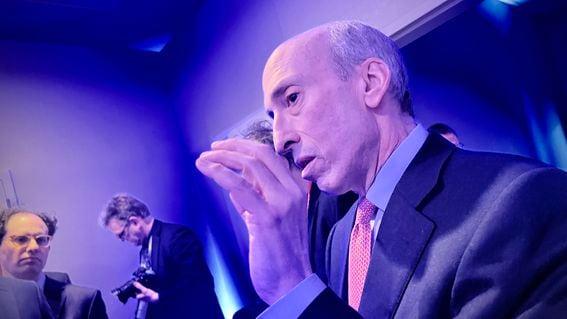
The chair of the Securities and Exchange Commission told senators in a budget hearing that the applications to run ether spot ETFs should be finished this summer. Securities and Exchange Commission Chair Gary Gensler suggested the ether ETFs are really already approved and all that remains are the registration details getting hammered out at the staff level. Gensler repeated his complaints about the noncompliant crypto industry, demurred on answering whether ETH is a commodity and argued that the CFTC isn't ready to police crypto markets. Commodity Futures Trading Commission Chair Rostin Behnam also addressed his agency's effort to ban elections contracts in the prediction markets. The final approvals for exchange-traded funds (ETFs) trading Ethereum's ether (ETH) should be finished this summer, U.S. Securities and Exchange Commission Chair Gary Gensler told senators in a budget hearing on Thursday. Gensler told a subcommittee of the Senate Appropriations Committee in a hearing justifying the market regulator's budget that the process is "working smoothly" after the initial approval of a group of ETFs. The agency had previously granted the initial round of applications but he said the final registration requirements – filings known as S-1s – are now being handled at the "staff level." Once those filings are approved, the new ETFs can be listed, opening the wider markets to easy-to-trade funds that hold actual ether, much like the earlier establishment of bitcoin spot ETFs that hold (BTC). The SEC had initially blocked the effort for bitcoin ETFs until a federal court ruled the agency was mishandling the matter, and Gensler has said the SEC has since been following that decision and allowing them. When asked directly whether ETH is a commodity, Gensler didn't respond with a yes or no, maintaining the uncertain position his agency has held on that asset. At the same hearing, when asked whether it's a commodity, Commodity Futures Trading Commission (CFTC) chief Rostin Behnam responded, "Yes." The question is important when trying to seek the proper U.S. watchdog for various tokens. The SEC will oversee securities tokens and the CFTC will have authority over the rest. While Gensler has repeatedly said the vast majority of digital assets should be considered securities, he refuses to identify which ones fit in which basket apart from those his agency has listed in enforcement actions. "While not all crypto are crypto securities – some are under Chair Behnam's jurisdiction – those that are have an obligation to disclose to the public," Gensler said, repeating his argument that most of the tokens remain unregistered and are violating the securities law. Gensler, who has run both agencies as chairman, said that the industry is "thumbing its nose" at the rules. He also suggested the CFTC isn't currently well-prepared to police a disclosure-based system of oversight, because that's not what it does, unlike the SEC. Behnam noted the CFTC still doesn't have some of the necessary authorities for policing the crypto markets if – as certainly legislative efforts in Congress would direct – it gets more responsibility for overseeing crypto trading. "We don't have those traditional regulatory tools – registration, custody, surveillance, oversight – that have really made American capital markets and derivative markets so strong," he said, adding that the CFTC would need a bigger budget to make that happen. Behnam was also asked about prediction markets popularized at such firms as PredictIt, Polymarket, Zeitgeist and Kalshi and his agency's stand against contracts predicting the outcome of elections. His agency recently moved to block such contracts. "The last thing we need right now is sort of commoditizing elections," Behnam said. "This, in my view, is clearly against existing law, and we're taking steps to make sure they're banned." Read More: SEC's Gensler Shrugs About New Crypto ETFs Strolling Through His Agency's Gates https://www.coindesk.com/policy/2024/06/13/ether-etfs-should-be-fully-approved-by-september-says-sec-chair-gensler/
2024-06-13 14:12
Most of the $16 billion inflow into spot bitcoin ETFs since their launch likely came from existing digital wallets on exchanges, the report said. Crypto markets have seen $12 billion of net inflows year-to-date, the report said. The bank said that the majority of the $16 billion inflow into spot bitcoin ETFs likely came from existing digital wallets on exchanges. JPMorgan said it was skeptical that the pace of inflows will continue for the rest of the year. Digital assets have seen $12 billion of net inflows year-to-date, and if flows continue at the same pace the number could grow to $26 billion by the end of the year, JPMorgan (JPM) said in a research report on Wednesday. Spot bitcoin (BTC) exchange-traded funds (ETFs) have led the way, attracting $16 billion of net inflows, the report said. This number, when combined with Chicago Mercantile Exchange (CME) futures flows plus capital raised by crypto venture capital funds, increases the total inflow into digital asset markets this year to $25 billion. Still, not all of these inflows are new money entering the crypto space. “We believe there has likely been a significant rotation away from digital wallets on exchanges to the new spot bitcoin ETFs,” analysts led by Nikolaos Panigirtzoglou wrote. This rotation is evidenced in the drop in bitcoin reserves across exchanges since the spot ETFs launched in January, which is estimated at 0.22 million bitcoin or $13 billion, the bank said. “This implies that the majority of the $16 billion inflow into spot bitcoin ETFs since launch likely reflects a rotation from existing digital wallets on exchanges,” the authors wrote. Using this assumption reduces the net flow into digital assets year-to-date to $12 billion from $25 billion, the bank said. This $12 billion net inflow is stronger than last year but is notably lower than during the bull run of 2021/2022, the report added. Given how high the bitcoin price is relative to miners’ production cost or relative to the cost of gold, JPMorgan said it is skeptical that inflows will continue at the same rate for the rest of the year. https://www.coindesk.com/business/2024/06/13/crypto-markets-have-seen-12b-of-net-inflows-this-year-jpmorgan-says/