2024-06-05 20:32
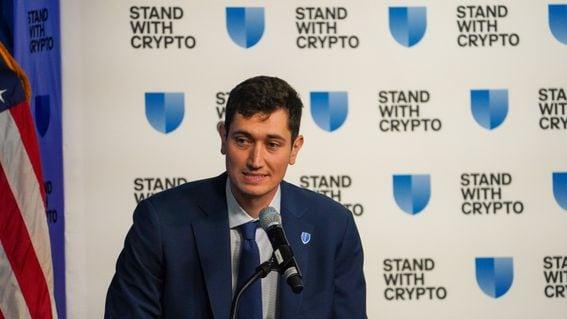
The organization, backed by crypto exchange Coinbase, signed a million online members, raised millions in donations and started a U.S. campaign fund in less than a year. Organizers of Stand With Crypto say the advocacy group is directing a wave of crypto-interested voters toward shifting digital assets policy in the U.S. In about 10 months since launching, the organization has gathered millions in donations and also started its own political action committee to influence individual races. Stand With Crypto, a digital assets advocacy group backed by Coinbase Inc., said it signed up its first million members as of Wednesday. The rapidly growing online band of crypto boosters maintains grades on U.S. politicians (as Coinbase once did), sets up public events to highlight digital assets issues and has recently established a political action committee (PAC) to engage directly with candidates. Membership in the organization is as simple as a quick online signup, and the list allows anonymity, though Chief Strategist Nick Carr said the vast majority have given physical addresses. "One million advocates from across state and political lines are sending a clear message to Washington. Crypto is a frontline issue, and we have the numbers to back it up," Carr said in a statement. The website for the group, which was established in August of last year, said it's collected millions in donations and aims to use that money to mobilize U.S. crypto enthusiasts toward political outcomes that favor the technology. "Stand With Crypto surpassed its goal of one million Stand With Crypto advocates faster than ever imagined," said Coinbase CEO Brian Armstrong, who is also among the group's leading donors, in a statement. "With exactly five months until the general election, crypto voters are not taking their foot off the gas." Read More: Coinbase-Backed Advocacy Group Enlists Crypto Masses, Raises $2M From 80,000 The crypto industry has taken an increasingly serious role in political advocacy this year, pumping more than $160 million into a campaign-finance effort that rivals major industries (and even the political parties' own congressional war chests). It has also anonymously supported at least one political organization, the Cedar Innovation Foundation, to apply pressure on Sen. Sherrod Brown (D-Ohio), whose Senate Banking Committee has so far failed to take up major crypto legislation. Two recent industry-sponsored surveys conducted by Harris Polls found a large number of voters seem interested in candidates' crypto views. In the most recent one, one-third of voters said they'll consider views on digital assets before making candidate decisions. However, another poll of swing state voters suggested that as many as 69% of them had negative views of cryptocurrency. https://www.coindesk.com/policy/2024/06/05/advocacy-group-stand-with-crypto-says-its-exceeded-one-million-signups/
2024-06-05 17:22
U.S. listed bitcoin miners have access to large amounts of power, making them potential takeover targets for hyperscalers and AI firms, the report said. Power demand from hyperscalers and AI firms may make bitcoin mining companies potential takeover targets, the bank said. JPMorgan said CoreWeave’s deal with Core Scientific validates the mining sector’s pivot to HPC. The report said that bitcoin miners under financial pressure following the recent halving may be more susceptible to a deal. Hyperscalers and artificial intelligence (AI) firms are exploring different alternatives to securing their energy needs, and this may make bitcoin (BTC) mining companies with attractive power contracts appealing acquisition targets, JPMorgan (JPM) said in a research report on Wednesday. A hyperscaler is a large-scale data center specializing in delivering huge amounts of computing power. Mergers and acquisitions are heating up in the mining sector, after the halving. On Tuesday, shares of Core Scientific (CORZ) surged higher after cloud computing firm CoreWeave signed a 200 megawatts (MW) artificial intelligence deal with the bitcoin miner, and was also reported to have made an offer to buy the company in an all-cash deal. Meanwhile, another large bitcoin miner, Riot Platforms (RIOT), made a hostile offer to buy out peer Bitfarms (BITF) last month. The deal with CoreWeave validates and may accelerate the mining sector’s involvement in high-performance computing (HPC), JPMorgan said in the report. Within the bank’s coverage, the Core Scientific news is most impactful to overweight-rated Iris Energy (IREN), which it said was early to embrace HPC and has the rights to develop over 2 gigawatts (GW) of power. JPMorgan said this deal could raise the “valuation floor for sub-scale mining operators, as a new class of buyers (Hyperscalers) has emerged.” The bank also added that it could help “rationalize the bitcoin network” by moving power capacity away from the miners, and this would improve the profits of the remaining operators. The bank estimates that U.S. listed bitcoin miners draw up to 5 GW of power and have access to an additional 2.5 GW, “which makes them a potentially attractive target.” Furthermore, some bitcoin miners are under financial pressure to exit the market following the recent halving event and so may be more receptive to a deal, the report added. Broker Bernstein said last week that Riot Platforms (RIOT) was the best positioned to attempt to consolidate the mining sector, as the miner has the financial capacity for deal-making. https://www.coindesk.com/markets/2024/06/05/bitcoin-miners-with-attractive-power-contracts-are-potential-ma-targets-jpmorgan-says/

2024-06-05 17:01
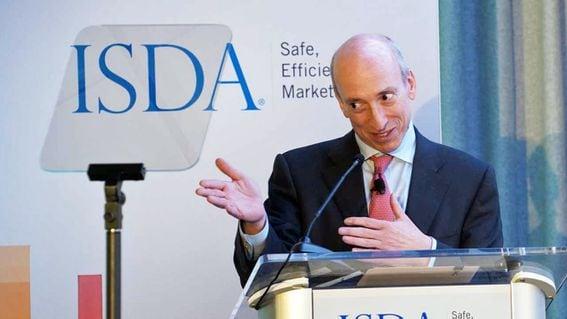
Once waging a legal battle against crypto ETFs, SEC Chair Gensler now talks about the pending ETH ETF as if it's a casual process and is jumping through the standard hoops. Ethereum checked the necessary box for an exchange traded fund after having traded as futures on the Chicago Mercantile Exchange for years, Gary Gensler told CNBC on Wednesday. The SEC chair remained vague about exactly when the industry may see the next major crypto token wrapped in ETFs. The approval of new exchange traded funds (ETFs) for Ethereum's ether (ETH) is a logical next step to the regulator previously approving spot bitcoin ETFs, U.S. Securities and Exchange Commission (SEC) Chair Gary Gensler seemed to suggest twice on Wednesday. Despite the crypto industry's widespread belief that Gensler's SEC was planning to block the ETH spot ETF before reversing course and granting the first stage of applications, the head of the agency sped through an account of its ongoing approval process as if it were a casual matter, echoing himself in two separate interviews – in a CNBC appearance and on the sidelines of an International Swaps and Derivatives Association/Securities Industry and Financial Markets Association event. "Ethereum had been traded on the Chicago Mercantile Exchange futures for three-plus years. And the staff looked at that closely, and that was approved," Gensler said in the television interview. "Now, the underlying exchange traded products (ETPs) still need to go through a process to have the disclosure about that. That will take some time, but they're working on that right now." He later told reporters that SEC staff approved ETF applicants' 19b-4 forms "as four months earlier at the commission level, we had approved the bitcoin exchange-traded products." His updates didn't reflect the drama associated with this major moment for the digital assets sector, which would follow the January approval of the earlier bitcoin spot ETFs that already redefined the status of (BTC) as a trading asset. Industry observers and participants widely expected the ETF applications to be rejected, citing a lack of public engagement from the SEC with applicants over their forms. This changed a few weeks ago, when the SEC asked exchanges to update 19b-4 forms on an expedited basis. Gensler's tone does track, though, with another of his recent appearances, in which he indicated that once the D.C. Circuit Court of Appeals sided with Grayscale against the SEC, the regulator's hand was forced when it came to such ETF approvals. "We do it within the law and how the courts interpret the law, and that's what I'm deeply committed to," Gensler had said two weeks ago, after having noted on stage at the event that the agency is trying to act in accordance with the court's ruling. That position would suggest that the SEC was going to approve ETH ETFs all along, just like BTC. Also, despite Gensler's seemingly sanguine explanation of the current process with the ETH applications, his comments left a key question still hanging: He said it'll "take some time," but when might this final approval happen? The precise answer seems unclear, so far. Some expect the funds, which would directly hold actual ETH and could be easily traded at any time just like other ETFs, will emerge this month or next. Securities disclosures Apart from his seeming openness on the ETF applications, Gensler reiterated his usual warnings Wednesday about the crypto industry and its lack of required public disclosures. He said on CNBC that many of the tokens "have not given you the disclosures that you not only need to make your investment decisions, but also that are required by law." When asked by reporters if he personally believes ether to be a security, he pointed to the fact that entrepreneurs and executives speak at conferences to promote their projects (while carrying out his usual disclaimer of not speaking to any specific asset). "These are the indicia of a security," he said, reiterating his earlier statement on legally-required disclosures. "What's more, you have the so-called crypto exchanges that are commingling and bundling functions where you, the investing public, do not have proper protection of the Congress laid out in the laws." As a result, the industry has faced the various bankruptcies and frauds that it has, he said. While Gensler said the Satoshi Nakamoto bitcoin white paper may have been "innovative," Gensler said, "this is a field that's quite centralized, that has not lived up to the vision, the Nakamoto vision when there's just a small handful of crypto intermediaries in which you're trusting your money, your assets." Read More: SEC's Gensler Going Rogue in Solo Quest to Stop U.S. Crypto Legislation? https://www.coindesk.com/policy/2024/06/05/secs-gensler-shrugs-about-new-crypto-etfs-strolling-through-his-agencys-gates/
2024-06-05 16:30
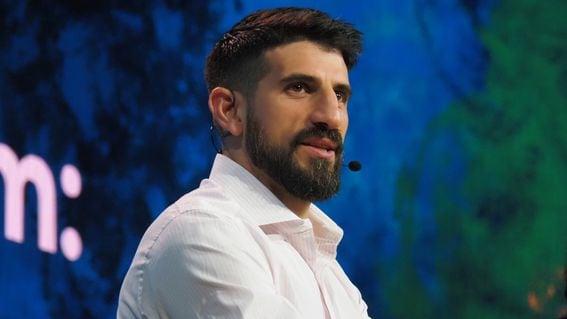
USDL is issued in the UAE and regulated by the Financial Services Regulatory Authority (FSRA) of Abu Dhabi Global Market (ADGM). Paxos Lift Dollar offers users a programmatic daily rate of around 5%, aligned with returns on U.S. Treasury bonds. USDL is regulated by the Financial Services Regulatory Authority (FSRA) of Abu Dhabi Global Market (ADGM). Cryptocurrency trading platform Paxos has introduced a yield-generating, USD-denominated stablecoin called the Lift Dollar (USDL), regulated in the United Arab Emirates (UAE), the company said on Wednesday. The stablecoin is issued by Paxos International, the firm’s UAE division, and regulated by the Financial Services Regulatory Authority (FSRA) of Abu Dhabi Global Market (ADGM). The largest stablecoin issuers, such as Tether and Circle, gather billions of dollars worth of interest on the T-Bills they hold, which has led to the creation of several yield-sharing stablecoins and blockchain-based U.S. Treasury products. Paxos CEO Charles Cascarilla said the new Lift Dollar is structured the same way as the other stablecoins issued by his firm: PayPal USD (PYUSD), Pax Dollar (USDP) and Pax Gold (PAXG). These are matched 1:1 with dollars, backed by short-term U.S. government securities, and all are overseen by a prudential regulator with all assets safely positioned remote from a potential bankruptcy situation, he said. “We’ve added programmatic daily yield so this looks a little bit more like a savings product than a checking account product, which is maybe the way to think about traditional stablecoins,” Cascarilla said in an interview. “[USDL] is going one step further from democratizing access to dollars, to also democratizing the risk-free rate, in the safest manner possible.” Paxos USDL will not be available in the U.S. because of a lack of regulatory guidance. At launch, USDL will be particularly focused on Argentina, where it will be available to consumers via distribution partners Ripio, Buenbit and TiendaCrypto, according to a press release. “For the launch, we're foregoing the 30 basis points (bips) of our asset management fee. So we’re only holding back 20 bips meaning users will get more than 5%,” Daya said in an interview. https://www.coindesk.com/business/2024/06/05/paxos-unveils-yield-generating-stablecoin-lift-dollar/
2024-06-05 15:22
Valentin Pletnev couldn't use his ticket for a Mar-a-Lago Trump gala, so prominent crypto figure Ryan Selkis went instead. Neither expected the U.S. policy whirlwind that followed, but even as Pletnev upgrades his DeFi platform to promote 'Yield for All,' it still won't be available in the country. Valentin Pletnev is far from the best-known name in cryptocurrencies, but a scheduling snafu that kept him away from Donald Trump's recent Mar-a-Lago NFT gala might've dramatically rerouted U.S. cryptocurrency policy. Only select holders of Trump's NFT collection were allowed into the exclusive May event. Pletnev snagged one of those tickets as soon as he learned of the gathering – earning it through the purchase of 100 Trump "Mugshot Edition" digital trading cards. "I thought it was hilarious because I'm not American," Pletnev, the German co-founder of Quasar Labs, which builds a decentralized finance protocol on the Cosmos blockchain, said in an interview with CoinDesk. Then the gala was moved to a time when Pletnev wasn't available, so he gave his ticket to Ryan Selkis, the founder of crypto data and analytics platform Messari and a vocal pro-crypto policy advocate. Selkis ended up on stage and touted the crypto revolution. So did Polygon's Mihailo Bjelic. Trump gave his own full-throated endorsement of crypto at the Palm Beach, Florida estate. The former U.S. president had previously derided cryptocurrencies as playthings "based on thin air." Pletnev insists that his NFT purchase – which let Selkis speak – played a key role in the events that followed: Within a few days, a vocal contingent of the crypto and blockchain industry rallied around former President Trump and then the notoriously crypto-averse U.S. Securities and Exchange Commission granted a surprise approval to the first exchange-traded funds that own Ethereum's ether (ETH). Following the gala, a widely circulated meme on X identified "Trump NFTs" and "Ryan Selkis Goes to Mar-a-Lago" as the first two dominoes to fall in a chain that ultimately culminated in the long-awaited approval of ether ETFs, a watershed moment for the melding of digital assets and traditional finance. While some close to crypto policy say the approval was likely no matter what, others viewed it as capitulation from Joe Biden's administration – proof that the crypto industry was finally being taken seriously by both parties as a political force. Within two days of the SEC approval, the Republican-controlled House approved the industry-friendly FIT21 bill with significant Democratic support. Then, the Democrat-controlled Senate passed a resolution to repeal SAB 121, which placed restrictions on financial institutions that custody crypto assets. The repeal was ultimately vetoed by president Biden, but it earned support from Senate Majority Leader Chuck Schumer, a Democrat who had days earlier expressed skepticism towards the resolution. "What else must have changed [Schumer's] mind in five days," Pletnev asked, if not "Ryan Selkis on stage with Trump, Trump saying 'I'm pro-crypto, crypto needs to stay in this country,' and all of Crypto Twitter realizing they might be team Trump?" Quasar's new vision Buoyed by the recent policy hype, Pletnev is revealing a top-to-bottom rebrand for his Quasar protocol oriented around simplifying decentralized finance, or DeFi, investing. "Fundamentally, crypto is only a big success if we increase the number of beneficiaries compared to traditional finance," Pletnev told CoinDesk. "If we don't achieve this, we risk replacing the financial oligarchy with a technocracy, which would be a sad outcome." Central to Pletnev's "Yield for All" vision will be the introduction of layered staking assets, or LSAs, which will combine staking and DeFi yields into a single token that accrues interest. Staking is one of the most popular DeFi strategies today. It involves parking digital assets with a blockchain to help "secure" it in exchange for a steady stream of interest. Frequently, users will stake assets and then re-invest them into other yield-generating DeFi platforms at the same time. Users can, for instance, stake assets into a platform like Lido, "restake" them into EigenLayer via a platform like EtherFi, and then borrow against their stake as a way to maximize their overall returns. If this all sounds complicated, that's because it is. Quasar aims to simplify things through its LSAs—assets that represent specific trading strategies and can be traded outright. Behind each LSA will be a basket of crypto assets deployed across a variety of DeFi protocols. The assets can accrue yields from these protocols, and they will be managed according to investment strategies built into Quasar's smart contracts. "DeFi is complicated. If it keeps fragmenting, it becomes a full-time job," said Pletnev. "We need to make DeFi work for the people by wrapping it in a simple, easy-to-use way." Quasar Finance launched its mainnet in 2023 as a "decentralized asset management" protocol based on the Cosmos blockchain ecosystem. The platform used—and will continue to use—Cosmos's Inter-Blockchain Communication (IBC) protocol, which facilitates interoperability across various blockchains. Quasar's approach isn't dissimilar from existing yield protocols like Yearn, all-in-one trading platforms that simplify DeFi by deploying user funds into premade trading strategies. The current Quasar protocol operates similarly: Users can deposit crypto into "vaults" that follow certain investment strategies and don't require much active oversight from users. With its LSAs, Pletnev says Quasar is taking extra steps to add fungibility, decentralization and ease of access to the platform. Yield for All? Despite the "Yield for All" pitch, Quasar, like many DeFi protocols worried about violating U.S. financial regulations, is not available for use in the United States—hence Pletnev's decision to become involved in U.S. politics. "I went to Draper University in the Bay Area, Tim Draper's private school," said Pletnev, referring to the Silicon Valley venture capitalist. "I would not be where I am without the United States. There is no other way of phrasing it." "The fact that the people of this country cannot benefit from what exists because of their country is insane to me," he said, "so I bought the [Trump] NFT because I thought someone should advocate for crypto." Quasar Labs has raised a total of $11.5 million from investors including Polychain Capital, Blockchain Capital, HASH Capital, CIB and Shima. The most recent funding round, disclosed in January, valued the company at $70 million. The platform's QSR governance token is trading at $0.11 cents, with a fully diluted value of $67 million. CORRECTION (June 5, 22:08 UTC): Senator Chuck Schumer voted to repeal SAB 121, which is separate from FIT21. https://www.coindesk.com/tech/2024/06/05/did-a-single-nft-purchase-change-washingtons-mind-on-crypto/
2024-06-05 12:02
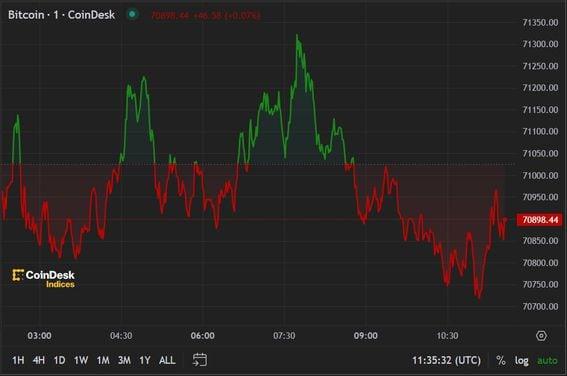
The latest price moves in crypto markets in context for June 5, 2024. Latest Prices Top Stories BTC crossed $71,000 early Wednesday after spot bitcoin ETFs had their best day of inflows since March. Bitcoin has risen about 3% in the last 24 hours, while the CoinDesk 20 Index (CD20), representing a broad measurement of the digital asset market, is up around 2.8%. Bitcoin peaked at $71,341 at the start of the European morning, its highest since May 21. It subsequently pulled back to trade around $70,900. Nevertheless, BTC is showing a green candle for the fifth consecutive day, its longest such stretch since March. U.S. spot bitcoin ETFs saw over $880 million in inflows on Tuesday, the most since March and the second-highest since they went live in January, provisional data shows. Fidelity's FBTC led the way with $378 million, while BlackRock's IBIT took on $270 million. Bloomberg analyst Eric Balchunas said on X that the ETFs have taken on a net $3.3 billion in the past four weeks, with a year-to-date figure of more than $15 billion. The increased activity comes a few weeks after U.S. spot ether ETF filings were approved and amid a positive outlook for cryptocurrencies from the ongoing U.S. presidential campaign. Bain Capital Crypto plans to start a second fund according to a filing with the SEC, more than two years after its first in March 2022. That $560 million fund launched just before the collapse of Do Kwon's luna triggered a massive rout in the crypto market. Despite the ensuing crypto winter, Bain Capital was an active investor throughout 2022 and 2023, participating in rounds such as Sam Altman's $115 million Worldcoin fundraise, privacy protocol Nocturne Labs and decentralized exchange aggregator Flood. The first fund focused on early-stage investments and liquid tokens across DeFi and Web3. Chart of the Day Bitcoin open interest has spiked over $2 billion since Monday to nearly $37 billion, marking the largest such increase since early April. Over $11 billion in BTC futures bets are live on the Chicago Mercantile Exchange (CME), followed by crypto exchange Binance at $8 billion. Open interest refers to the number of unsettled futures contracts and indicates a rise in money entering the market, usually a sign of further expected volatility. Source - TradingView - Shaurya Malwa Trending Posts U.S. Lawmakers Push Biden to Bring Back Detained Binance Exec Tigran Gambaryan From Nigeria What's Next for FIT21? (A Consensus 2024 Recap) Ether Price Poised for Supply 'Shock' as ETFs May Attract $4B Inflows in Five Months, K33 Research Says https://www.coindesk.com/markets/2024/06/05/first-mover-americas-bitcoin-tops-71k-after-best-day-for-etf-inflows-since-march/