2024-05-21 19:36
Crypto market-structure bill FIT21 is set for a vote on Wednesday, though its chances in the Senate remain uncertain. Eight House Democrats signed onto a memo arguing in favor of a largely Republican-driven bill to establish U.S. regulations over the crypto markets. The U.S. House is set for a final vote on the first major crypto legislation, and approval would send it to a murky fate in the Senate. The U.S. House of Representatives is on the verge of a vote on Wednesday that is widely expected to approve comprehensive cryptocurrency legislation with bipartisan support – a major milestone for the industry – and several Democrats there are pushing their colleagues to vote yes. At least eight House Democrats were vocally supporting the Financial Innovation and Technology for the 21st Century Act (FIT21) – and they may recruit more – according to a memo shared with CoinDesk by a congressional aide. At this point, the bill is scheduled for floor discussion and a vote later in the day on Wednesday. "As Democrats, we feel this is a crucial opportunity to regulate the digital asset markets," the eight lawmakers wrote in the internal memo Tuesday asking support from their colleagues. "This should not be a partisan issue," according to the lawmakers, including Reps. Wiley Nickel (D-N.C.), Yadira Caraveo (D-Colo.), Jim Himes (D-Conn.), Jasmine Crockett (D-Tex.), Ritchie Torres (D-N.Y.), Darren Soto (D-Fla.), Josh Gottheimer (D-N.J.) and Don Davis (D-N.C.). But despite fans on both sides of the aisle in the House, the effort further highlights the lack of similar progress in the Senate, where the crypto market-structure legislation could fizzle. To that end, senior staff of the House Financial Services and Agriculture committees working on the bill said Tuesday that they're having increasing discussions with Senate counterparts but are also open to legislative vehicles the bill could eventually be attached to as this congressional session winds toward its close. "What we want is to have a substantial vote total this week in the House that will show momentum," said Rep. Patrick McHenry (R-N.C.), the chairman of the House Financial Services Committee who has shepherded the bill in the retiring lawmaker's final months in Congress. He lamented to reporters on Tuesday that the effort that was meant to happen almost a year ago was delayed this long. "We're now in May of an election year." Still, he said his fellow lawmakers now have an "awareness" of the existence of crypto voters, too, and "that is supportive of our efforts." FIT21 would establish a clear framework for digital assets in the U.S., identifying where and how each token and exchange might be regulated. It establishes consumer protections, disclosures and addresses the use of crypto in illicit finance. The vote on the bill represents the first time such a comprehensive piece of crypto legislation has reached a final decision in either chamber of Congress. Read More: Crypto Industry Rallies Behind House Bill as It Heads Toward Final Vote The Democratic advocates made a case for stepping in to police the crypto markets, where the leading businesses are waging a multi-front legal battle with the Securities and Exchange Commission (SEC) over how much authority that regulator rightfully has. The lawmakers also argued that the U.S. is falling behind other jurisdictions that have already instituted rules for the industry. "Roughly 20% of Americans have invested, traded, or used crypto, so it’s not going anywhere," according to the Democrats' memo. "Meanwhile, Congress hasn’t passed legislation to usher in this new generation of internet technology responsibly." The House's digital assets legislation isn't yet facing any White House promises for a veto, unlike the recent vote in the Senate that saw a large number of Democrats join all the Republicans to approve a resolution to reverse an SEC crypto account policy – Staff Accounting Bulletin No. 121 (SAB 121). Republican aides said they expect some of the same 21 Democratic names who voted in the House to overturn SAB 121 might also support this bill. FIT21 has previously cleared its two relevant House committees with some Democratic support. House Financial Services Committee Ranking Member Maxine Waters (D-Calif.) and House Agriculture Committee Ranking Member David Scott (D-Ga.) – the leading Democrats on their respective panels – sent their own email to fellow Democrats saying they still "strongly oppose" the effort, but they won't organize any voting against it, Politico previously reported. Consumer advocates including Americans for Financial Reform argued against the bill, too, saying it didn't sufficiently protect consumers and uses an "easily manipulated definition" of decentralization when deciding how things should be regulated. Rep. Glenn "G.T." Thompson (R-Pa.), chairman of the Agriculture Committee, told reporters that passing legislation is urgent, because the current state of regulation has driven crypto business away from the U.S. "Right now, most of them are parked somewhere offshore, because the only regulatory structure they see is regulation by enforcement," he said. In the Senate, a wide-ranging bill from Sens. Cynthia Lummis (R-Wyo.) and Kirsten Gillibrand (D-N.Y.) is currently the closest equivalent to FIT21, and the House aides said that talks are underway about the topics on which those bills find common ground. Rashan Colbert, head of policy at dYdX Trading and a former legislative assistant to Sen. Cory Booker (D-N.J.), noted that the bill has been working its way through the House for a year and a half. "[For] the Senate to take this up, [starting] with the committee process to go through, that would be needed to really consider this bill in full," he said. "So unfortunately, I think that there's not a great chance of Senate consideration this Congress." One of the key components to iron out would be funding the Commodity Futures Trading Commission, which would have a much more significant and defined role in policing the crypto spot markets but currently has a tiny fraction of its sister agency's budget. Nikhilesh De contributed reporting. https://www.coindesk.com/policy/2024/05/21/several-us-house-democrats-petition-colleagues-to-join-yes-side-on-crypto-bill/

2024-05-21 17:30
Uniswap’s lawyers say the protocol doesn’t meet the SEC’s own definition of an exchange. Uniswap Labs moved Tuesday to quash a looming regulatory battle over Ethereum's dominant decentralized crypto exchange, imploring the Securities and Exchange Commission in legal filings that its planned lawsuit wasn't worth the fight. The company received a Wells notice – essentially a heads-up from the SEC notifying the recipient that the regulator believes it broke the law – in April. The notice accused the Uniswap protocol of being an unregistered securities exchange and the interface and wallet as being unregistered securities brokers. In their response to the SEC’s Wells notice, Uniswap Labs pushed back against this assertion, arguing that the protocol does not meet the definition of an exchange and is thus not subject to regulation by the SEC. Though Uniswap Labs said it invented the protocol, it said the protocol is now a “passive” technology that people use to trade cryptocurrencies. Uniswap Labs’ Chief Legal Officer Martin Ammori told reporters on Tuesday that the SEC would have to redefine what an exchange is in order to have jurisdiction over Uniswap. Under the current definition, Ammori said, Uniswap would have had to be specifically designed for securities trading. “It is general purpose, and the majority of its volume are obvious non-securities like Ethereum, Bitcoin and stablecoins,” Ammani said, adding that bitcoin, ether and stablecoins account for 65% of the protocol’s trading volume. Ammori said that the SEC knows that the current definition of an exchange does not cover any of Uniswap Labs products. “That’s why, as we speak, there’s a pending rulemaking where the SEC is trying to redefine about half a dozen words in their own regulations to try to capture us. That’s not going to work,” Ammori said. “It goes beyond their authority given by Congress.” Ammori also said that the SEC’s accusation that Uniswap’s interface and wallet are brokers will fail as well, pointing to a recent ruling from a federal judge dismissing the SEC’s claims that the Coinbase Wallet constituted an unregistered securities broker. Because the SEC would have to stretch its authority to regulate Uniswap, the protocol’s lawyers argued, the agency “should not take on these significant litigation risks.” The lawyers added that bringing a case against Uniswap would push American crypto investors to use foreign trading protocols and would discourage “future innovators from attempting to foster new ideas that bring much-needed competition and innovation to financial and commercial markets.” “We will litigate if we have to, and if we litigate we will win,” Ammori said. “But we are hoping that the SEC sees that their current strategy is not protecting anyone and not benefiting Americans.” What's in the Uniswap Wells Notice Tuesday's filing shed additional light on the arguments the SEC appears poised to make in its yet-to-be-filed enforcement action against Uniswap Labs. The regulatory agency is targeting Uniswap's native UNI token as well as liquidity provider (LP) tokens. LP tokens are core to how so-called "automated market makers" such as Uniswap work. Users who deposit their assets into the protocol's trading pools get LP tokens as a receipt on their contribution. They can swap their LP tokens for the value of their deposits. Meanwhile, the protocol uses those deposits to make sure other traders can make the trades they wish. According to Uniswap Labs' Wells response, the SEC alleges LP tokens are investment contracts whose distribution violates securities law. Uniswap Labs rejects that argument on the grounds that LP tokens don't fit into the regulator's frameworks, and are rather "bookkeeping devices." Last December the SEC hinted at increased scrutiny of LP tokens in its settlement with BarnBridge DAO, according to the law firm K&L Gates. If it moves forward with the allegations Uniswap Labs outlined Tuesday, the regulator's enforcement action could outline a coming fight with broad implications for how DeFi ticks. https://www.coindesk.com/policy/2024/05/21/uniswap-labs-urges-sec-to-drop-pending-enforcement-action-in-wells-response/

2024-05-21 17:05
The news set off a debate on the social-media platform X about whether advising the EigenFoundation might constitute a conflict of interest – given the flagged risks to Ethereum from restaking protocol EigenLayer. Dankrad Feist, namesake of the Ethereum data-storage method of "danksharding," disclosed in a post on X that he has taken on an advisory role at EigenFoundation, which supports the pioneering restaking protocol EigenLayer. Feist promised that the allocation of EIGEN token he has received will not influence his positions on how EigenLayer should be developed. Disclosure follows a similar posting earlier in the week by another prominent Ethereum Foundation researcher, Justin Drake. The advisory arrangements have raised questions about possible conflicts of interest, especially with many blockchain experts flagging potential systemic threats to Ethereum posed by the emergence of EigenLayer. A top Ethereum Foundation (EF) developer, Dankrad Feist, disclosed Tuesday that he has accepted a paid role at EigenFoundation, a newly created non-profit meant to guide EigenLayer, the pioneering "restaking" protocol that many skeptics have flagged as potentially posing systemic risks to the world's largest smart-contracts blockchain. Feist disclosed in a post on X that the position comes with a significant allocation of EigenLayer’s new EIGEN token, though did not specify how many tokens he would be receiving. The announcement comes a few days after another top EF developer, Justin Drake, also disclosed that he would be advising the EigenFoundation, with "a significant token incentive which could easily be worth more than the combined value of all my other assets (mostly ETH)," with a value of "millions of dollars of tokens vesting over 3 years." The news set off a debate on crypto twitter about whether advising the EigenFoundation would constitute a conflict of interest, especially given how prominent Drake and Feist are at the Ethereum Foundation – and how serious many blockchain experts are taking the potential systemic threats posed by the emergence of EigenLayer. The disclosures came after the crypto influencer Cobie used the social-media platform X, where he has 724,000 followers, to publicly ask Ethereum co-founder Vitalik Buterin how he felt about "core developers or researchers taking life–changing $ packages from projects built on Ethereum to become 'advisors,' when those projects may have conflicted incentives with Ethereum, either now or in the future?" That post came in response to a post by Buterin in which he wrote that he was "really proud that Ethereum does not have any culture of trying to prevent people from speaking their minds." Some posters on X applauded the Cobie call-out. “Props to @cobie for insisting on ethical disclosures and holding people to account despite the onslaught of toxic bagerholderism he gets in response...very few willing to do it,” said @lex_node on X. Feist is a well known contributor to the Ethereum discourse and technology, so prominent that the technology of "danksharding" – a way of storing data at cheaper fees than from using regular transactions – is named after him. "I am taking this position personally, not representing the Ethereum Foundation, and with a focus on risks and decentralization. I am therefore fully expected to take contrarian views on Eigenlayer," Feist wrote in his post. "I do receive a significant amount of tokens from this position. I do not believe that they will change or influence my positions on how the core protocol should be developed, but I believe that the community should know about this, so that they can keep me accountable." Feist acknowledged that many skeptics fear "Eigenlayer will lead to a dystopia of dangerously designed restaking services," and that a "second type of risk comes from the additional load imposed on stakers by running restaking services," which "can lead to centralizing forces." "I think Eigenlayer will be a major benefit to Ethereum, if it is done by someone with high integrity," Feist wrote. "I trust the current leaders are intending to do that, and I am planning to hold them accountable for it." Drake noted in his disclosure that he pledged "to reinject all advisorship proceeds towards worthy projects within the Ethereum ecosystem, either as investments or donations," and that he also stands ready "to end the advisorship at any time, e.g. should EigenLayer go in a direction I deem to be against Ethereum's interests." He also said that, given his "focus on restaking risks," one can expect his "default public stance to continue to lean critical of EigenLayer." "I will try to make my criticism constructive, advocating for mitigations to risks like the erosion of solo validators and the intersubjective overloading of Ethereum consensus,” Drake wrote. Another user on X, @themandalore9, wrote: “I applaud the transparency, but he was probably the biggest / most well known voice in the fight against LST's and restaking. I know he say's he'll stay critical, but money corrupts the subconscious in ways that you'd never believe.” https://www.coindesk.com/tech/2024/05/21/second-ethereum-foundation-researcher-acknowledges-advisory-deal-paid-in-eigen/

2024-05-21 16:14
Gala investor DWF Labs also said that it had purchased 28 million GALA tokens "to alleviate market selling pressures." Hacker returned $23 million worth of ether to Gala Games after Monday's exploit. CEO Eric Schiermeyer said "will probably buy and burn." Gala investor DWF Labs also said that it had purchased 28 million GALA tokens. Gala Games has received nearly $23 million worth of ETH tokens from the hacker who on Monday minted and then sold hundreds of millions worth of its native (GALA) token, according to on-chain records and statements in Gala's Discord server. The change of fortunes leaves Gala with an unexpected $23 million windfall in ETH tokens. "We will probably buy and burn on galaswap," said the project's CEO Eric Schiermeyer, also known as Benefactor, in its Discord server. That means using the ETH to buy GALA tokens and then taking those tokens out of circulation. Gala Games is a blockchain gaming platform with a variety of video games where players hold NFTs and other crypto assets. The GALA token is the platform's currency for buying and selling in-game assets. The move comes one day after an unidentified hacker exploited Gala's internal controls to mint 5 billion new GALA tokens. The individual then sold 600 million of those tokens on decentralized exchanges and netted nearly 6,000 ETH tokens. On Tuesday the wallet associated with the hack transferred all of its ETH to a wallet controlled by Gala Games. "We believe we have identified the culprit and we are currently working with the FBI, DOJ and a network of international authorities," Schiermeyer said Monday. The exploit caused GALA's price to drop as much as 19% on Monday as traders fretted over the implications of the increased circulating supply and the hackers' selling pressure. Earlier Tuesday, Gala investor DWF Labs said it had purchased 28 million GALA tokens "to alleviate market selling pressures." GALA was trading around $0.043 at press time, still off of yesterday's pre-hack heights. CORRECTION (March 21, 3:07 UTC): Corrects GALA trading price. https://www.coindesk.com/markets/2024/05/21/gala-games-hacker-returns-23m-in-eth-founder-proposes-buy-and-burn/

2024-05-21 12:03
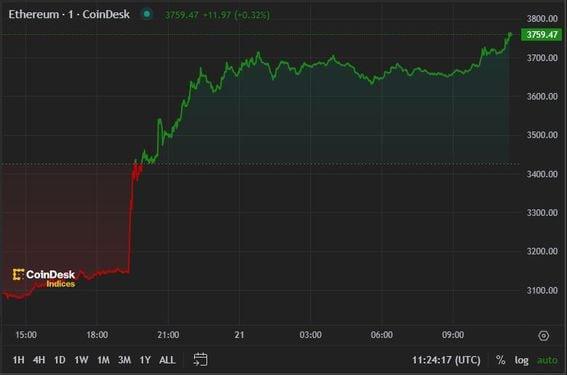
The latest price moves in crypto markets in context for May 21, 2024. Latest Prices Top Stories Bitcoin rose above $71,000 during the European morning after analysts saw the possibility of an ether ETF being approved in the U.S. improving. BTC has climbed nearly 6% in the last 24 hours, eclipsing $71,000 for the first time since early April. The CoinDesk 20 Index (CD20), which offers a broad measurement of the digital asset market, rose more than 8.5% while ETH jumped almost 20% to over $3,700. The market movements caused more than $260 million in short liquidations, the most since Feb. 28. Ether shorts lost over $115 million, followed by bitcoin shorts at just over $99 million, Coinglass data shows. ETH has been buoyed by favorable regulatory developments that seem to indicate increasing chances of spot ether ETFs being approved by the SEC after the regulator asked exchanges to update 19b-4 filings, which propose rule changes. As a result, the ether implied volatility curve, which shows market expectations of future volatility across different strike prices and expirations, flattened as 25-delta risk reversals hit year-to-date highs above 18%, and traders heavily bought $4,000 calls for 24 May and 31 May, Presto Research analysts wrote. A Polymarket contract asking if an ether ETF would be approved by May 31 jumped from 10 cents to 55 cents, representing a 55% chance that approval will take place by then. Meme coins on the Ethereum ecosystem like MOG and PEPE surged on the increasing likelihood of ether ETFs being approved. Meme tokens are often seen as a leveraged way to bet on the growth of their underlying blockchain. MOG rose nearly 50% while PEPE climbed over 20%. “Established memes are generally high beta for the native token of the chain they’re on, and Mog has established itself as a winner on Ethereum,” Viro, a Mog core team member, said in an interview over Telegram. “I think the market sees that there’s quite a lot of room to catch up to Pepe, and that’s why you see the outperformance. If you think memes are good beta; you’ll go for the higher caps like pepe or you’ll slide further down the curve for mog.” Chart of the Day The chart shows the most traded ether options on the crypto exchange Deribit in the past 24 hours. Call options at strikes well above ether's going market rate and expiring at the end of May and June have been in demand in a sign of bullish market sentiment. A call buyer is implicitly bullish on the market. Source: Velo Data - Omkar Godbole Trending Posts Ether ETF Speculation Could Weigh on SOL, Wider Altcoin Market NYAG Takes Victory Lap as Court Approves Genesis Settlement Democrat House Leadership Says Crypto Bill Vote Won't Be Whipped https://www.coindesk.com/markets/2024/05/21/first-mover-americas-bitcoin-hits-71k-as-ether-etf-hopes-build/
2024-05-21 11:40
Annualized yields on ether staking are nearly 3% as of Tuesday, data from popular staking service Lido shows. Fidelity has amended its S-1 filing with the SEC, indicating that it will not stake ether in its proposed spot exchange-traded fund. Staking involves locking cryptocurrencies to support blockchain operations in return for rewards, with annualized yields on ether staking currently around 3%. An S-1 update filed to the U.S. Securities and Exchange Commission early Tuesday showed that Fidelity has rolled back plans to stake ether (ETH) holdings in its proposed spot exchange-traded fund (ETF). In previous filings, the firm said it intended to “stake a portion of the trust’s assets” to “one or more” infrastructure providers. However, it clearly stated in Tuesday’s update that it would “not stake the ether” stored with the custodian. Staking is the process of locking certain cryptocurrencies for a set period of time to help support the operation of a blockchain, in turn, for a reward. These rewards are largely considered passive income among crypto traders. Data from popular staking service Lido shows that annualized yields on ether staking were nearly 3% as of Tuesday. CoinDesk reported on Monday, that the U.S. Securities and Exchange Commission (SEC) asked aspiring ether exchange-traded fund exchanges to update 19b-4 filings ahead of a key deadline this week – boosting expectations of an ETH ETF. https://www.coindesk.com/business/2024/05/21/fidelity-drops-staking-plans-in-updated-ether-etf-filing/