2024-05-16 16:48
First came "The Bait." In an indictment, U.S. prosecutors detailed the incredibly complicated Ethereum exploit – in which attackers targeted the controversial area of "maximal extractable value," known as MEV. They had it all planned out. In late 2022, the brothers Peraire-Bueno – twenty-something graduates of Massachusetts Institute of Technology who had turned their sights on blockchain – embarked on an effort that ultimately netted them $25 million, in one of the most sophisticated exploits in a decade or so of frequent crypto exploits. At the outset, according to U.S. prosecutors, they outlined a four-step plan. First there was "The Bait." Then there was "Unblinding the block," followed by "The Search," and ultimately "The Propagation." "In the months that followed, the defendants followed each stage as outlined in their Exploit Plan," according to an indictment. The U.S. Department of Justice on Wednesday charged two brothers, Anton Peraire-Bueno, 24, and James Peraire-Bueno, 28, for exploiting a vulnerability in a popular software program used by trading bots on the Ethereum blockchain, netting an estimated $25 million of gains during a 12-second exploit in April 2023. Their father is Jaime Peraire, the former head of MIT's department of aeronautics and astronautics, CNBC reported. How did it all work? The exploit happened thanks to a vulnerability that the brothers discovered in MEV-boost, a piece of software used by roughly 90% of the validators that run the blockchain, allowing them to see the transactions in blocks before they were officially sent off to validators. MEV, or maximal extractable value, is sometimes known as an “invisible tax” that validators and builders can collect from users by reordering or inserting transactions in a block before they’re added to the blockchain. Sometimes the practice is compared with frontrunning in traditional stock markets, but due to the difficulty of eradicating it completely, the Ethereum community has more or less accepted the practice, and simply tried to minimize the deleterious effects. One of those mitigating strategies is through the use of MEV-Boost, a software program used by roughly 90% of Ethereum validators. The idea is that all comers could earn MEV more equitably. Such a this-is-just-how-it's-done attitude was explicitly acknowledged by the prosecutors in their charging document. "Tampering with these established MEV-Boost proposals, which are relied upon by the vast majority of Ethereum users, threatens the stability and integrity of the Ethereum blockchain for all network participants," according to the indictment. Bots, searchers, relays, bundles and builders On Ethereum, users submit transactions that are added to a "mempool” – an area where transactions are in a holding pattern. MEV-boost lets "block builders" assemble those mempool transactions from the mempool and put them into blocks. Then, MEV bots, or "searchers,” look into the mempool and assess which transactions could make profitable trades, and sometimes bribe those block builders to rearrange or insert certain transactions to squeeze out some extra profits. Ethereum validators then take those blocks from MEV-boost and ink them to the chain, where they become irreversible. All these steps are typically executed automatically by the software in fractions of seconds. What the Peraire-Bueno brothers did in this case was target three MEV bots who didn’t have certain checks in place, and set up 16 validators designed to entice the bots. When the searchers bundle transactions together, they have a target transaction, a signed transaction before it, and a signed transaction after. “The rules of the game are, ‘Well, I give you this bundle, and the bundle has to execute atomically,’ meaning it will only go if all three transactions are included in exactly this order, and any other thing than that, it's not going to work,” Matt Cutler, the CEO of Blocknative, a blockchain infrastructure firm, told CoinDesk in an interview. Because the brothers set up malicious validators, their intent was always to seize on the opportunity to exploit the bots that did not have those checks, by pulling apart those transactions. “Because the honeypot transactions were very lucrative, and the bots didn't have checks in place to prevent certain conditions from happening, and they fundamentally trusted the integrity of the validator and MEV-boost ecosystem, the malicious validator got access to signed transactions that were secured and they were then able to manipulate those signed transactions to drain the bots of $25 million of funds,” Cutler said. 'False signatures' In its allegations, the government went out of its way to demonstrate that the activities – targeting a crucial juncture of the blockchain's inner workings, at a level that's technical even for experienced blockchain developers – diverged from the community norms, and into the realm of fraud. Specifically, the brothers were accused of sending a "false signature" in lieu of a valid digital signature to a crucial player in the chain known as a "relay." A signature is needed to reveal the contents of a proposed block of transactions – including all of the potential profits contained inside the bundle. "In this process, a relay acts in a manner similar to an escrow account, which temporarily maintains the otherwise private transaction data of the proposed block until the validator commits to publishing the block to the blockchain exactly as ordered," the prosecutors wrote. "The relay will not release the transactions within the proposed block to the validator until the validator has confirmed through a digital signature that it will publish the proposed block, as structured by the builder, to the blockchain." Based on their research and planning, the prosecutors alleged, the brothers "knew that the information contained in the false signature was designed to, and did, trick the Relay to prematurely release the full content of the proposed block to the defendants, including the private transaction information," according to the indictment. As Cutler put it, “Stealing is stealing, regardless of the terms that enable that stealing.” “Just because your car door is unlocked, doesn't mean it's okay to break into your car, right?” he said. Ethereum is often susceptible to some controversial MEV trading practices, like front-running and so-called sandwich attacks. But many leading figures in the MEV ecosystem view the exploit that took place last year as pure theft. Taylor Monahan, a lead product manager at MetaMask, wrote on X that “Yes, if you steal and launder $25 million dollars you should expect to go to prison for a long time lmfao.” “It’s a little bit robbing the robbers you could arguably say, but regardless it was clearly an exploit, a manipulation of rule sets, in a manner that is seen to be in violation of established laws of the jurisdiction, right,” Cutler said. Almost to underscore the point, the government alleged that in the weeks following the exploit, Anton Peraire-Bueno "searched online for, among other things, 'top crypto lawyers,' 'how long is us statue [sic] of limitations,' 'wire fraud statute / wire fraud statute [sic] of limitations,' 'fraudulent Ethereum addresses database' and 'money laundering statue [sic] of limitations.'" The prosecution also noted that the day after the exploit, James Peraire-Bueno emailed a bank representative asking “for a safe deposit box that was large enough to fit a laptop.” https://www.coindesk.com/tech/2024/05/16/how-2-brothers-allegedly-cheated-a-noxious-but-accepted-ethereum-practice-for-25m/

2024-05-16 15:05
The bank sees limited upside for the bitcoin price in the near term due to a number of headwinds. JPMorgan estimates that the current mining cost for bitcoin miners is around $45,000. The launch of the Runes protocol meant the hashrate didn’t immediately fall post-halving as expected, the report said. Due to several headwinds, the bank doesn't see any upside in the bitcoin price in the near term. The current hashrate and power consumption on the Bitcoin (BTC) network implies an estimated mining cost of about $45,000, down from above $50,000, JPMorgan (JPM) said in a research report on Thursday. The bank said it had previously anticipated a significant drop in the hashrate after the halving as unprofitable miners exited the network. This is now happening but with some delay. The quadrennial halving, which slows the rate of growth in bitcoin supply as miner rewards are cut by 50%, occurred last month. Hashrate refers to the total combined computational power that is being used to mine and process transactions on a proof-of-work blockchain. The reason for the delay was likely the launch of the Runes protocol, a new form of token creation on the network, which triggered a temporary spike in transaction fees, the report said. “This provided a temporary boost to miner revenue in the immediate aftermath of bitcoin halving,” analysts led by Nikolaos Panigirtzoglou wrote, adding that “bitcoin miners were able to offset the loss in issuance reward due to halving with the surge in transactions fees, keeping the block rewards for miners almost unchanged.” “The boost from Runes proves short-lived, however, with users' activity and fees dropping dramatically over the past week or two,” the authors wrote, noting that “this highlights the ongoing challenge faced by bitcoin miners to maintain a sustainable source of revenue in particular in the post halving environment.” As the Runes hype faded and the temporary boost for miners dissipated, power consumption on the network has fallen more than the hashrate, which shows that unprofitable miners with inefficient rigs have exited, the bank said. There is also a feedback loop with bitcoin prices. "The more bitcoin prices decline the higher the number of unprofitable miners that come under pressure to leave the Bitcoin network and the larger the resulting decline in the hashrate and bitcoin production [mining] cost,” the report added. JPMorgan sees limited upside for bitcoin in the near term due to several previously identified headwinds, including a lack of positive catalysts and the disappearing retail impulse. https://www.coindesk.com/markets/2024/05/16/bitcoin-mining-cost-estimate-drops-to-45k-as-inefficient-miners-exit-jpmorgan/

2024-05-16 14:20
Wisconsin's state pension put $160 million into BlackRock and Grayscale's Bitcoin ETFs, showing even risk-averse investors are able to embrace crypto and possibly presaging a "slowly building wave of demand." Roughly 500 institutional investors revealed allocations into the spot bitcoin ETFs in the first quarter. These included institutions of all sorts, with institutional advisers making up 60% of holders and hedge funds roughly 25%, an outcome that isn't normally the case after only a few months following the launch of a new ETF, an expert says. One surprising investment came from the state of Wisconsin, which allocated $160 million into the funds, and could spur more interest from pension funds in the future. Spot bitcoin (BTC) exchange-traded funds debuted with a giant splash in January, quickly attracting billions of dollars of investment. But who was buying them and why have inflows stalled in recent weeks? Was it a fad that fizzled? For those looking to get excited about bitcoin's long-term prospects among large, professional investors, a new data point this week made another big splash: The U.S. state of Wisconsin's pension fund disclosed in a quarterly filing that it had stashed about $160 million into bitcoin ETFs from BlackRock and Grayscale by the end of March. Pensions are generally conservative with their investments and slow to embrace new things, and Wisconsin is not usually the land of flashy purchases. But if bitcoin is making inroads there – posting some of the investment industry's highest returns over the past decade no doubt helps – then there might be good reason to suspect the original cryptocurrency can keep expanding its investor base. "Wow, a state pension bought [BlackRock's bitcoin ETF] in the first quarter," Bloomberg Intelligence senior ETF analyst Eric Balchunas wrote in an immediate reaction on X. "Normally you don't get these big fish institutions [investing] for a year or so (when the ETF gets more liquidity)." He added: "Good sign, expect more, as institutions tend to move in herds." Over 500 institutional investors held one or more spot bitcoin ETFs as of the end of first quarter, which is well above the average of 200 for a newly launched ETF, Balchunas pointed out. Almost all types of institutions were represented, including private equity, insurance companies, brokerage accounts, among others, according to Bloomberg data. Investment advisers made up about 60% to the total and a quarter were hedge funds. Balchunas said that seeing all types of investors represented in the first quarter is unusual and is normally not seen until years after the launch of a new ETF. The biggest buyer turned out to be hedge fund Millennium Management, which allocated roughly 3% of its total assets into several funds, the majority into BlackRock's IBIT. It is important to realize that 13F filings only tell part of the story, and don't give any insight into why someone made an investment. Not all of these are long-term bets or even investments hinging on bitcoin's price rising. Some are undoubtedly from trading firms' market-making businesses, positions held so they can act as the other side on someone else's trade and then likely liquidated quickly. The filing is also backward-looking, and investments may have added to, reduced or completely reversed by the time the public sees this disclosure of positions held on March 31. Bitcoin's price has fallen since hitting a record high in March, possibly giving reason for firms to reduce their investments. The biggest surprise might be that a pension was involved, given the industry's aversion to risk and the potential for bureaucracy to prevent embracing something new like bitcoin ETFs (though bitcoin itself is 15 years old). In 2020, insurance giant Massachusetts Mutual bought $100 million worth of bitcoin and took a stake in crypto shop NYDIG, and the industry expected competitors to follow suit with similar moves – but that really didn't materialize in a big way. The introduction of bitcoin ETFs makes it easier, though – even if it might take time for more pensions to copy Wisconsin. Instead of buying bitcoin directly and then sorting out how to hold it safely, an investor (large or small) can simply buy an ETF that holds it. ETFs trade just like regular stocks; administrative concerns like custody are minimal or nonexistent. "Pensions typically have highly rigorous due diligence processes, which means it can take time when deciding to allocate to a new investment – particularly one in an emerging asset class," said Nate Geraci, president of the ETF Store. The allocation from Wisconsin's board of investors within only a few months of the launch of the ETFs shows that institutions of that size can quickly get comfortable with the structure and liquidity of these funds, he said. 'Wave of demand' "I expect to see more pensions follow suit, but it will be a slowly building wave of demand versus something that happens overnight," Geraci said. Kyle DaCruz, head of digital assets at VanEck, one of the issuers of the spot bitcoin ETFs, said the recent development shows pension plans are now comfortable investing in digital assets. "My assumptions would be that it will certainly help pensions and institutions get comfortable sooner, though I anticipate it being a relatively small number to start," he said. A representative for the Wisconsin investment board declined to comment. Pension funds are likely some of the most risk-averse investors in the industry as they are, by law, forced to "minimize the risk of large losses." Digital assets, some of the riskiest assets out there, are therefore not typically thought to be a great investment for retirement funds. This is also one reason why investment giant Vanguard is not letting clients buy spot bitcoin ETFs as the company doesn't see digital assets fitting into a long-term portfolio, like a retirement fund. News on Tuesday about the appointment of BlackRock's former head of ETFs, Samil Ramji, as Vanguard's CEO sparked chatter that the firm might change its stance on crypto, but Ramji said in an interview with Barron's on Wednesday that he has no intent of reversing Vanguard's decision to launch a spot bitcoin ETF. "Behind the scenes, I think a lot of investment committees at these bigger institutions are working through getting approvals for allocating funds to bitcoin. This sort of approval process doesn't happen overnight, however, meaning that it will take months and possibly years for this sort of institutional adoption of bitcoin to fully play out, but it's clearly happening," said Stephanie Vaughan, chief operating officer at Seven Seas Capital. "And, yes, it is different this time. With the stamp of approval not only from the federal government but also massive firms like BlackRock and Fidelity, the game has changed," she said. https://www.coindesk.com/news-analysis/2024/05/16/as-a-pension-embraces-bitcoin-hope-grows-for-cryptocurrencys-long-term-prospects-among-even-conservative-pros/

2024-05-16 11:17
The Securities and Exchange Board of India's position was made to a government panel that could submit its report to the Finance Ministry by June, the report said. India's markets regulator has suggested that several regulators oversee trade in cryptocurrencies, Reuters reported. The suggestion was made to a government panel tasked with formulating policy for the Finance Ministry to consider. India's markets regulator has recommended that oversight of cryptocurrency trading should be vested in several authorities, Reuters reported. The Securities and Exchange Board of India's (SEBI) suggestion was made to a "government panel" tasked with formulating policy for the finance ministry to consider, Reuters said, citing documents. It added that the panel could submit its report by June. SEBI's position differs from that of the Reserve Bank of India (RBI), which "remains in favour of a ban on stablecoins," according to a person with direct knowledge of the panel's discussions cited by the report. The RBI has repeatedly said it views cryptocurrencies as an existential threat to policy sovereignty. According to the report, SEBI said it could monitor cryptocurrencies that take the form of securities as well as initial coin offerings (ICO); the RBI could regulate assets backed by fiat currencies such as stablecoins; and the Insurance Regulatory and Development Authority of India (IRDAI) could oversee insurance and pension related virtual assets with the Pension Fund Regulatory and Development Authority (PFRDA). Investor grievances in cryptocurrencies should be resolved under India's Consumer Protection Act, the report said. India is in the middle of national elections, with results scheduled for June 4. Jayant Sinha, chair of the parliament's Standing Committee on Finance told CoinDesk in December that the country is unlikely to bring a crypto or Web3-specific legislative bill anytime soon, possibly not before mid-2025. India's crypto policy has largely been in the hands of the Finance Ministry, which has refused to say whether crypto is legal or illegal in the nation, while imposing stiff taxes on the industry. However, signals of credibility change for crypto have been emerging. Last year, the Finance Ministry led India's push as G20 president to frame global consensus around crypto. An official later said India would analyse and decide its own position on crypto in the coming months. Last week, a different ministry official said the registration of more than 46 crypto-related firms with the nation's financial intelligence unit signals a credibility shift, even if legitimacy falls under the purview of policy makers. SEBI, RBI, India's Finance Ministry, IRDAI and PFRDA did not respond to a CoinDesk request for comment. Read More: Binance, KuCoin Win Registration From India Anti-Money Laundering Regulator as Crypto Credibility Improves https://www.coindesk.com/policy/2024/05/16/indias-market-regulator-suggests-shared-crypto-oversight-even-as-rbi-seeks-stablecoin-ban-reuters/

2024-05-16 10:48
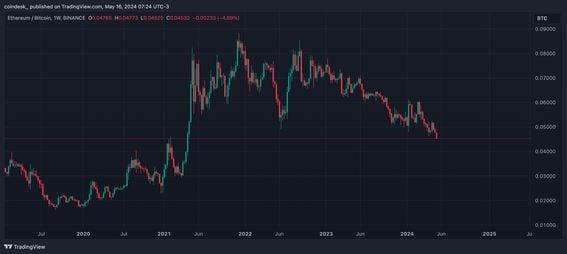
"Ether is a 'lightning rod' for negative sentiment from crypto native and external players and has several weak spots," one observer said. The ether-bitcoin ratio slides to a three-year low, extending year-to-date losses to nearly 16%. Several factors, such as uncertainty about the launch of spot ETH ETF in the U.S. and the growth of Ethereum-killers like Solana, are responsible for ether’s underperformance. The ratio between ether (ETH) and bitcoin’s (BTC) dollar-denominated prices continues to slide, extending year-to-date losses as suggested by the bearish death cross pattern a month ago. ETH/BTC slipped to 0.04563 on crypto exchange Binance soon before press time, reaching the lowest since April 2021, according to charting platform TradingView. This year, the ratio has declined nearly 16%, indicating a bias for bitcoin or the leading cryptocurrency by market value. The slide to three-year lows follows reduced demand for exchange-traded products (ETPs) tied to ether. According to Bloomberg data quoted by ETC Group in its weekly report, global ether ETPs registered net outflows of around $63.5 million last week, with Hong Kong-listed exchange-traded funds (ETFs) losing the most. Meanwhile, bitcoin ETPs raked in $92.5 million last week. Several factors, including competing layer 1s and lingering uncertainty about the debut of spot ETH approvals in the U.S, are likely responsible for ETH falling out of investor favor. “The approval of spot bitcoin ETFs in the U.S. has reinforced bitcoin’s store-of-value narrative and its status as a macro asset. On the other hand, open questions about ETH’s fundamental positioning within the crypto sector remain. Competing layer-1s (L1s) like Solana detract from Ethereum’s positioning as the 'go-to' network for decentralized app (dApp) deployment,” Coinbase Institutional’s Research analyst David Han said in a note Wednesday. Solana’s share in total decentralized exchange volumes has grown tenfold from 2% to 21% in one year, eating into Ethereum's market share. The U.S. Securities and Exchange Commission (SEC) green-lighted nearly a dozen spot BTC ETFs in January. Since then, these funds have drawn roughly $12 billion in net inflows, according to data source Farside Investors. Approval of spot ETFs tied to ether will open a similar pool of capital for Ethereum’s native token, although it’s unclear when the SEC will approve it. Traders on decentralized betting platform Polymarket see just a 10% chance of the SEC approving a spot ETF on or before May 31. The regulator has until May 23 to decide whether to approve or reject VanEck’s application to launch a spot Ethereum ETF. The deadline for BlackRock’s application is June 23. According to finance lawyer Scott Johnsson, the SEC is looking for reasons to deny ETH ETF applications by BlackRock and others on grounds that they have been improperly filed as commodity-based trust shares and do not qualify if they hold a security. Ilan Solot, co-head of digital assets at Marex Solutions, said ether is a "lightning rod" for negative sentiment from crypto native and external players and has several weak spots. “Capital gets fragmented. There are proportionally greater numbers of ways to get exposure to the ecosystem through the many Layer 2s tokens (OP, ARB…) and native protocol tokens in each one. The capital gets fragmented," Solot said in an email. Solot added that strong anti-ETH sentiment from [rival] Solana community and Bitcoin propounders is driving negative ether narratives and the high beta cryptocurrency is a "perfect vehicle" for external players to express bearish view given it trades on traditional exchanges such as the Chicago Mercantile Exchange. Lastly, Ether recently turned inflationary, reversing the bullish deflationary supply trend seen consistently since its parent network Ethereum transitioned to a proof-of-stake consensus ecosystem in September 2022. https://www.coindesk.com/markets/2024/05/16/ether-bitcoin-ratio-slides-to-lowest-since-april-2021-heres-why/
2024-05-16 09:25
One trading desk has seen an uptick in call buying activity with targets of as high as $120,000 for December 2024. Bitcoin’s price could reach $74,000 in the coming weeks amid softer U.S. inflation figures and institutional demand, which favors riskier assets. Large asset managers like Millennium and Schonfeld have invested in bitcoin spot ETFs, indicating growing institutional interest. Selling pressure from short-term is easing, some on-chain analysts said in a Thursday report. Bullish sentiment for riskier assets following soft inflation figures could propel bitcoin (BTC) prices toward the $74,000 mark in the coming days as institutional demand continues to grow, Singapore-based QCP Capital said in a note early Thursday. The softer-than-expected U.S. Consumer Price Index (CPI) rose 0.3% versus 0.4% in March amid economist forecasts for 0.4%, triggering a breakout for BTC. The asset regained the $66,000 mark for the first time since April and posted its biggest single-day gain since March. Such a move, coupled with demand from traditional finance, could see bitcoin regaining its March record of $73,700. “We expect bullish momentum here that could take us back to the highs of nearly $74,000,” QCP traders said. “The desk saw sizeable buyers of $100K-$120k BTC Calls for Dec 2024 on this move higher in spot.” “Institutional demand for bitcoin continues to grow, with large asset managers Millennium and Schonfeld investing approximately 3% and 2% of their AUM into the BTC spot ETF,” they added. Multiple filings on Wednesday showed that several big-name funds, such as Millenium Management and Elliot Capital, held millions worth of bitcoin ETFs in their portfolios. Meanwhile, some analysts say the selling pressure on bitcoin appears to have eased off, citing on-chain and exchange data. “Short-term Bitcoin holders are selling at basically zero profit and traders are depleting their unrealized profits in the last few months,” CryptoQuant analysts shared in a Thursday report. “Bitcoin balances at OTC desks stabilizing, which suggests there is less Bitcoin supply coming into the market to sell via these entities.” The firm defines short-term traders as addresses that hold bitcoin for less than 155 days and are likely to capitalize on short-term price movements. A breakout in bitcoin comes after weeks of low volatility. Since March, the market has been range-bound between $60,000 and $70,000, with the halving event in April not providing the expected boost due to a general lack of market catalysts, traders have previously said. Higher risk appetite for token bets showed signs of beginning earlier this week after an X post by retail trader Keith Gill sent some meme stocks and meme coins surging. Gill's online persona and investment strategies contributed to a short squeeze on video game retailer GameStop’s stock in 2021, and his first post on social application X in three years was considered by some to be a sign of market volatility in the months ahead. https://www.coindesk.com/markets/2024/05/16/bitcoin-traders-expect-prices-to-hit-74k-highs-as-selling-pressure-eases/