2024-05-13 10:52
One trader said recent declines are likely related to miners' asset sell-offs and fears of tighter regulation of cryptocurrencies. Since March, the market has been range-bound between $60,000 and $70,000, with the halving event in April not providing the expected boost due to a general lack of market catalysts, a trader said. One firm said short-term bitcoin holders, who have historically influenced market trends, might play a significant role in the coming months. After periods when 94% of both long—and short-term holders were in profit, there has been a shift towards selling, leading to significant drawdowns in the following four to six months. The current cycle could follow a similar pattern if institutional demand and macroeconomic conditions weaken. Bitcoin (BTC) could see a panic sell-off if it closes under the $60,000 level in the coming days, according to FxPro trader Alex Kuptsikevich. Crypto traders are targeting a break above $65,000 before sentiment can be deemed bullish. BTC briefly jumped to over $63,000 in European morning hours on Monday, jolting alternative and major tokens. Ether (ETH), Solana’s SOL and dogecoin (DOGE) 3% in the past 24 hours, with most gains coming after BTC’s rise. TON, the token of the Tonchain blockchain closely related to the messaging service Telegram, rose 7%, leading the jump among majors. The CoinDesk 20 (CD20), a broad-based liquid index of the biggest tokens minus stablecoins, was up 2.24%. BTC has largely remained range-bound between $60,000 and $70,000 since March, with the highly-anticipated halving event in April turning out to be a sell-the-news play amid a general lack of market catalysts. Inflows from exchange-traded funds (ETFs) have waned in the past few weeks, as reported, adding to a bearish sentiment. Alex Kuptsikevich said in a Monday note to CoinDesk that price action has been characterized by a sequence of lower lows and lower highs, marking a sign of investors selling into strength on price rallies. “There is pressure likely related to asset sell-offs by miners and fears of tighter regulation of cryptocurrencies,” Kuptsikevich said, referring to the drop in mining difficulty after April’s halving. “A failure below $60K could trigger something of a panic sell-off. The positive scenario, in our opinion, will become the main one with a rise above $65K, fixing the price at the 50-day moving average and the reversal area in early May,” he added. Mining difficulty measures how difficult it is for miners to solve mathematical puzzles that accept and confirm transactions on a proof-of-work blockchain. The increase in resources required to solve these puzzles strains miners' businesses, making them unprofitable and resulting in fewer miners. Short-term holders may influence drawdowns Elsewhere, analysts at crypto investment firm Ryze Labs said in a weekly note that the behavior of short-term bitcoin holders—or those who hold the tokens for less than 155 days—could largely influence markets in the coming months. Ryze Labs said there have been three instances in which 94% of both long—and short-term Bitcoin holders were in profit: from mid-November 2017 to mid-April 2017, mid-February to mid-April 2021, and most recently, from the end of February 2024 to the beginning of April. The peak values of Bitcoin held by short-term investors were $117.8 billion in 2017 and $289.9 billion in 2021. During these times, long-term holders and miners sold Bitcoin to short-term holders, who held it for less than 155 days. However, following these peaks, short-term holder losses increased rapidly, leading to a cycle inversion in which short-term sellers sold to long-term holders. The team observed that this shift has historically resulted in significant bitcoin price drawdowns in the following four to six months. “In the most recent cycle, short-term holders had Bitcoin valued at $218.9 billion. While most were initially in profit, they started to sell actively. About one month after this period, the maximum price drawdown from the period's high is approximately -6%,” the analysts said. “The current cycle may differ from previous ones due to institutional demand supported by improving macroeconomic conditions. However, if these supportive factors weaken, a Bitcoin price drawdown similar to past cycles could occur,” they added. https://www.coindesk.com/markets/2024/05/13/bitcoin-below-60k-could-trigger-panic-selling-crypto-analyst-says/

2024-05-13 10:50
Police in Panshi City, Jilin arrested six people for running an "underground bank." Chinese police identified what they called an "underground bank" providing illegal currency conversion services. The operators exploited crypto's anonymity and ease of cross-border transfers to provide the service, China News Service reported. Chinese police arrested six people involved in using cryptocurrency to provide an illegal currency conversion operation that handled some 2.14 billion yuan ($296 million), according to a China News Service report published on Weixin. The "underground bank" was uncovered by the Public Security Bureau of Panshi City, Jilin, the state-owned news service said. The operation used domestic accounts to receive and transfer funds while exploiting the anonymous, borderless characteristics of over-the-counter virtual currency trading to exchange between the yuan and South Korean won. Users included Korean purchasing agents, e-commerce firms and import/export companies, among others, according to the report. https://www.coindesk.com/policy/2024/05/13/chinese-police-bust-296m-illegal-crypto-based-currency-operation-report/

2024-05-13 10:48
Wednesday's U.S. CPI data is expected to show the cost of living likely increased 3.4% over the year in April, a moderation from March's 3.5%. The expansion of the top three stablecoins, USDT, USDC and DAI, a powder keg used to fund token purchases, has stalled since the bitcoin halving. A potential soft U.S. CPI print on Wednesday may revive inflows into the market. China's plan to step up fiscal support to the economy may bode well for risk assets. The expansion of stablecoins, or the dollar-pegged cryptocurrencies, which played a crucial role in the crypto bull market of the first quarter, has halted since the Bitcoin blockchain implemented the supposedly bullish mining reward halving on April 20. The combined market value of the top three stablecoins, namely tether (USDT), USDC, and DAI (DAI), which dominate the stablecoin market with a share of over 90%, has been fluctuating between $149 billion and $150 billion for the past three weeks. The consolidation comes after several weeks of an uptrend and may have bearish implications for the market, according to 10x Research. "Since the halving, we have seen nearly zero growth in stablecoin inflows, and bitcoin futures leverage has been dramatically reduced. Contrary to the bullish tweets about a post-halving rally, crypto users have voted with their money by withdrawing or pausing inflows," Markus Thielen, founder of 10x Research, said in a note to clients Monday. Thielen added that bitcoin (BTC) could correct to $55,000 or lower in the coming weeks, and ether (ETH), the world's second-largest token, could drop to $2,500. Traders widely used stablecoins to fund cryptocurrency purchases and derivatives trading. Hence, the expansion of their supplies is said to represent an increase in inflows into the market, a bullish development, and vice versa. The combined market cap of the three stablecoins increased over 23% to nearly $149 billion in four months leading up to the halving. Market leader bitcoin's price rose by over 50% to $65,000 during that time, with the total crypto market capitalization increasing by 50% to $3.2 trillion. The stall in stablecoin expansion coincides with a marked slowdown in inflows into the U.S.-listed spot exchange-traded funds (ETFs). The chart by Coinglass shows daily flows into the ETFs have slowed notably in the weeks on either side of the fourth halving, taking the wind out of the bitcoin bull run. Since halving, the cryptocurrency has largely traded lackluster between $60,000 and $65,000. U.S. CPI and China stimulus may offer support Some observers expect a potential softer-than-expected U.S. consumer price index (CPI) print on Wednesday to lift bitcoin above $65,000. "Wednesday’s CPI will be key to see if we can break above the $65,000 and make progress back towards the year highs, in line with equities. The lack of leverage suggests the market is under positioned for a move higher and has been forced to chase this bounce this morning," the founders of newsletter service LondonCryptoClub told CoinDesk. According to Bloomberg, the consensus is for the data to show the cost of living likely increased 3.4% over the year in April, a moderation from March's 3.5%. The core CPI, which strips out the volatile food and energy component, rose 3.6% year-on-year, down from March's 3.8%. A renewed slowdown in inflation will likely raise hopes for Fed rate cuts this year, spurring inflows into risk assets, including cryptocurrencies. China's plans to inject liquidity into the system could help as well. According to Bloomberg, the world's second-largest economy aims to sell one trillion yuan of debt through December, the fourth such issuance in the past 26 years. "Bitcoin bounced to $63,000 early today probably because China is about to flood the market with liquidity in a "QE with Chinese characteristics," the founders at the LondonCryptoClub said. "This morning, China fired the starting gun to issue RMB 1trn ($140bn) in long-dated bonds to help stimulate the economy. The PBOC has also hinted under instruction from Xi that they will purchase these bonds in the secondary market. China is about to inject a wave of liquidity into markets," the founders added. https://www.coindesk.com/markets/2024/05/13/stablecoin-expansion-stalls-ahead-of-us-inflation-data/

2024-05-13 09:49
The company has also secured registrations in India and Dubai. Custody provider Liminal won Abu Dhabi's approval to operate as a regulated custodian within the Middle East. The Singapore-headquartered company is now functioning with regulators' blessings in the Middle East and India as well as its home base. Liminal, a Singapore-headquartered provider of custody services, won regulatory approval in Abu Dhabi as its expansion outside its home base takes another step forward, its representatives told CoinDesk in an interview Monday. The firm's First Answer Middle East subsidiary received the Financial Services Permission (FSP) from the Abu Dhabi Global Market's (ADGM) Financial Services Regulatory Authority (FSRA) on Thursday, allowing it to provide custody in the region. It was granted in-principal approval last year. In the past few weeks, Liminal has seen a series of regulatory positives in the Asian Pacific (APAC) and Middle East and North Africa (MENA). Late last month, its Dubai entity, First Answer Custody FZE, secured initial approval from the emirate's Virtual Asset Regulatory Authority (VARA). Liminal's Indian subsidy, First Answer India Technologies, is also registered as a reporting entity. "We initiated a strategic drive two years ago to secure regulatory licenses in key markets across APAC and EMEA (Europe, Middle East and Africa), strategically positioning ourselves to cater to institutional clients," said Manan Vora, senior vice president of strategy and business operations. "Our strategic vision is to expand from our present technology presence in Europe and Taiwan to pushing for regulatory victories there. In Indonesia, we are already working as a technology provider for the nation's sovereign digital asset exchange." Last week, an official of India's Financial Intelligence Unit (FIU) told CoinDesk that Liminal's unit in the country had been registered as a reporting entity. That makes it the first digital asset custodian registered with the FIU, company representatives said. In November, the nation's premier investigating police agency, the Central Bureau of Investigation (CBI), appointed Liminal to manage seized digital assets. Liminal has also been active at home. When Singapore introduced new licensing requirements for custody solutions providers in April, Liminal was already providing custody solutions and was thus grandfathered into the new guidelines. That arrangement lasts for six months. Liminal has notified the Monetary Authority of Singapore (MAS) that it has begun the process of applying for a license. Read More: Wallet Firm Liminal Raises $4.7M From Elevation Capital, CoinDCX, Sandeep Nailwal and Others https://www.coindesk.com/policy/2024/05/13/custody-provider-liminal-wins-approval-in-abu-dhabi-as-it-extends-expansion-in-asia/

2024-05-13 06:07
The announcement comes as the yen, one of the top five global reserve currencies, bears the brunt of Japan's fiscal imprudence. Metaplanet adopts bitcoin as a reserve asset to hedge against Japan’s debt burden and yen volatility. At over 250%, Japan's debt-to-GDP ratio is the highest among advanced countries, according to the IMF. Tokyo-listed Metaplanet has adopted bitcoin (BTC) as a strategic reserve asset as a hedge against Japan's debt burden and the resulting volatility in the yen. "Metaplanet has adopted bitcoin as its strategic reserve asset. The move is a direct response to sustained economic pressures in Japan, notably high government debt levels, prolonged periods of negative real interest rates, and the consequently weak yen," the company said in the press release on Monday. Since April, Metaplanet has acquired 117.7 BTC ($7.19 million), following the strategy pursued by U.S.-listed MicroStrategy (MSTR), which has acquired several billion dollars worth of bitcoin, per Bitcointreasuries.net. Metaplanet, an early-stage investment firm, has moved away from any involvement in Web3 and is now only focused on bitcoin alongside exposure to commercial real estate. The move stands out because it comes at a time when Japan's fiscal crisis is said to be playing out in the currency market. Crypto propounders have long hailed bitcoin as a hedge against fiscal and monetary imprudence. The ratio between Japan's gross debt and gross domestic product (GDP) currently exceeds 254%, the highest in the advanced world, according to data tracked by the International Monetary Fund. The U.S. debt-to-GDP ratio has exceeded 123%. The relatively higher debt has kept the Bank of Japan (BOJ) from raising interest rates in lockstep with the Federal Reserve (Fed) and other major central banks. Higher interest rates raise the cost of servicing debt, further complicating the fiscal issues. While the Fed has lifted rates above 5% since early 2022, the benchmark borrowing cost in Japan remains near zero. As such, the yen, one of the top five global reserve currencies, has depreciated sharply. Interest rate differentials heavily impact fiat currency exchange rates. Data from the charting platform TradingView show that the Japanese yen has depreciated by 50% against the U.S. dollar since early 2021. The yen recently slipped past 155 per U.S. dollar, reaching a 34-year low. The sell-off reportedly saw BOJ sell dollars to put a floor under the yen in a classic currency market intervention. "As the yen continues to weaken, Bitcoin offers a non-sovereign store of value that has, and may continue, to appreciate against traditional fiat currencies," Metaplanet said, adding that BOJ's strategy of keeping rates low while intervening in the FX markets represents an "unsustainable monetary paradox." The company plans to hold bitcoin for the long term to ensure minimally realized taxable gains and to acquire more bitcoin by issuing long-dated yen liabilities when the opportunity arises. https://www.coindesk.com/markets/2024/05/13/metaplanet-makes-bitcoin-a-reserve-asset-as-japans-debt-mountain-grows/

2024-05-11 16:00
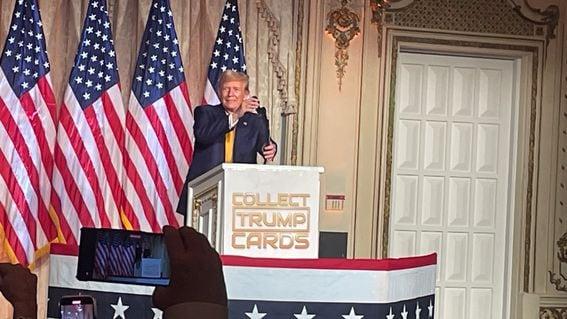
At the Mar-a-Lago dinner, Donald Trump wooed a constituency Joe Biden has thoroughly snubbed. But the presidential candidate isn't exactly fluent in cryptocurrency policy. PALM BEACH, FL. — During his first stint in the White House Donald Trump was no fan of cryptocurrencies; he once tweeted they were "based on thin air." He later sold millions of dollars worth of NFTs. This week, he rebranded himself as crypto's candidate of choice. "If you’re in favor of crypto you’re gonna vote for Trump because they want to end it," he said at a Wednesday night party in Mar-a-Lago, referring to Democrats and President Joe Biden. He also vowed to make sure his campaign can accept crypto donations. The 77-year-old candidate's apparent turnabout came as little surprise to his audience of some 200 supporters. Many had bought $10,000 of Trump Trading Card NFTs to join this surreal, sweltering outdoor reception at the former President's Floridian palace. A CoinDesk reporter also attended (as a +1). For nearly an hour, Trump fielded questions from a sea of sweat-drenched suit-wearers. Only a handful of them focused on crypto, an incredibly niche wedge issue that was the nominal anchor of the entire event. But it was enough to make a few things clear: One exchange highlights points 1 and 3 (we will return to 2 later). When asked how he felt about central bank digital currencies (CBDCs) and "government blockchains" (two things that crypto proponents generally oppose) Trump responded "I think it all has its place." He continued: "We have some incredible things happening, I mean crypto, if you go back to crypto a couple years ago, people said it wasn’t gonna make it but now it's up in record numbers. I guess you could say it's a form of currency and I think I’m for that, more and more I’m for that." The substance of Trump's support for crypto might be less important to the industry's (likely small) cadre of single-issue voters than the fact he's saying anything positive about it. Trump appears to be the first major party presidential candidate that's embraced crypto. Blasting Biden On the other side of the race is an openly hostile presidential administration. Joe Biden's SEC chairman Gary Gensler is waging lawfare against many parts of the crypto industry. And earlier Wednesday, hours before his opponent's golf-resort gala, the President vowed to block a House effort to dismantle an SEC accounting rule for crypto that political opponents argue has hampered the industry's growth. "Biden doesn’t even know what it is. If you ask Biden, 'Sir, are you for or against crypto?' he’ll say, 'What’s that? Get me off the stage.' He has no idea," Trump said. Whether or not that somewhat plausible presumption is true, Trump followed up with an attack on Gensler, an official well-versed in crypto. "I’ll say this: I’m fine with it, I want to make sure it's good and solid and everything else but I’m good with it," Trump said of crypto. He later said, "If we’re gonna have what we have then we’re going to have to embrace a lot of things that not everybody likes." Hours before Trump's impromptu Q&A, the Biden campaign team roasted "people suckered into paying as much as $10,000 for simple digital images of him" in an email to supporters. The email blasted Trump for holding a glitzy NFT dinner instead of campaigning during his midweek break from court. But Trump was campaigning on Wednesday night. He was vying for votes from the exceptionally loud crypto crowd that Biden had thoroughly snubbed. Sure, only a few hundred heard him firsthand. Their videos of Trump's pro-crypto musings ricocheted across social media and triggered a torrent of media coverage for crypto's self-appointed political champion. "There's 50 million crypto holders in the U.S. That's a lot of voters," Ryan Selkis, the CEO of crypto data platform Messari claimed to Mar-a-Lago's packed ballroom where VIPs (those who bought $10,000 of NFTs ) mingled with dinner attendees (who paid $4,700). Trump had unexpectedly called Selkis onstage. The soundbites that emerged from Wednesday's NFT gala may accelerate crypto's polarization by locking it in the same us-or-them shackles that bind much of American politics. Bitcoin's libertarian roots hardly resonate today; crypto has its proponents on both sides of the aisle. Republican politics' most powerful voice cast crypto's bipartisan reality aside in declaring Democrats want to kill it off. "The Democrats are very much against it," Trump said, hours after 21 of the House's 213 Democrats voted to repeal the SEC accounting rule. Trump framed himself as the industry's only hope. His fluency in the industry's issues was spotty. Asked how he would change hostile U.S. policies that drive crypto businesses out of the country, he said: "We'll stop it, because I don't want that, I don't want that. I want that – if we're going to embrace it then we have to let them be here." 'We Made NFTs Hot Again' There was one area of crypto where Trump spoke more-or-less expertly: his NFTs. Three collections of Trump NFTs – digital trading cards that depict an uber-jacked Donald in various states of patriotism – have generated millions of dollars in sales. Wednesday's dinner gala celebrated high-rollers who bought into his "Mugshot Edition" third collection. "We did it when NFTs were not hot and we made NFTs hot again," Trump claimed of his cards, adding that some NFT buyers made tens of thousands of dollars on the resale market. Asked by one attendee if he would sell a fourth NFT collection, the longtime businessman demurred. "I believe in supply and demand. And as you know 1 did great, 2 did great, 3 did great. At some point maybe that turns around." He polled the audience: How many Mugshot high-rollers wanted a series 4 collection of NFTs? Most raised their hands. Trump sounded bewildered: "Based on supply and demand, wouldn’t that maybe keep your prices, of the stuff you already bought, wouldn't that keep it lower?" He tested their resolve. "Who would like not to see a fourth collection for that reason?" Only a couple of hands shot up. "Ok, a couple of economists," Trump said to the laughter of the crowd. https://www.coindesk.com/policy/2024/05/11/trumps-pro-crypto-bluster-at-nft-gala-lacked-policy-substance/