2024-05-10 20:42
The legislation known as FIT21, which would set up a system to govern U.S. crypto markets, is headed toward a House vote, though that may mark the end of this effort. A bill to set out a regulatory regime for U.S. cryptocurrency markets will finally get a vote from the overall House of Representatives, said Rep. Patrick McHenry. The House Rules Committee approved the legislation for a vote next month, potentially pushing it toward a high-water mark for crypto legislation in the U.S. The most comprehensive U.S. cryptocurrency legislation to so far make it through a congressional committee will get even further, with the entire House of Representatives set to vote on whether to approve it soon, according to Rep. Patrick McHenry (R-N.C.), the chairman of the House Financial Services Committee. His panel last year had cleared the Financial Innovation and Technology for the 21st Century Act, or FIT21, in a bipartisan vote that drew a handful of Democrat supporters in spite of opposition from their ranking member on the committee, Rep. Maxine Waters (D-Calif.) That bill is on a path toward becoming the first significant digital assets regulatory legislation to clear one of the chambers of Congress now that it's been cleared for a vote next month by the House Rules Committee, according to McHenry. The bill, which had also been approved by the House Agriculture Committee, is the "culmination of years of bipartisan efforts to finally provide clarity," said the North Carolina lawmaker, who is retiring from Congress at the end of the year and made crypto legislation one of his priorities on his way out. "With the floor vote announced today, Congress will take a historic step to provide a clear regulatory framework for digital asset markets," McHenry said in a statement. "This legislation will cement American leadership of the global financial system for decades to come and bolster our role as an international hub for innovation." Though it's a mark of progress to get legislation that far in a highly partisan and combative Congress, the bill is unlikely to find parallel action in the Senate – which is needed for Congress to fully approve legislation and send it to the president to sign into law. That chamber hasn't yet done high-level work on a similar effort, though lawmakers there recently showed some willingness to find a path for another crypto effort: a bill to regulate the issuers of stablecoins. Read More: Stablecoin Bill Unlikely to Get Pinned to FAA Reauthorization, Putting Effort On Hold Again https://www.coindesk.com/policy/2024/05/10/us-houses-mchenry-says-bill-on-crypto-market-structure-will-get-floor-vote/

2024-05-10 20:26
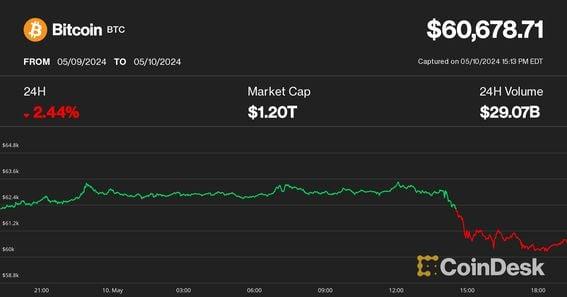
This period could last between one to six months, and the sentiment will be the most negative right before the turnaround, one hedge fund manager said. BTC has been sliding since reaching an all-time high in March. Friday's quick tumble showed less interest from dip buyers, suggesting that a bottom might be near, Santiment said. The lull could continue into early summer, setting up a very bullish second half of the year, Bitfinex analysts said. Crypto markets are stuck in a lull with digital assets consolidating for the last few weeks, testing investors conviction whether the bull market will resume. All attempts for a sustained rally over the past weeks have been sold off, the latest instance coming Friday with bitcoin (BTC) tumbling nearly 5% from $63,000 to just above $60,000 amid discouraging inflation expectations and hawkish commentary from Federal Reserve policymakers. Blockchain activity also points to low participation, with transactions on the Bitcoin network falling off a cliff and second-largest ether (ETH) turning inflationary. We have been here before. The current period resembles the action from April through September of 2023 when bitcoin was stuck in the $25,000-$30,000 range for an excruciating six months. Eventually, cryptocurrencies were able to sustain a multi-month rally, with BTC ultimately hitting an all-time high in March of this year. "Bitcoin is in the 'bore you to death' phase," Charles Edwards, founder of crypto hedge fund Capriole Investment said in an X post Thursday. This period of consolidation could last for anywhere between one to six months, he explained, during which BTC will be rangebound with low volatility until market participants lose their patience. The sentiment will be the most negative just before the consolidation ends, he added. "When you are sufficiently bored from sideways chop, common symptoms will include thinking the halving is priced in, the bull market is over and selling to buy stocks at the bottom," Edwards said. "Your symptoms and shorts will peak just before the mega rally." Said bottom might be near, according to analytics firm Santiment. "Traders are showing weak 'buy the dip' interest in bitcoin's latest retrace," Santiment said Friday monitoring social media interactions. "Generally, the crowd's lack of faith is a strong sign of prices being close to a bottom." Bitfinex analysts noted in a Friday report that bitcoin's recent weakness happened amid a surging U.S. dollar with interest rate cut expectations tempered, and said the lull could continue into early summer. "We expect the market to remain uncertain over the short-term in a low volatility environment till the actual tapering of QT [quantitative tightening] takes place in June." The Federal Reserve announced plans to curb the pace of its balance sheet run-off starting next month, which would impact dollar liquidity positively benefitting risky assets such as cryptocurrencies that are sensitive to the global liquidity environment. However, the greenback's tumble from a six-month peak last week following the Fed meeting and weak jobs report – coinciding with BTC to rebound from near $56,000 – was a turning point in the trend, and a weaker dollar could support the next leg in the crypto rally. "We believe sustained strength and a reclaim of range lows on BTC post-FOMC and job market data and the simultaneous weakness in the dollar is a sign of a new regime, which would set us up for a very bullish Q3-Q4 for bitcoin," the authors said. https://www.coindesk.com/markets/2024/05/10/bitcoin-is-in-a-bore-you-to-death-phase-but-bottom-could-be-close-analysts-say/
2024-05-10 17:12
The much-hyped restaking project initiated its long-awaited though highly controversial plan to distribute EIGEN tokens, by opening a window of time where eligible users can claim them. They're not freely tradeable, but speculators in side markets put the fully diluted value around $15 billion. EigenLayer's EIGEN token is trading around $9 in side markets like Aevo where traders can bet on the eventual price. EIGEN airdrop, which the team refers to as a "stakedrop," has been controversial due to the team's decision to make the tokens non-transferable, at least initially, as well as to "geoblock" users in many countries from claiming them. EigenLayer's restaking protocol is pitched as a major new frontier for decentralized-finance projects, by repurposing security borrowed from the Ethereum blockchain. EigenLayer has finally kicked off its long-awaited EIGEN airdrop, but it will be a while before users can trade their new tokens – since the project has made them non-transferable. The Eigen Foundation, a non-profit introduced last week by Eigen Labs, the team behind EigenLayer, opened up "claims" on EIGEN on Friday. Officials have said they would become transferable at a yet-to-be-defined later date. The Eigen Foundation said in a Telegram message that they are targeting September 30. Speculators on decentralized exchanges like Aevo and Hyperliquid are currently valuing EIGEN at around $9. EIGEN's total supply at launch is 1,673,646,668.28466 tokens, which would give the token a fully diluted value of $15 billion. Both markets allow users to trade perpetual futures, or "perps," which are futures contracts that have no expiration date – crypto-native trading instruments that allow people to speculate on the future price of an asset without trading it outright. "You can probably view it as what people expect the spot price will trade at when it is transferable," Julian Koh, CEO of Aevo, explained in a Telegram message. "People use it as a reference price like how people use prediction market odds as a reference for the actual event." EigenLayer, the restaking service on Ethereum, is one of the buzziest blockchain startups to ever launch a token, raising more than $100M from Andreessen Horowitz, and luring in some $16 billion worth of user deposits into its "pooled security" system before it even launched. While EigenLayer has emerged as one of the most talked-about blockchain projects to date, its EIGEN token has generated significant controversy. As most of EigenLayer's key features remain in progress, the main incentive for depositing into the platform thus far has been "points," which are score-counts that crypto traders expected would be tied to a future airdrop. Last week, Eigen Labs, the team behind EigenLayer, unveiled details behind EIGEN, which it called a "Universal Intersubjective Work Token" that would help power the EigenLayer platform under the hood. EIGEN's distribution plan was immediately met with backlash from EigenLayer point-earners. In addition to the lengthy non-transferability period, some took issue with the project's decision to bar users from some jurisdictions – like the U.S., Canada and China – from claiming tokens. The grumbles came partly because the project had placed no geographic restrictions on the deposits or points awards. Others were disappointed that some points from third-party "liquid restaking services" would not be considered in the "Season 1" airdrop even though they accounted for a large portion of overall deposits. (It remains to be seen how those points will be accounted for in EigenLayer's eventual "Season 2" airdrop). EigenLayer revised its plan in response to the community feedback, allocating extra funds for some users in the "Season 1" airdrop. CORRECTION (May. 10, 20:06 UTC): Some liquid restaking points will be counted in the Season 1 airdrop. https://www.coindesk.com/tech/2024/05/10/eigenlayer-opens-claims-for-airdrop-of-eigen-token-though-its-non-transferable/

2024-05-10 16:30
The vote passed with overwhelming support, with 65 addresses representing 14.6 million CELO tokens signaling approval for the measure. The Celo community voted Friday to approve using Optimism's OP Stack technology for migrating its current standalone blockchain over to a layer-2 network atop Ethereum. The vote, officially proposed May 3 passed with overwhelming support, with 65 addresses representing 14.6 million CELO tokens signaling approval for the measure, with two addresses representing 20,484 CELO abstaining. Due to the magnitude of the decision, tantamount to an existential transformation, Celo community leaders have said that the change would not take place automatically (the usual practice) but only upon the "completion of upgrades from our validators." Described as a "temperature check," the vote follows an announcement last month that cLabs, the primary developer firm behind the Celo blockchain, and as such one of the most influential voices in the community, proposed choosing the OP Stack last month as the primary technology for its new home. The developer had spent several months evaluating various customizable stacks from different layer-2 teams on why they may be the best fit for Celo, and the process had turned into an unusually public and closely-watched competition – almost like a blockchain edition of TV's The Bachelorette. Celo originally announced plans to use OP Stack last July, when the decision was shared to become the broader Ethereum ecosystem as a layer-2 chain, morphing from its current state as a layer-1 chain. But the transition became competitive when Arbitrum Orbit, zkSync’s ZK Stack and Polygon CDK threw themselves into the mix, offering to provide technology to Celo. Ultimately, the Celo team ended up right where they began. “The OP Stack largely provides what is needed to deploy an L2. Minimal changes are needed to support Celo's unique features,” the proposal reads. “It is battle-tested with multiple chains in production and compatible with other stacks, such as Polygon's Type 1 ZK Solution.” https://www.coindesk.com/tech/2024/05/10/celo-community-ratifies-plan-to-use-optimisms-op-stack-for-new-layer-2-chain/

2024-05-10 16:26
Dorsey, who led the social media platform from 2015 to 2021, developed a strong interest in crypto during that time and is now fully focused on the sector. Jack Dorsey believes the price of bitcoin could reach over $1 million by the end of 2030. His outlook aligns with that of other industry leaders, such as Cathie Wood, who predicted that bitcoin could go as high as $1.5 million by that time. Former Twitter CEO and now founder and backer of several crypto projects, Jack Dorsey, believes that bitcoin (BTC) will go as high as $1 million by 2030. When asked about a price prediction for bitcoin in an interview with Pirate Wires, Dorsey said, “I don’t know. Over… at least a million. I do think it hits that number and goes beyond.” While the price of the cryptocurrency is interesting, he said, it’s the ecosystem and movement that fascinates Dorsey. “The most amazing thing about bitcoin, apart from the founding story, is anyone who works on it, or gets paid in it, or buys it for themselves—everyone who puts any effort in to make it better—is making the entire ecosystem better, which makes the price go up,” he said. While $1 million seems like a stretch from bitcoin’s current price of $60,886, other big names in the industry have voiced similar outlooks. Ark Invest founder and CEO Cathie Wood has even taken it a step further, predicting the token will reach $1.5 million by 2030. Ever since stepping down as Twitter CEO in 2021, Dorsey has become an advocate for the industry, leading and endorsing several projects over the years. In 2019, he became a backer of social media startup BlueSky, which he recently stepped away from as his vision for a decentralized social media platform aligns more with a competitor Nostr. Dorsey also founded a company called Square in 2009, which was rebranded to Block in 2021 as his interest in blockchain technology grew. https://www.coindesk.com/markets/2024/05/10/former-twitter-ceo-jack-dorsey-says-bitcoin-will-go-beyond-1-million-in-2030/

2024-05-10 16:11
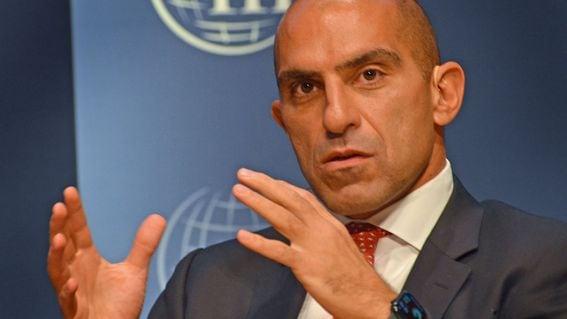
The U.S. derivatives regulator approved a proposed rule that punctuates a long-standing legal dispute between the agency and predictive markets platforms. The U.S. derivatives agency approved a proposal to ban popular prediction market trading, with three of the five commissioners approving the proposed rule. The public will have 60 days to weigh in with comments on the potential rule. The U.S. Commodity Futures Trading Commission (CFTC) proposed a formal rejection of event contracts that bet on the outcome of political activity in a vote on Friday, beginning an effort to wall off U.S. customers from platforms that allow the trading of predictive contracts. The agency has conducted a years-long legal fight with such firms, and the proposed rulemaking approved by the three Democratic appointees to the U.S. derivatives agency would declare trading on political outcomes as "contrary to the public interest" and legally equate them with illicit contracts on war, terrorism and assassination. Agency officials also noted that the CFTC is not a gambling regulator, and the agency wouldn't be capable of ensuring market integrity in this field. Prediction platforms including PredictIt, Polymarket, Zeitgeist and Kalshi give users opportunities to buy contracts on the outcomes of actual events, including elections and policy developments, and they've been popular in crypto circles. Buyers make yes-or-no bets that pay off if they're right and cost them money if they're wrong. Contracts on political contests, awards contests and the outcome of games would be banned for U.S.-regulated companies under the proposal. "Contracts involving political events ultimately commoditize and degrade the integrity of the uniquely American experience of participating in the democratic electoral process," Chairman Rostin Behnam argued in the Friday meeting. "To be blunt, such contracts would put the CFTC in the role of an election cop." Behnam had signaled in March that this proposal was coming, and the draft rule that moved forward today still needs to pass through a 60-day period of public comments and then a process to approve a final rule. During the Friday meeting, Commissioner Caroline Pham – one of the opponents of the proposal – called it a "stunning overreach." She also criticized the agency's legal and enforcement track record and suggested a need for Government Accountability Office review of the regulator. "A third-party review can help us get back to the basics and on track," Pham said. Commissioner Summer Mersinger also voted against the proposal. Because the rule had such a significant enforcement aspect, Commissioner Christy Goldsmith Romero called it a "dereliction of their duties" that the agency's enforcement staff wasn't on hand for Friday's meeting. Brian Quintenz, a former CFTC commissioner and current adviser to prediction markets company KalshiEx (which is suing the regulator for denying its own effort to launch election markets), said in an email to CoinDesk that this move represents "bad government." "Instead of regulating these new markets and letting them flourish responsibly, the Commission is simply going to ban a large swath of it. "Financial regulation should be based on data and the law, not ignorant preconceptions. Further, the Commission is creating huge amounts of uncertainty and is already pushing individuals who need these risk management tools to offshore and unregulated venues, potentially exposing consumers to significant harm." Nikhilesh De contributed reporting. https://www.coindesk.com/policy/2024/05/10/us-cftc-proposes-ban-on-political-event-contracts/