2024-05-10 12:11
Apple's brief mention of Render-powered 3D design software Octane cheered bulls on RNDR. TON, RNDR have rallied over 13% in 24 hours, leading crypto markets higher. RNDR cheers Apple's brief mention of Render-powered 3D design software Octane. Alternative cryptocurrencies with positive news flows are shining bright as the bitcoin rebound spurs renewed risk-taking in the crypto market. In the past 24 hours, TON, the native cryptocurrency of the layer project The Open Network, has risen 17.5% and decentralized GPU-based rendering solution Render Network's RNDR token has gained 13.2%, according to data source Coingecko. Both are among the best-performing coins of the past 24 hours. Bitcoin, the market leader, has rallied 6% to $63,000. TON's rally seems to be driven by reports that the highly-anticipated launch of the viral Telegram-based game Notcoin's native coin, NOT, will happen on May 16. The token will be minted on The Open Network. Leading cryptocurrency exchanges like Binance, Bybit, OKX and Bitfinex have already decided to support NOT. On Thursday, Binance announced a launchpool for NOT, offering 3 billion coins to users who stake their BNB or FDUSD stablecoin. OKX unveiled a "jumpstart" campaign, rewarding TON stakers with NOT tokens. The program will begin on May 16 at 06:00 UTC and run for three days. Meanwhile, RNDR continued to cheer Nasdaq-listed tech giant Apple's brief mention of Render-powered 3D design software Octane Tuesday. Since then, the token has risen over 20%, taking the month-to-date gain to over 56%. "Pro rendering apps like Octane will flat-out fly, Apple’s vice president of platform architecture, Tim Millet, said in a four-minute keynote speech Tuesday, noting the software's performance on the new iPad. Bitcoin breaks trendline Bitcoin has broken past a downward trendline alongside a stock market that's taking aim at new record highs. Data released Thursday showed initial applications for unemployment benefits in the U.S. rose last week to the highest since August, strengthening the case for Fed rate cuts this year. According to Alex Kuptsikevich, senior analyst at FxPro, $64,000 is the level to beat for the bulls. "Bitcoin has made two attempts since the start of the day on Friday to break the $63.0K level, which doesn't look like a meaningful turning point. Much more interest is focused on the $64.0K area on the upside and $60.0K on the downside," Kuptsikevich said in an email. Still, some analysts are worried that supply overhang from the distribution of coins to creditors of crypto exchange Gemini's Earn program and long-defunct crypto marketplace Mt. Gox could cap the upside in bitcoin in the near term. https://www.coindesk.com/markets/2024/05/10/ton-rndr-surge-more-than-13-as-bitcoin-rebounds-to-63k/

2024-05-10 10:27
KuCoin paid a fine of $41,000 and Binance's financial penalty is still to be determined after a hearing with the FIU. The two exchanges – among nine banned in December – have become the first offshore crypto related entities be registered. The registrations will add "little more credibility to the system," the regulator said. Binance, the world's largest cryptocurrency exchange, and rival KuCoin became the first offshore crypto-related entities be approved by India's anti-money laundering unit, months after being banned for "operating illegally." The two have been registered with the country's Financial Intelligence Unit (FIU-IND), the most senior official of the unit, which falls under the nation's Finance Ministry, told CoinDesk. They were among more than 9 offshore entities banned – others included Huobi, Kraken, Gate.io, Bittrex, Bitstamp, MEXC Global and Bitfinex – at the end of last year. The approval marks a credibility shift for crypto in the nation, said Vivek Aggarwal, who heads FIU-IND, at a meeting with several financial journalists. The unit will set up a working group with the industry to review compliance guidelines on money laundering laws for virtual digital asset service providers, he said. “It is parliament and government as a whole,” that need to give legitimacy to the industry, he said. The registrations act to “safeguard the Indian economy. If any business is ring-fenced from being abused for financial crime then automatically it has, if not legitimacy, at least little more credibility to the system,” Aggarwal said. KuCoin paid a penalty of $41,000, the first crypto entity to do so, and has resumed operations. Binance has not resumed operations because it is expected to pay a penalty after a hearing with the FIU. The Economic Times, citing people familiar with the matter, said Binance would settle with a $2 million fine. “Binance is registered but the compliance proceedings are not completed because the amount of penalty has to be decided by me and that hearing is still going on,” said Vivek Aggarwal, who heads FIU-IND. Among the other sanctioned platforms, Kraken, Gemini, and Gate.io have begun negotiations with the regulator. Both OKX and Bitstamp have submitted plans to exit the country. India now has as many as 48 crypto entities registered as reporting entities under the nation’s Prevention of Money Laundering Act, Aggarwal said. Friday's meeting marks the first time the FIU has officially spoken to the press about crypto and comes after Aggarwal and other FIU officials met representatives of all 48 entities, also a first. Ambiguous position for crypto industry Nationally, India’s position on crypto has remained slightly ambiguous. The imposition of stiff crypto taxes in 2022, along with the crypto markets winter pushed Indian traders to switch to international exchanges, hurting the local crypto industry. Trading volumes shifted back to Indian exchanges after the ban on offshore entities. India also made it its G20 presidential priority in 2023 to achieve global consensus in framing crypto policy and got all members to agree to global guidelines, though the country came under scrutiny for pushing global consensus without having its own legislation in place. India has kept a crypto bill in cold storage since 2021 and has indicated it will decide its position in the coming months. Previously, a senior lawmaker told CoinDesk that no bill is likely before mid-2025. Building blocks The occasion also saw the unveiling of a report titled “Virtual Digital Asset Service Providers: Road to Effective Compliance under PMLA” by the crypto advocacy body, Bharat Web3 Association. The forward for the report is written by Aggarwal: “This document also reflects our commitment to fostering a regulatory environment that not only keeps pace with innovation but also safeguards the financial system against risks associated with money laundering." Offshore entities wishing to register with the FIU do not need to have an office in India. but require a principal compliance officer to be registered along with their address and other details, Aggarwal said. Those that have not won registration with unit and were sent a show cause notice in December remain blocked even if they have initiated talks. “The primary goal of AML/CFT (anti-money laundering and counter-terrorism framework) is that I should have full visibility of those transactions whenever I want and also I should get reports of suspicious transactions,” Aggarwal said. “To that extent, we have the compliance in place.” Read More: India's Local Crypto and Web3 Advocacy Body Asked for Action Against Offshore Entities: Source https://www.coindesk.com/policy/2024/05/10/binance-kucoin-win-registration-with-indias-financial-intelligence-unit/

2024-05-10 10:15
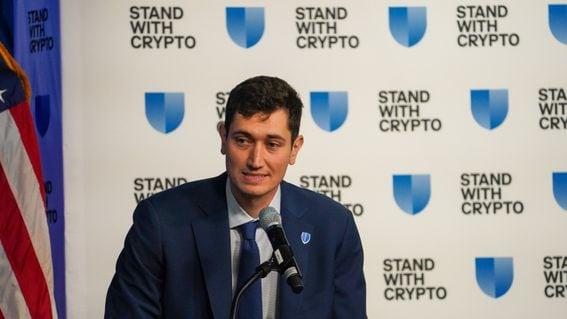
Stand With Crypto – an advocacy group started by Coinbase last year – will start gathering cash from more than 400,000 members to give to favored congressional candidates. Crypto advocacy group Stand With Crypto is opening its own Political Action Committee ahead of this year's elections. The group's own members will support the PAC, though they're limited to $5,000 contributions. The fast-growing organization of cryptocurrency supporters, Stand With Crypto, is getting into campaign financing with the opening of its own political action committee (PAC) that will make direct donations to endorsed congressional candidates, said Chief Strategist Nick Carr. Its opening slate of endorsements will feature five candidates seeking open seats in the U.S. House of Representatives and Senate, though the money will have to wait. Stand With Crypto's effort is an "associated PAC," meaning it's supported by the nonprofit group's own members, and each of them will be limited to $5,000 contributions. Once they start adding cash to the PAC coffers, then the committee can start making direct donations to candidates as they face the latter months of the primaries and the big contest of November's general election, the group announced Friday. "I think it's incredible to see the amount of growth in such a short time span of Stand With Crypto," Carr said in an interview with CoinDesk. His organization, started in August 2023, now reports more than 443,000 people signing on. Separately from the PAC, the organization says it's raised more than $86 million to conduct advocacy operations, which have included supporter events, town halls and a presidential candidate forum. Though billed as a grassroots organization, some of its major donations have come from corporate names, such as Coinbase CEO Brian Armstrong. Coinbase launched the group last year. What separates the new PAC from other prominent crypto campaign-finance efforts is the others have been dominated by a handful of major digital assets businesses, giving $10 million or more to Fairshake and affiliated PACs. Those organizations target candidates with unlimited indirect support that's deployed independent of their campaigns. Stand With Crypto's PAC, as a political arm of the "social welfare" organization that's classified as a 501(c)(4), will give donations directly to the candidates, Carr said, targeting "individuals who have demonstrated an impressive knowledge and commitment to crypto and blockchain innovation in America." The amounts will be limited by the constraints that come with direct donations. And unlike with financial support to the organization itself, giving to the PAC will require the donors to identify themselves publicly. The group endorsed a city councilman in Oregon, Democrat Eddy Morales, who is heading into a congressional primary there in a couple of weeks and said on his campaign website that "artificial intelligence, blockchain, and other technologies are still emerging and allow people to build wealth, own their own data, and have a seat at the table in the economy of the future," adding that he'd "focus on creating a regulatory framework that provides clarity to these industries." It also highlights Troy Downing, a Montana Republican who is the state's securities watchdog and is running for a House seat there amid a crowded field facing a June primary. The group additionally endorsed three candidates that other crypto PACs have previously favored: Alabama Democrat Shomari Figures; Rep. Jim Banks (R-Ind.), who just won his party's primary this week to pursue a Senate seat; and West Virginia Gov. Jim Justice, seeking the Senate seat left open by a departing Sen. Joe Manchin (D-W.V.) The endorsements will continue with future selections, Carr said, and the organization already has a well of incumbent candidates to choose from, because it maintains a grading of the members of Congress based on crypto friendliness. https://www.coindesk.com/policy/2024/05/10/stand-with-crypto-sets-up-election-war-chest-backs-candidates-seeking-open-seats/
2024-05-10 08:31
A DOGE price pattern that presaged the early 2021 surge looks set to recur. DOGE's weekly price averages appear on track to confirm a bullish golden cross. The previous golden cross, seen in early January 2021, presaged an 8,000% price surge. Dogecoin (DOGE), the world's largest meme cryptocurrency by market value, seems headed toward a repeat of the bullish "golden cross" technical pattern that presaged the early 2021 surge. DOGE, which has a market cap of about $22 billion, has demonstrated remarkable performance this year, with a price surge of over 70% and significantly outpacing the near 50% increase in bitcoin (BTC), the largest cryptocurrency, according to CoinDesk data. The 50-week simple moving average (SMA) of the meme token's spot price is now trending north and looks set to cross above the 200-week SMA in the upcoming weeks, confirming a golden cross. In other words, near-term price momentum could soon outperform long-term momentum, potentially evolving into a prolonged bullish trend. Momentum traders frequently use moving-average crossovers as a part of a structured approach to identifying entry and exit points in the market. The DOGE price topped its 200-week SMA in March, breaking out of a prolonged sideways consolidation, and has since established a foothold above the critical average. The impending golden cross would be the first in over three years. The previous one, seen in early January 2021, presaged a four-month rally that saw prices surge over 8,000% to a record 76 cents on Binance. That said, past data does not promise future results. And that's particularly true in the case of moving average crossovers, which tend to lag prices and have been known to trap traders on the wrong side in traditional markets. Besides, meme coins like DOGE lack real-world use cases and are mainly driven by speculation, which makes them more sensitive to fiat liquidity conditions and global interest-rate expectations. During DOGE's early 2021 run, interest rates were near or below zero worldwide, which catalyzed unprecedented risk-taking across all corners of the financial market. That's not the case any more, with rates in the U.S., the world's largest economy, at multiyear highs above 5%. Read: Is It Late 2020 All Over Again for Dogecoin? CORRECTION (08:52 UTC): Corrects third paragraph to say that the 50-week SMA looks set to cross above the 200-week SMA, not 200-day SMA. https://www.coindesk.com/markets/2024/05/10/dogecoin-appears-headed-for-a-golden-cross/

2024-05-10 06:53
Judge William H. Orrick is scheduled to hear the matter on June 12. Kraken's lawyers have asked a court to dismiss SEC's claims against to avoid a "significant reordering" of the U.S. financial regulatory structure. The matter appears to be boiling down to whether the SEC has jurisdiction over the cryptocurrencies Kraken listed. Crypto exchange Kraken has asked a U.S. court to dismiss the claims brought against it by the U.S. Securities and Exchange Commission (SEC) to avoid a "significant reordering" of the U.S. financial regulatory structure, according to court filings submitted in the Northern District of California on Thursday. The SEC initially sued Kraken last November, alleging it did not register as a broker, clearinghouse or exchange. This was months after settling charges over Kraken's former staking service. In February 2024, the crypto company moved to kick out the SEC's lawsuit. It argued that cryptocurrencies – at least, those listed in the SEC's complaint – should be treated like commodities and not securities, CoinDesk reported earlier. Last month, the SEC filed a 39-page opposition to Kraken's motion to dismiss in which it said "it is simply not the case that this enforcement action exceeds the authority Congress granted the SEC." "The SEC was created by Congress to enforce the Securities Act and Exchange Act, including the requirement that securities intermediaries register with the SEC," the filing from April said. "In applying the Howey test in its determination that Kraken must register, the SEC is simply following its Congressional mandate." The SEC further argued that it is not "assuming new powers" and Congress does not need to "enact bespoke laws to each new technology that emerges." Kraken's latest reply to the SEC's motion to dismiss hinges on the extent to which one can interpret the SEC's jurisdiction by using the Howey test which determines what is and is not a security. It does so by determining whether four criteria are met - an investment of capital, in a common enterprise, with the expectation of profit, driven by the efforts of others. "The SEC cannot satisfy Howey’s additional requirements that there be investments of money in a common enterprise with a reasonable expectation of profits based on the efforts of others," Kraken's lawyers wrote. "This would gut Howey by significantly expanding the SEC’s jurisdiction to a host of investment activities that were never delegated to the agency. Such a significant reordering of the U.S.’s financial regulatory structure should be debated in Congress, not in the courts." Judge William H. Orrick is scheduled to hear the matter on June 12. Read More: Looking at Kraken's Motion to Dismiss an SEC Lawsuit Nikhilesh De contributed to this report. https://www.coindesk.com/policy/2024/05/10/kraken-asks-court-to-dismiss-sec-claims-to-avoid-significant-reordering-of-us-financial-structure/

2024-05-10 06:00
The new Arbitrum-powered tool could give Russians critical of Putin a way to anonymously voice their displeasure. Exiled Russian opposition leader Mark Feygin is launching an anonymous, blockchain-powered referendum on the legitimacy of Vladimir Putin’s victory in Russia’s election. The vote will be conducted on an app called Russia2024, built using Rarimo’s Freedom Tool. Vladimir Putin just won his fifth term as Russian president, though the 87% landslide election victory has been labeled preordained, stage-managed and a farce. Now, exiled opposition leader Mark Feygin is leading an effort to give Russians an anonymous, blockchain-powered way to register a "protest vote" against Putin. The results of this effort would, of course, have no legal weight in Russia and would not end Putin's presidency per se, but the referendum could, in theory, give a public relations boost to efforts to oust him. And it gives Russians a way to voice criticism in a nation where the consequences of dissent can be high; opposition leader Alexei Navalny recently died while jailed in an Arctic penal colony. The vote will be conducted on an app called Russia2024, built using Rarimo’s Freedom Tool, which will use the Arbitrum blockchain and zero-knowledge cryptography, making voters' identities untraceable. “Dissent in Russia is growing more risky and public opinion harder to track,” Feygin said in a statement. He was exiled from Russia years ago, termed a foreign agent in 2022 and remains a wanted person in Russia. He is a former lawyer for the founders of the protest collective Pussy Riot. “It is critical that we provide reliable, surveillance-proof avenues for protest and polling. Russia2024 and its underlying technology has enabled that,” he added. Only holders of Russian passports will be able to cast their vote. Around 34.6 million Russians have a valid passport. Users will need to download the Russia2024 app and prove their citizenship by scanning their passports with their phones. The passports have a biometric chip that the tool uses to confirm the voter's identity and facilitate an anonymous vote. If a person doesn’t own a smartphone, a single phone can be used as a shared voting machine. Voting will be allowed for about two weeks, and the backers behind the tool are “sure” it is a secure way to vote and that voters don't need to fear repercussions. “Even after Navalny’s death, people came out and protested so they will vote as a countermeasure to the result,” said Freedom Tool co-founder Lasha Antadze, who has previously collaborated with the Ukrainian government to digitize the privatization of state properties. “Decentralized voting and the Freedom Tool is designed such that there is no single entity to attack, block or get rid of. You can’t hack it just like you can’t hack bitcoin.” In the shadow of the war with Ukraine Antadze also holds passports from Ukraine and Georgia. Putin’s victory is expected to give him the means to continue his war against Ukraine. “We are handing out the open-source technology to everyone. It’s not only Ukrainians or Georgians building,” Antadze said when asked about the possible perception that this is backed by Ukrainian interests. “We got a lot of contributions through anonymous letters from cryptography professors within Russia. It’s a kind of wartime defense technology.” Antadze, who spoke to CoinDesk from London, said the Russia2024 app was removed from the Apple app store initially, but they expect it to be back online this Friday. The app is available on Google's app store. Referendums have been used for different reasons across the world: for signaling dissent in Canada, to pass specific policy in Switzerland and to choose whether a region wants to stay united with a nation or not in the U.K. The main global “real world use case” is that it “can guarantee that authenticity,” it can “cut the cost” of any election-related voting exercise by “10 times” and the technology can be used by other nations, too, Antadze said. https://www.coindesk.com/policy/2024/05/10/exiled-russian-opposition-leader-launches-blockchain-based-referendum-on-vladimir-putins-election-win/