2024-05-08 12:01
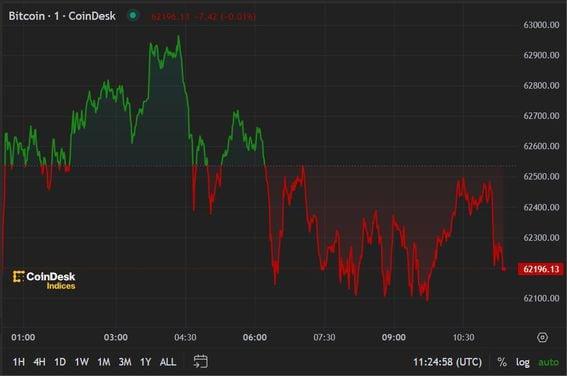
The latest price moves in crypto markets in context for May 8, 2024. Latest Prices Top Stories Bitcoin slid toward $62,000 during the Asian and European mornings on Wednesday as part of a broader dip across the crypto market in which tokens lost more of their gains from the rally at the end of last week. BTC is priced at around $62,200 at the time of writing, down nearly 2.9% in the last 24 hours. The CoinDesk 20 Index (CD20), which measures the performance of the whole digital asset market, has sunk around 3.65%. Solana is one of the worst affected of the leading altcoins, falling 6.5% to $146, while ether has declined by around 3.63% to trade around $3,000. Bankrupt cryptocurrency exchange FTX proposed a new reorganization plan that would see 98% of its creditors get back 118% of their claims in cash within 60 days of court approval. The proposed payouts are higher than earlier estimates from the FTX estate, which said in October it expected to pay back only 90% of customer funds. The estate said it expects to have between $14.5 billion and $16.3 billion in cash available from scraping together the company's assets and liquidating them. It also denied that the recovery in crypto prices since FTX's collapse in November 2022 is the driving force behind its pile of cash. Holders of liquid staking tokens on decentralized options platform Lyra Finance can now generate additional yield using automated versions of strategies like basis trade and covered calls. Lyra says holders of rswETH and eETH, the native liquid staking tokens of Swell Network and Ether.Fi respectively, could earn an annual percentage yield of 10%-50%. Liquid staking protocols like Swell and Ether.Fi allow users to deposit their tokens, which are then restaked in EigenLayer, thereby receiving liquid staking tokens that can be exchanged for ether. “We believe that tokenized derivatives yield is a game-changing primitive that will underpin the bootstrapping of networks and the expansion of sustainable crypto economic markets,” Nick Forster, co-founder of Lyra, said. Chart of the Day The chart shows bitcoin call-put skews, which measure demand for calls relative to puts. The seven-day (red) and 30-day (light blue) skews remain below zero, indicating persistent demand for put options, offering protection against price drops. It likely reflects concerns about the U.S. SEC not approving the spot ether ETF this month. Source: Amberdata - Omkar Godbole Trending Posts The Crypto Lawsuit State of Play BlackRock, Ondo, Superstate: The Biggest Movers in the RWA Sector in Q1 Former NFL Star Rob Gronkowski to Pay $1.9M to Settle Crypto Investor Suit https://www.coindesk.com/markets/2024/05/08/first-mover-americas-bitcoin-hovers-above-62k/
2024-05-08 11:08
BTC's volatility risk premium (VRP) has collapsed in a sign of a market trending towards stability, where future uncertainties are less of a concern. BTC's volatility risk premium (VRP) has collapsed since halving, a sign traders foresee relatively stable market conditions ahead. ETH's VRP remains elevated compared to bitcoin. A week ago, Arthur Hayes, the former CEO of the BitMEX crypto exchange, said bitcoin (BTC) had bottomed out, but the expected move higher is likely to be slow. Now, an indicator called the volatility risk premium (VRP) is suggesting the same, signaling a relatively low volatility market environment ahead, which could be seen as a positive development by long-term investors. VRP reflects the tendency of an underlying asset's option-induced implied volatility, a measure of expectations for price turbulence, to exceed realized volatility over time. The spread represents the premium options sellers demand for additional risks associated with future uncertainty and price volatility. The one-month VRP has collapsed to 2.5% from 15% since the Bitcoin blockchain implemented mining reward halving on April 20, according to data tracked by Bitfinex's analysts. The VRP calculation is based on the gap between Volmex's bitcoin 30-day implied volatility index (BVIV) and one-month realized volatility (VBRV). "The significant narrowing of the VRP indicates a realignment of market expectations to a more stable and predictable environment post-halving," analysts at Bitfinex said in a note shared with CoinDesk. "The market consensus seems to be that future volatility may be less than previously anticipated following the halving." In other words, uncertainty has ebbed and market participants foresee more predictable market conditions. On April 20, the Bitcoin blockchain cut per block supply emission to 3.125 BTC from 6.125 BTC in a quadrennial event that halved the pace of supply expansion. The consensus is that global debt concerns and massive fiscal spending by the U.S. will help bitcoin repeat its record of posting solid gains in the months after the halving. As of writing, the leading cryptocurrency by market value was changing hands at $62,400, largely unchanged since halving. Prices, however, have recently recovered from lows near $56,500. ETH outlook relatively uncertain While ether's (ETH) one-month VRP has declined to 8.5% from 18%, it remains elevated compared with bitcoin, a sign traders see ether's future as relatively uncertain. "A possible reason for Ethereum VRP to drop less, is that the SEC’s ETF decision on May 23, 2024 acts as an additional uncertainty for the ETH price. This also confirms that VRP captures the premium related to future uncertainty," Bitfinex's analysts said. The U.S. Securities and Exchange Commission is facing several applications for spot ether exchange-traded funds. https://www.coindesk.com/markets/2024/05/08/key-bitcoin-indicator-points-to-period-of-calm-in-crypto-market/

2024-05-08 02:49
The new reorganization plan must first be approved by a Delaware bankruptcy court. Bankrupt cryptocurrency exchange FTX has proposed a new reorganization plan that would see a whopping 98% of its creditors get back 118% of their claims – in cash – within 60 days of court approval, according to new documents filed Tuesday evening. Under the plan, other non-governmental creditors would get back 100% of their claims plus up to 9% interest to compensate them “for the time value of their investments.” The arrangement is still subject to approval by the Delaware bankruptcy court overseeing the bankruptcy case. The proposed payouts are higher than earlier estimates from the FTX estate, which said in October it expected to pay back only 90% of customer funds. In January, current FTX CEO John Jay Ray III revised that estimate, telling the court he expected to be able to pay customers back in full. Though the crypto market has rebounded since FTX’s collapse and subsequent bankruptcy – irking many of FTX’s customers, who have missed out on the opportunity to profit from the run-up in crypto prices while their funds are stuck in bankruptcy limbo – the estate denies that the market recovery is the driving force behind its massive pile of cash. In a Tuesday press release, the FTX estate said it expects to have between $14.5 and $16.3 billion in cash available for distribution by the time a plan is approved by a Delaware bankruptcy court – the result of a year-and-a-half of scraping together the company’s scattered assets around the world and liquidating them. “As previously disclosed, FTX.com had a massive shortfall at the time of the Chapter 11 filing in November 2022 – holding only 0.1% of the Bitcon and only 1.2% of the Ethereum customers believed it held,” the press release stated. “Accordingly, Debtors have not been able to benefit from the appreciation of these missing tokens during these Chapter 11 cases.” Other sources of value, including investments made by FTX and Alameda Research – such as its 8% stake in AI startup Anthropic, which was sold piecemeal to institutional investors for $884 million in March – have been liquidated to generate cash to pay back the claims. FTX's new reorganization plan would also settle a host of claims from regulators and government agencies, including the Internal Revenue Service (IRS) and U.S. Commodity Futures Trading Commission (CFTC). The IRS agreed to resolve its $24 billion in claims in return for a $200 million cash payment and a $685 million subordinated claim that will only be paid out after all creditors and other governmental entities. The CFTC and other unnamed governmental claimants agreed to subordinate their claims as long as FTX users and investors were paid in full with interest. There are also plans for a special fund created to make “supplemental restitution” to certain customers and creditors, though the details of this agreement have not been finalized, according to the press release. A hearing to discuss the proposed plan is scheduled for June. The specter of Sam Bankman-Fried Former FTX CEO and convicted fraudster Sam Bankman-Fried previously attempted to use the estate’s ability to pay back customers in full as evidence that the collapse of his exchange had “zero” harm to its customers. Before his sentencing in March, Bankman-Fried’s lawyers argued that their client should receive a light sentence, in part because customers would get all their money back. Ray, along with dozens of FTX creditors, wrote to the court arguing that the estate’s ability to claw together enough to money pay back his victims – the result of “tens of thousands of hours … spent digging through the rubble of Mr. Bankman-Fried’s sprawling criminal enterprise to unearth every possible dollar, token or other asset” – doesn’t mean his conduct wasn’t criminal. Bankman-Fried was sentenced to 25 years in prison. He plans to appeal his sentence and conviction. Edited by Daniel Kuhn. https://www.coindesk.com/policy/2024/05/08/nearly-all-ftx-creditors-will-get-118-of-their-funds-back-in-cash-estate-says-in-new-plan/
2024-05-08 01:00
The market maker will provide liquidity for OSL Digital Securities and Haskey HK Exchange, both of which are sub-custodians of platforms facilitating the operation of the bitcoin and ether ETFs in Hong Kong. Crypto trading firm Wintermute will provide liquidity for the Hong Kong-listed spot bitcoin and ether ETFs, the company announced. The London-based company said it wants to play a bigger part in the Asian market, hence the partnership. Looking to strengthen its market share in the Asia region, Wintermute will be a liquidity provider to the recently launched Hong Kong-listed spot bitcoin and ether exchange-traded funds, the company announced Wednesday. The London-based firm is partnering with OSL Digital Securities and HashKey HK Exchange, both of which are sub-custodians of virtual asset trading platforms facilitating the operation of the ETFs, according to the statement. “Crypto ETFs provide a means for investors at all levels to enter into the world of digital assets through a regulated and government-endorsed investment vehicle," said Wintermute CEO Evgeny Gaevoy. "[They] play a key role in bringing the next wave of investors into the crypto space, both institutional and retail … Increasing access to digital assets will play a critical function in further accelerating growth, and Wintermute is excited to play a key role in that process.” The market maker will help both OSL and HashKey with the buying, selling and delivery of the underlying assets of the ETFs, in this case bitcoin (BTC) and ether (ETH), to allow for a seamless creation and redemption process. The partnership is part of a broader expansion to the Asian market, the company said. “Hong Kong has established itself as a leading advocate for crypto in the APAC region, and we are hopeful that other countries will follow their lead in the near future,” Gaevoy said. The three Hong Kong-listed bitcoin ETFs, which went live on April 29, have so far seen a slow start compared to their counterparts in the U.S. As of the close on Monday they had accumulated just shy of 4,400 bitcoins or roughly $276 million in assets under management. https://www.coindesk.com/business/2024/05/08/crypto-trading-firm-wintermute-to-provide-liquidity-for-hong-kong-bitcoin-ether-etfs/

2024-05-07 17:59
The NBA's Victor Oladipo and racecar driver Landon Cassill also struck deals, and a group of Voyager investors said this was the "first tranche" of settlements with promoters of the former cryptocurrency lender. Former New England Patriots and Tampa Bay Buccaneers tight end Rob Gronkowski will pay $1.9 million to settle claims brought against him by former customers of Voyager Digital, a cryptocurrency lender. The settlement, which is still subject to approval by the court overseeing the civil lawsuit, will see the National Football League star known as "Gronk" pay into a $2.4 million pool alongside National Basketball Association player Victor Oladipo and racecar driver Landon Cassill, according to a court filing dated May 3. Gronkowski became a "brand ambassador, Voyager shareholder" and holder of Voyager's VGX token in September 2021, a company press release announced at the time. Voyager filed for bankruptcy in 2022. A group of Voyager investors sued Dallas Mavericks owner Mark Cuban and other Voyager promoters that same year, adding Gronkowski and other promoters last year. The investors announced they had reached a deal with Gronkowski in February. Last week's filing saw the Voyager investors announce that they were ready to proceed with "the first trance of proposed Class Settlements," which were made with Gronkowski, Oladipo and Cassill. "Plaintiffs have now settled with Voyager promoters Cassill, Gronkowski, and Oladipo for millions of dollars in relief to the class leaving Co-Defendants Mark Cuban and the Dallas Mavericks as the remaining Defendants for trial in November 2024," the filing said. According to an accompanying exhibit, Gronkowski will pay $1.9 million, Oladipo will pay $500,000 and Cassill will pay $25,000 to settle the claims. If the court approves the settlement, the claims against the three will be dismissed. Coincidentally, the investors filed the proposed settlement with the court just two days before former NFL quarterback Tom Brady – Gronkowski's former teammate – participated in a comedic roast, which saw several comedians and other stars comment on Brady's previous crypto endorsements, though without mentioning FTX, Sam Bankman-Fried's defunct exchange Brady promoted. Comedian Kevin Hart joked that the roast was taking place at the Kia Forum and not the Crypto.com Arena to avoid reminding people Brady owed them money, while fellow comedian Nikki Glaser took a more pointed approach. "Tom also lost $30 million in crypto. Tom, how did you fall for that? I mean, even Gronk was like, 'Me know that not real money,'" she said. https://www.coindesk.com/policy/2024/05/07/former-nfl-star-rob-gronkowski-to-pay-19m-to-settle-crypto-investor-suit/

2024-05-07 17:23
New legislation is on the way to target mixers as money-laundering tools, according to Rep. Sean Casten, who also highlighted Tether as the favorite token for illicit finance. A new bill from House Financial Services Committee Democrats is expected to target crypto mixing services this week. Legislation from the minority party is unlikely to move the needle in the waning months of the House's crypto negotiations, though its topic is at the center of discussions over illicit finance in the digital assets sector. Several Democrats on the House Financial Services Committee have a bill coming this week to target money laundering through cryptocurrency mixing services, said Rep. Sean Casten (D-Ill.), one of its backers. The legislation will "clamp down on mixers," Casten said of the bill during a hearing Tuesday on U.S. securities enforcement practices, adding that the effort will also be supported by Reps. Brad Sherman (D-Calif.), Emanuel Cleaver (D-Mo.) and Bill Foster (D-Ill.) "The presumption should be that these are money laundering channels," Casten said, unless sufficient audit work shows otherwise. "Let's go through and get that cleaned up and fixed." Such a bill would arrive as U.S. authorities continue to crack down on mixers, accusing the privacy services of being tools for illicit finance, including in the well-known Tornado Cash case and the more recent pursuit of the developers behind Samourai Wallet. A Democrat bill arriving in the Republican-majority House during this latter stage of the congressional session is unlikely to go anywhere, but it highlights one of the central points around illicit finance at the heart of lawmaker negotiations about future crypto policy. Read More: Distilling the Tornado Cash and Samourai Suits Casten also noted Tuesday his concerns about the offshore-issued stablecoin, Tether (USDT), and reports that it's backed "Russia's war machine" and been used for funding Hamas. Despite crypto lobbyists' ongoing insistence that digital assets policy is a bipartisan exercise, the hearing saw Democrats finding fault with the crypto industry while Republican lawmakers criticized the aggressive enforcement posture of the Securities and Exchange Commission (SEC) and its use of legal actions to try to steer industry behavior. Rep. Bill Huizenga (R-Mich.) was among Republicans who highlighted the recent scandal of SEC lawyers' abuses in the DEBT Box case, and he also noted that the agency is using it's so-called Wells notices – written alerts to a company warning of planned enforcement actions – "at an astonishing rate, especially when it comes to digital assets." Sherman, one of the backers of the pending mixer bill and a very vocal crypto critic, argued that the digital assets industry "has fought tooth and nail against any meaningful regulation." "Crypto is a garden of snakes," he said. "Recent SEC actions illustrate that." https://www.coindesk.com/policy/2024/05/07/crypto-mixers-targeted-in-us-house-democrats-effort-to-clamp-down-on-money-laundering/