2024-05-01 18:08
Hopes for a series of interest rate cuts in 2024 have all but vanished over the past few weeks as both the economy and inflation exhibit unanticipated strength. As expected, the Federal Open Market Committee of the U.S. Federal Reserve on Wednesday left its benchmark fed funds rate range unchanged at 5.25-5.50%. Also pretty much as expected, the FOMC acknowledged that progress on lower inflation has stalled this year and said it wouldn't be appropriate to trim rates until it has greater confidence inflation is moving "sustainably" towards 2%. The price of bitcoin (BTC) has bounced modestly in the minutes since the news hit, but remains under pressure, down more than 4% for the session at $58,000. In addition to the rate news, the FOMC announced it is slowing the reduction of Treasuries held on its balance sheet – the so-called quantitative tightening (QT) – from $60 billion per month to just $25 billion per month. Other things being equal, the move is likely to boost risk appetite and asset prices, wrote economist Joseph Brusuelas. Markets came into 2024 expecting a long series of rate cuts from the U.S. central bank, but those hopes have been whittled down sharply over the past few weeks as the economy continues to show strength and inflation has actually risen a bit in the year's first four months. According the CME FedWatch tool, markets (prior to today's Fed decision) were pricing in a nearly 25% chance of zero rate cuts this year. One month ago, there was just a 1% chance of no Fed easing in 2024. That change in expectations has weighed a bit on traditional markets, with the Nasdaq lower by about 5% since hitting its 2024 high about three weeks ago and the S&P 500 off by a similar amount since touching its year-to-date high in late March. It's also likely contributed to the plunging bitcoin price, which is now down more than 20% from its record high from mid-March above $73,000. A check of traditional markets shortly after the FOMC announcement, finds stocks remaining little-changed and the dollar and bond yields slightly lower. Gold is up 0.5% at $2,316 per ounce but remains about 4% down from its record high above $2,400 hit in mid-April. Further clues to the Fed's thinking will come shortly as Chairman Jerome Powell will hold his post-meeting press conference at 2:30 p.m ET. https://www.coindesk.com/business/2024/05/01/federal-reserve-holds-policy-steady-says-progress-on-inflation-has-stalled/

2024-05-01 17:32
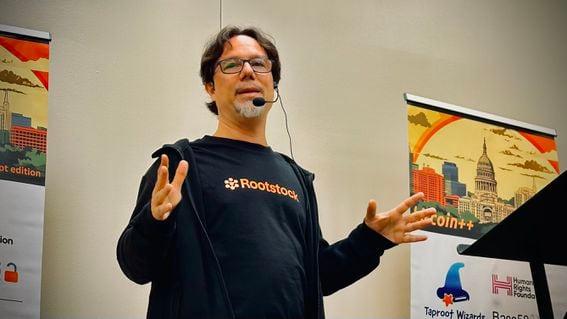
The new project would build off the much-discussed "BitVM" design released last year by developer Robin Linus, which has kindled hopes that the oldest and largest blockchain could eventually see Ethereum-style programmable layer-2 networks. Rootstock's new plan to bring programmability to Bitcoin could unfold over the next 12 months. The project could lead to the development of layer-2 networks atop Bitcoin without requiring any major changes to the blockchain's underlying code. Sergio Demian Lerner, an Argentine developer known for his early work on Satoshi Nakamoto's bitcoin stash, discussed the project Wednesday at the Bitcoin++ developer conference in Austin. AUSTIN, TEXAS — The founder of Bitcoin layer-2 protocol Rootstock has detailed plans for a new "BitVMX" project designed to improve the oldest blockchain's programmability by keying off developer Robin Linus's much-discussed "BitVM" design unveiled last year. Sergio Demian Lerner, a Buenos Aires-based programmer known for his early research on Bitcoin founder Satoshi Nakamoto's mining activities and later for contributing to the Ethereum blockchain's development, discussed the project onstage Wednesday at the Bitcoin++ conference in Austin, Texas. "We have a roadmap to finish this in one year" and "we are moving forward at full speed," Lerner said during the presentation. Linus's release of BitVM last year has been widely cited by Bitcoin developers as a breakthrough for the 15-year-old blockchain since it theoretically would facilitate the development of programmable layer-2 networks similar to those that are being used in the Ethereum blockchain ecosystem to make transactions cheaper and faster. Key to the project's promise is that BitVM would require no changes to the underlying Bitcoin code – seen as crucial due to the blockchain's decentralized governance, often lacking consensus among developers over major upgrades. Lerner had disclosed last month during an exclusive interview last week on CoinDesk's The Protocol podcast that he was working with colleagues on the new project without providing details. Last week, Rootstock Labs published a blog post on the effort, arguing that "theory and practice are two very different things," referring to Linus's original concept. "The BitVMX research team intends to build on this initial discovery with additional innovations to create an improved development framework for running programs on Bitcoin," according to the blog post. "The name is a nod to BitVMX’s origins while highlighting its focus on extending Bitcoin and accelerating the development of the next generation of sidechains and layer 2s." Rootstock Labs added that "a team of core contributors is working on a public roadmap of proposed improvements to the network in the next 12 months." According to an accompanying whitepaper, "BitVMX framework provides the foundations to run any CPU on Bitcoin, with a focus to run a fully-compliant RISC-V processor programmable using a standard compilation toolchain" – a technical description of the new system that boils down to facilitating a "myriad of use cases." https://www.coindesk.com/tech/2024/05/01/bitcoins-ethereum-style-programmability-could-come-in-12-months-rootstock-founder-says/
2024-05-01 14:37
The cryptocurrency is now trading below the average spot ETF purchase price of about $58K, and this could trigger liquidations, the bank said in a report. Bitcoin could target $50K-$52K on the downside, Standard Chartered said. The bank said bitcoin is now trading below the average spot ETF purchase price of $58K. Risk assets like crypto are feeling the pinch due to rising macro headwinds and falling liquidity. Bitcoin’s (BTC) breakdown through the $60K technical level opens the way for another move lower to the $50K-$52K range, investment bank Standard Chartered said in emailed comments on Wednesday. The driver of the move lower seems to be a combination of crypto specific factors and macro influences, the bank said. Bitcoin was trading 6% lower at around $57,200 at publication time. There have now been five consecutive days of outflows from U.S. spot bitcoin exchange-traded funds (ETFs), the bank noted, and BTC is currently trading below the average ETF purchase price of about $58K. “This means that more than half of the spot ETF positions are under water and so the risk of liquidation of some of them must be considered as well,” analyst Geoff Kendrick wrote. The bank notes that headlines around the Hong Kong spot ETF launch were also poor, as attention was focussed on the turnover volume of $11 million “rather than the net asset position of the new ETFs which was pretty good.” Risk assets such as cryptocurrencies, which thrive on liquidity, are also facing increasing macro headwinds, the bank said. It noted that broader liquidity measures in the U.S have deteriorated sharply since mid-April. The bank advises buying bitcoin if it reaches the $50K-$52K range or if U.S. CPI on the 15th, a measure of inflation, is “friendly.” Read more: Bitcoin ETF Slowdown Is a Short-Term Pause Not the Beginning of a Negative Trend: Bernstein https://www.coindesk.com/business/2024/05/01/bitcoin-could-drop-further-to-as-low-as-50k-standard-chartered-says/

2024-05-01 12:01
The race is on to build a dominant restaking protocol for Solana. Restaking, an already hot service on the Ethereum blockchain, is now entering the Solana ecosystem, bringing profit-making opportunities but also risks. Jito, a Solana-based project, is building a restaking service, four people familiar with the matter said. A CoinDesk investigation found half a dozen teams quietly building out Solana restaking. The crypto restaking craze is spreading from Ethereum (ETH) to Solana (SOL), opening up money-making opportunities for investors and luring big players like Jito (JTO) and a handful of newcomer teams. Ethereum and Solana are both proof-of-stake blockchains, meaning their networks are secured by a decentralized community of operators, often called validators, who pledge, or "stake," ETH or SOL, respectively, for a financial reward. Crypto's billion-dollar startup darling EigenLayer took this trust concept and literally leveraged it with restaking. Now, crypto investors could stake their idle ETH tokens to secure pretty much anything (and get some extra yield in the process). They did so with abandon: EigenLayer hoovered up $15 billion of ETH capital in less than a year. The same game is poised to emerge in the Solana ecosystem in the coming weeks and months. Solana infrastructure project Jito is building a restaking service, four people familiar with the matter told CoinDesk. The yet-to-be-announced program is set to compete against a growing stable of companies all trying to replicate EigenLayer's magic outside of the Ethereum ecosystem. "There's a lot of hype around it right now. It's kind of like a gold rush," said Jito Labs CEO Lucas Bruder, while declining to comment on his company's plans. Restaking on Solana is so nascent that major protocol developers and even insiders at the influential Solana Foundation said they have yet to delve into the companies trying to bring it to their realm. Nevertheless, a CoinDesk investigation found over half a dozen teams quietly building out Solana restaking. Some are hewing closely to EigenLayer's core design: a mechanism for many different crypto protocols to share the economic security of the blockchain's native token. Interviews with the teams building this infrastructure, investors evaluating it and startups who might utilize it showed how Ethereum's trickle-down tech is being reimagined for Solana. Nevertheless, doubters fear restaking brings little benefit to Solana and fret it could build a financial house of cards. Solana's restaking scene has no big kahuna just yet. Jito contends with two hush-hush companies raising capital from venture capital firms (Solayer Labs and Cambrian), one Cosmos-centric team whose system is already live (Picasso) and at least two hackathon teams (DePHY and Repl). They're all eager to catch the Solana restaking wave – if it comes at all. Restaking emerges Restaking is the latest answer to the security question at the heart of everything in crypto: how to use economic games to protect decentralized computing systems. Validators earn interest as a reward, and their stake acts like collateral: If a validator tries to lie to the blockchain, a portion of the stake gets revoked (or "slashed") by the network. What it all boils down to: The cost of attacking the system is roughly the amount of money staked in its defense. That's why Ethereum is considered so safe: there's over $100 billion worth of ETH staked. Solana, too, is well-regarded in part because of its mammoth $42 billion stake. Restaking promises to apply this economic game to pretty much anything, leveraging the big staking numbers on incumbent protocols to help secure upstart blockchain services. Rather than 100 projects being separately secured by, say, $1 billion each, via restaking they could all be protected by their collective $100 billion. While EigenLayer's restaking systems mostly benefit Ethereum scaling solutions – the so-called layer-2 blockchains built atop Ethereum and designed to augment its abilities – the restaking schemes being built for Solana are generally focused on applications. That's partly because Solana isn't seen as fragmented as Ethereum; it isn't dependent upon, and subservient to, a vast array of layer-2 blockchains. One builder, Nicholas Deng of hackathon contestant DePHY, which raised $2 million in January, said restaking could provide "better security for applications." Major venture capital firm Multicoin Capital – one of the most influential names in the Solana ecosystem with investments in many protocols, including the network itself – has its doubts. In an interview, Managing Partner Tushar Jain said he's yet to see the commercial problem that restaking solves. "Something that literally no developer has come to us and said is, 'You know why users aren't using my product? It's because there isn't enough economic security backing the consensus behind my protocol.'" Head of the pack Jito's plans for restaking remain cloudy. The company behind the massively popular client hasn't publicly committed to entering the restaking game. Bruder declined to comment on its plans beyond saying Jito is "thinking a lot about it." The revelation nonetheless puts Jito in a strong position for early dominance of the Solana restaking scene. Jito has a strong reputation among protocols and validators; over 73% of stake-weight, or the proportion of SOL tokens pledged to secure the Solana blockchain, run on validators that use Jito technology. Its distribution of JTO tokens in December kicked off the ongoing rush of Solana ecosystem airdrops. This made it a household name among airdrop farmers, a core contingency of stakers and restakers. Jito's still-unannounced vision for restaking includes SPL assets (the Solana equivalent of Ethereum's ERC-20 tokens), one DeFi team familiar with the plans said. "I believe in the economic security of Solana. But I also believe that governance tokens from protocols can be used for economic security, as well," Bruder said. Plenty of investors believe in Jito. Two venture capitalists who asked to remain anonymous said Jito "has the best shot out there" because its team is intimately familiar with Solana's architecture, and the Solana community with it. "There's a lot of skepticism within the community about non-Solana native teams pulling this off," one of the VCs said. Cambrian Cambrian founder Gennady Evstratov told CoinDesk his seven-person team is finalizing a $2.5 million fundraise. The valuation is around $25 million, three investors said. Cambrian seeks to be for Solana what EigenLayer is for Ethereum: a security layer that uses restaking to support all sorts of "middleware" that isn't happening on the main chain. Its pitch deck from February proposes use cases spanning off-chain computation and zero-knowledge proof processing. "I wouldn't deny that we are inspired heavily by the EigenLayer model, but we are more than that," including a computation layer, he said. He compared Cambrian to a "decentralized" Amazon Web Services. "It can be used to create lots of services out of the box to serve as a computational and security layer for different parts of the ecosystem." Within weeks, Cambrian will open up its testnet, he said. He's keeping a close eye on competitor Solayer Labs, whom he estimates is lagging behind Cambrian in its tech stack. Solayer Labs Whether that's the case is hard to tell. Like most of the teams interviewed for this article, Solayer Labs has not launched yet – let alone open-sourced its codebase. Three venture investors familiar with the matter said the Delaware-incorporated, months-old company was looking to raise $8 million at an $80 million valuation in a seed round. Polychain Capital is leading the fundraise with a $4 million check, one investor said. Solayer Labs' Rachel Chu would not share the final terms, but she told CoinDesk the startup is close to raising $10 million, with one check coming from Anatoly Yakovenko, one of Solana's founders and figureheads. (Yakovenko didn't respond to a request for comment.) His participation is a sign of embrace for a team that doesn't have deep Solana roots. Chu was previously a core developer at Ethereum-based decentralized exchange SushiSwap, while her business partner Jason Lee built Ethereum wallet service MPCvault. "Ultimately the problem we're trying to solve is scaling Solana," Chu said. An April 8 blog post outlined Solayer Labs' plans to build "a network of app-chains secured through Solana's economic security and execution" whose users will be able to customize their environment: "App builders at scale want more [transactions per second], less competition for blockspace, lower fees, and the aggregate economics that their business generates." "Solana has premium vertical stack features," she said in a Telegram message on April 29. "At the same time, we will see different strategies toward creative scaling solutions to efficiently distribute the workloads." Chu said Solayer's upcoming Shared Validator Network could include Actively Validated Services (AVS) that secure Solana infrastructure. "The initial AVSs we're excited about are MEV strategies, distributed computing and oracle networks," she said. A company blueprint calls for at least four experimental MEV-focused AVSs, including one that would auction "the right to extract MEV" and another that would police the MEV space. It also outlines a "decentralized GPU cluster" and an AVS that would task node operators with transaction sequencing, among other proposals. Picasso Picasso started building a restaking mechanism half a year ago and opened Solana's only functioning product earlier this month. Executive Director Henry Love claimed Picasso is "probably at least 12 to 18 months ahead" of Cambrian and Solayer Labs. Picasso's road to restaking came a little backward. Instead of setting out to build a generalized platform through which anyone could secure anything, it first sought a way to secure its own piece of tech: a bridge connecting Solana with the Cosmos (ATOM) family of blockchains. EigenLayer told Picasso it was keeping its system limited to Ethereum, according to Love, so the company started building its own restaking hub and AVS. Restakers had deposited $8 million worth of SOL and a handful of liquid staking tokens by press time. His plan is to open Picasso's staking hub to other teams and builders that want to secure their crypto contraptions on Solana, Love said. Points, points, points Staking aside, crypto's most prominent economic game is its players' eternal search for gains. Traders are unyielding in their hunt for high-returning capital routes through which to jam their tokens. Airdrop hunters in the EigenLayer ecosystem believe the points they're accruing through restaking will one day grant them tokens – another source of yield. This paradigm is set to play out again on Solana. "The winner is decided not by anything but yield," Love said of the coming battle between Solana's restaking protocols. His team at Picasso is running a gamified rewards program through its Mantis interface that increases yields for winners. Cambrian plans to run a points program and release a token after its restaking network launches late in the second quarter or early in the third quarter, Evstratov said. Solayer Labs has its own multistage points program in the works. As described in its documentation, early birds will get a staggering leg up on latecomers. Depositors in Solayer's first phase (whitelisted for "our earliest supporters") will have two weeks to deposit as much as they wish for three times as many points as in later rounds. Those later rounds will have caps on total value locked, or TVL, and smaller points multipliers. Jito doesn't stand to inspire the same airdrop hunter calculus as the others. It already airdropped its JTO token last year. "When that party's over – when inflationary emissions and tokens are given out as points or whatever – you need to look for places that have real revenue and real value-add. And the piece of that going back to the restakers will determine which platform is going to get the most restakers," Love said. Restaking skepticism But deep skepticism remains across the Solana ecosystem. Ethereum's reliance on layer-2 networks to function and its hulking base of staked assets make restaking especially useful there, said Ryan Connor of Blockworks Research. He thinks of Ethereum as a "modular" blockchain; it performs one task while outsourcing other things to layer 2s – the kind of thing that makes it ripe for restaking, since a shared pool of assets might be the only way to secure such a sprawling expanse of interconnected infrastructure projects. Solana, meanwhile, is an "integrated" blockchain that tries to do everything in one place. "It isn't to say there is *no* need on Solana, just far less of a need than Ethereum and other modular systems" that could use restaking, he said in a Telegram message. Fearful naysayers fret that restaking is crypto's latest ticking time bomb – a rehypothecation of trust that will inevitably collapse. They point to the specter of contagion risk: the idea that if an operator is slashed by an AVS, the impact could ripple across the entire staking ecosystem, depleting the value of the entire restaking pool and cutting down the security of every other AVS as a result. There's added risk from "liquid restaking" services – intermediaries that take deposits from users, restake them into EigenLayer and equivalent platforms and offer receipts, called "liquid restaking tokens" (LRTs), that can be traded in decentralized finance to earn even larger yields. With the rise of LRTs comes an even larger fear of a mass catastrophe: If protocols start leveraging people's trust by allowing them to stake SOL, its liquid staking tokens and also liquid restaking tokens, then the surface area for a rehypothecation crisis grows. One slashed AVS or depegged asset could topple many. One prolific angel investor in Solana projects told CoinDesk he had not yet invested in any restaking teams. When asked why, he responded cheekily: "Just debating when restaking blows up crypto." CORRECTION (May 2, 00:12 UTC): An earlier version of this article misidentified the lead investor in Solayer's seed round. Hack VC was in the running, but Polychain's check ultimately claimed the crown, people familiar with the situation said. https://www.coindesk.com/business/2024/05/01/restaking-gold-rush-spreads-to-solana-from-ethereum-with-jito-and-others-joining-in/

2024-05-01 10:49
Between 2022 and 2023, crypto alongside retail banking, wholesale banking and wealth management posed the greatest risk of being exploited for money laundering, a report by the U.K. Treasury department showed. Crypto firms were amongst the sectors that posed the greatest money laundering risk, according to a U.K. government report. The country has been trying to tackle crypto crime lately, and the police have stationed crypto tactical advisors across the country. Crypto firms, alongside retail banking, wholesale banking and wealth management, posed the greatest risk of being exploited for money laundering between 2022 and 2023, a report by the government’s financial arm said on Wednesday. The conclusion from the report came from the Financial Conduct Authority risk assessments on 238 firms. The FCA is a financial regulator in the U.K., and it has been ensuring crypto firms register with it and comply with its money laundering rules since 2020. The country has been trying to clamp down on crypto-related crime recently. The U.K. police said it had crypto tactical advisors stationed across the country to help seize digital assets attached to crime in October 2022. At the time, the National Police Chiefs’ Council said they had managed to seize hundreds of millions worth of crypto from crimes. Data from the newly released report showed that between 2022 and 2023, there were the equivalent of 52.8 full-time financial crime specialist employees that were dedicated to anti-money laundering supervision at the FCA and 15.8 of those focused on supervising crypto businesses. Meanwhile, wider supervisory teams outside the dedicated financial crime specialist teams opened 95 cases in relation to crypto-assets between the reports recording period. https://www.coindesk.com/policy/2024/05/01/crypto-was-one-of-the-biggest-money-laundering-risks-in-2022-2023-uk-gov-report/

2024-05-01 08:22
BTC is down about 6.3% in the last 24 hours having dropped below the $60,000 support level late on Tuesday. Bitcoin fell in line with the wider crypto market, with ether and other altcoins also declining. Financial markets have been dogged by risk-off sentiment in the run-up to the Fed's interest-rate decision and press conference later today. 10x Research said it's eyeing a price target of $52,000-$55,000 as it predicts further selling pressure. Bitcoin (BTC) traded around $57,700 during the European morning on Wednesday after sinking to the lowest level since the end of February as the world's largest cryptocurrency recorded its worst month since November 2022. BTC has fallen about 6.3% in the past 24 hours having dropped below the $60,000 support level late on Tuesday, CoinDesk data show. The wider crypto market, as measured by the CoinDesk 20 Index (CD20), lost almost 9% before recovering some of the decline. Cryptocurrencies have been dogged by risk-off sentiment in the broader financial markets amid a stagflationary feel in the U.S. following indications of slower growth and sticky inflation that have tapered hopes of an interest-rate cut by the Federal Reserve. The Federal Open Market Committee is due to give its latest rate decision later today. Ether (ETH) slipped about 5%, dropping below $3,000, while dogecoin (DOGE) led declines among other major altcoins with an 9% slide. Solana (SOL) and avalanche (AVAX) both lost about 6%. Bitcoin fell in April, returning its first monthly loss since August. The 16% drop was the worst since November 2022, when crypto exchange FTX imploded, but some analysts are warning of further downside in the immediate future. Digital asset research firm10x Research said it sees selling pressure toward the $52,000 level based on outflows from the U.S. spot exchange-traded funds, which have totaled $540 million since the Bitcoin halving on April 20. It estimates that the average entry price of U.S. bitcoin ETF holders is $57,300, which could therefore prove to be a key support level. The closer the spot price of bitcoin is to this average entry price, the greater the likelihood of further ETF unwinding, 10x CEO Markus Thielen wrote on Wednesday. "There might have been a lot of 'TradeFi' tourists in crypto – pushing longs until the halving – this time is now over," he wrote. "We expect more unwinding as the average Bitcoin ETF buyer will be underwater when Bitcoin trades below $57,300. This will likely lower prices to our target levels and cause a -25% to -29% correction from the $73,000 top – hence our price target of $52,000/$55,000 during the last three weeks." https://www.coindesk.com/markets/2024/05/01/bitcoin-sinks-below-58k-crypto-market-drops-9-in-run-up-to-fed-decision/