2024-04-30 22:25
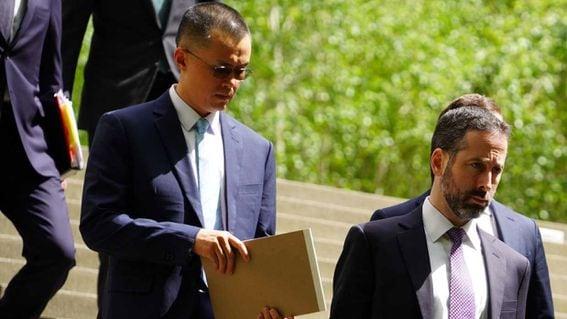
Judge Richard Jones said he spent the weekend poring over the voluminous letters of support for the ex-CEO of Binance until the book they were contained in literally fell apart. Ex-Binance CEO Changpeng Zhao may be off to federal prison for financial crimes that led the cryptocurrency exchange he founded to agree to pay a $4.3 billion fine. But his reputation, at least in a Seattle courtroom on Tuesday, was never better. The judge, CZ's defense lawyers and even prosecutors acknowledged during the 2 1/2 hour sentencing hearing that this 47-year-old billionaire was not your run-of-the-mill criminal defendant. Instead, he was a philanthropist, a do-gooder, a first-time lawbreaker and family man who turned himself in to accept whatever may come. This unexpected resuscitation of the crypto kingpin's reputation factored into his fate: a tremendously light sentence of four months, far less than the three years prosecutors sought to punish – in their telling – this historically egregious violation of the Bank Secrecy Act (BSA). U.S. Judge Richard Jones, 74, had none of it. "To be honest with you, sir, everything I see about your history and characteristics are of a mitigating nature," he said to Zhao near the start of his sentencing. He recalled going through a book of glowing sentencing letters that CZ's friends and family had submitted. Not everything worked out for CZ in court. He's still due to spend four months in prison for failing to implement effective money-laundering controls as CEO of Binance, the world's largest crypto exchange. A source at the U.S. Department of Justice said he's the first CEO to go to prison under the BSA. If the court proceedings were the model of the man, though, CZ will enter prison rejuvenated. "Lots of really good people do bad things and violate the law," prosecutor Kevin Mosley told Judge Jones when asked if his team's sentencing recommendation factored in CZ's prolific global philanthropy efforts. CZ's lawyers later called out Mosley's unconvincing insistence that it had. Judge Jones said he spent the weekend poring over the voluminous letters of support for CZ from friends and family until the book they were contained in literally fell apart. "I don't think I've ever seen a volume of letters" consistent in their characterization of a passionate if flawed defendant, the judge said. CZ leaned forward in his seat throughout Judge Jones' sentencing remarks. He nodded every time the judge pointed out the former CEO's instances of wrongdoing. His body language telegraphed he anticipated the light sentence he got; it was almost like CZ knew what was coming when he flashed those four fingers months ago. "You risked your entire net worth to make Binance a success," Judge Jones said at one point. Naturally, the most sterling representations came from CZ's own legal team. They reminded the judge repeatedly that Zhao had been living in the United Arab Emirates, a country with no extradition treaty with the U.S. His massive fortune could have funded a lifestyle on the run, they said. But he cracked a deal with prosecutors instead. That, the support letters, his "extraordinary" cooperation with the government and a whistle-clean past ("No criminal history, no fraud, no other crimes," as defense lawyer William Burke put it) led Judge Jones to impose a light sentence, he said. Still, CZ's hubris worked against him. "The mere fact that you can place your name next to the largest crypto operation on the planet does not give you discretion to pick and choose which regulations to follow," Jones said, adding that wealth and power did not free CZ from following the law. The whole thing makes CZ's coming prison sentence likely to be more of a blip in his story than the end of his line. As the billionaire himself pointed out, he's spent the past few months working on a global online education initiative for children. He seems likely to return to that work on the other side. That could come perhaps even within the year. https://www.coindesk.com/business/2024/04/30/how-czs-good-guy-reputation-secured-4-month-prison-sentence/
2024-04-30 21:17
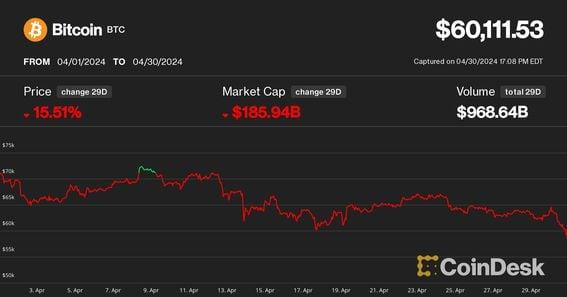
Recent U.S. economic data could prompt more hawkish forward guidance from the Federal Reserve. Bitcoin has lost over 16% in April, on track for its worst month since November 2022. BTC could drop to the mid-to-low $50,000 region, Ledn CIO said. The Hong Kong spot crypto ETF debut wasn't as poor as it was made out to be, a Bloomberg Intelligence ETF analyst noted. It might be time to call the cryptocurrency correction a bear market, as bitcoin (BTC) tumbled below $60,000 with what appeared to be a poor debut of spot ETFs in Hong Kong and interest rate fears giving traders plenty of reason to sell on Tuesday. BTC hit a $59,100 low in the afternoon hours, its weakest price since late February and down over 5% over the past 24 hours. The broad-market CoinDesk 20 Index (CD20) declined even more during the same period, falling 6% as ether (ETH), solana (SOL) nursed 7%-8% losses. Bitcoin now lower by roughly 20% from its all-time high above $73,000 hit in mid-March. Traditional markets struggled as well after a spate of U.S. economic reports Tuesday morning had a stagflationary feel, showing slowing growth and speedier price pressures. The Nasdaq shed 2% for the day, while the S&P 500 fell 1.6%. Recent reports showing stronger U.S. economic data and hotter inflation significantly tapered U.S. Federal Reserve interest rate cut expectations and that's weighing on the digital asset market, Joel Kruger, market strategist at LMAX Group, pointed out in a Tuesday report. "We continue to see evidence of the Fed needing to be leaning back to a higher for longer policy outlook, despite investor calls for more accommodation," Kruger said. "With the U.S. dollar coming back into favor across the board, we are seeing this filter over into crypto assets as well." Worst month since FTX With Tuesday's decline, BTC and the broader crypto market are on track to snap their seven-month winning streak with their worst monthly decline since November 2022, when crypto exchange FTX imploded. With a few hours left from the last day of the month (UTC time), bitcoin is down over 16% through April, and ether is lower by 18%.. Smaller cryptocurrencies suffered an even deeper correction, with altcoin darlings SOL, dogecoin (DOGE), avalanche (AVAX) lower by 35%-40% this month. Overall, the total crypto market capitalization shed nearly 18% of its value, recording its biggest decline since June 2022, TradingView data shows. Bitcoin's decline might not be over "I’m expecting a sell-off to the mid-to-low $50,000 region [for BTC], which should prove to be a buying opportunity," said John Glover, chief investment officer of crypto lending firm Ledn. Seasonal effects with lower interest during the summer months also point towards lower prices, K33 Research noted. "A trader opting for a strategy of buying BTC on the May open and closing the trade on the September close would’ve seen a cumulative return of -29% in the past five years," K33 analyst Vetle Lunde said. "Whereas a trader buying the October open and selling during the April close would’ve experienced a massive 1,449% return." The (not so) tepid Hong Kong ETF debut The first day of Hong Kong-listed spot bitcoin and ether ETFs failed to wow market participants focusing on the products tepid, just over $10 million trading volume. The debut, however, was more successful than at first impression considering that the Hong Kong ETF market is only a fraction of the U.S. market size, Bloomberg Intelligence senior ETF Eric Balchunas analyst pointed out. "If you localize numbers, this was big," Balchunas said. ChinaAMC's bitcoin product alone gathered over $123 million of assets in its first trading session, making it the sixth best ETF launch over the past three years and is already among the top 20% largest ETFs, he cited Bloomberg data. Balchunas also added that the Hong Kong-listed ETFs arrived at a "good time" and could help offset the outflows from U.S. products that have slowed down recently. https://www.coindesk.com/markets/2024/04/30/bitcoin-tumbles-below-60k-risking-deeper-pullback-as-crypto-markets-endure-worst-month-since-ftx-crash/
2024-04-30 19:49
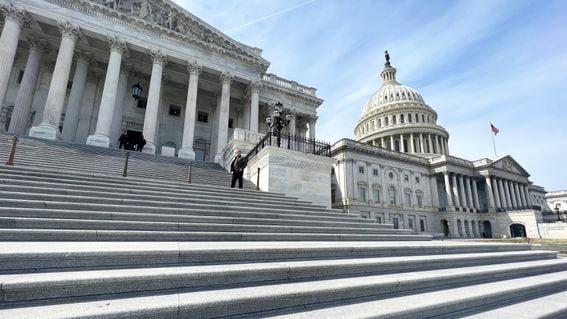
A flash of hope that an FAA bill could carry U.S. stablecoin rules across the finish line has been momentarily dashed as congressional leaders were said to ward off amendments. A Democratic aide familiar with the negotiation said House and Senate leaders are insisting on a clean FAA reauthorization that wouldn't allow the attachment of a stablecoin bill. The effort has drawn key support and may be tried again as the congressional session wanes. Advocates for long-awaited U.S. stablecoin legislation tried to tie it onto an unrelated must-move reauthorization bill, but leaders in the Senate and House of Representatives are seeking to keep that effort clear of such attachments, according to a Democratic aide. U.S. lawmakers had been engaged this week in serious conversations about whether to jam a stablecoin regulation amendment onto the Federal Aviation Administration reauthorization legislation, which is approaching a deadline. Such efforts to use that bill for other business were rebuffed by leaders favoring a so-called clean bill, so the leading stablecoin negotiation between House Financial Services Committee Chair Patrick McHenry (R-N.C.) and its top Democrat, Rep. Maxine Waters (D-Calif.), will return to talks on a final deal, said the aide, who requested anonymity because the negotiations aren't public. Still, the serious maneuvering on behalf of stablecoin oversight reveals how much closer that vital corner of the industry is getting to daylight. For the first time, the necessary senators engaged in the negotiations. Senate Banking Committee Chairman Sherrod Brown (D-Ohio) has said he's open to pairing stablecoin regulation with his push for a bill opening access to the financial system for cannabis businesses. And Senate Majority Leader Chuck Schumer (D-N.Y.) seemed to be on board for that, though Minority Leader Mitch McConnell (R-Ky. ) continues to signal he opposes marijuana banking. The energy devoted this time could suggest that stablecoins may come up again when other must-pass bills move through Congress – and it may now be intertwined with the high-profile marijuana legislation. "We believe this push will reveal how much support both have in Congress and who remains opposed," said Jaret Seiberg, an analyst with TD Cowen, in a research note. "It is why we see this effort offering insight into what could happen with these bills later this year when we expect the real push for enactment." The vehicle that carries the stablecoin (and possibly marijuana) legislation doesn't have to make sense. As the industry learned previously, an infrastructure bill carried the most important move against crypto to date. A final compromise version of the stablecoin bill that pleases both parties and both chambers hasn't yet emerged, so industry insiders are hesitant about cheering it on until they can get a good look. "As with all legislation, the devil is in the details," said Kristin Smith, CEO of the Blockchain Association, in an interview with CoinDesk. "We look forward to seeing and providing feedback on any new drafts of compromises that emerge." At this stage, multiple lawmakers could have major incentives to make a stablecoin bill happen. "Brown has an incentive to get SAFER Banking [the marijuana banking bill] over the finish line this year, which would give him a win on a subject popular with voters, cannabis reform, months before a tough re-election fight," according to a Tuesday analysis from Beacon Policy Advisors, a firm that tracks financial policy in Washington. Beacon also noted that this is "a legacy-defining issue for McHenry, who is retiring from Congress at the end of his term." Read More: U.S. Senators Lummis, Gillibrand Take on Stablecoin Legislation With New Bill https://www.coindesk.com/policy/2024/04/30/stablecoin-bill-unlikely-to-get-pinned-to-faa-reauthorization-putting-effort-on-hold-again/
2024-04-30 18:52
The man sometimes called "Bitcoin Jesus" did not pay capital gains on hundreds of millions of dollars he raised in selling bitcoin in 2017, the DOJ alleged. Roger Ver, now a bitcoin cash (BCH) advocate, but an early bitcoin (BTC) investor, was indicted for tax fraud on Tuesday, a press release from the U.S. Department of Justice said. The release said Ver was arrested over the weekend in Spain and his extradition back to the U.S. will be sought. Known as "Bitcoin Jesus," Ver is accused of failing to file tax returns from the sale of assets or paying an "exit tax" on capital gains after he gave up U.S. citizenship and set up businesses and secured citizenship in St. Kitts and Nevis. Ver sold "tens of thousands" of bitcoins in November 2017, taking in $240 million in cash, the DOJ alleged. "Even though Ver was not then a U.S. citizen, he was still legally required to report to the IRS and pay tax on certain distributions such as dividends from MemoryDealers and Agilestar, which were U.S. corporations," said the DOJ. "Ver allegedly concealed from his accountant that he had received and sold MemoryDealers’ and Agilestar’s bitcoins that year," the government continued. "As a result, Ver’s 2017 individual income tax return did not report any gain or pay any tax related to the distribution of MemoryDealers’ and Agilestar’s bitcoins to him." Ver has previously pleaded guilty and served time for selling explosives on eBay. A cryptic message was Ver's most-recent post on X, reading: "Don't expect bad people to do good things." https://www.coindesk.com/policy/2024/04/30/roger-ver-indicted-for-tax-fraud/

2024-04-30 15:32
Rodrigo Seira has rejoined Cooley LLP, the law firm where he worked previously, according to his LinkedIn profile. Rodrigo Seira, special counsel at Paradigm, has departed the cryptocurrency-focused venture capital firm to rejoin Cooley LLP. Seira was also a founding member of DLX Law, a blockchain and crypto-focused boutique. Rodrigo Seira, special counsel at Paradigm, has departed the cryptocurrency-focused venture capital firm, according to his LinkedIn profile and a person familiar with the situation, to rejoin Cooley LLP, the law firm where he worked previously. Prior to joining Paradigm, Harvard Law School graduate Seira was outside counsel to crypto investors and entrepreneurs at Cooley. Seira was also a founding member of DLX Law, a blockchain and crypto-focused boutique. During his 2 1/2 years at Paradigm, Seira helped create the firm's Policy Lab to advance crypto innovation and lawmaking in the U.S. Paradigm’s Policy Lab aimed to bring together academics, policy experts, lawyers and technologists to do research on policy issues facing crypto, according to a blog post by the firm. Last month, Paradigm was reportedly looking to raise between $750 and $850 million for a new fund. Paradigm did not immediately respond to requests for comment. https://www.coindesk.com/business/2024/04/30/paradigm-special-counsel-has-left-the-crypto-focused-vc-firm/

2024-04-30 14:45
BlackRock's first tokenized offering, created with Securitize, has captured almost 30% of the $1.3 billion tokenized Treasury market in just six weeks. BlackRock's BUIDL fund grew $70 million last week to take the top spot from Franklin Templeton's BENJI offering, which saw minor outflows, blockchain data shows. Growth of Ondo Finance's OUSG token was responsible for large part of the inflows. Asset management company BlackRock's (BLK) tokenized asset fund BUIDL became the largest of its kind Tuesday, overtaking rival Franklin Templeton's similar offering just six weeks after its debut. The BlackRock USD Institutional Digital Liquidity Fund, represented by the BUIDL token on the Ethereum (ETH) network and backed by U.S. Treasury bills, repo agreements and cash, now boasts $375 million of deposits after enjoying $70 million of inflows last week, blockchain data by rwa.xyz shows. The fund, created with tokenization services platform Securitize, has captured almost 30% market share since its debut on March 21. Meanwhile, the Franklin OnChain U.S. Government Money Fund with the BENJI token slid to $368 million in assets under management after experiencing minor outflows during the same period. The change in guard was largely thanks to the growth of Ondo Finance (ONDO), whose tokenized Treasury offering OUSG leverages BlackRock's token as reserve asset and enjoyed $50 million of inflows in a week. The rapid growth of BlackRock's first tokenized offering, occurred as putting conventional assets like bonds and credit onto blockchain rails in forms of tokens – also known as tokenization of real-world assets (RWA) – has captivated digital asset firms and traditional finance (TradFi) giants alike. Tokenization could offer benefits like faster, around-the-clock settlements, increased operational efficiency and greater transparency. U.S. Treasuries among RWAs have emerged as a gateway for tokenization efforts as a low-risk, well-known instrument where investors can park their on-chain cash and earn stable yield without leaving the blockchain ecosystem. The tokenized Treasury market swelled to near $1.3 billion from near $100 million in early 2023, propelled by in part of BlackRock entrance to the competition. https://www.coindesk.com/markets/2024/04/30/blackrocks-buidl-becomes-largest-tokenized-treasury-fund-hitting-375m-toppling-franklin-templetons/