2024-04-30 06:52
The $2.8 billion coal giant said that it is mining bitcoin with the excess power it generates. Alliance Resources says it has mined 425 BTC with excess power at its facility The company is the latest publicly listed entity to have bitcoin on its balance sheet NASDAQ-listed coal miner Alliance Resource Partners (ARLP) said in an earnings call that it has mined $30 million in bitcoin (BTC) using excess power at its facilities. “In the second half of 2020, we started mining bitcoin as a pilot project to monetize the already paid-for yet underutilized electricity load at our River View mine,” Cary Marshall, the firm’s chief financial officer, said during an earnings call. Marshall said that at the end of the quarter, the company had 425 bitcoins on its balance sheet – which it is valuing at $30 million – and after factoring in the net costs of property, plant, and equipment, it was up $7.3 million. ARLP was up 5% after the earnings, which also saw the company beat revenue estimates. Marshall said that the company isn’t “buying bitcoin or anything of that nature” and is only mining bitcoin with the equipment it has. “We do have some extra capacity that we’re renting out to other bitcoin miners within the data center that we’ve effectively built for this bitcoin mining to take advantage of the low energy costs we have,” he continued. In the grand scheme of things, ARLP’s bitcoin on the balance sheet holdings are relatively small. Data compiled by BitcoinTreasuries.net shows that MicroStrategy has the largest holdings at $13.5 billion. Other notable entries on the list include Tesla, which has $615 million. Bitcoin is currently trading above $63,000, up 1.3%, according to CoinDesk Indices data. https://www.coindesk.com/markets/2024/04/30/coal-miner-alliance-resource-dabbles-in-crypto-mining-mines-425-btc/

2024-04-29 20:48
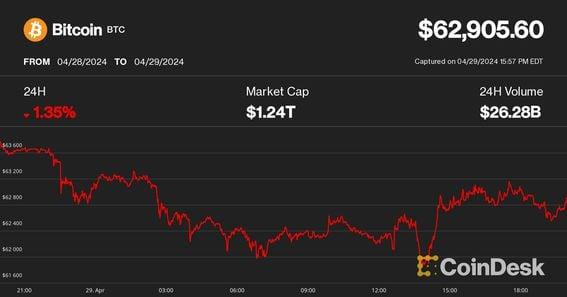
Despite muted anticipation for the new products, an executive of one of the issuers reportedly expects that the first-day issuance of the Hong Kong offerings will exceed the U.S. debut in January. Cryptocurrencies gave up their weekend gains, with the broad-market CoinDesk Market Index declining 3% over the past 24 hours. The first batch of Hong Kong-listed spot bitcoin and ether ETFs will start trading on Tuesday morning. ChinaAMC's head of digital asset management said the offerings will be beneficial for crypto prices improving liquidity and expand participation. Crypto markets were lower across the board, with bitcoin (BTC) wavering near $63,000 as the upcoming Hong Kong crypto spot exchange-traded fund (ETF) debut has failed to spark excitement among investors. BTC drifted lower during the day from $64,000 over the weekend, slipping briefly to $61,800 before recovering to just near $63,000 at U.S. afternoon hours. The largest crypto by market value was recently changing hands at $63,000 down about 1% in the past 24 hours, holding up better than the broad-market CoinDesk Market Index (CD20), which lost 3% over the same period. Most altcoin majors also gave up their weekend gains, with ether (ETH), solana (SOL), dogecoin (DOGE) declining 4%-6%. Crypto markets have been drifting sideways for the last few weeks in lack of a strong investment narrative to drive prices, cooling from last month's record-breaking BTC price action and altcoin and memecoin frenzy. CoinDesk's Bitcoin and Ether Trend Indicators both remain in neutral reading, indicating a market without a clear direction. Even though spot-based bitcoin and ether ETFs in Hong Kong will start trading on Tuesday morning local time, the incoming debut didn't spark a similar level of anticipation ahead of the event as to the fever pitch that preceded the U.S. spot bitcoin ETFs. Notably, BTC nearly doubled in price during three months leading up to the January 11 debut, and significant inflows helped propel BTC over $73,000 in March. Defying the muted anticipation, an executive of ChinaAMC – one of the three issuers of the new Hong Kong-listed spot ETFs – reportedly said during a press briefing that the first-day issuance of shares may surpass the U.S. debut's $125 million, referring to the new products' seed funding. "I am very confident that the initial listing scale of Hong Kong’s virtual asset spot ETF can exceed the issuance scale on the first day of the United States," said Zhu Haokang, head of digital asset management and family wealth. Wayne Huang, head of ETF and custody at crypto exchange OSL, said that the exchange had completed the first day of raising funds for two of the new offerings, and confirmed Haokang's forecast. "Judging from the numbers, the transactions are indeed far greater than the capital inflow of the U.S. bitcoin spot ETF on its first day of trading," Huang said. Haokang also said that the ETFs will be beneficial for crypto prices as the offerings feed more liquidity to digital asset markets, broaden funding channels and participation. https://www.coindesk.com/markets/2024/04/29/bitcoin-wavers-around-63k-awaiting-hong-kong-spot-crypto-etf-debut/
2024-04-29 20:33
To this point, the company has not adopted fair value accounting for its bitcoin stack, resulting in the first quarter write-down despite a major rally in prices. MicroStrategy (MSTR) reported a net operating loss of $53.1 million, or $3.09 per share, in the first quarter after taking a digital asset impairment charge of $191.6 million, according to a Monday afternoon press release. While some had expected the company might adopt the new digital asset fair value accounting standard, and thus report a sizable profit thanks to bitcoin's (BTC) first quarter rally, the company elected not to do so. By the old standard, MicroStrategy at quarter's end valued its bitcoin holdings at a price of $23,680 each, or $5.1 billion, rather than March's closing price of $71,028, or $15.2 billion. The company also announced a small April addition of 122 tokens to its bitcoin stack, bringing total holdings to 214,400. That would be valued at $13.5 billion at bitcoin's current price of about $63,000. For all of 2024 so far, MSTR has acquired 25,250 bitcoins for $1.65 billion, or an average price of $65,232 each. Shares are lower by 3.3% in after hours trading. Speaking on the earnings call, CFO Andrew Kang said the company fully plans to adopt the new digital asset fair value accounting rule and is currently evaluating the best time to do so. The Financial Financial Accounting Standards Board (FASB) has mandated that the new rule be implemented by Jan. 1, 2025, but early adoption is allowed. Update (April 29, 22:31 UTC): Added comments from the CFO. https://www.coindesk.com/business/2024/04/29/microstrategy-q1-operating-loss-of-531m-after-bitcoin-holdings-impairment-charge-of-1916m/
2024-04-29 20:05
Rodriguez, 35, will remain on house arrest in Pennsylvania until his trial. NEW YORK — Samourai Wallet co-founder Keonne Rodriguez pleaded not guilty to two criminal charges tied to creating and marketing the privacy-focused bitcoin wallet application and mixing service in a Manhattan courtroom on Monday. Rodriguez, 35, and his Samourai Wallet co-founder William Lonergan Hill, 65, were arrested last week – Rodriguez in Pennsylvania and Hill in Portugal – and charged with one count each of conspiracy to commit money laundering and conspiracy to operate an unlicensed money transmitting business. The charges carry a maximum sentence of 20 years and five years, respectively. Prosecutors have alleged that, between 2015 and the seizure of Samourai Wallet’s servers last week, the app “facilitated more than $100 million in money laundering transactions from illegal dark web markets,” and around $2 billion total in “unlawful transactions.” The arrests and shutdown of Samourai Wallet come as the U.S. government prepares for its case against Tornado Cash developer Roman Storm, and have led to an outcry among many in the crypto industry, who believe the case is a sign the government is attempting to criminalize financial privacy. In the Department of Justice’s (DOJ) press release announcing the pair’s arrest last week, prosecutors said that Rodriguez and Hill “encouraged and openly invited users to launder criminal proceeds” and considered “restricted markets” to be a target demographic. Rodriguez was initially arrested around 6 a.m. at his home in Harmony, Penn. on April 24. He was subsequently released by a Pennsylvania judge on a $25,000 bond and ordered to present himself before a magistrate judge in the Southern District of New York (SDNY) on Monday morning. Magistrate Judge Barbara Moses ruled to release Rodriguez on a $1 million bond on Monday, accepting the conditions set in a bail package that both federal prosecutors and Rodriguez’s lawyers – Sean Buckley and Michael Keilty of international law firm Kobre Kim – had agreed to. Rodriguez’s bond will be secured by real estate in Pennsylvania and the signature of his wife and another family member. Other than traveling to and from court proceedings, Rodriguez will remain at home and will be monitored by location tracking technology. Rodriguez’s next hearing will be in Manhattan on May 14 at 2 p.m. in front of District Judge Richard Berman. Berman oversaw Mango Markets exploiter Avraham Eisenberg’s trial earlier this year. https://www.coindesk.com/policy/2024/04/29/samourai-wallet-co-founder-keonne-rodriguez-pleads-not-guilty-released-on-1m-bond/

2024-04-29 18:40
Zhu Haokang is head of digital asset management and family wealth at one of the ETF providers, ChinaAMC, and expects initial subscriptions into the products will surpass those seen by the U.S. funds. In addition to the higher seed money, Zhu Haokang also took note of the availability of in-kind subscriptions and redemptions as well as the regulatory clarity in Hong Kong that allowed a spot ether ETF before one was available in the U.S. Also participating in the briefing was Wayne Huang, head of ETF and custody at crypto exchange OSL. Source: Foresight News What does China Asset Management (Hong Kong) think about the scale of capital inflows on the first day of listing of Hong Kong cryptocurrency ETFs tomorrow? Zhu Haokang : I am very confident that the initial listing scale of Hong Kong’s virtual asset spot ETF (more than US$125 million) can exceed the issuance scale on the first day of the United States. The issuance scale of the 10 US Bitcoin spot ETF issuers on the first day of January 10 this year was $125 million. Huaxia is confident that it will become the largest ETF issuer among the three issuers. The details will be revealed to everyone at 9:30 tomorrow morning. Wayne Huang : There will be an announcement from the Hong Kong Stock Exchange at 9:30 tomorrow morning, but OSL has indeed completed its first day of raising funds on OSL today with two funds (including Huaxia and another fund that cooperates with us). Judging from the numbers, the transactions are indeed far greater than the capital inflow of the U.S. Bitcoin spot ETF on its first day of trading. What is the difference between Spot China Bitcoin ETF and Spot China Ethereum ETF and other ETFs? Zhu Haokang : The first difference is that compared with the US spot Bitcoin ETF, we have spot and physical subscriptions and redemptions, which the US spot Bitcoin ETF does not have. In addition, there are two differences between ChinaAMC's products and the other two: ChinaAMC's Hong Kong spot ETF is the only ETF with Hong Kong dollar, US dollar and RMB counters. The second is that in addition to listed shares, we have unlisted shares. These two points are not available in the other two companies. In addition to Hong Kong, where else have investors participated in the Hong Kong virtual asset spot ETF? Zhu Haokang : Thanks to the physical subscription method, first of all, investors include Bitcoin mines, etc. They can use their Bitcoin holdings to directly purchase virtual asset spot ETFs in Hong Kong. Secondly, in countries and regions that have not yet issued ETFs outside of Hong Kong, such as Singapore and the Middle East, we have also come into contact with a large number of investors who are extremely interested. In addition, although the current spot Bitcoin ETF market in the United States is very large, compared with the United States, Hong Kong uses cash and physical subscriptions and is open for trading during Asian trading hours, which will still attract many American investors. Finally, several family offices in Asia and overseas are also very interested in spot crypto ETFs. Is there currently only one securities firm, Victory Securities, qualified to conduct relevant transactions in physical subscriptions? Wayne Huang : Not only Victory Securities can do physical subscription, but also Huaying Securities with the support of OSL. Currently, there are three securities firms that can do physical subscription, and there will be more follow-up later. Therefore, after the ETF is listed tomorrow, many brokers will follow up, and it is possible that more brokers will participate in the entire ecosystem of virtual asset ETFs in May. What are the specific operations for physical purchase? Wayne Huang : Physical subscription is a pioneering initiative for Hong Kong ETFs that is different from US ETFs. First, the brokerage firm needs to upgrade its No. 1 license to be able to handle virtual asset transactions. Investors can transfer their coins to OSL through this brokerage firm, and then finally transfer their equity back to OSL. Transfer it to the fund's custody account and complete the entire process of physical subscription. What is OSL’s anti-money laundering process in physical subscription? Is it acceptable for the counterparty to be the wallet of the other exchange? Wayne Huang : First, investors must connect to OSL through a brokerage firm to open an account. We will perform a whitelist verification on the wallet that is about to transfer money to prove that this wallet is held and controlled by the investor. Second, we will verify the investment. The user's private wallet must be screened to see if there are any suspicious transactions in the wallet's past dozens of transactions on the chain. Only wallets that have passed the whitelist verification can allow him to transfer money. Can a wallet be the wallet of another exchange? In theory, this can be done. If the anti-money laundering rules of the other exchange are consistent with the OSL rules, we can accept the other party's transfer of coins, but we need the other exchange to provide certain customer information. Can Hong Kong’s cryptocurrency spot ETFs be open to mainland investors? Or will there be a possibility of opening it up to mainland investors in the future? Zhu Haokang : Currently, mainland Chinese investors are not allowed to invest in Hong Kong’s cryptocurrency spot ETFs. Hong Kong’s qualified investors, institutional investors, retail investors, and international investors that meet the regulations can all invest in cryptocurrency spot ETFs. For details, you can consult brokers and sales channels, and continue to pay attention to whether there are corresponding regulatory adjustments or the introduction of a specific regulatory framework in the future. Hong Kong’s Ethereum spot ETF is the first in the world, but if the United States finally determines that “Ethereum” is a security, will it affect Hong Kong’s Ethereum spot ETF? Wayne Huang : Probably not, because whether the United States defines Ethereum as a security does not affect the independent decision-making of the Hong Kong Securities Regulatory Commission. The Hong Kong Securities Regulatory Commission has its own set of procedures for determining whether a certain virtual asset is a security and whether it can be opened to retail traders. It will not be affected by different opinions between various departments in the United States, or ultimately their own unilateral definition. to Hong Kong. I also want to emphasize why Hong Kong can be the first in the world to launch an Ethereum spot ETF, rather than the United States? The regulation of cryptocurrency in the United States has multiple departments speaking out at the same time, or trying to regulate it. Who should supervise cryptocurrencies in Hong Kong has long been decided, namely the China Securities Regulatory Commission. The China Securities Regulatory Commission has given some very clear regulatory frameworks. Hong Kong has already had a clear definition of Ethereum. Ethereum It is not a security, but the first non-securities virtual asset to be included in Hong Kong supervision together with Bitcoin, and it is one of the two targets that can be provided to retail investors. Will Hong Kong launch other virtual asset ETFs? Wayne Huang : Only Bitcoin and Ethereum for now. We have repeatedly discussed with the China Securities Regulatory Commission the process of how to list coins in compliance transactions in Hong Kong. Let me share briefly. First, we need the issuer of the virtual asset or ourselves to find a legal opinion stating whether the coin is a security or a non-security. And turn the legal opinion and our due diligence on the currency into a detailed research report and submit it to the China Securities Regulatory Commission. After final approval by the China Securities Regulatory Commission, it will be first opened to professional investors. When a certain level of liquidity is reached, it will be included. After a period of time within the scope of an index, we can apply to the Securities Regulatory Commission to upgrade the currency to be traded by retail investors. But so far, after 4 years of operation, OSL still has only two assets, Bitcoin and Ethereum, open to retail investors for trading. That is to say, for the time being, only these two coins meet the conditions for launching ETFs. , but we have been discussing and studying with the China Securities Regulatory Commission. Will you consider launching ETFs such as inverse leverage of virtual assets? Zhu Haokang : ETF itself is full of financial attributes, which involve the innovation of many financial products. We have also seen some international investment banks make some financial innovations and develop similar derivatives on existing US products. We are also paying close attention and communicating with a large number of investment banks and securities firms. To give a simple example, the Hong Kong Stock Exchange also allows ETFs to be short-selling and even margin trading. We are also communicating with our partners to create more income and more innovation in financial products for our ETF investors. . How do you think the next cryptocurrency ETF will affect the price of cryptocurrency? Zhu Haokang : Based on the analysis of various factors, we believe that cryptocurrency ETFs will be beneficial to cryptocurrency prices. First, Hong Kong’s crypto spot ETF market injects more liquidity into the crypto market. Second, accelerate the compliance of the industry. Third, funding channels have been expanded. Fourth, investors may obtain arbitrage opportunities between ETF prices and spot prices, allowing more market makers and arbitrage investors to actively participate. Fifth, with the passage of our crypto spot ETF, trading factors in traditional markets will also directly affect the cryptocurrency market. Sixth point, we believe that Hong Kong’s regulatory framework is relatively clear, and the issuance of Bitcoin and Ethereum ETF products provides great convenience. Seventh point, we believe that Hong Kong, as an international financial center, will attract more Chinese investors to trade during Asian time periods, improve market liquidity, and perform better than similar products in Europe or Canada. Huaxia’s rates are higher than those of the other two Hong Kong companies. Are you worried about lack of competitiveness? Zhu Haokang : I think everyone is more concerned about the fee issue. First of all, the fee structure of China Asset Management Hong Kong fully follows the standards of thematic and complex ETFs listed in Hong Kong. You can refer to the past listed cryptocurrency, futures ETFs and various thematic ETFs. Charges. Our charges are lower than similar charges. Second, our products provide very high flexibility in trading options, not only supporting listed and unlisted shares, but also supporting three types of over-the-counter transactions in US dollars, Hong Kong dollars and RMB. This is our unique advantage. Thirdly, the complexity and innovation of our products determine the importance of our risk management and operational stability. https://www.coindesk.com/markets/2024/04/29/press-briefing-with-chinaamc-executive-ahead-of-tuesday-launch-of-hong-kong-spot-bitcoin-and-ether-etfs/

2024-04-29 18:09
Sreeram Kannan, leader of the project, had previously refused to confirm any plans for an EIGEN token. That hadn't stopped crypto traders from betting heavily on the likelihood; they poured in more than $15 billion of deposits, aiming to collect incentives for early users. EigenLayer, the restaking protocol that has racked up $15.7 billion in deposits, released a whitepaper Monday confirming plans for an EIGEN token, in what's likely to be one of the year's most highly anticipated reward giveaways for users of the Ethereum blockchain ecosystem. According to a blog post written by the Eigen Foundation, the non-profit supporting the protocol, there will be a total supply of about 1.67 billion EIGEN tokens, and 45% of those will go toward the EigenLayer community. The 45% is divided into three subgroups, with stakedrops, future community initiatives and ecosystem development each receiving buckets of 15%. "The total supply of EIGEN at launch is 1,673,646,668.28466 tokens," the foundation revealed. "This number is the result of encoding the phrase 'Open Innovation' onto a classic telephone keypad." EMBED: https://twitter.com/eigenfoundation/status/1785000100315504776 Crypto traders have been speculating for many months that EigenLayer would come out with its own token, and they had piled deposits into the protocol even before it went live a few weeks ago, on bets that they would receive rewards for early users. EigenLayer is at the core of a new trend known as "restaking," where users’ ether (ETH) tokens that are deposited or "staked" as security on the Ethereum blockchain can be repurposed to secure additional networks or protocols. The project is led by Sreeram Kannan, who founded it in 2021 when he was an associate professor of electrical and computer engineering at the University of Washington. EigenLayer went live earlier this month, but it is has not yet activated most of the core features that make the project notable – including its reward system and mission-critical "slashing" mechanism. In Monday's post, Eigen Foundation wrote that the first "season" of the "stakedrop," as the team described the planned token release, some 5% of the token supply will be distributed to users based on their staking activities on March 15, at Ethereum block No. 19437000. The claim for these EIGEN tokens opens on May 10, and will close after 120 days. According to the foundation, investors will be allocated 29.5% of the token supply, and 25.5% will go towards early contributors. Both groups will have a three-year lock period, “with a full lock in year one, followed by a linear unlock of 4% of their total allocation each month over the next two years.” In addition, at the launch of the EIGEN token, users will be able to secure EigenDA, Eigenlayer’s Actively Validated Service (AVS) for data availability, with their EIGEN tokens. Other AVSs are expected to follow, the foundation wrote. That restaked ETH is used collectively to secure these auxiliary AVS networks on EigenLayer. As part of the EIGEN drop, the protocol is bringing in a new technological design known as "intersubjective forking,” a feature meant to support “intersubjective faults.” “Intersubjective faults are instances of misbehavior that cannot be objectively identified on-chain, yet any two reasonable observers would agree that a penalty is deserved,” according to the blog post. The system will empower the AVSs to make a "much wider range of credible commitments than is possible today, significantly expanding the possibilities of what can be built on EigenLayer," the foundation said. "Use cases include transaction ordering, databases, prediction markets, storage services, oracles, artificial intelligence, and more." https://www.coindesk.com/tech/2024/04/29/eigenlayer-after-touching-off-restaking-frenzy-plans-own-eigen-token/