2024-04-26 16:45
Custodia filed a notice of appeal on Friday after a judge last month ruled it did not have the right to a Fed master account. Custodia, a Wyoming-based crypto bank, filed a notice of appeal against a court ruling that affirmed the Federal Reserve's rejection of its bid for a master account. A federal judge ruled last month that the Kansas City Fed had the discretion to reject Custodia's bid for a master account. Custodia, according to the court, had not provided sufficient evidence to back up accusations that the Fed's Board of Governors was illegally leaning on the Kansas City branch to reject the bank's bid for the master account which, if granted, would let Custodia directly access the Fed and not need intermediary banks. The ruling came years after Custodia first filed suit, alleging the Fed had taken too long to make a decision. The company helmed by Caitlin Long, who helped draft Wyoming's special purpose depository institution law, later refiled the suit after the Fed formally denied its master account application. "Unless Federal Reserve Banks possess discretion to deny or reject a master account application, state chartering laws would be the only layer of insulation for the U.S. financial system," Judge Scott Skavdahl wrote last month. "And in that scenario, one can readily foresee a 'race to the bottom' among states and politicians to attract business by reducing state chartering burdens through lax legislation, allowing minimally regulated institutions to gain ready access to the central bank's balances and Federal Reserve services." At the time, a Custodia spokesperson said the company was reviewing the ruling. Custodia also filed an objection to the Fed's attempt at collecting legal fees, arguing both that the case was ongoing due to the appeal and that granting the fees might "chill" future lawsuits by companies against government or quasi-government entities. CORRECTION (April 26, 2024, 18:30 UTC): Corrects that the court ruled on Custodia's master account application. https://www.coindesk.com/policy/2024/04/26/custodia-bank-appeals-court-loss-in-fed-membership-lawsuit/

2024-04-26 11:00
The Ethereum development company is seeking regulatory clarity on a number of questions, in a case that some experts see as potentially heading to the Supreme Court. Consensys, one of the main supporters of the Ethereum network, claims the U.S. Securities and Exchange Commission (SEC) is attempting a power grab over Ethereum (ETH), the second-largest blockchain by market capitalization. And so, as natural, the Ethereum development company is suing, citing regulatory overreach. “The U.S. Securities and Exchange Commission seeks to regulate ETH as a security, even though ETH bears none of the attributes of a security – and even though the SEC has previously told the world that ETH is not a security, and not within the SEC’s statutory jurisdiction,” according to the lawsuit filed in a Texas court on Thursday. Over-and-above Consensys’ lawsuit is the growing trend of U.S. crypto companies and organizations willing to fight back against what they see as overzealous regulation. There are many unsettled questions regarding crypto law, and going on the offensive – possibly even bringing a case before the Supreme Court – would be one way to get answers. Coinbase, for instance, is spending big to challenge a case brought by the SEC, and itself went to the courts to sue the agency seeking to get clarity on key questions of crypto law. Kraken and Uniswap, also facing SEC suits, vowed to fight back – and LBRY, now defunct, literally fought until the end. Then there are the lobbyist organizations like the Blockchain Association, which this week sued the SEC over a narrow point of law, the definition of a “broker” that, if the agency had its way, would have broad impact over the crypto industry. In 2022, Coin Center sued the U.S. Treasury Department (and lost) for sanctioning crypto mixer Tornado Cash. “Consensys is joining some of the leading companies in the space in a broad industry pushback against regulation by enforcement that is destructive to the future of the internet. This is the responsibility of every Web3 company that has the capital and expertise to navigate the U.S. power structures,” Lex Sokolin, founder of Generative Ventures and a former Consensys employee, told CoinDesk in an interview. "It's invigorating to witness top actors in our field engaging with regulators to seek clarity in our exponentially growing industry,” CEO of the dYdX Foundation and former Consensys lawyer Charles d'Haussy told CoinDesk. About face A key argument of Consensys’ suit is that the SEC had already declared that ETH is not a security, all the way back in 2018 when then SEC Director William Hinman gave a speech stating as much. It confirmed this position in 2021, when the first ETH futures launched in the U.S., putting the asset under the purview of the Commodities Futures Trading Commission (CFTC). There’s an argument to be made that the SEC had a fresh start to reevaluate Ethereum after it dropped mining for proof-of-stake. However, some experts note the SEC approved additional futures products after that happened, again dampening the argument that ETH is a security. When news first dropped that the SEC was possibly investigating the non-profit Ethereum Foundation and subpoenaing firms for information related to Ethereum’s development, many experts interviewed by CoinDesk agreed that it would be illegal to reverse course after so much time. An entire multi-billion dollar industry has already been built on the understanding that ETH is a commodity. It’s “the whole ‘you can't just arbitrarily change your mind and damage people for hundreds of billions of dollars after a decade’ and also by the way the CFTC will likely fight back” argument, Austin Campbell, a Columbia Business School assistant professor and former adviser to stablecoin issuer Paxos, told CoinDesk in an interview at the time. "The case we have filed today is intended to preserve access for the thousands of developers, market participants, and institutions who have a stake in the world's second largest blockchain," Joe Lubin, Ethereum co-founder and Consensys CEO, said in a statement. "The SEC cannot be allowed to arbitrarily expand its jurisdiction.” According to the complaint, Consensys is looking to clarify three particular points: first, that ETH is a commodity; second, that the most popular Ethereum wallet, developed by Consensys, is not a broker; and lastly to get an injunction to leave developers alone and preemptively prevent the SEC from suing the company. In addition to receiving multiple subpoenas in 2023 and in recent weeks, Consensys’ court filing also disclosed that the company received a Wells Notice on April 10, or an indication that the SEC is working to build a case. According to Consensys Senior Counsel and Director of Global Regulatory Bill Hughes the company complied with the “voluntary” requests for information. Notably, the SEC asked for information not only about Consensys itself – including questions about its ETH holdings and treasury sales, and whether it contributed to the Ethereum Improvement Proposals (EIP) that led to Ethereum’s switch to proof-of-stake – but also questions about open source developers. “The fact that they're looking at open source protocol developers, certainly with an eye on building a case to enforce, really struck us as way out of bounds,” Hughes said, adding that Consensys was asked to provide lists of coders and their GitHub repositories. “To some degree, they are redefining their regulatory purview and becoming an internet regulator. “This is not something we necessarily enjoy doing or want to do. But to a large extent it's necessary to defend the use of and building upon Ethereum and really all programmable blockchains in the United States,” he added. ‘Remarkable acceleration’ While standing up for open source development may be motivating factor, Hughes suggested that the company was forced to move by what they saw as a “remarkable acceleration in their aggressiveness with respect to Ethereum” and their interactions with the agency that “made it clear that they viewed [Consensys] as the target for an Ethereum enforcement action.” “Should they be left unopposed they could do meaningful harm to our company in particular and the broader ecosystem. It comes to a point where you just can't wait any longer,” he said. In particular, the SEC appears to be building a case that MetaMask Swaps, a decentralized exchange aggregator for swapping tokens that charges a 0.875% transaction fee, and MetaMask Staking, a relatively recent product essentially limited to users with 32 ETH to spare to become an Ethereum validator that takes a 10% cut of staking rewards, are in violation of securities or brokerage laws. (Several state regulators have also challenged the legal ground of staking.) “The end goal of the suit is to get the judge to agree and issue an order finding that Ethereum is a commodity, that the SEC has been acting beyond its statutory authority and in violation of procedures it's required to comply with, and that peer to peer software that people use to read and transact with themselves on the blockchain is not a broker,” Hughes said. But other experts CoinDesk spoke to say the case may have an even loftier vision. “This Consensys lawsuit is a really big deal. They’re positioning themselves to challenge the SEC’s authority to regulate crypto,” University of Kentucky law professor Brian Frye said in an interview, noting the case was filed it in the 5th Circuit — which is “notoriously anti-government and anti-regulatory.” In other words, Consensys may be trying to build a case worthy of taking before the Supreme Court. Frye noted that this particular SCOTUS would likely be willing to “revisit and narrow” the scope of the Howey test, one of the ways the SEC determines whether something is a security, and the basis for the majority of its litigation against crypto firms. “Consensys hired Wachtell, which is the most expensive law firm in the world. That means they are really, really serious,” Frye said. It’s worth noting that Consensys recently relocated to Texas (its new listed address is a WeWork) from New York, which would make establishing jurisdiction in the 5th Circuit easier. “If that happens, there’s just no way SCOTUS doesn’t take the case,” Frye added. For his part, Hughes denied the claim, saying that Texas is business-friendly and home to a burgeoning crypto scene. (CoinDesk’s Consensus 2024 conference will be held in Austin in May, for instance.) “By contrast, New York was getting a little chillier,” he said. In any case, Consensys’ legal maneuver certainly changes the dynamic between the firm and would-be regulator. Its lawsuit doesn’t necessarily preclude the SEC from filing its own case, or unilaterally declaring ETH a security (which it has been reluctant to do so far), which would essentially make it illegal to spend ETH in the U.S. But the situation is “meaningfully different” now that Consensys is a plaintiff rather than just a target. At the very least it’s one way to show the world that the SEC’s Enforcement Division, and likely leadership, “considers Ethereum security” without having the gall to state it directly. “We think our action is appropriate because we think that the right answer needs to be gotten to and we're happy to call the question,” Hughes said. https://www.coindesk.com/consensus-magazine/2024/04/26/consensys-a-target-for-the-secs-assault-on-eth-is-fighting-back/
2024-04-26 10:44
The new laws set up "enhanced" due diligence and customer checks for crypto firms. The European Parliament has approved a broad package of anti-money laundering laws targeting various financial services and entities, including crypto. In addition to enhanced due diligence, the measures will give journalists and other interested entities free and direct access "to beneficial ownership information" in national registries. The European Parliament voted to adopt a new package of laws tightening money laundering and terrorist financing measures across the EU. The laws target large cash payments, crypto firms and football clubs, among others. In addition to creating a single rulebook for the 27 nations that make up the European Union, the package approved on Thursday sets up an anti-money laundering authority based in Frankfurt to oversee the implementation of the relevant frameworks – particularly those the bloc deems as the "riskiest entities." "The new laws include enhanced due diligence measures and checks on customers’ identity, after which so-called obliged entities (e.g. banks, assets and crypto assets managers or real and virtual estate agents) have to report suspicious activities to [Financial Intelligence Units] and other competent authorities," a press statement on the vote said. Crypto policy watchers in the EU raised concerns that the requirements imposed on digital assets may be unfairly strict compared to other financial sectors when the bloc struck a political deal on the package back in January. The new measures also seek to give people or entities with "legitimate interest," including journalists, media professionals, civil society organizations and other competent authorities, "immediate, unfiltered, direct and free access to beneficial ownership information held in national registries and interconnected at EU level." Beneficial ownership information refers to identifying information about entities or people that own or control companies. A joint parliamentary committee voted on texts of the package in March, ahead of the plenary vote on Thursday. To become law, the EU Council, which groups lawmakers from member states, still needs to formally adopt the package. https://www.coindesk.com/policy/2024/04/26/eu-parliament-adopts-anti-money-laundering-rules-package-also-policing-crypto/

2024-04-26 10:25
The investment firm sold 237,983 BITO shares worth $6.7 million at Thursday's closing price of $28.22 from its Next Generation Internet ETF (ARKW) ARK bought over 4 million BITO shares late last year as a short-term play in anticipation of the approval of spot bitcoin ETFs in the U.S., with plans to swap them once the approval came. Following consistent sales in January, ARK has sold the last of its BITO shares in the past week. Cathie Wood's ARK Invest offloaded the last of its shares in ProShares Bitcoin Strategy ETF (BITO) on Thursday. The investment firm sold 237,983 BITO shares worth $6.7 million at Thursday's closing price of $28.22 from its Next Generation Internet ETF (ARKW). ARK bought over 4 million of the shares late last year as a short-term play in anticipation of the approval of spot bitcoin ETFs in the U.S., with plans to swap them once the approval came. Following consistent sales in January, ARK has sold the rest of its BITO shares in the past week. Meanwhile, its own ARK 21Shares Bitcoin ETF (ARKB) is now the fund's largest holding with 2,480,644 shares, worth $160.6 million at Thursday's closing price of $64.76. This constitutes a 10.4% weighting of the fund's total value. Read More: Morgan Stanley May Soon Allow Brokers to Pitch Bitcoin ETFs to Customers: Report https://www.coindesk.com/markets/2024/04/26/ark-sells-last-of-its-proshares-bitcoin-futures-etf-shares/

2024-04-26 07:44
Risk assets will likely rally if the TGA estimate is maintained at or lowered from the current $750 billion, one observer said. U.S. Treasury’s refinancing announcement, detailing the three-month borrowing needs and the balance to be held in the Treasury General Account, is due on May 1. The gross issuance of bonds is likely to decline for the first in two years, offering relief to markets. Risk assets will likely rally if the TGA target is maintained at or lowered from the current $750 billion. The past few weeks have been quite boring for crypto traders as bitcoin (BTC), the leading cryptocurrency by market value, has been primarily range-bound between $60,000 and $70,000. The broader uptrend, however, could soon resume as analysts expect next week’s quarterly refinancing announcement (QRA) from the U.S. Treasury Secretary Janet Yellen to offer relief to riskier assets. The announcement, detailing the three-month borrowing needs of the U.S. government, has become pivotal in the post-coronavirus world of record debt, elevated inflation and interest rates. The announcement also discloses the size and duration of the bond issuance, as well as the balance to be held in the Treasury General Account (TGA). The debt issuance plan impacts markets through the yield channel. Higher bond issuance or supply pushes down bond prices and lifts yields, the so-called risk-free rate, disincentivizing risk-taking in financial markets. Reduced issuance has the opposite effect. In its previous announcement dated January 29, the Treasury predicted net borrowing of $202 billion in net marketable debt in the second quarter with a TGA cash balance of $750 billion. That’s down significantly from the first quarter’s net borrowing of $760 billion. Financing needs are typically lower in the second quarter as tax payments fill government coffers. According to Saxo Bank, the upcoming QRA is likely to offer relief, with quarterly gross issuance set to decline from its peak of $7.2 trillion for the first time in two years. “Factoring in upcoming bills and coupon redemptions, and the latest Treasury financing estimates, the total gross issuance of U.S. Marketable Treasury securities is projected to decline for the first time since the second quarter of 2022,” Althea Spinozzi, head of fixed income strategy, said in a QRA preview. “Therefore, the big focus for markets shifts towards announcement concerning the Treasury General Account (TGA) level," Spinozzi added. The TGA is the U.S. government’s operating account maintained at the Federal Reserve to collect tax revenue, customs duties, proceeds from the sale of securities, public debt receipts and meet government payments. The TGA is a liability on the Fed’s balance sheet and must be matched by assets. When the Treasury drains the TGA balance, money moves from the TGA account to bank accounts of individuals and businesses, boosting reserves available with commercial banks. That, in turn, boosts lending, leading to monetary easing in markets and the wider economy. An increase in the TGA balance has the opposite effect. During the debt ceiling drama of early 2023, the Treasury drained the TGA balance as part of extraordinary measures implemented to keep the government functioning. That kept risk assets, including cryptocurrencies, in a bullish trajectory. Per Spinozzi, risk assets will likely rally if the QRA maintains the TGA target at $750 billion or lowers it. “If the TGA is maintained at its current level of $750 billion or lower, it implies no change or the potential release of more funds into the economy, providing a boost to economic activity. This might lead to bullish sentiment in risky assets such as stocks and lower-rated corporate bonds," Spinozzi noted. On the other hand, if the debt announcement matches estimates but raises the TGA target, it would mean the government intends to hold more cash. Such an outcome may not bode well for risk assets. Arthur Hayes, a co-founder and former CEO of crypto exchange BitMEX and the chief investment officer at Maelstrom, who predicted bitcoin's pre-halving weakness, echoed similar sentiments on X. Hayes explained that the Treasury may stop issuing long-term Treasuries, draining the TGA balance, currently $1 trillion, or issue more short-term bills, unlocking liquidity through the RRP [reverse repurchase agreement] facility. Yellen could also combine both, leading to a liquidity deluge. "If any of these three options happen, expect a rally in stonks and, most importantly, a re-acceleration of the #crypto bull market," Hayes said. The outstanding overnight (ON) reverse repurchase agreements represent the excess cash parked with the Federal Reserve. The balance has been drained rapidly since 2022 from over $2 trillion to under $500 billion, according to data source MacroMicro. https://www.coindesk.com/markets/2024/04/26/the-key-to-reviving-bitcoin-bull-run-is-the-us-treasurys-refunding-announcement/
2024-04-26 07:07
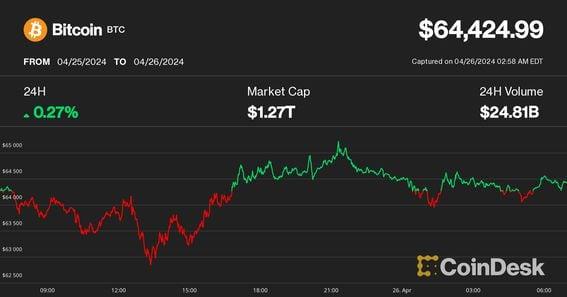
The relationship between bitcoin's price and ETF outflows is weakening BTC is trading above $64K even as outflows accelerate. The correlation between ETF outflows and BTC’s price is weakening. Bitcoin (BTC) is trading above $64K in the early afternoon of East Asia’s trading day, even as outflows from bitcoin exchange-traded funds (ETFs) pick up significantly. Market data shows that the U.S.-listed ETFs had a daily total net outflow of $217 million. This brings the total outflow so far this week to $244.49 million. In comparison, bitcoin is up around 3.7% in the last week. According to JPMorgan, the correlation between bitcoin ETF prices and inflows has weakened, dropping from a high of 0.84 in January to 0.60 in recent assessments. This indicates a decrease in the alignment between BTC prices and spot ETF flows, CoinDesk reported in February. Given its size, the outflow from Grayscale’s converted bitcoin ETF (GBTC) is of particular interest to traders. Data from SoSoValue shows that since Monday, GBTC has experienced an outflow of $417 million during the last week—yet BTC prices still increased in the face of it. Liquidation data is also fairly flat, according to GoinGlass, with $60 million in liquidations in the last 24 hours. Of this $60 million, BTC made up $13.48 million worth, and $6.17 million longs were liquidated against roughly $7 million in shorts. Meanwhile, the CoinDesk 20 (CD20), a measure of the largest digital assets, is flat, trading at 2,246. https://www.coindesk.com/markets/2024/04/26/bitcoin-stable-above-64k-while-etf-outflows-hit-200m/