2024-04-24 13:00
The app, which has been available in the U.S. since 2020, also recently expanded its services to Africa. Bitcoin payments app Strike is now available to customers in Europe. The firm has been on an expansion streak recently, launching in several countries globally, most recently in the African region. Strike, the payments application using the Bitcoin blockchain, has launched in Europe, allowing customers to buy, sell and withdraw bitcoin (BTC) in the region, it announced Wednesday. The company recently expanded its services to Africa and is already rolled out in Asia, the Caribbean and Latin America. Customers can check their local iOS or Android app store to see if the app is available in their country as some are excluded from the expansion. “As the third-largest economy globally … Europe presents vast opportunities for bitcoin adoption,” Strike said in a press release. “We’ve seen the demand and heard the feedback first-hand from the community.” Strike, a product of Chicago-based Zap Solutions that is led by entrepreneur Jack Mallers, launched in the U.S. in 2020. The app can be compared to Cash App or PayPal, two popular online payment systems, in that it lets customers send and receive money around the world. The difference is that Strike uses the Bitcoin blockchain to do so, making transfers faster and cheaper than other alternatives. European customers will be able to buy, sell and withdraw BTC directly with euro deposits through SEPA, the region’s payments provider. The recipient of the funds can then choose to receive the value in either bitcoin, euro or, in some regions, Tether’s USDT stablecoin. https://www.coindesk.com/business/2024/04/24/bitcoin-payments-app-strike-launches-for-european-customers/

2024-04-24 11:18
Zhao is scheduled to be sentenced on April 30 after he and Binance settled charges with the U.S. Department of Justice (DOJ) in November 2023. Binance founder and former chief executive Changpeng "CZ” Zhao apologized for his “poor decisions” and accepted “full responsibility” for his actions in a letter to the judge overseeing his case filed on Tuesday. Zhao is scheduled to be sentenced on April 30 after he and Binance settled charges with the U.S. Department of Justice (DOJ) in November 2023. Despite Zhao waiving the right to appeal any sentence up to 18 months back then, the DOJ has now sought a 36-month sentence. Read More: Binance Founder Changpeng Zhao Should Spend 3 Years in Prison, DOJ Says In the letter addressed to the U.S. Judge from the Western District of Washington, Richard A. Jones, Zhao said, "There is no excuse for my failure to establish the necessary compliance controls at Binance” and gave an assurance that this would be his only “encounter with the criminal justice system.” Going forward, Zhao said, he wanted to support biotech startups and the youth. Along with Zhao’s letter, there were 161 other letters of support seeking leniency from family members, friends and others. Zhao’s sister, Jessica Zhao, who was a former Managing Director at Morgan Stanley, said that although her brother has made mistakes, he lives to do well for others. She cited the example of the FTX fallout and said Zhao ensured Binance never misused any customer funds. He Yi, another Binance co-founder and mother of CZ’s three children, wrote, “If the cryptocurrency industry is compared to the Wild West, then CZ is the guardian of this wilderness.” “Even the U.S. has not decided how to regulate and define this industry,” Yi wrote. As a founder who has never managed a company of this size, he was sure to encounter blind spots.” His wife Yang Weiqing, with whom Zhao raised two children, stated the example of how Binance donated tens of millions of yen to the disaster-stricken areas of Japan in 2018, despite having withdrawn from the Japanese market just months before. Zhao’s children, Rachel and Ryan, both students in U.S. universities, provided anecdotes of a supportive father and asked the Judge not to define Zhao's character solely through this one incident. A notable letter of support came from Tigran Gambaryan, Binance’s Head of Financial Crime Compliance and a former special agent in the U.S. Department of Treasury, who is languishing in a Nigerian jail at the moment in a dispute between Binance and Nigeria. The letter was written on January 1, 2024, before he was arrested. “While acknowledging CZ’s prior missteps, I can attest to his integrity, business insight, and philanthropic actions have had a ripple effect, influencing not only Binance’s corporate philosophy but also positively impacting lives globally,” Gambaryan wrote. Letters of support also came from Max S. Baucus, former U.S. Ambassador to China, Professor Jeremy R. Cooperstock, McGill University, Associate Professor Ronghui Gu, Columbia University, Morgan Stanley Managing Director Sean Yang, and members of the ruling family in the United Arab Emirates. Nikhilesh De contributed to this story. https://www.coindesk.com/policy/2024/04/24/binance-founder-changpeng-zhao-apologizes-ahead-of-sentencing-161-others-send-letters-of-support/

2024-04-24 11:08
The number of addresses holding stablecoins has risen 15% this year, according to data source rwa.xyz. The number of addresses holding stablecoins has risen 15% this year. Rating agency S&P 500 said regulatory clarity could bring banks into the stablecoin market. Stablecoins are hotter than ever. The number of addresses holding dollar and crypto-pegged stablecoins has increased 15% this year to above 93.6 million, the highest on record, according to data source rwa.xyz. Stablecoins are cryptocurrencies with values pegged to an external reference, like the U.S. dollar. They can be broadly categorized as fiat-backed, crypto-backed, or algorithmic stablecoins. As of the time of writing, there are 35 stablecoins in existence, boasting a combined market capitalization of $157 billion. Tether (USDT) holders, with an industry-leading market cap of $114.07 billion, accounted for just over 80% of the total stablecoin addresses, followed by USDC and BUSD. The tally of the so-called holding addresses increased even during the 2022 crypto bear market. The Fed raised interest rates rapidly in 2022, boosting investor demand for the U.S. dollar and greenback-equivalents like the dollar-pegged cryptocurrencies. Not only that, but the number of addresses transferring stablecoins has also increased rapidly over the years. In March alone, active stablecoin addresses rose past the 26 million mark for the first time on record, per rwa.xyz. Details show that nearly 20 million, or 77% of those addresses, were based on TRON and Binance Smart Chain (BSC), largely representing retail investor participation. “Zooming in and looking at transfer volumes, one notices that despite the dominant active address counts, TRON and BSC are a minority of $ volumes, demonstrating their popularity amongst retail participants,” crypto analytics newsletter OurNetwork’s April 23 edition said. OurNetwork added that Ethereum, the world’s largest smart contract blockchain, and its rival Solana accounted for a giant share of the transfer volume due to their large decentralized finance ecosystem. Stablecoin use cases A 2022 report by the Federal Reserve said stablecoins could be used for several purposes, including cross-border payments, internal fund transfers, and liquidity management within firms. Moreover, a single stablecoin can serve a different purpose depending on jurisdiction. For instance, in high-inflation nations like Zimbabwe and Nigeria, stablecoins have been adopted as alternative means of payment, remittances, and stores of value assets. Meanwhile, in advanced economies, stablecoins are widely used to fund cryptocurrency purchases. Tether LTD, the company behind USDT, recently partnered with Telegram Open Network (TON), issuing $60 million of USDT on the TON blockchain. “This deal deploys USDT onto the blockchain of the eponymous messaging app, opening the door for native usage of Tether to the nearly billion Telegram users,” OurNetwork said. Regulation is the key According to rating agency S&P, regulatory clarity will likely encourage banks to adopt stablecoins. Last week, U.S. Senators Cynthia Lummis (R-Wyo.) and Kirsten Gillibrand (D-N.Y.) introduced a joint 179-page bill on regulating stablecoins. “Assuming the bill is approved, and that relevant banking regulation follows, the new rules may offer banks a competitive advantage by limiting institutions without a banking license to a maximum issuance of $10 billion," S&P said. S&P added that USDT, which is issued by a non-U.S. entity, is not a permitted payment stablecoin under the proposed bill, meaning stateside entities will not be able to hold or transact in tether. As such, tether’s dominance could wane and users will likely switch to U.S.-issued stablecoins. https://www.coindesk.com/markets/2024/04/24/number-of-stablecoin-holders-nears-100m-mark-data-show/

2024-04-24 07:51
Crypto’s significance as an election issue remains non-existent or at best negligible. India's multi-phased election kicked off earlier this month and the manifestos of the major political parties have not made any crypto-specific promises. However, promises related to the digitization of the nation have been made, even if crypto is at best a negligible issue for voters. India’s general election in 2024 is not expected to immediately affect crypto policy, and its current – restrictive – rules are expected to continue on through the upcoming Parliamentary term. The world’s most populated country and the fastest growing major economy kicked off its multi-phased elections this month, with results expected on June 4, 2024. Several industry analysts told CoinDesk they don't expect any changes to crypto policy after the next term's lawmakers are elected, resulting in the near-term continuation of rules that have stifled the nation's digital asset ecosystem. Prime Minister Narendra Modi, 73, is aiming for a third five-year term as the face of the ruling Bharatiya Janta Party (BJP), and is overwhelmingly expected to win the elections, pre-election surveys have shown. Such is his expected dominance that the Indian National Congress (INC), the major opposition party and several regional parties, around 40 in total, have come together to form a coalition called I.N.D.I.A (Indian National Developmental Inclusive Alliance) to fight him. The election is for 543 seats in the lower house of Parliament, referred to as the Lok Sabha. The party or alliance with the most seats would select the country's prime minister and form a government. Crypto as an election issue Crypto’s significance as an election issue remains non-existent or at best negligible. Web3 remains esoteric for an overwhelming majority of the voting population. Even the fact that India has implemented a steep tax deducted at source on crypto transactions (1% on every transaction) is unlikely to play a role in this year's election in any major way. Issues such as lack of jobs, a Hindu-nationalist agenda against a constitutionally enshrined secularism, alleged marginalization of minorities, the role of electoral bonds, institutional independence and agrarian policies have dominated the headlines, making sure that crypto is not even a political talking point. “Indian elections are still focussed mainly around socio-political issues,” said Kiran Vivekananda, Chief Public Policy officer at one of India’s largest cryptocurrency exchanges, CoinDCX. “Technology has started becoming an agenda item but is more from the setting up [of a] manufacturing base in India and the job-creation lens.” Yet, Vivekananda expressed hope that the incoming government would work more closely with the industry to understand its challenges, provide solutions and protect the interests of citizens. However, other entrepreneurs believe more needs to be done by the Indian crypto industry. “Developments in the U.S. show that crypto can indeed become a political talking point, influencing policy and voter choices,” said Ashish Khandelwal, founder of Anq, a digital banking platform and a person who has been engaging with legislators. “To mirror the U.S., the Indian crypto industry needs to highlight how the tech can offer more than just investment opportunities, creating awareness around tangible benefits.” No crypto-related promises Neither major party, Modi’s BJP nor the INC, have mentioned the words cryptocurrency, blockchain or Web3 in their manifestos. However, this isn’t necessarily reflective of their plans toward the ecosystem. Indian government and political stakeholders, like other nations, have often used euphemisms to refer to the crypto-related space. The ruling BJP’s manifesto said the party would educate senior citizens to avoid digital scams, take stringent action against those who threaten the nation’s digital sovereignty and would develop “Digital Public Infrastructure to remove information asymmetry in agriculture.” The Congress Party (another name for INC) said it would give farmers the option to upload the sale-and-purchase agreement of the produce on a “digital ledger” and “work on digital/cybersecurity issues that may threaten India's digital financial infrastructure.” So far, during Modi's second term, his crypto-related policies included stiff taxes including a 30% tax on profits from selling digital assets, no off-setting of losses, a 1% tax deducted at source for every transaction and mandated registration of exchanges with India’s anti-money laundering and terrorist financing watchdog. These policies and other enforcement related actions brought the industry to its knees. Only the recent bull run and the government’s banning of off-shore exchanges at the nudging of India’s crypto policy advocacy body appears to have brought some respite to the industry. The Modi government “has consistently maintained a lukewarm stance towards cryptocurrencies,” putting in place a “patchwork of regulations,” said Mohit Chawdhry, a fellow at the Esya Centre Think Tank which has extensively researched how the crypto policies have so far impacted the industry. A weak opposition party has not framed a comprehensive position on crypto policy, though at this point it is simply fighting for survival against the Modi juggernaut. No major changes in the near-term Regardless of how Parliament shakes out, India’s Web3 policies are expected to remain largely unchanged in the near future. In the more likely scenario of Modi winning, his policies are expected to continue, and even if they would be updated, crypto is unlikely to be an immediate priority. Modi’s government has made no public indications that once it comes to power, crypto policy may be updated. In another, less likely, scenario of the opposition alliance winning, the coalition government is likely to have other priorities. The coalition has not yet indicated any thoughts on how its members may approach crypto policy. The best case scenario for a change in India’s crypto policy is around the end of 2024, one person familiar with the framing of crypto regulations in the government but unauthorized to speak to reporters told CoinDesk. And this isn't due to any specific policies that may be updated or introduced – it will simply take the government months to transition into governing after election results are announced in six weeks. The Modi government “does not appear to be keen on a holistic policy framework for virtual digital assets,” said the Esya Centre's Chawdhry. “It seems that other emerging technologies, such as artificial intelligence and extended reality, are higher priorities for policymakers.” Recently, finance minister Nirmala Sitharaman remained slightly ambiguous about crypto, saying the government’s position has always been that crypto assets can be traded, but that the government hasn't regulated them in the past, and won't change that stance yet. Some change by 2025 The past few years of the Modi government indicate changes will come. One of the major achievements touted by the Modi government has been its role in shaping globally coordinated crypto policy under its 2023 presidency of the Group of 20. India made it a priority and brought the major economies of the world to agree to a set of guidelines. India has also purportedly achieved its ambitions with the digital rupee. "The policymaking process for crypto will definitely pick up pace in this (expected and upcoming) term of the Modi government,” said Tanvi Ratna, the founder and CEO of the emerging technology think tank Policy 4.0, which contributed to key research and inputs towards the G20 policy framework created under India. “We can expect a close alignment between the government strategy [and] the global framework agreed by the G20 under India's leadership. Also worth noting that India's crypto policy will evolve alongside the scale up and launch of the eRupee. We are looking towards a very dynamic five years in India,” Ratna said. Read More: India Won't See Crypto or Web3 Bill for Another 18 Months, Senior Lawmaker Tells CoinDesk https://www.coindesk.com/policy/2024/04/24/whats-at-stake-for-crypto-in-india-as-the-worlds-largest-democracy-is-in-the-midst-of-its-national-election/

2024-04-24 07:09
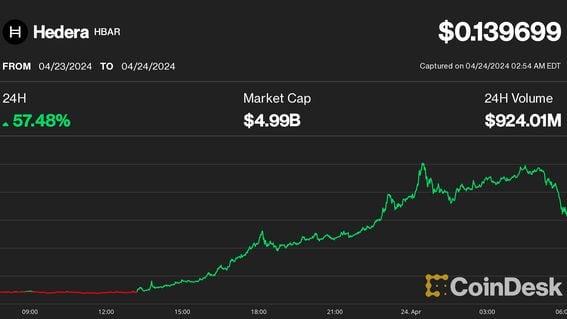
The market gave back some of its earlier gains after realizing BlackRock wasn't directly involved in the tokenization on Hedera's blockchain. Hedera's HBAR token rallied Tuesday after a foundation supporting the project announced that BlackRock's U.S. Treasury money market fund had been tokenized on the Hedera blockchain. The token gave back some of its gains when investors realized BlackRock was not directly involved. BlackRock later told CoinDesk it has "has no commercial relationship with Hedera nor has BlackRock selected Hedera to tokenise any BlackRock funds." Sometimes the use of the passive voice is just clumsy writing; other times it's a grammatical structure to which investors need to pay close attention. The HBAR Foundation, which supports the Hedera ecosystem, announced Tuesday that shares in BlackRock's ICS U.S. Treasury money market fund had been tokenized on the Hedera blockchain in collaboration with Archax. Hedera supporters on social media jumped to the conclusion that BlackRock chose Hedera to tokenize its fund, and the blockchain's native HBAR token surged by over 107%. But while shares in BlackRock fund had indeed been tokenized, it wasn't the world's largest asset manager that did the tokenizing – which could explain why the foundation's announcement carefully said the fund "is tokenized," not "BlackRock has tokenized." Once the market realized this, HBAR slipped 25%. A spokesperson for BlackRock told CoinDesk late Wednesday: "BlackRock has no commercial relationship with Hedera nor has BlackRock selected Hedera to tokenise any BlackRock funds. As we have in the past, BlackRock will communicate directly with the public on the evolution of our digital asset strategy." Archax CEO Graham Rodford said "it was indeed an Archax choice to put [the fund] on Hedera," in response to criticism about misleading marketing from Hedera supporters. BlackRock entered the real-world asset (RWA) tokenization sector last month when it launched its USD Institutional Digital Liquidity Fund on Ethereum. The HBAR token is still up by 61% over the past 24 hours, but the 2% market depth remains relatively thin, with $900,000 in cumulative bids on the Binance and Upbit order books within 2% of the current price of 14 cents. The token has over $2.6 billion in trading volume over the past 24 hours, according to CoinMarketCap. CoinGlass data shows funding rates across all derivative exchanges are heavily negative, which means those holding short positions have to pay those holding long positions, indicating a bearish bias. The ratio of longs and shorts on Binance is currently 0.85. The weighted short interest, coupled with a lack of liquidity, creates a landscape for a volatile trading period that could culminate in a return to parity or a short squeeze, with open interest having risen by 442% to $160 million in the past 24 hours. CORRECTION (April 24, 21:59 UTC): Corrects article throughout to say that the HBAR Foundation, not Hedera, announced the tokenization. https://www.coindesk.com/markets/2024/04/24/hederas-hbar-doubles-then-falls-25-as-blackrock-links-diminish/
2024-04-24 06:52
The favorite to win, Mexico City’s former Mayor Claudia Sheinbaum, is expected to remain aligned with her party’s previous position on crypto, one that focuses more on protecting customers than any explicit legislation. In Mexico's coming election, cartel violence, corruption and migration push any chance of crypto becoming an election issue to the sidelines. Voting in Mexico will take place on June 2, with results expected between June 5 to June 8. Mexico is poised to have its biggest election ever in a few weeks, with 100 million voters choosing 628 elected officials, thousands of local officials and the president. And crypto issues will remain on the sidelines during the campaign. The future of crypto will be determined by which party and presidential candidate takes over from President Andres Manuel Lopez Obrador, who cannot run again under the constitution. The three way battle for the presidency falls between Mexico City’s former mayor Claudia Sheinbaum fielded by the ruling left-wing Morena party, Senator Xóchitl Gálvez from the Strength and Heart for Mexico coalition and former legislative deputy Jorge Álvarez Máynez of the Citizen Movement party. According to the polls, Sheinbaum is the favorite to win the presidency, with Gálvez and Máynez respectively a distant second and third. Sheinbaum has indicated that the economic-integration between the U.S. and Mexico is such that whoever, Donald Trump or Joe Biden, comes to power, she’s confident of having a good relationship with both, if she came to power. Mexico is the largest market for remittances from the U.S. Her party’s government has so far kept crypto on the sidelines of financial integration, imposing a 20% tax on crypto gains, but without comprehensive legislation. A fintech law and other regulations require cryptocurrency exchanges in the nation to be registered under global requirements for anti-money laundering and terror financing. Sheinbaum’s party has been projecting a focus on regulating blockchain to make the technology and ecosystem more secure. In the unlikely event that any of the other contenders come to power, crypto still may not be front and center as a priority. Mexico has seen dozens of candidates murdered in the build up to this election reflecting cartel violence is one of the leading issues among corruption and migration Still Gálvez and Álvarez Máynez’s party, have in separate ways, advocated for using blockchain to fight corruption in government and the real state sector, said Pavel Salas, chief growth officer at Gear. Read More: Nearly $100M Wagered on U.S. Presidential Election on Polymarket https://www.coindesk.com/policy/2024/04/24/in-mexicos-biggest-election-yet-crypto-remains-on-the-sidelines/