2024-04-24 06:31
Use of Tether has increased in Venezuela after the U.S. reimposed sanctions on oil exports. A tether spokesperson said that it will freeze addresses linked to evading sanctions. Reuters reported earlier this week that Venezuelan oil company PDVSA was using USDT via intermediaries to bypass U.S. sanctions. Venezuela’s original crypto project, Petro, was shut down earlier this year. Stablecoin issuer Tether has said it will freeze wallets that are using USDT to evade sanctions on oil exports in Venezuela. The decision comes after Reuters reported that Venezuela’s state-run oil company PDVSA increased its use of tether after the U.S. reimposed sanctions on oil exports. The firm froze 41 wallets tied to the U.S. Treasury Department’s Office of Foreign Assets Control (OFAC) Specially Designated Nationals (SDN) list in December. “Tether respects the OFAC SDN list and is committed to working to ensure sanction addresses are frozen properly,” a Tether spokesperson told CoinDesk. PDVSA’s use of USDT, which began last year, has accelerated following the U.S.’s decision to reimpose sanctions due to concerns over Venezuela’s upcoming election. Venezuela began experimenting with cryptocurrencies in 2018, setting up a token called “petro” as it aimed to tackle economic instability spurred by U.S. sanctions. The token was shelved earlier this year following a lack of adoption. Using cryptocurrencies allows PDVSA and its counterparties to avoid transacting in cash that could be seized by the U.S. in foreign bank accounts. Reuters reports that PDVSA uses intermediaries when transacting in tether to make transfers harder to track. OFAC is privy to the use of crypto, having increased its clamp down on the industry over the past year, fining crypto exchange CoinList $1.2 million for aiding Russian users evade sanctions in December after imposing sanctions on a crypto mixer that was allegedly used by hackers in North Korea. In October last year, Tether froze 32 crypto addresses tied to terrorism and warfare in Israel and Ukraine. One year earlier, however, Tether took a stance against freezing wallets tied to sanctioned coin mixing service Tornado Cash. https://www.coindesk.com/policy/2024/04/24/tether-will-freeze-wallets-evading-venezuelan-sanctions/
2024-04-24 05:43
The DOJ wants Zhao to serve 36 months after his guilty plea last year. Binance's founder and former chief executive, Changpeng "CZ" Zhao, should spend three years in prison for his role in enabling the crypto exchange to violate federal sanctions and money laundering laws, the U.S. Department of Justice said Tuesday night. The former CEO's attorneys argued he should serve no jail time, citing the fine he paid and his "extraordinary acceptance of responsibility." Attorneys with the DOJ filed a sentencing memo arguing he should spend 36 months in prison and pay a $50 million fine after he pleaded guilty to violating the Bank Secrecy Act last November. Hours later, Zhao's defense team filed its own sentencing memo, saying "no defendant in a remotely similar BSA case has ever been sentenced to incarceration." Instead, they suggested he be sentenced to probation, which could include home confinement at his home in Abu Dhabi. "The sentence in this case will not just send a message to Zhao but also to the world. Zhao reaped vast rewards for his violation of U.S. law, and the price of that violation must be significant to effectively punish Zhao for his criminal acts and to deter others who are tempted to build fortunes and business empires by breaking U.S. law," the filing said. Zhao originally faced up to 18 months in prison under the terms of his plea agreement. The DOJ argued in Tuesday's filing that "the scope and ramifications of Zhao's misconduct were massive," and so "an upward variance is appropriate here." "In part because Zhao failed to implement an effective AML program at Binance, illicit actors used Binance’s exchange in various ways, including operating mixing services that hid the source and ownership of cryptocurrency; transacting in illicit proceeds from ransomware attacks; and moving proceeds of darknet market transactions, exchange hacks, and various internet-related scams," the filing said, pointing to fund movements from darknet markets and crypto mixers. Much of the filing echoes arguments made by the DOJ when it first announced charges against Binance and Zhao last year, pointing to how the exchange operated within the U.S. The filing also walks through the DOJ's sentencing guidelines calculations, noting that the guidelines recommend 12 to 18 months, but saying Zhao knew Binance was violating the law and encouraged it. The filing also took aim at how the Sentencing Guidelines address Bank Secrecy Act violations, saying they "are not designed to adequately punish either misconduct on this scale or misconduct that harms U.S. national security." The $50 million fine was already agreed to by both the prosecution and Zhao's defense team. Zhao also waived the right to appeal any sentence up to 18 months. Defense pushes back Zhao did not know and was never "explicitly informed" of specific transactions on Binance with criminal funds, his defense filing said. "Although Probation references a conversation in which Binance’s chief compliance officer warned Mr. Zhao that there were users from sanctioned countries on Binance.com ... the reality is that Binance, as a non-U.S. company, was not prohibited from having users from U.S.-sanctioned countries on its platform," the filing said. By contrast, the sanctions charge to which the Company pleaded is a novel and narrow one (applied for the first time against Binance) that an algorithmic matching engine violates U.S. sanctions law by randomly pairing users in sanctioned countries with users in the United States." Those transactions only made up a microscopically tiny portion of Binance's trading volume, the filing said, making it "inconceivable that Mr. Zhao acted knowingly and deliberately to bring them about." Zhao also does not pose any risk of recidivism, the filing argued, saying that he should be sentenced to probation instead of prison. Parts of the memo are redacted, though the sections immediately following the redacted portions reference Zhao's background and letters of support. Zhao's supporters include Yi He, the mother of three of his children, his former wife Yang Weiqing, his two adult children with Yang, former U.S. Senator and current Binance lobbyist Max Baucus and a few dozen other individuals. He was originally set to be sentenced in late February, but the hearing was postponed by mutual agreement to April 30. He hasn't been able to return to Dubai, where his partner and some of his children live, since he first appeared in federal court in Seattle, Washington last year. Binance, the world's largest crypto exchange, pleaded guilty to charges of its own at the same time as Zhao, agreeing to a massive $4.3 billion fine and that it would report to a court-appointed monitor. The monitor has yet to be appointed. https://www.coindesk.com/policy/2024/04/24/binance-founder-changpeng-zhao-should-spend-3-years-in-prison-doj-says/

2024-04-24 05:33
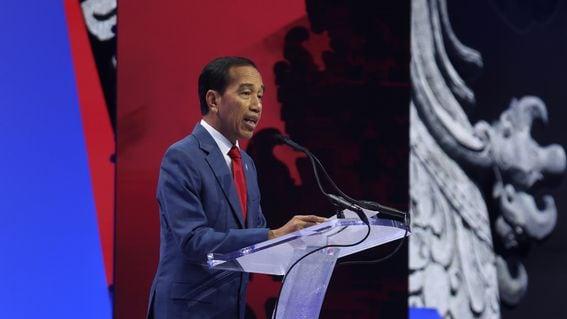
The amount of money laundered through crypto in 2021 is considered "extremely large" according to the president. Indonesian President Joko Widodo warned the Financial Transaction Reports and Analysis Centre (PPATK) to monitor the use of crypto and non-fungible tokens (NFTs) for money laundering during a speech last Wednesday at the 22nd Anniversary of the National Movement for Anti-Money Laundering and Terrorism Financing Prevention at the State Palace, Jakarta. The president said he is aware of indications of money laundering through crypto assets amounting to $8.6 billion (139 trillion IDR) in 2021, referring to data from the 2022 Crypto Crime Report by Chainalysis, “This amount, equivalent to Rp 139 trillion globally, is not just large – it is extremely large," Widodo said during his address. "We must move quickly and stay ahead of them. Otherwise, we will continually fall behind," he added. Besides crypto and NFTs, the president – who is affectionately called “Jokowi” – also highlighted the need to monitor other potential tools for money laundering including virtual assets, marketplace activities, electronic money and AI-driven transactions. Responding to the president's directive, Mahendra Siregar, chairman of the Board of Commissioners of the Financial Services Authority (OJK), said that his agency would oversee these concerns when crypto regulation transitions to the OJK next year. "In due course, as members of the Anti-Money Laundering and Terror Financing Prevention Team, we will have the authority to monitor these issues, including whether their use overlaps with services from other financial institutions," Mahendra said on Wednesday to reporters during a press conference. Currently, crypto assets in Indonesia are considered commodities and are regulated by the Commodity Futures Trading Regulatory Agency (Bappebti). According to Law Number 4 of 2023, the oversight of crypto assets will transition to the Financial Services Authority (OJK) in January 2025. New president In terms of government support, Indonesia's new leadership shows a clear stance on crypto. In the February 2024 elections, the newly elected president and vice president, Prabowo Subianto and Gibran Rakabuming Raka, openly expressed a strong interest in crypto. Gibran, the son of current President Widodo, vocally emphasized that Indonesia needs blockchain and crypto experts to advance the country's technological sector during election campaign, while Prabowo and Gibran's National Campaign Deputy Chairman, Erwin Aksa, previously mentioned that Prabowo and Gibran will improve tax compliance supervision for crypto assets as many are not compliant in reporting taxes. The official inauguration of Prabowo and Gibran is set for October 20, 2024. Editor's note: Joko Widodo and Mahendra Siregar's comments have been translated from Indonesian. https://www.coindesk.com/policy/2024/04/24/indonesian-president-joko-widodo-warns-of-money-laundering-via-crypto-and-nfts/
2024-04-24 04:36
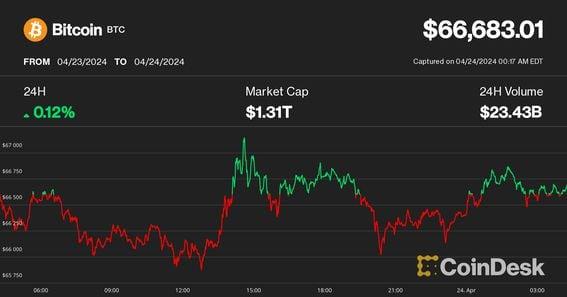
Investors are still gauging macroeconomic factors, one observer said. Bitcoin and Ether were stable in the morning hours of the Asia trading day The CoinDesk 20 Index is flat as traders can't decide on a direction to take. Bitcoin (BTC) and ether (ETH), the crypto market leaders, continue to trade in tight ranges as traders reassess macro conditions after halving. At press time, bitcoin (BTC) traded above $66,600 while ether (ETH) changed hands at $3,240, according to CoinDesk Indicies data. After a volatile last few weeks involving missile strikes between two geopolitical foes and excitement about the bitcoin halving, a sense of calm has returned to the market, with bulls and bears unwilling to lead the price action. "After the halving, market volatility was somewhat muted," Thomas Kim, a trader at Presto, told CoinDesk. "Recent three-day realized volatility was well below the implied volatility of BTC options, and investors may still need to gauge macroeconomic variables." Liquidation data from CoinGlass shows that in the last 12 hours, $52.46 million in positions have been liquidated. Ether and BTC positions are the largest, respectively, but there's also $6.86 million in HBAR liquidations – owing to the token's recent surge in volume crossing the $1 billion mark – as well as $1.83 million in PEPE liquidations. Justin d'Anethan from Keyrock, a crypto market maker, said in a Telegram interview with CoinDesk that traders are indecisive and can't make up their minds on what position to take. "It's an interesting – albeit not very dynamic – market to look at, both on the crypto and traditional side; traders seem unable to decidedly turn bullish or bearish, as evidenced by prices staying put," he told CoinDesk. The CoinDesk 20 Index, a measure of the largest digital assets by market cap, is flat, trading at 2,343. "There's a flurry of negative news weighing on markets," d'Anethan continued, pointing to the SEC's clear desire to delay the ETF application, President Joe Biden's comments about crypto mining, and continuing crypto investment product outflows. "On the flip side, and on a maybe more bullish side, the pullback we saw last week, which was intently caused by some leveraged long liquidations, has probably cleared some froth and left us sitting at a respectable level with some committed capital," he said. Coinglass data says that over the weekend of April 12-13, when Iran launched its missile attack on Israel, over $1.4 billion in long positions were liquidated. "With the halving, crypto investors are not willing to part with their coins and are probably setting themselves up for higher prices long term." https://www.coindesk.com/markets/2024/04/24/bitcoin-ether-coil-as-crypto-traders-in-limbo-after-halving/
2024-04-23 17:48
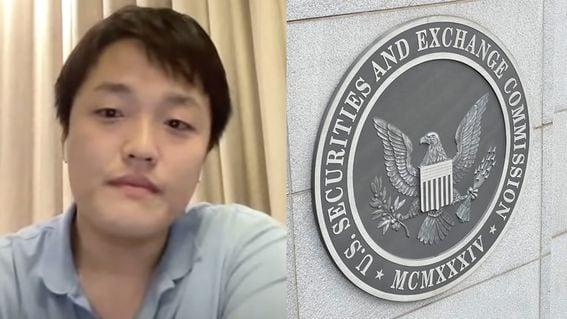
The massive sum is a “conservative measure” of Terraform Labs and Do Kwon’s ill-gotten gains, according to the SEC. The SEC asked a New York judge to impose $5.3 billion in fines against Terraform Labs and Do Kwon to resolve the civil fraud case against them. The regulator says the fines are a “conservative” but “reasonable approximation” of Terraform and Kwon’s “ill-gotten gains" from the fraud. The U.S. Securities and Exchange Commission (SEC) has asked a New York court to impose $5.3 billion in fines on Terraform Labs and co-founder Do Kwon for their role in the $40 billion implosion of the Terra ecosystem in 2022. Terraform Labs and Kwon were found liable on civil fraud charges earlier this month, when a Manhattan jury concluded that they had misled investors about the stability of their so-called “algorithmic” native stablecoin, Terra USD (UST), and the use cases for the Terra blockchain. In the SEC’s motion for final judgment, filed two weeks after the conclusion of the trial, the regulator is requesting that Terraform Labs and Kwon pay $4.74 billion in disgorgement and prejudgment interest, as well as a collective $520 million in civil penalties: $420 million from Terraform Labs and $100 million from Kwon’s pocket. In an accompanying memorandum of law, the SEC attempted to justify the total amount to the court by saying that Kwon and Terraform Labs made “over $4 billion in ill-gotten gains (and likely much more) from their illegal conduct.” Sales of LUNA and MIR to institutional investors totaled $65.2 million and $4.3 million, respectively, sales of LUNA and UST through the Luna Foundation Guard (LFG) totaled $1.8 billion, and investors bought $2.3 billion in UST on various crypto asset trading platforms between June 2021 and May 2022, according to court documents. The SEC added that the fine amount represented a “conservative” but “reasonable approximation” of Terraform and Kwon’s “ill-gotten gains.” No remorse In addition to steep monetary penalties, the SEC is also seeking injunctions preventing Kwon and Terraform Labs from committing further securities violations, buying or selling “any crypto asset security,” as well as an officer-and-director ban on Kwon, which would bar him from ever serving as an officer or director at an SEC-reporting public company. The SEC said such measures were necessary to deter future violations, as “Defendants have not shown remorse for their conduct, nor can there be any doubt that they are in position where additional violations are not only possible but likely are already occurring.” The SEC appeared to take particular issue with current Terraform Labs’ CEO Chris Amani’s testimony during the nine-day trial, during which he said that the company is “still working to build” products and continuing to sell tokens. The SEC called Amani’s testimony a “frank acknowledgement of likely recidivism” and added: “Terraform’s new CEO took the stand in a stunning display of chutzpah and attempted to garner sympathy by noting that Terraform had distributed a new version of their token – LUNA 2.0 – to their victims, all the while continuing to spend the millions they had reaped from investors and engaging in additional unregistered distributions of these securities.” Terraform weighs in In a motion filed the same day as the SEC’s, Terraform said that the court should not grant the SEC any injunctive relief or disgorgement against it, only an “appropriate civil penalty” per violation that the SEC can prove occurred in the U.S. During the trial, Amani testified that the company, which is currently in bankruptcy, had approximately $150 million in assets remaining. A representative for Terraform Labs did not respond to CoinDesk’s request for comment. Do Kwon Kwon’s lawyers also filed a memorandum of law claiming that injunctive relief against him is not warranted, due to the fact that he is not currently employed and has pending criminal charges against him. They also added that Kwon has “no illegal profits … to disgorge.” Kwon remains in Montenegro, where he was arrested and jailed last year for attempting to use forged Costa Rican travel documents en route to Dubai. The Montenegrin government is currently weighing competing extradition requests from both the U.S. and South Korea, Kwon’s native country, which both hope to try him on criminal charges tied to the Terra collapse. https://www.coindesk.com/policy/2024/04/23/do-kwon-terraform-labs-should-get-53b-fine-sec-tells-court/
2024-04-23 16:47
The defunct crypto exchange will distribute 142,000 BTC and 143,000 BCH to creditors later this year, 10 years after its implosion due to a hack. Mt. Gox creditors recently noted updates on their crypto claims, which may mean payouts may be coming soon. The distribution of over $9 billion worth of BTC could "become a relevant negative price contributor in the next weeks," K33 analysts said. The crypto market has mostly shrugged off last week's correction, but there's a possible catalyst ahead that could weigh on prices through the next few weeks, putting a rally higher in jeopardy. Crypto firm K33 Research said in a Tuesday report that Mt. Gox, a crypto exchange that imploded due to a hack in 2014, is gearing toward distributing 142,000 bitcoin (BTC) worth roughly $9.5 billion and 143,000 bitcoin cash (BCH) worth $73 million to creditors, posing a substantial overhang on digital asset prices. "Mt. Gox coins could become a relevant negative price contributor in the next weeks," authors Anders Helseth and Vetle Lunde wrote. The warning comes as creditors saw their BTC and BCH claims were being updated recently in the Mt. Gox claim filing system, a development that could foreshadow upcoming payments earlier than previously expected. The trustees of the defunct exchange last year set an Oct. 31, 2024 deadline to reimburse creditors. Creditors saw a similar update mid-March on their cash repayments with several users claiming that they have received the transfer, the K33 report noted. If the crypto payout process mirrors fiat refunds, creditors could start receiving digital assets as soon as next month, the authors said. While it's unlikely that creditors will sell their payouts en masse, the report explains, the anticipation could prompt market players to stay cautious and avoid taking risks ahead of the event. "Repayments do not necessarily equate to selling pressure, as creditors might opt to hold on to funds," but it's "an overhang that might spook the market shortly," Helseth and Lunde said. https://www.coindesk.com/markets/2024/04/23/mt-goxs-looming-9b-payout-could-weigh-on-bitcoin-prices-k33-research-warns/