2024-04-22 21:17
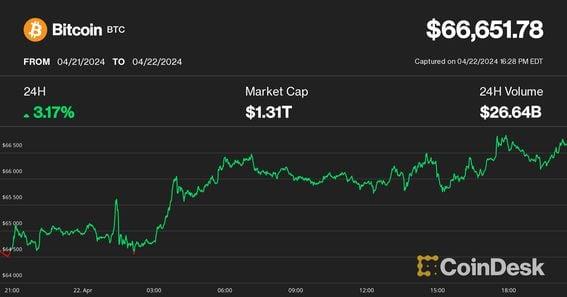
Crypto-focused stocks also bounced higher, led by bitcoin miners Riot Platforms and Hut 8. The bounce was broad-based, with nearly all cryptocurrencies of the Coindesk Market Index up in the past 24 hours. Funding rates for some altcoins and memecoins turned deeply negative, potentially leading to a swift move higher in a short squeeze, QCP Capital noted. Crypto markets climbed higher Monday with bitcoin (BTC) nearing $67,000 as fears about a deeper correction allayed. Bitcoin, which underwent its quadrennial halving event during the weekend cutting the issuance of new supply in half, climbed over 3% over the past 24 hours, recently changing hands at $66,500. Ether (ETH) held steady near $3,200, but lagging with its 1.5% advance during the same period. Crypto's strong showing was broad-based, with 163 out of 173 cryptos in the CoinDesk Market Index (CMI) posting positive daily returns. The broad-based CoinDesk 20 Index (CDI) gained over 3% during the day, led by layer-1 blockchain Near Protocol's native token (NEAR) up 15%. The bounce extended to digital asset-focused stocks, with shares of crypto exchange Coinbase (COIN) and MicroStrategy (MSTR) rallying 7% and 12%. Publicly listed miners Riot Platforms (RIOT) and Hut 8 (HUT) surged 15%-20%, while Marathon Digital (MARA) advanced 6% during the day, after transaction frenzy caused a spike in fees – an increasingly important revenue source for miners – gave hopes for better bottom lines for the companies. Markus Thielen, founder of 10x Research, said Thursday in an interview with CoinDesk TV that bitcoin's halving "is not a bullish event" and warned of market weakness for the next few months, with potentially a deeper correction in the cards. The key reason would be miners offloading their BTC inventory worth $5 billion to keep their operations steady after having their revenue cut, he explained. On the longer outlook, though, the past three halvings were followed by an exponential move higher for bitcoin's price about 50-100 days after the event, crypto hedge fund QCP Capital pointed out in a Monday market update. "If this pattern is repeated this time, BTC bulls still have a few weeks to build a larger long position," the report said. The fund also noted that funding rates – the cost leveraged derivatives traders need to pay for keeping their positions open – cooled off from very hot levels, and even turned into deep negative territory for some smaller cryptocurrencies, making them ripe for a swift move higher if risk-appetite returns. "What we could see in the short-term is a short-squeeze led by altcoins and memecoins which have seen persistent negative funding, with some as deep as -100% [annualized]," QCP Capital said. "Improving speculative sentiment could see short covering and a resumption of leveraged longs." https://www.coindesk.com/markets/2024/04/22/bitcoin-eyes-67k-after-halving-as-altcoins-primed-for-short-squeeze-hedge-fund-says/
2024-04-22 19:15
Increasing on-chain use of the network are driving up fees. Welcome to “Epoch V” of Bitcoin. On April 20 Bitcoin underwent its fourth successful halving, the programmed slashing of the amount of new bitcoin (BTC) that enters into circulation via mining. While the event itself is a bit of a barnburner — a moment for people around the world to celebrate virtually and in person — many eyes are on what is to come. The launch of Runes, a new protocol that enables the creation of meme coins on Bitcoin, coincided with the halving. Already hundreds of tokens have launched, contributing over $80 million in fees to bitcoin miners. This increased trading activity has also driven up the costs associated with sending a transaction on Bitcoin, with the current average price over $70, an increase of 1,395.8% over the trailing 30 day average, according to TokenTerminal. While it’s hard to say whether this activity will level out, there are some who think “Epoch V,” or the period of time leading up to the next halving in 2028, will be when Bitcoin layer 2s like the Lightning Network will finally catch on. On April 20, bitcoin fees hit an all-time high of $128. “Anything that causes fee rates to spike will probably drive people to seek out other solutions,” Bitcoin Core developer Ava Chow said in an interview with CoinDesk. “Lightning is one option. Also there are side chains like Fedimint, Ark and a bunch of layer 2s. High fee environments will prompt people to look into them.” It’s a point echoed by a recent Messari report, which argued that with the rising level of on-chain activity, “layer-2 solutions for Bitcoin are not just a luxury but a necessity,” analyst Nikhil Chaturvedi wrote. Bitcoin is no longer just “digital gold,” but a platform on which to build. This shifting mindset was stirred by the launch of the Ordinals protocol last year, which enabled new ways of storing data on the smallest units of BTC, called satoshis. There have already been over $3 billion in NFT-like Ordinal “inscription” sales, and trading activity is trending up with the average number of transactions approaching 2 million. But Ordinals is hardly alone in driving up Bitcoin fees. BitVM, a way to move computation off-chain, enables people to build Ethereum-like smart contracts on Bitcoin. Babylon is building a way to stake and earn yield on BTC holdings. And layer 2s like Stacks and Merlin are becoming home to a number of decentralized apps and meme coins. Interestly, in the days since the halving, tokens associated with Bitcoin L2s have outperformed BTC. For instance, Elastos’ ELA token has risen 11%, and SatoshiVM’s SAVM climbed 5%. Stack’s STX token has gained nearly 20% to $2.87 — though that may also have been driven by the network’s anticipated Nakamoto upgrade, which began rolling out today. While market forces will likely drive action to Bitcoin’s secondary layers, that may not always be a good thing. For one thing, those with low bitcoin balances may be priced out from using platforms like Lightning, if they want to use it non-custodially and set up their own channels, Chow suggested. “The problem is, all of these layer 2s require an on-chain transaction,” Chow said, referring to something like the “inbound capacity” needed to fund a Lightning account. Lightning users also have to pay for an on-chain closing transaction. “In a high fee environment that means it's going to be a little bit hard to actually start using those things.” Of course, there are workarounds to this: custodial Lightning companies that subsidize these surprisingly expensive transactions. “I am concerned higher BTC fees will drive users to custodial Lightning services … giving BTC users no sovereignty or anonymity over their BTC holdings,” pseudonymous bitcoiner and Lightning critic Sovereign Matt told CoinDesk. “Custodial Lightning services will become the new banks/middlemen that people will have to trust with their life savings as it will be too expensive to self-custody and transact using mainchain bitcoin.” To some extent, all of this is downstream of the so-called Blocksize Wars over how to scale Bitcoin years ago, where it was decided that instead of ramping up the size of Bitcoin blocks to scale the chain through layer 2s. That set Bitcoin down the path it’s currently on. “There's basically two schools of thought on increasing the number of transactions per block. You can make blocks bigger, or you can make transactions smaller,” Chow said, adding that expanding the block size is like “brute forcing” a solution. There are ways of making bitcoin transactions smaller, and more compact, but until that happens, it’s like layer 2s will grow. https://www.coindesk.com/consensus-magazine/2024/04/22/how-the-bitcoin-halving-will-drive-action-to-layer-2s/

2024-04-22 16:12
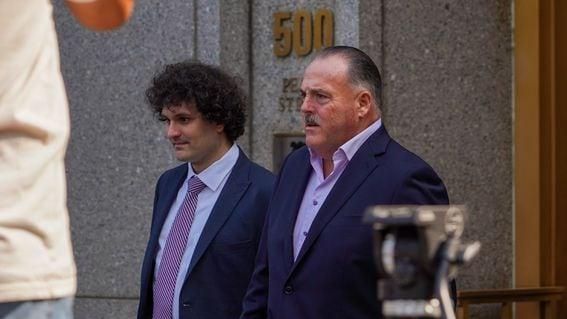
Bankman-Fried’s one-time friends and co-defendants Caroline Ellison, Gary Wang, and Nishad Singh have already settled with the investors. Sam Bankman-Fried has inked a settlement agreement with a group of FTX customers who have agreed to drop their class action lawsuit against him in exchange for his help going after celebrity promoters of the collapsed exchange. The agreement, filed in a Miami court on Friday, has not yet been approved by a judge. If approved, the settlement would release Bankman-Fried from both current and future civil liability tied to the collapse of FTX. Bankman-Fried's end of the bargain will see him providing the plaintiffs’ attorneys with information – including both testimony and documents in his possession – to “aid in victim recovery” and assist their litigation efforts against a host of celebrity promoters and venture capital firms who endorsed FTX. He has also agreed to provide the attorneys with financial information and documents, including a total of his remaining personal assets and his firm’s 2021 investment in AI startup Anthropic. The pending settlement agreement comes shortly after Bankman-Fried was convicted of fraud and sentenced to 25 years in prison for his role in FTX’s implosion. Bankman-Fried has appealed his sentence and conviction. Bankman-Fried’s one-time friends, colleagues and co-defendants Caroline Ellison, Nishad Singh and Gary Wang, as well as FTX lawyer Dan Friedberg, have made similar settlement agreements with the plaintiffs’ attorneys. Several of the smaller celebrity promoters – including finance Youtubers Andrei Jikh, Graham Stephan, Jaspreet Singh, Tom Nash, Brian Jung and Jeremy Lefebvre – have also settled, contributing to a common fund of $1.4 million to fund the lawsuit, according to court documents. Jacksonville Jaguars quarterback Trevor Lawrence, who was paid $500,000 in 2022 to endorse FTX subsidiary Blockfolio, also settled with the plaintiffs last year. But most of the big name promoters of FTX – like athletes Tom Brady, Steph Curry, Shaquille O’Neill, Naomi Osaka and Shohei Otani and supermodel Gisele Bundchen – are fighting the lawsuit, as are over a dozen domestic and international venture capital firms. https://www.coindesk.com/policy/2024/04/22/sam-bankman-fried-agrees-to-help-ftx-investors-go-after-celeb-promoters/
2024-04-22 15:48
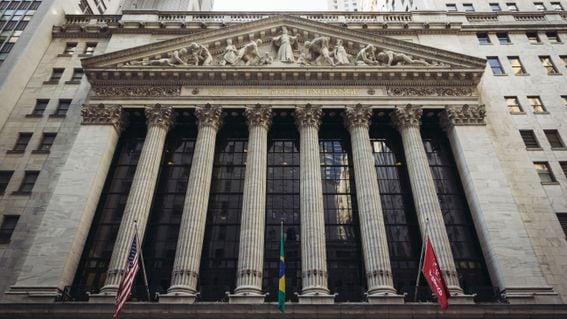
Round-the-clock trading became popular with the rise of cryptocurrencies and an increase in retail investor activity during the Covid-19 pandemic. The New York Stock Exchange is seeking opinions from market participants about shifting the U.S. stock market to a 24/7 operating schedule. Round-the-clock trading became popular during the Covid-19 pandemic, when the trading of cryptocurrencies picked up and retail investor interest blew up. A Steve Cohen-backed trading platform, 24 Exchange, is currently awaiting a decision from the SEC on whether it can launch the first 24/7 exchange. The New York Stock Exchange has asked market participants about how they'd feel if the market operated 24 hours a day, the same schedule that cryptocurrencies use, the Financial Times reported. NYSE, whose roots stretch back to the 18th century, famously signals the start and end of daily trading with bell-ringing ceremonies in the morning and afternoon – though, because of electronic trading, buying and selling has for decades actually taken place before the first bell at 9:30 a.m. and after the second one at 4 p.m. New York time. But a startup, 24 Exchange, which is backed by billionaire hedge fund manager Steve Cohen, wants to take that a step further as the first stock exchange to allow 24/7 trading. Several retail brokers like Robinhood already let clients trade day and night. And cryptocurrencies never stop trading. “Anyone who wants to trade crypto 24/7 would also like to trade Apple or Microsoft 24/7,” 24 Exchange’s founder and CEO, Dmitri Galin, told Bloomberg in 2023. Round-the-clock trading became a popular idea after interest in crypto blew up and retail trading grew tremendously during the Covid-19 pandemic. Increased investor interest from Asia and Europe in U.S. financial assets has also picked up in recent years. “The world changed with the pandemic and with crypto trading 24/7. Everybody has the infrastructure and the support to handle trading overnight now,” Brian Hyndman, chief executive of Blue Ocean, an overnight-trading provider, told the Financial Times in December. Questions in NYSE’s survey included whether participants would prefer overnight trading to take place seven days a week, how investors should be protected from price fluctuations as well as opinions on the staffing of overnight sessions, according to the FT. The SEC has several months to make a decision on 24 Exchange’s application. https://www.coindesk.com/markets/2024/04/22/nyse-asks-market-participants-about-247-trading-for-stocks/
2024-04-22 15:02
The new network will be built on top of layer-2 network Shibarium and offer enhanced privacy for users. Investors participating in the round purchased $12 million worth of the new blockchain's upcoming utility and governance token TREAT. Investors include Animoca Brands, DWF Ventures, Polygon Ventures and others. Shiba Inu, the Ethereum-based ecosystem represented by the second-largest canine-themed token SHIB, raised $12 million in a token sale round for building its privacy-focused blockchain, according to a Monday press release. The list of investors participating in the round are Comma 3 Ventures, Big Brain Holdings, Cypher Capital, Shima Capital, Hercules Ventures, Animoca Brands, Morningstar Ventures, Woodstock Fund, DWF Ventures, Polygon Ventures, Stake Capital, Illuminati Digital Capital, Primal Capital, Mechanism Capital and Spirit Dao, who all purchased the new network's upcoming utility and governance token TREAT. The deal was completed by Shiba Inu Mint S.A., an ecosystem development firm incorporated in Panama, the press release added. The fundraising came after CoinDesk reported in February that Shiba Inu developers are working with cryptography company Zama on a privacy-focused new network on top of Shibarium, the ecosystem's Ethereum-based layer-2 blockchain. The network will be powered by Fully Homomorphic Encryption (FHE), a privacy tool that lets developers use data on untrusted domains without needing to decrypt it. SHIB gained 2.2% over the past 24 hours, in line with the broad-market CoinDesk 20 Index's advance. It's the 12th-largest cryptocurrency with a nearly $16 billion market capitalization. https://www.coindesk.com/business/2024/04/22/shiba-inu-fetches-12m-investment-in-a-token-sale-to-build-privacy-focused-blockchain/

2024-04-22 13:00
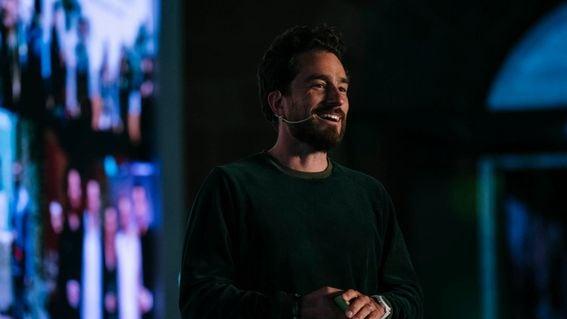
CLabs officially proposed using Optimism’s OP Stack for the transition. The proposal will be discussed on a couple of community calls and then go to a vote among holders of the project's CELO tokens, under the chain's governance rules. The primary developer behind the Celo blockchain has been on the hunt since last year for the technology for its planned layer-2 network atop Ethereum – and the selection process had turned into a surprisingly competitive bake-off between leading providers. On Monday, the team officially proposed using Optimism’s OP Stack for the transition. The proposal will be discussed on a couple of community calls and then go to a vote among holders of the project's CELO tokens, under the chain's governance rules. CLabs, Celo’s developer, has spent the past couple months evaluating technical proposals from various layer-2 teams on why they may be the best fit for their new blockchain. The big idea is that the Celo team sees a more prosperous future as a part of the broader Ethereum blockchain ecosystem, as a layer-2 chain, than in its current form as a standalone, or layer-1, chain. When Celo originally announced it would migrate to a layer 2, cLabs had originally suggested choosing the OP Stack. That's where the team ended back at, eight months after its initial announcement, following extensive consideration of all of the competing layer-2 tech providers. “We know a lot more than we knew back eight months ago when we first started really zooming in on this,” Rene Reinsberg, co-founder of Celo and president of Celo Foundation, said in an interview with CoinDesk. “I'm very happy we didn't just make a decision last year, but did all this due diligence.” Optimism wins another During the selection process, cLabs was considering whether to deploy on OP Stack, Arbitrum Orbit, zkSync’s ZK Stack or Polygon CDK. In a blog post sent to CoinDesk, Celo mentions that ultimately OP Stack fit their needs, and that it could be compatible with components from other layer-2 teams, specifically including Polygon’s Type 1 prover. “Even some of the stuff we learned on the other stacks, I think it's going to be helpful as the entire architecture kind of gets built and deployed over time,” Reinsberg told CoinDesk. The OP Stack has become quite popular over the last few months among blockchain projects, with Coinbase tapping the technology last August to build out its own layer-2 chain, Base. Just last week, Worldcoin announced plans for a layer 2, World Chain, also built with OP Stack. “It's super cool to actually see them [Celo] be keen on OP Stack, do deep due diligence and look at all these chains,” said Ryan Wyatt, chief growth officer at the Optimism Foundation, in an interview with CoinDesk. “I mean, there's a lot of opportunities around this build-a-blockchain out of the box. So I love that they did it and then ultimately concluded that we're going with OP Stack.” https://www.coindesk.com/tech/2024/04/22/celo-chooses-optimism-concluding-bake-off-among-layer-2s/