2024-04-19 11:08
The TON network has seen rapid growth recently helped by incentives for onboarding Telegram users. Tether said it aims to boost USDT and XAUT tokens on TON for peer-to-peer payments targeting Telegram's 900 million user base. The TON network was launched by Telegram, but separated after regulatory concerns. Tether, the company behind the $108 billion market cap USDT, said it is expanding the dollar-pegged stablecoin and its gold-backed XAUT sibling natively on The Open Network (TON), a blockchain adjacent to messaging app Telegram. Tether's transparency page earlier today showed that there's $10 million worth of USDT authorized on the TON blockchain, with $3 million being already issued. With the move, Tether aims to boost USDT and XAUT for "borderless, peer-to-peer payments" among Telegram's nearly 900 million users, according to a statement issued during the Dubai 2049 conference. The expansion will also benefit the rapidly growing TON ecosystem, where users will be able to use the stablecoins in decentralized finance (DeFi) applications. "The launch of USDT and XAUT on TON will allow seamless value transfer, increasing activity and liquidity while offering users a financial experience that can match those found in the traditional financial system," Tether CEO Paolo Ardoino said in the statement. "This furthers our mission of powering open financial infrastructure across the blockchain space.” The Open Network is a decentralized layer-1 network initiated by Telegram but operating independently since the company abandoned development due to regulatory concerns. The ecosystem has seen rapid growth lately with incentives for onboarding Telegram users, boosting the number of monthly active addresses to over 1.7 million from less than 100,000 six months ago, according to blockchain data by Tonstat. Telegram also recently switched to the network's native token, toncoin (TON), from euros as a payment for its advertisement platform. The TON token was up earlier in the day, then tumbled as much as 15% following the news. It's still up 7% over the past 24 hours and tripled in price this year, boasting nearly a $25 billion market capitalization. While Telegram's crypto wallet supports various blockchains for deposits and withdrawals, "to encourage the adoption of TON, trading fees are substantially reduced," Halil Mirakhmed, chief operating officer of Wallet in Telegram, told CoinDesk. "Within the Ton Space ecosystem only USDT on TON is available, streamlining the user experience for those invested in the TON ecosystem," he added. Following the announcement, Ramp Network, a fintech company connecting crypto with traditional banking rails, said Friday it will enable purchases and withdrawals of USDT on TON. The company will start by allowing on-ramping from fiat currencies to USDT on TON on its website and integrate to third-party wallets supporting TON-based assets, and plans to add off-ramp capabilities later. "Crypto transactions should be as simple as texting," Ramp CEO Szymon Sypniewicz said in a statement. "We look forward to seeing how enabling access to instant, low-cost crypto transactions can improve the lives of hundreds of millions of users in the TON ecosystem." https://www.coindesk.com/business/2024/04/19/tether-is-expanding-its-usdt-xaut-stablecoins-to-ton-network-transparency-page-shows/

2024-04-19 08:54
GBTC again led the outflows, while inflows into BlackRock's IBIT continued to slow, provision data from Farside show. The U.S. spot ETFs lost $4.3 million in outflows on Thursday, taking the five-day tally to over $319 million. GBTC again led the outflows, while inflows into BlackRock's IBIT continued to slow. The U.S.-based spot bitcoin (BTC) exchange-traded funds (ETFs) registered cumulative outflows of $4.3 million on Thursday, extending the four-day run of withdrawals ahead of the supposedly bullish mining reward halving. Since April 12, the ETFs have witnessed a total net outflow of over $319 million, with Grayscale's GBTC accounting for a large share of the withdrawals, provisional data published by Farside Investors showed. For instance, on Thursday, GBTC alone saw a significant loss of $90 million in outflows, which was partially offset by inflows into Fidelity's FBTC and BlackRock's IBIT. The Grayscale ETF has been losing money since day one for several reasons, including the fund's relatively costly fee structure. So, GBTC outflows may not be a cause for concern, but the recent slower inflows into other ETFs might be. BlackRock's IBIT attracted just $18.8 million on Thursday, down 93% from the monthly high of $308.8 million on April 5. "Key liquidity drivers, such as stablecoin growth and US-listed Bitcoin ETF inflows, have slowed down - as we have mentioned for several weeks. ETF flows peaked on March 12, and four consecutive days of net outflows have recently been seen. Demand for US-listed Bitcoin ETFs appears saturated, as even a 10-15% decline in Bitcoin prices has not increased net inflows," Matrixport said in a market update early Friday. Bitcoin changed hands at $64,700 at press time, down over 13% from the record highs above $73,500 last month, CoinDesk data show. The pullback could be attributed to several factors, including U.S. tax payments, the dwindling probability of the Fed rate cuts, and Iran-Israel tensions. "The geopolitical risk in the Middle East could have been a qualified event to allocate into Bitcoin, but prices traded lower instead of up. This was a real test in cementing Bitcoin as a risk-off asset—unfortunately, Bitcoin somewhat failed as its price stagnated and sold off," Matrixport added. Late Friday, Bitcoin's blockchain is set to halve per block coin emission to 3.125 BTC from 6.25 BTC, reducing the pace of supply expansion by 50%. Historically, halvings have presaged major rallies, though the magnitude and duration of uptrends have not been consistent. The consensus in the crypto community is that the impending halving will put cryptocurrency on a long-term bullish path. However, several observers, including Goldman Sachs and JPMorgan, have suggested otherwise, with the later signaling the potential for deeper price correction after the halving. https://www.coindesk.com/markets/2024/04/19/bitcoin-spot-etfs-register-five-day-withdrawals-streak-ahead-of-halving/

2024-04-19 08:50
Bitcoin's rally in the past six months will help cushion crypto miners from the effects of the 50% cut in their earned rewards, the report said. Miners are better positioned for this halving due to the large gains in bitcoin in the last six months, the report said. If history repeats itself, bitcoin will enjoy a strong rally after the event, the broker said. A potential increase in network fees could offset the impact of reduced rewards, Benchmark noted. Crypto miners are the group most affected by bitcoin's (BTC) reward halving, and they are better positioned this time round due to the cryptocurrency's gains in the past six months, broker Benchmark said in a research report on Thursday. The largest cryptocurrency by market value rallied about 140% in the past two quarters, while ether (ETH), the second-largest, added 85%, CoinDesk Indices data show. The CoinDesk 20 Index, a measure of the broader crypto market, gained 115%. The quadrennial event slows the rate of growth in bitcoin supply by 50% and is expected to occur late this evening or early tomorrow UTC. Benchmark cited Haris Basit, the chief strategy officer of bitcoin miner Bitdeer Technologies (BTDR), who said the recent increase in the price of BTC could bail out many of the Bitcoin network’s less-efficient miners in the near-term. Given bitcoin’s recent outperformance, the “role of the halving in driving the retirement of inefficient mining rigs and reducing the network hashrate would be much less dramatic than it would have been absent the rally,” Basit said at a Benchmark-hosted event. “Most of the publicly traded bitcoin miners have initiated or announced plans to increase their electricity and hashrate capacities as a means of adjusting to their reduced revenue and gross profit profiles,” Benchmark analyst Mark Palmer wrote, noting that due to uncertainty around the halving nearly all of the listed miners’ stocks are down year-to-date despite a 46% rally in bitcoin in the same period. “The impact of the halving on bitcoin miners’ economics could be more offset over time if history repeats and a strong rally in the price of the cryptocurrency occurs during the months following the event,” Palmer wrote. The broker noted that a potential increase in network fees could also help to mitigate the impact of reduced block rewards. The halving’s effect on the cryptocurrency’s price “could be magnified by the concurrent demand shock created by the emergence of spot bitcoin exchange-traded funds (ETFs) following their approval in the U.S. in January,” the report said. “We expect the inflows into spot bitcoin ETFs to grow dramatically once institutions begin to invest in them in earnest.” https://www.coindesk.com/business/2024/04/19/bitcoin-miners-are-better-positioned-for-the-halving-this-time-round-benchmark/

2024-04-19 02:49
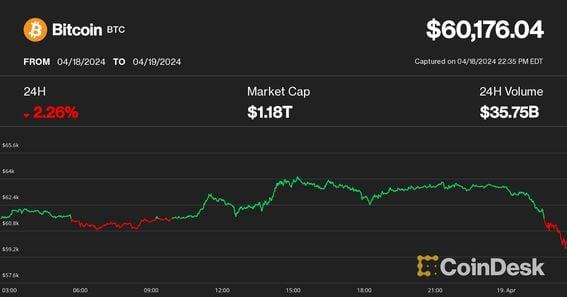
Iran's first strike on Israel pushed down crypto and risk assets, while leading to a spike in gold. The next threshold for bitcoin is $55,000 if the market turmoil continues, according to an analyst. Tokenized gold PAXG is up 3%. Bitcoin (BTC) came back over $62,000 as the market recovered after reports of limited damage from an Israeli strike on Iranian military targets. ABC News first reported that Israel had launched a retaliatory strike against Iran on Friday morning. CNN quoted local media as saying that various military bases and airfields in the country have been hit by missiles. Al Jazeera reported that Iranian authorities are downplaying the nature of the attack, claiming it was a limited drone strike. Ether (ETH) also recovered slightly, according to CoinDesk Indices data, but was still trading below $3000. PAXG, a tokenized version of gold run by Paxos, is up nearly 3%, according to market data. March Zheng, a managing partner at Bizantine Capital, said that the next threshold for bitcoin is $55,000, should market turmoil continue. “If there is a panic sell for bitcoin due to war-related news, it would still be a good buying opportunity,” added Jun-Young Heo, a derivatives trader at Presto, in a Telegram message. Major stock indices in Asia are also down, with Hong Kong's Hang Seng index down 3.5%, Japan's Nikkei 225 down 6.5%, and Taiwan's TAIEX down 5%. U.S. stock futures similarly fell while crude oil prices rose, MarketWatch reported. The market now appears to be overlooking the attack and is now focused on the upcoming halving. “BTC saw high volume and retracement going from 64k to 61k a day before the expected halving event with the 'sell the news' most likely being priced in at this point, showcased by a negative BTC funding rate,” Semir Gabeljic, director of capital formation at Pythagoras Investments, wrote in an email interview with CoinDesk. "All of the recent retracements, including this one, are in line with historical halving drawdowns; the only difference and consideration is the uncertainty of the macro landscape ahead, which will create additional volatility to come," he added. The CoinDesk 20 (CD20), a measure of the performance of the most liquid digital assets, is up 0.47%, trading at 2,137. https://www.coindesk.com/markets/2024/04/19/bitcoin-dips-below-60k-as-israel-launches-strike-on-iran/
2024-04-18 20:38
Institutions launching bitcoin ETFs this year have buoyed the bitcoin price to record levels. Does that mean the impact of the halving — the four-year slashing of the bitcoin reward — could be relatively muted? This year’s halving — the quadrennial slashing of the amount of new bitcoin (BTC) entering into circulation — may be the most important since the first one around 12 years ago. And yet, despite intense interest in the event, its price impact may be more muted this year than previous halvings. Recently launched protocols, like Ordinals, and an increasingly robust mining sector, mean the effect could be relatively soft. This article is part of CoinDesk’s “Future of Bitcoin” package. The Bitcoin halving, expected to take place late Friday night or early Saturday (April 20), comes with heightened expectations. In each previous case so far, the halving preceded massive sector-wide rallies. There is an ongoing debate whether the halving is “priced in,” or whether the reduced amount of bitcoin entering into circulation (this time dropping from around 900 BTC per day to 450 BTC) will create a kind of supply shock that will drive prices up (assuming demand for bitcoin remains constant or increases). There are two economic theories that explain this debate. On one side are those who believe the halving is priced in believe the efficient market theory. They say because the event is known in advance, and everyone shares the same information, it is impossible that bitcoin is currently undervalued. On the other side are those who point to the historic four-year boom and bust cycle in crypto and/or the aforementioned supply-and-demand constraints. Whatever theory you believe, it’s worth noting that this Bitcoin halving is already markedly different. For one, it’s the first time in Bitcoin history that bitcoin’s price has increased before the event. That’s largely because of the launch of nearly a dozen spot bitcoin exchange-traded funds in the U.S., which have been vacuuming up bitcoin at unprecedented rates. BlackRock’s bitcoin fund, for instance, has the fifth-fastest inflows of any ETF so far this year. “There’s more work to do, but the industry has made significant progress in making bitcoin more accessible and easier to use since 2020,” Miles Suter, Bitcoin product lead at Cash App, told CoinDesk in an email. “While the recent rally has been led by institutional investors, with past halvings we’ve seen a positive sentiment shift in the market that attracts new retail traders; I think the cycle will repeat itself.” What’s different? The institutions The institutionalization of bitcoin has another element over and above changing the kinds of buyers of bitcoin (or the way they enter the market): It also serves to legitimize the sector. In previous years, the biggest-name buyers of bitcoin were Michael Saylor’s relatively unknown software company MicroStrategy, known bitcoin fan Jack Dorsey’s Block and Elon Musk’s Tesla, which partially walked back its commitment due to environmental concerns. ETFs changed that forever. This isn’t to suggest that Wall Street doesn’t have its detractors, but it is significant that firms like BlackRock, Fidelity, Franklin Templeton, VanEck and WisdomTree were all clamoring to be first to market in offering a traditional onramp into this nascent digital economy. Bitcoin, once thought to be the Wild West, is becoming normalized — and no one is quite sure what is on the other side. “The people, institutions and governments that matter in the big picture are only *just beginning* to wake up to Bitcoin,” Lane Rettig, founder of SpaceMesh and former Ethereum developer, said. “Yes, this process takes a painfully long time, longer than we expect or would like - it's like a dragon slowly awakening, and right now it's just begun to stir.” It was a point echoed by Nelson Rosario of Rosario Tech Law, who views the halving as just the latest thing to drive attention to Bitcoin. “I think the questions I've seen around this halving somewhat miss the point. The fact is Bitcoin is at all-time high levels. It is a semi-regular news story in the financial press, and yet mass adoption still feels years away,” he said. Macroeconomic factors Indeed, analysts at both JPMorgan and Goldman Sachs this week published reports dampening the idea that the halving will bring in new buyers. A rallying market leading into the halving may be a way to generate buzz, but it may have also “pulled forward” a portion of “the typical post-halving rally,” JPMorgan analysts Reginald Smith and Charles Pearce wrote. More importantly, macroeconomic conditions in 2024 are completely different than during the preceding decade of low interest rates and low inflation. Goldman's Fixed Income, Currencies and Commodities as well as Equities teams wrote that the higher interest rates today may make high risk investments like crypto less attractive. It’s a point bolstered by BTC’s performance this week following news the Federal Reserve is reversing course from lowering interest rates, which would have brought liquidity into the economy. Price predictions from market analysts vary wildly, with some saying bitcoin could fall to as low as $40,000 post halving or rally above $150,000 by the end of the year. Pseudonymous trader Poordart gave a “primitive calculation” adding to the idea that bitcoin could fall following the halving. “Assuming miners sell all mined bitcoin eventually, reducing the average daily number of bitcoin mined from 900 to 450 ($54 million to $27 million at current prices) should have some effect — $189m inflow per week less required just to keep price stable,” he told CoinDesk. Bitcoin’s 50% price gains this year seem to support the idea that people are willing to take risks — though that doesn’t mean traders shouldn’t proceed with caution. To some extent, the stakes of this halving are even more unclear than ever due to these institutionalization and macroeconomic trends, with some concerned that the halving distracts from the ultimate mission of Bitcoin. "It is an odd thing to have to treat very, very human-made events as if they are acts of nature or God,” Nathan Schneider, professor of media studies at the University of Colorado Boulder and author of “Governable Spaces: Democratic Design for Online Life.” “I long for the day when network-native economies are designed to serve human flourishing, not arbitrary parameters in code." Others, like Sarah Meyohas, creator of Bitchcoin and recent Satoshi Nakamoto inscription and hologram series, sees the halving as a symbol of Bitcoin’s resilience. “As we approach Bitcoin's halving, I am moved by the notion that a few people can shape the future of an entire generation through ideas alone.” How the halving will impact bitcoin miners A mix of factors — including halving the block reward, higher costs, cautious investors and an increasingly crowded mining sector — could be a harsh reality for bitcoin miners after the halving ramps up competition to find the next block. Historically, the halving has been a boon for the price of bitcoin, helping miners reap a fat profit margin. However, this time, it's different as publicly-traded and private bitcoin miners will have to work harder not just to mine the next block but also to convince investors and the markets to have faith in their ability to make money. Heading into this halving, miners are greeted with a cautious tone from investors. For instance, stocks from mining firms Marathon Digital, Hut 8 and Riot Platforms are down roughly 33%, 35% and 46%, respectively, this year. The risk associated with bitcoin mining is seen as greater than alternative mainstream ways to get exposure to crypto, including spot bitcoin ETFs, equities like Coinbase (COIN) and the broad based CoinDesk 20 index, which are less volatile. To be able to survive and thrive after this halving, miners will need to be efficient, cash flow generating and have proper treasury management in place, CryptoQuant CEO Ki Young Ju wrote. He predicts that even if bitcoin remains at the $60,000 price level the current crop of mining machines would become unprofitable to run for many firms — leading to a wave of bankruptcies. Unless they are able to quickly deploy the latest generation of more efficient machines, Ju said that bitcoin’s price will need to rise to around $80,000 for miners to remain profitable using Bitmain's S19 XP mining machines, the most commonly utilized miners by U.S. companies. Miners have already started to replace their older-generation machines with newer ASICs. However, having the latest technology may not be enough to appease investors. Miners must prove they can make money by deploying capital efficiently, cutting costs, finding cheaper sources of power and generating positive cash flow for shareholders. Doom and gloom? For profitable firms, the post-halving landscape may become a season for mergers and acquisitions. Firms like Galaxy Digital, with its Helios mining farm, the largest liquid-cooled mine in the Northeast, are already buying up less efficient machines as the cheap cost of electricity in West Texas makes it profitable to run outdated chips. It’s not all doom and gloom. Increasingly, transaction fees are becoming a significant contributor to miners. Historically, miners earned lion's shares of profit from the block rewards. However, with the increasing ways to use the Bitcoin blockchain — most notably through the Ordinals protocol — miners are taking in more through increased fees. Another option, which some miners have already started to include in their business plan, is to diversify into other sources of revenue, such as repurposing existing data centers to host computing resources for artificial intelligence or cloud computing. While others see the drop in revenues as potentially existential for miners, some experts think that the effects will be relatively muted compared to prior years. Some, like Colin Harper, researcher and writer for Luxor Technology’s Hashrate Index, thinks that this could be the first year that there is no dip in Bitcoin's hashrate, or the amount of energy contributed to network security, because prices have remained so high. "Mining margins won't be as good after the halving as they are now, obviously, but they won't be horrendous," Colin Harper, researcher and writer for Luxor Technology’s Hashrate Index, told CoinDesk. "And if the new Runes fungible token protocol makes a significant impact on transaction fees, then margins will be healthy enough to keep miners with higher costs online for longer than not." Launch of Runes As mentioned, NFT-like inscriptions, made possible by the launch of the Ordinals protocol, have changed the game for Bitcoin. Not only has it shifted the economic landscape for miners, but it's also renewed developer excitement in the first cryptocurrency, which in recent years was losing out to chains like Ethereum and Solana. This halving will also see the launch of the Runes protocol, created by Ordinals creator Casey Rodarmor. The system, which will allow tokens to be created, minted and transferred on Bitcoin, is set to launch immediately following the halving with the goal of introducing greater utility to Bitcoin — a mission which started with Rodarmor's prior creation, Ordinals. Rodarmor has described Runes as creating a venue for meme coins on Bitcoin, only with greater simplicity and efficiency than is currently provided by the BRC-20 token standard. Already, several Runes projects are being planned to coincide with the launch of the new protocol. Network security Although, in prior years, halvings did not lead to an economic attack on Bitcoin (like a 51% attack), there are some concerns that lower profitability could lead to enough miners turning off that it becomes theoretically possible. For instance, Bitcoin's hash rate declined 15% after the 2020 halving, 5% after 2016's halving, and 13% after 2012, therefore making Bitcoin less secure. “The halving is one of the dumbest parts of how Bitcoin was designed. If you're going to reduce subsidy over time, the right way to do it is gradually, rather than shocking the system every four years,” legendary Bitcoin Core developer Peter Todd told CoinDesk. “Fortunately fees are getting higher, so the risk of havings is reducing. Hopefully this one goes alright.” Rodarmor, and others, see Runes as important to the post-halving Bitcoin ecosystem in that it could bring out additional demand for block space — thereby bolstering the mining economy. Higher fees for validating transactions could however help to offset lower block reward revenue and keep the hash rate higher. "I wouldn't advocate changing the halving schedule, but if I was going to design Bitcoin from scratch, I probably would not have picked such a fast decay," Rodarmor told CoinDesk. "But you don't go to war with the army you want, you go to war with the army you have. And this is the Bitcoin we have." Ordinals was contentious among some corners of the Bitcoin community for causing network congestion and soaring user fees, something Runes would also probably face if it proves successful. "I don't think that the best and highest use case for Bitcoin is Runes; I think that is bitcoin itself as a neutral, value delivery network," Rodarmor said. "However, I do think that it is good to create sources of demand for Bitcoin transactions, because ultimately that helps the security of the network." If all goes well, it may not matter whether bitcoin is priced in. https://www.coindesk.com/consensus-magazine/2024/04/18/this-bitcoin-halving-is-different-but-is-it-priced-in/

2024-04-18 19:38
Avail shared in a blog post that 354,605 wallet addresses are eligible to claim the 600 million tokens in their “unification drop.” Avail, a closely watched blockchain data-availability (DA) project, confirmed details of an upcoming drop, after screenshots of the eligibility criteria leaked out last week on the social-media platform X. According to a blog post from the Avail team, 354,605 wallet addresses are eligible to claim the 600 million tokens in their “unification drop.” Recipients are widespread, but the team said that they must be either blockchain ecosystem developers, testnet contributors, users of rollups (Polygon, zkSync, Starknet, Optimism, and Arbitrum), Polygon PoS stakers or Avail community members that have made significant ecosystem contributions. Recipients are able to start verifying token claims now up until May 4, and the tokens will be distributed when Avail DA launches. Last week, CoinDesk reported that the details of the token airdrop were leaked, and many of the details were confirmed in Avail’s blogpost on Thursday. Avail came into the limelight last year for developing its DA solution, which helps blockchains with data processing off-chain. DA solutions have gained a lot of buzz over the past few months, with the debut of projects like Celestia, which went live in October, and Eigenlayer’s EigenDA, which went live last week. In February, Avail shared details about two other core products that the team is building out: Avail Nexus, which is an infrastructure layer that connects different rollups to each other through the Avail ecosystem, and Avail Fusion, which will take crypto assets like ether (ETH) or bitcoin (BTC) and contribute them to Avail’s security. “The unification drop is a unifying force bringing different communities together, rewarding developers, governance contributors, technical educators, rollup users, stakers and other valuable contributors from across multiple blockchain communities,” Avail wrote in a blogpost. https://www.coindesk.com/tech/2024/04/18/avail-confirms-token-airdrop-plans-a-week-after-leaked-screenshots/