2024-04-17 11:57
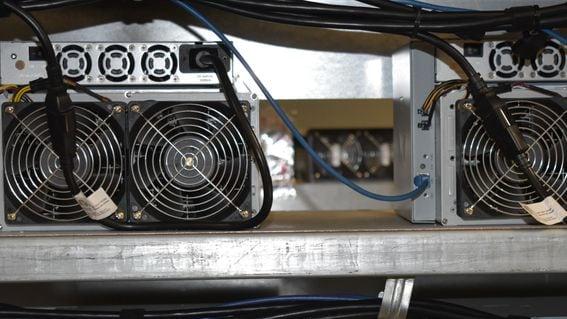
Recent weakness in bitcoin mining stocks ahead of the reward halving offers an attractive entry point for investors, the report said. JPMorgan notes that mining stocks have slumped ahead of the bitcoin halving. The bank favors Riot Platforms and Iris Energy. Bitcoin’s outperformance may mean that part of the typical post-halving rally has been pulled forward, the report said. Recent weakness in mining stocks ahead of the bitcoin (BTC) halving offers an attractive entry point for investors, JPMorgan (JPM) said in a research report on Tuesday. The total market cap of the 14 U.S.-listed bitcoin miners tracked by the bank fell 28%, or $5.8 billion, to $14.2 billion, from March 31 to April 15, the report said. All of the stocks underperformed bitcoin and all lost at least 20%. The report noted that bitcoin has gained 43% year-to-date and 130% in the last six months, as it “appears a portion of the typical post-halving rally was pulled forward.” The quadrennial reward halving slows the rate of growth in bitcoin supply and is expected to occur around April 19-20. The bank said it is especially bullish on overweight-rated Riot Platforms (RIOT) and Iris Energy (IREN) as these stocks offer attractive relative valuations. “With the bitcoin halving on the horizon, we expect heightened volatility and trading volume in both bitcoin and mining stocks,” analysts Reginald Smith and Charles Pearce wrote. JPMorgan notes that mining profitability was lower in the first two weeks of April as “network hashrate growth outpaced bitcoin price appreciation.” https://www.coindesk.com/markets/2024/04/17/bitcoins-outperformance-means-some-of-expected-post-halving-rally-may-have-come-early-jpmorgan/
2024-04-17 10:37
Bitcoin’s bullish trajectory is expected to resume after the halving once mining hashrates have adjusted to the lower rewards and ETF inflows resume, the report said. Bernstein recommends buying bitcoin miners Riot Platforms and CleanSpark ahead of the halving. Bitcoin’s bullish trajectory to resume after the reward halving, Bernstein said. The broker maintained its cycle high forecast of $150,000 by 2025. The “miner fear factor” is at its peak ahead of the imminent halving, and investors should buy outperform-rated Riot Platforms (RIOT) and CleanSpark (CLSK) because the market will reward these companies for their superior execution and for being market leaders by self-mining hashrate, broker Bernstein said in a research report on Wednesday. Bernstein notes that mining stocks have continued to underperform bitcoin (BTC) year-to-date as the halving raised concerns over profitability once rewards are slashed by 50%. The quadrennial event slows the rate of growth in bitcoin supply and is due around April 19-20. Hashrate refers to the total combined computational power that is being used to mine and process transactions on a proof-of-work blockchain. “Historically, bitcoin price breakout has always followed the halving event and sometimes a few months after halving,” analysts Gautam Chhugani and Mahika Sapra wrote. “However, in the current 2024 cycle, the exchange-traded fund (ETF) approvals in January led to a strong price appreciation pre-halving,” the authors wrote, noting that bitcoin has dropped as much as 15% only in the last 10 days, following slower ETF inflows. The broker said it expects bitcoin’s bullish trajectory to resume after the halving once the mining hashrates have adjusted to the lower rewards and ETF inflows resume. The rollout of spot bitcoin ETFs by wirehouses and registered investment advisors (RIAs) “will continue to provide structural demand for bitcoin,” Bernstein said. “We continue to expect bitcoin to touch a cycle high of $150K by 2025.” https://www.coindesk.com/markets/2024/04/17/buy-bitcoin-miners-ahead-of-the-halving-bernstein-says/

2024-04-17 09:00
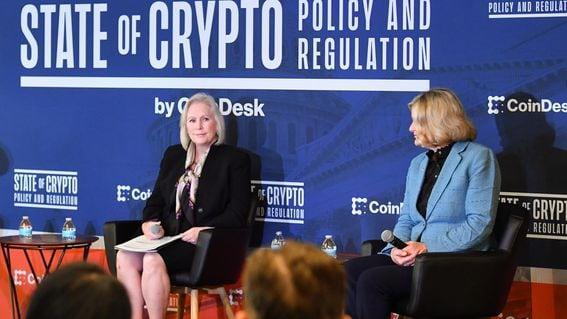
Senators Cynthia Lummis and Kirsten Gillibrand unveiled a new bill Wednesday, hoping to move the needle on stablecoin legislation. U.S. Senators Cynthia Lummis and Kirsten Gillibrand introduced a new stablecoin bill on Wednesday, hoping to create definitions for who can issue dollar-pegged digital assets and how. A stablecoin bill is the type of crypto-specific legislation most likely to become law, but progress on these efforts has stalled out in the past. U.S. Senators Cynthia Lummis (R-Wyo.) and Kirsten Gillibrand (D-N.Y.) are taking another swing at crypto-specific legislation, with a narrowly tailored bill seeking to define how stablecoins – cryptocurrencies that maintain value with some other asset or currency – will operate in the U.S. The lawmakers unveiled a new stablecoin bill Wednesday in the latest effort to create legislation directly addressing this corner of the crypto market. Under their proposed bill, payment stablecoin issuers would have reserve and operational requirements, including needing to create subsidiaries specifically to issue stablecoins. The bill would also require stablecoin issuers to deal in dollar-backed tokens. A payment stablecoin, as defined by the bill, would be any dollar-pegged digital asset "that is, or is designed to be, used as a means of payment or settlement." Issuers would be "obligated" to convert to dollars, and the asset itself won't be a security. Issuers would either have to be non-depository trust companies registered with the Federal Reserve Board of Governors or a depository institution "authorized as a national payment stablecoin issuer." Both state and federal regulators would have roles overseeing these entities. Stablecoin issuers would also be required to ensure their tokens are fully backed by reserve assets and disclose to the public what those assets are. They would also need to tap a non-depository trust as a custodian, and the trust will be required to use a depository institution as a sub-custodian, according to the bill. The bill also appears to ban algorithmic stablecoins, which are typically undercollateralized tokens designed to maintain their value through algorithmic mechanisms. In a statement, Gillibrand said a regulatory framework for stablecoins "is absolutely critical to maintaining the U.S. dollar's dominance," and the proposed bill would keep the existing dual banking system intact. "It protects consumers by mandating one-to-one reserves, prohibiting algorithmic stablecoins, and requiring stablecoin issuers to comply with U.S. anti-money laundering and sanctions rules," she said. "To draft the strongest bill possible, our offices worked closely with the relevant federal and state agencies and I’m confident this legislation can earn the necessary support in the Senate and the House." Her counterpart, Lummis, said the bill also meets "the growing demand for our ever-evolving financial industry" in a statement, echoing Gillibrand's point on the dual banking system and the dollar's dominance. The bill created a $10 billion limit for non-depository trust institutions to be able to issue payment stablecoins. Once the issuer exceeds that amount, it must be "a depository institution that has been authorized as a national payment stablecoin issuer," the bill's text said. At present, the largest U.S.-based stablecoin issuer, Circle (with $33 billion in outstanding (USDC)), is not a depository trust institution. The next largest, Paxos, does have a limited purpose trust charter through the New York Department of Financial Services, though its market cap falls well below that $10 billion cutoff. A Senate staffer described the $10 billion limit as the approximate cutoff between a small community bank and a larger regional financial institution with systemic risk potential. Lummis and Gillibrand have jointly introduced a number of bills addressing the digital assets market, including a bill last summer that would create legal definitions for decentralized finance and draw lines for where federal agencies like the Commodity Futures Trading Commission have jurisdiction over crypto. While these bills have not gone anywhere, a Senate staffer told reporters on Tuesday that the lawmakers had sought feedback from federal regulators and the White House. Stablecoin legislation has long been seen as the type of crypto-specific legislation most likely to become law in the U.S., though progress has been slow. House Financial Services Chair Patrick McHenry (R-N.C.) and Ranking Member Maxine Waters (D-Calif.) have worked on stablecoin legislation for years. A bill advanced out of committee last year, but progress stopped after then-Speaker of the House Kevin McCarthy was ousted. Last week, Punchbowl News reported that Senate Majority Leader Chuck Schumer (D-N.Y.) met with McHenry and Waters to discuss potentially attaching stablecoin legislation to a bill reauthorizing the Federal Aviation Administration, seen as a must-pass piece of legislation. On Tuesday, Sen. Sherrod Brown, who chairs the Senate Banking Committee, signaled stablecoin legislation could advance if it included certain specific safeguards. https://www.coindesk.com/policy/2024/04/17/us-senators-lummis-gillibrand-take-on-stablecoin-legislation-with-new-bill/
2024-04-17 08:36
Bitcoin's fourth mining reward halving is just two days away. Bitcoin's mining-reward halving alone did not catalyze previous bulls runs, macro factors probably played a role, Goldman said. Continued gains in BTC may be contingent on strong inflows into the spot ETFs. Bitcoin's fourth mining-reward halving is just two days away. The quadrennial event will reduce BTC's per block emission to 3.125 BTC from 6.25 BTC, halving the pace of new supply. Previous halvings preceded massive multimonth rallies in BTC, and the crypto community is confident that history will repeat itself. Investment banking giant Goldman Sachs, however, cautioned its clients from reading too much into the past halving cycles. "Historically, the previous three halvings have been accompanied by BTC price appreciation after the halving, although the time it took to reach the all-time highs differs significantly. Caution should be taken against extrapolating the past cycles and the impact of halving, given the respective prevailing macro conditions," Goldman's Fixed Income, Currencies and Commodities (FICC) and Equities team said in a note to clients on April 12. The chart shows bitcoin's performance after previous halvings on Nov. 28, 2012, July 9, 2016, and May 11, 2020. Though bulls were in the driver's seat following each of the three halvings, the magnitude and the time taken to reach the eventual peak differed. More importantly, the macroeconomic environment on those occasions differed from today's high inflation, high-interest rate climate. Back then, M2 money supply of major central banks – U.S. Federal Reserve, European Central Bank, Bank of Japan and People's Bank of China – grew rapidly, as CoinDesk reported last year. Interest rates were stuck at or below zero in the advanced world, which catalyzed risk-taking across the financial market, including cryptocurrencies. In other words, for history to repeat itself, macro conditions need to be supportive of risk-taking. That's not the case today: Interest rates in the U.S., the world's largest economy, stand above 5% and markets have recently priced out hopes of cuts this year in the light of sticky inflation and a resilient economy. The bitcoin price has rallied 50% this year, reaching record highs well ahead of the halving, thanks to inflows into the U.S.-based spot exchange-traded funds (ETFs) and has risen over 130% in six months. According to Bloomberg, the 11 spot-based ETFs, which went live three months ago, have amassed $59.2 billion in assets under management, creating a demand-supply imbalance. As such, some analysts believe the major portion of the usual post-halving surge has been brought forward, leaving the door open for a sell-the-fact pullback after the April 20 halving. According to Goldman, BTC's halving is a "psychological reminder to investors of BTC's capped supply," and the medium-term outlook depends on the uptake of the ETFs. "Whether BTC halving will next week turn out to be a “buy the rumour, sell the news event” is arguably less impactful on BTC’s medium term outlook, as BTC price performance will likely continue to be driven by the said supply-demand dynamic and continued demand for BTC ETFs, which combined with the self-reflexive nature of crypto markets is the primary determinant for spot price action," the team wrote. https://www.coindesk.com/markets/2024/04/17/goldman-cautions-against-extrapolating-previous-bitcoin-halving-cycles-for-price-predictions/

2024-04-17 06:00
Rodarmor created last year's breakout Ordinals protocol, which is used to create non-fungible tokens (NFTs) on Bitcoin. Now, he says the relevance of protocols like his new Runes, used to create fungible tokens, is set to grow. Bitcoin's next quadrennial halving is imminent – now likely to happen Friday or early Saturday. But a large number of the 15-year-old blockchain's developers and users are turning their attention to an event that's expected to take place immediately following the halving: the launch of Casey Rodarmor's Runes protocol. Rodarmor's big project release last year – the Ordinals protocol for creating NFT-like "inscriptions" on Bitcoin – brought a fresh spirit of playfulness and development vigor to the notoriously conservative blockchain's ecosystem, while showering crypto miners with a cumulative $256 million in revenue. (The popularity of the transactions caused knotty problems like network congestion and soaring user fees, among the tradeoffs.) The Runes protocol, which will allow users to spin up scads of tokens atop Bitcoin like those commonly seen on other blockchains like Ethereum and Solana, could build on the success of Ordinals. But the arrival of Rodarmor's new platform could also fundamentally stretch the boundaries of what has previously been considered acceptable in Bitcoin culture, where any digital tokens besides the native cryptocurrency bitcoin have long been viewed as taboo. Ordinals allowed attaching pieces of data known as "inscriptions" to satoshis, the smallest denomination of BTC – effectively allowing for non-fungible tokens (NFTs) to be minted and traded on Bitcoin, an activity that was previously only available on other blockchains. Soon afterward, another developer, Domo, unveiled "BRC-20" – a standard for creating fungible, or tradable, tokens, another feature that hadn't previously existed on Bitcoin. Rodarmor himself has described Runes as a more efficient method of creating new tokens atop Bitcoin, writing in a in a post on X on April 1 that the protocol was "built for degens and memecoins." "I'm creating a venue for people to create sh!tcoins," Rodarmor said in February on an episode of his podcast, Hell Money. The question is whether they will take off, the way Ordinals did. Runes' 'Simplicity and Security' Rodarmor describes Runes as a protocol and token standard that can address some of the shortcomings of BRC-20. With BRC-20, users can only transfer one type of token to one destination with one inscription. Runes, however, will allow users to fan out different tokens in a single transaction that transfer any number of Runes from the inputs to the outputs. Rodarmor says Runes will offer greater simplicity and security to users than the current BRC-20 standard does. "To transfer a BRC-20 token takes three transactions due to the way inscriptions work. You need two transcriptions to create the inscriptions and one to transfer the resulting inscription to the recipient," Rodarmor told CoinDesk in an interview. "The other shortcoming is complexity. BRC-20 is essentially a superset of Ordinals inscriptions, whereby if you're writing a BRC-20 index, you have to include an Ordinals index and then additionally add the logic for the BRC-20 on top of that." Runes, by comparison, is a standalone protocol with no dependencies on Ordinals, Rodarmor said. It is also designed to be more efficient. With the exception of creating a rune, which is done by a two-inscription process, everything else takes one transaction. "The transactions are very small and the transfers are very efficient," he added. The first rune, technically "rune 0" has been named by Rodarmor as "UNCOMMON•GOODS," he said. "It has an open mint, starting on the halving and ending on the next halving," Rodarmor said. "It is indivisible, so the unit can't be divided into subunits, and each mint transaction gets one unit." Bitcoin Halving and Runes There's no real technical reason that Runes needs to launch right at the halving. It is just "thematically cool," Rodarmor said. However, he does argue there are post-halving trends that Runes will influence. The halving – Bitcoin's fourth in its 15-year history, a core feature of Satoshi Nakamoto's original programming – will see miners' reward for adding new blocks to Bitcoin cut by 50% from 6.25 BTC to 3.125 BTC. The security of Bitcoin is tied to the difficulty of the network, or the number of hashes needed to add a new block. Should the hash rate fall because the block reward has been slashed by 50%, among many potential reasons, the network would be less secure, since it would be easier to add new blocks. "The halving programming is a very aggressive schedule," Rodarmor said. "I wouldn't advocate changing it, but if I was going to design Bitcoin from scratch, I probably would not have picked such a fast decay." As a result of the halving, the network's security may become more reliant on transaction fees – the small amounts of bitcoin paid to miners to validate a transaction by including it in the latest block. The halving of block rewards would then need to be offset by an increase in BTC's price, incentivizing more mining activity and thereby increasing the hash rate. Should this not happen though, fees would need to increase instead. "We already frequently see blocks where the fee is greater than the block subsidy, and that will become more common over time with each halving," Rodarmor said. Runes could therefore play a part in generating sources of demand for block space, helping to drive up fees that could become more important in securing the network. This view is by no means universal in the Bitcoin community. Ordinals proved controversial among some developers for causing congestion on the network and bringing out a spike in fees, an accusation Runes may face as well – if it proves successful. How does Runes work? Runes builds on Ordinals by using UTXOs – unspent transaction outputs, a key element of Bitcoin creator Satoshi Nakamoto's network design – to generate transactions. UTXO is the term for the amounts of crypto left over after a transaction, similar to change remaining after completing a purchase in cash. The new protocol extends the UTXO concept through the ability to hold a balance in any number of Runes tokens. A single Rune can contain 10 units of Rune A, 100 units of Rune B and 1,000 units of Rune C, and so on, with any UTXOs unspent by a transaction destroyed. Users would therefore send a bunch of Runes on different inputs, which will be transferred to an OP_RETURN to be burned. That is unless they mark it with a "Runestone," a pointer that specifies an alternative output, rendering them non-spendable and thus ignored by Bitcoin Core, the network's software. A Runestone could be used to create a new Rune, known as "etching," or mint or transfer existing Runes. Rodarmor sums up Runes as a "simple OP_RETURN-based protocol," as presented through around 2,000 lines of code. The concept of not creating leftover UTXOs is "a very simple strict improvement over BRC-20," Bitcoin entrepreneur Dan Held wrote in a blog post earlier this month. "Inscriptions have doubled the size of the UTXO set in just the past year and the majority of those are forever useless," he wrote. Read More: Bitcoin Meme Coin PUPS Fuelled by Hype Ahead of Runes Release https://www.coindesk.com/tech/2024/04/17/runes-casey-rodarmors-protocol-for-shtcoins-on-bitcoin-set-to-go-live-at-halving/

2024-04-17 04:37
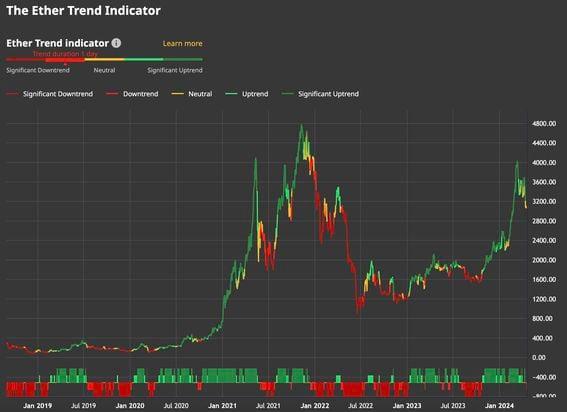
Some other catalyst needs to happen before bullish sentiment returns, says one trader. BTC is up, trading above $64,000 while ETH prices continue to decline. The CD20 is flat, trading at 2,174. Ether (ETH) was changing hands just above $3,000 during the opening hours of the Asia trading day as the CoinDesk Indices Ethereum Trend Indicator flipped negative, signaling a bearish shift in momentum. At the same time, bitcoin (BTC), is trading slightly above $64,000 after challenging it for most of the Asia trading morning. "Unexpected higher U.S. treasury yields, a stronger dollar, and geopolitical risks in the Middle East weighed down on crypto markets," Jun-young Heo, a Derivatives Trader at Singapore-based Presto, said in an interview on Telegram with CoinDesk. Yeo said that risk-off sentiment was also reflected in the derivatives market, with funding rates in some exchanges turning negative and three-month basis yields "plunging" to 10%. "Short-term put options are more expensive than call options for both BTC and ETH," Heo continued. Liquidations in the last 12 hours came in almost evenly split between bullish and bearish futures bets, with $31.1 million in long positions getting liquidated and $36.49 million in shorts getting rekt. "It seems investors have been unable to break all-time highs but remain unwilling to completely turn bearish either," Justin d'Anethan, head of business development at Keyrock, a crypto market maker in Hong Kong, said in a note to CoinDesk. The CoinDesk 20, an index measuring the performance of the world's largest digital assets, is effectively flat trading at 2,174. "It is a difficult environment to navigate with a series of positive crypto-centric catalysts," he continued. On the other hand, the macro side of things seems to be dominating all risk assets, with more hawkish rate expectations in light of surprisingly higher inflation and, of course, the increase in tension in the Middle East." d'Anethan also noted that sideways price action and settling into a range could, in crypto, set the stage for more explosive moves, with leveraged traders taking a view and then suffering from violent liquidation events when the scene clears up, bringing a decisive move in markets. "It might need some time or other catalyst rather than known events to turn this sentiment back to bullish," added Heo. https://www.coindesk.com/markets/2024/04/17/ether-prices-in-downtrend-as-bitcoin-challenges-64k/