2024-04-10 21:00
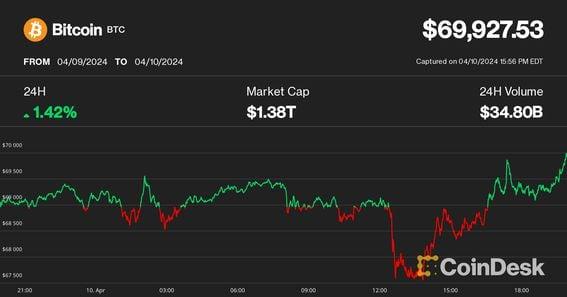
Major U.S. equity indices closed the day lower after disappointing CPI numbers, while BTC was up 1%. Bitcoin (BTC) climbed back to $70,000 Wednesday, reversing its knee-jerk dip following hotter-than-anticipated U.S. inflation data for March. BTC slipped nearly 4% to $67,500 during early U.S. hours after a government report showed the Consumer Price Index (CPI) rising faster than analyst expectations, prompting investors to temper their expectations for rate cuts this year. The dip echoed through multiple asset classes, but bitcoin gradually erased all its losses, and was up over 1% over the past 24 hours, outperforming U.S. equities and gold, both of which finished with sizable declines for the day. At press time, bitcoin had slipped a bit from the $70,000 level, trading at $69,800. Most cryptocurrencies lagged behind BTC, with the broad-market CoinDesk 20 Index down 0.6% during the same period, dragged lower by a 5%-7% decline in major altcoins polkadot (DOT), bitcoin cash (BCH), near (NEAR) and aptos (APT). Decentralized exchange Uniswap's governance token (UNI) plummeted more than 10% as it received an enforcement notice from the U.S. Securities and Exchange Commission, foreshadowing regulatory actions against the platform. Digital asset hedge fund QCP Capital said the rebound showcased the underlying demand for bitcoin, with investors seeing dips as a buying opportunity. "This bounce is not surprising as the desk continues to see strong demand for long-dated BTC calls even on this dip," QCP said in a Telegram update. "It is indicative of deep structural bullishness in BTC." Will Clemente, co-founder of Reflexivity Research, noted in an X post that the ever-increasing U.S. debt levels are more important for the big picture than individual CPI readings, and the most likely scenario is that policymakers will let inflation run higher than the 2% target to help inflate the debt. "Bitcoin is an insurance against this," Clemente added. https://www.coindesk.com/markets/2024/04/10/bitcoin-rebounds-to-70k-shrugging-off-hot-us-inflation-print/
2024-04-10 20:15
Steven Nerayoff has retained well-known civil liberties lawyer Alan Dershowitz to serve as a consultant on constitutional issues in the case. Steven Nerayoff, a former adviser to the Ethereum network, is seeking $9.6 billion in damages from the U.S. government stemming from a 2019 case against him that was later dropped. Lawyers for Nerayoff allege their client was framed by the FBI and federal prosecutors in order to get him to turn over evidence on high-profile people in the crypto industry. Steven Nerayoff, an early adviser to the Ethereum network, has filed a notice of his intent to sue the U.S. government for $9.6 billion in damages connected to his 2019 arrest on criminal extortion charges, which his lawyers called “fabricated” and “baseless.” Nerayoff’s Federal Tort Claims Act (FTCA) form, which was provided to CoinDesk by his lawyers, is the first step towards filing a lawsuit against the Department of Justice (DOJ). In FTCA cases, the agencies involved must be notified of the claimant’s intention to sue at least six months before a lawsuit is formally filed. Well-known civil liberties lawyer Alan Dershowitz confirmed Wednesday that he will serve as a consultant on constitutional issues for Nerayoff’s case. The government’s charges against Nerayoff were dropped in May 2023. Two months earlier, prosecutors moved to end the case, admitting that they had obtained material exculpatory evidence and were unable to prove the charges in the indictment beyond a reasonable doubt. Nerayoff’s lawyers had, before that, filed a motion to dismiss that was chock-full of explosive claims against the federal investigators and prosecutors involved in the case. Nerayoff and his lawyers say that he was the victim of an elaborate, years-long setup by the Federal Bureau of Investigation (FBI) with the ultimate intention of getting him to turn over evidence on important figures in the crypto industry. The FBI did not respond to CoinDesk’s request for comment by the time of publication. On the morning of Sept. 17, 2019, Nerayoff claims he was arrested by a dozen gun-wielding FBI agents and interrogated for “hours” in an unmarked van parked outside his home. According to Nerayoff, the agents told him he would “not see his young minor children grow old” unless he cooperated by giving them information. The government denied the majority of Nerayoff’s claims in a filing of its own, including the assertion that Nerayoff’s colleague and former co-defendant on the extortion charges, Michael Hlady, was a government informant. Nerayoff’s lawyers maintain that Hlady, who was convicted of swindling Catholic nuns out of nearly $400,000 in 2010, was “insinuated … into [his] orbit” by the FBI, in order to help them build a case against Nerayoff. In 2021, Hlady pleaded guilty to the extortion charges Nerayoff was also tied up in. But last month, the government moved to drop the charges against him and allow him to withdraw his guilty plea, instead having him plead guilty to one count of wire fraud in an unrelated fraud scheme he committed while out on bond. https://www.coindesk.com/policy/2024/04/10/former-ethereum-adviser-intends-to-sue-us-government-for-96b-over-dropped-extortion-charges/

2024-04-10 20:13
Massive demand for a China-listed gold ETF sent its premium soaring to 30% earlier this week. Hong Kong regulators will likely approve spot bitcoin ETFs as early as next week, Reuters reported Wednesday. The funds could offer an alternative to Chinese investors reluctant to invest in domestic real estate and stocks, one observer noted. "The market should not expect flows anywhere near the size of U.S. spot ETF flows," said a K33 analyst. Heightened anticipation for spot-based bitcoin ETFs in the U.S. and the eventual inflows supercharged bitcoin's run-up to new all-time highs, and now Hong Kong regulators reportedly are inching closer to approving similar funds, news that thus far has been mostly unnoticed in crypto circles. These vehicles, however, could open the floodgates for Chinese investors looking for a new haven next to gold and overseas real estate and stocks in which to store their wealth. "[They] will be a big deal," Noelle Acheson, macro analyst and author of Crypto Is Macro Now newsletter, said in an email interview with CoinDesk. "It's not just for the access to hedge funds and family offices based in the region; it's also because of the access it gives to mainland investors." Chinese investors are reluctant to invest in domestic real estate and stocks given the well-documented troubles of the country's housing market, construction sector and equities. That, in turn, has spurred interest in alternative assets like gold, Acheson explained. Notably, trading with a gold-linked ETF in China was halted earlier this week after its price premium reached 30% as investors piled into the asset trading at record high prices. In similar fashion, there could be "a significant flow of funds into BTC," Acheson said, adding that the investment case for the largest cryptocurrency will become even more prevalent if concerns about further devaluation of the yuan ramp up. "Chinese authorities most likely realize that a significant portion of their citizens will be diversifying into hard assets whether approved or not, and would probably prefer that they be in assets not related to the U.S. economy," Acheson noted. Markus Thielen, founder of Singapore-based analytics firm 10x Research, said that the ETFs could raise the probability of a Chinese retail buying frenzy similar to the 2013 bull market. Bitcoin's popularity exploded in the country that year, driving the price to over $1,000 from only $10 in January., The rally didn't end until China's government banned financial institutions from trading the asset in December. "70% of Chinese own property and as the market has recently repriced lower together with the stock market, there are not many alternatives," Thielen said. "Bitcoin is one." While the approval of ETFs could be a further positive catalyst for bitcoin, the market should not expect flows anywhere near the size seen by the U.S. spot funds, said Vetle Lunde, senior analyst at K33 Research. The two futures-based bitcoin ETFs listed in Hong Kong have seen "solid" growth this year more than doubling their assets in BTC terms, he noted, but their combined size is less than 2,000 BTC, or just 2% of the U.S.-listed futures ETFs. "The small size of HK futures ETFs compared to the U.S. is, in our opinion, a signal to the market that HK ETFs should see less exuberant flows than those witnessed in the U.S.," Lunde said. https://www.coindesk.com/markets/2024/04/10/hong-kongs-incoming-spot-bitcoin-etfs-could-be-big-deal-heres-what-analysts-say/

2024-04-10 18:57
Uniswap’s CEO Hayden Adams took to X on Wednesday to say that the exchange is “ready to fight” after receiving notice that the regulator is planning an enforcement action. Decentralized crypto exchange Uniswap received a notice from the U.S. Securities and Exchange Commission (SEC) that it intends to pursue an enforcement action, the company disclosed on Wednesday. Uniswap's native token, UNI, dropped 9.5% immediately after the news. Uniswap CEO Hayden Adams announced the receipt of the so-called Wells notice on X, saying he wasn’t surprised, “just annoyed, disappointed, and ready to fight.” Wells notices are preliminary warnings that inform respondents of the charges the regulator is considering bringing against them. They usually lead to enforcement actions. In a press conference on Wednesday afternoon, Uniswap’s COO Mary-Catherine Lader and Chief Legal Officer Marvin Ammori told reporters that the content of the Wells notice was focused on Uniswap acting as an unregistered securities broker and unregistered securities exchange. It remains unclear whether Uniswap’s native token, UNI, was implicated as a potential security in the SEC’s notice. Ammori said that he believes that Uniswap does not meet the SEC’s current definition of an exchange. He also pointed to a recent ruling in the SEC's case against Coinbase – in which a judge said that Coinbase Wallet was not a broker – as a good sign for Uniswap's ability to beat the SEC on the same charges (the judge ruled that the SEC's other allegations against Coinbase could move forward). “I am confident that the products we offer are legal and that our work is on the right side of history,” Adams wrote. "But it’s been clear for a while that rather than working to create clear, informed rules, the SEC has decided to focus on attacking long-time good actors like Uniswap and Coinbase. All while letting bad actors like FTX slip by." Adams said that Uniswap will fight the charges. “I'm frustrated that the SEC seems to be more concerned with protecting opaque systems than protecting consumers. And that we'll have to fight a US government agency to protect our company and our industry,” Adams wrote. “This fight will take years, may go all the way to the Supreme Court, and the future of financial technology and our industry hangs in the balance. If we stand together we can win. I think freedom is worth fighting for. I think DeFi is worth fighting for.” An SEC spokesman said the agency "does not comment on the existence or nonexistence of a possible investigation." Regulation via enforcement In a Wednesday blog post, Uniswap wrote that the Wells notice, as well as the SEC’s lawsuits against Coinbase and other crypto companies, indicates that their action against Uniswap is just “the latest political effort to target even the best actors building technology on blockchains.” Uniswap denies that the tokens it offers for sale are securities, despite the SEC’s position that most tokens besides bitcoin fall under their jurisdiction. “The reality is that tokens are a digital file format, like a pdf or spreadsheet, and can store many kinds of value. They are not intrinsically securities, just as every sheet of paper is not a stock certificate,” the blog post said. “The overwhelming volume of traded tokens are definitively not securities – they are stablecoins, community and utility tokens, and commodities like Ethereum and Bitcoin.” The blog post added that, in cases where a token may in fact be a security, “the SEC has refused to create a path for businesses to register.” Uniswap did not comment further on the matter, aside from directing CoinDesk to Adams' social media post and the company's blog post. Waiting on Congress Uniswap argued that the SEC has “no authority from Congress” to oversee the crypto markets, citing SEC Chairman Gary Gensler’s past testimony before Congress that a new law would need to be passed to give the agency the necessary powers to effectively regulate the industry, though Gensler has since argued that the existing securities laws are sufficient for the regulator to police crypto. Efforts to pass a comprehensive regulatory framework for the crypto industry have stalled, and will likely remain stagnant ahead of the upcoming presidential election. https://www.coindesk.com/policy/2024/04/10/defi-exchange-uniswap-receives-enforcement-notice-from-the-sec/
2024-04-10 17:59
The "restaking" protocol with $15 billion in deposits won't pay rewards to depositors and is missing its mission-critical "slashing" feature. The blockchain project EigenLayer didn't go live on Ethereum's mainnet until Tuesday, but it had already become one of the network's biggest-ever protocols, with $12 billion worth of user deposits – a hot ticket partly because of its highly touted innovation of "restaking," a new technology that could usher in dramatic changes in the way crypto protocols bootstrap their security. A closer inspection reveals that EigenLayer has not yet activated most of the core features that make the project notable – including its reward system and its mission-critical "slashing" mechanism. In the fast-moving, big-money world of crypto, EigenLayer has attracted a level of investor, developer and media interest that's rare: On top of its $15 billion worth of deposits at press time, Eigen Labs, the project's developer, raised a staggering $100 million from venture giant Andreessen Horowitz last year. There's also a cottage industry of startups – called "actively validated services" (AVSs) – that are waiting to plug into EigenLayer's security apparatus, as well as "liquid restaking" startups aiming to piggyback off of EigenLayer's success, already netting billions of dollars in their own deposits. EigenDA, a data-availability protocol built by Eigen Labs, was the first AVS to launch on EigenLayer – released on Tuesday in tandem with the rest of the EigenLayer protocol. As other AVS networks wait in the wings – for now, they're only allowed to "register" – EigenDA is supposed to be a proof-of-concept for what EigenLayer will eventually enable for other services: A way for networks to base their own security on Ethereum's. In EigenLayer's current, arguably still larval state, however, EigenDA relies on a strikingly conventional security model. The protocol is controlled by a globally distributed set of operators, but they won't be financially punished if they act dishonestly – a core component of EigenLayer's purported security model. The protocol also won't pay out rewards to depositors, which is supposed to be the main incentive for restaking. Sreeram Kannan, EigenLayer's founder and chief architect, acknowledged in an interview last week that the launch would move forward without some crucial functionality, instead proceeding under a "phased" rollout under an unspecified timeline. "We are allowing the EigenLayer marketplace to develop and stabilize before introducing in-protocol payments and slashing to mainnet later this year," EigenLayer said on Tuesday in its launch thread. The use of so-called training wheels is not out of the norm in crypto – particularly given the experimental culture of the industry: When a startup is trusted with billions of dollars in user deposits, Silicon Valley's "move fast and break things" approach doesn't really cut it. "There are a lot of other projects that just take shortcuts and kind of balloon and are much, much higher risk than this," said Mike Silagadze, CEO of Ether.fi, a liquid restaking service that has deposited $3.8 billion worth of its users' funds into EigenLayer. "I think relative to other crypto projects, this has actually been reasonably measured." But as the third-largest decentralized finance protocol in terms of total value locked (TVL) – and competitors beginning to encroach on its turf – expectations for EigenLayer couldn't be higher. The current state of EigenLayer EigenLayer centers around "restaking" – a way of repurposing the Ethereum blockchain's security to cover additional protocols, these AVSs. Technically how it works is that investors can take the ether (ETH) they've staked on the main Ethereum chain, and then reapply (or "restake") it to secure the AVSs; they could be blockchain bridges, crypto exchanges or data storage facilities. The benefit for EigenLayer investors – called "restakers" – is that they get an extra rate of return on top of the interest they already receive for staking ETH. The AVSs get the advantage of "pooled security." Kannan gives the example of 100 blockchain protocols that are each secured by $1 billion worth of stake. Imagine that "instead of each of the protocols having $1 billion separately staked, there was $100 billion commonly staked across 100 protocols," said Kannan. "To attack any one protocol, now you need $100 billion rather than needing $1 billion." That's the idea, at least. The actual meat of the EigenLayer security system remains more theory at this point than reality, as do the pieces of EigenLayer's design that are supposed to pay out interest to depositors. Take, for example, the "slashing" feature that sits at the center of EigenLayer's security system. Slashing is integral to EigenLayer: It ensures that networks built on top of the protocol can penalize operators if they act dishonestly – by revoking all or a portion of their restaked deposits. But slashing wasn't included in EigenLayer's launch this week, and in an interview, Kannan couldn't give a firm timeline on when it would be ready – beyond that it would be sometime later this year. There also remain big questions about how the whole thing will actually work – including how, and in what proportion, slashed tokens will be burned and distributed once they've been revoked. For AVSs to build on EigenLayer, such questions eventually need to be answered. "Even though the full slashing is not live, we are going to run this system in beta and make sure that people are able to use it, and maybe have redundant backups and other stuff," said Kannan. Another yet-to-be-defined element of EigenLayer's programming is its "attributable security" system – a fallback mechanism that Kannan plans to use to protect against black swan events that threaten to wipe out the protocol's security apparatus. The feature exists to address the potential for contagion risk – the idea that a slashing event triggered by one AVS could hurt the security of every other AVS. Attributable security works a lot like insurance (crypto founders mint new terms as quickly as they do new tokens), and in principle, a new actuarial market will spring up with pricing for each of the AVSs, ostensibly linked to their perceived risk. "A service that's built on Eigenlayer can come in and say, 'Out of this $100 billion that is totally staked, I want a particular attribution of $3 billion,'" explained Kannan. "Now, it's EigenLayer as a protocol's job to make sure that even if every other AVS is simultaneously depleted, I will be able to redistribute the amount of $3 billion to this AVS." But asked to define how EigenLayer's attributable security market will actually price things in practice, Kannan said that his team "has not published" anything on it yet. Then there's EigenLayer's fee system – the source of revenue it will use to reward interest to depositors, which is supposed to be the main incentive for restaking. Kannan said in an interview with CoinDesk that the fee system is at the top of his team's priority list and should be easy to implement, but its absence means that users won't be able to earn interest for restaking with AVSs. In the absence of this core feature, the billions of dollars deposited into EigenLayer thus far have come as a result of the platform's point system: EigenLayer prints out loyalty points that investors hope will eventually be convertible into real crypto tokens. Until EigenLayer launched this week, many crypto traders and users were simply pursuing these points – Earning them by depositing assets into EigenLayer and liquid restaking protocols like Ether.Fi, and, in some cases, buying the points outright and trading them on 40x leverage via third-party crypto protocols aimed at risk-seekers. "In hindsight, I would probably say, man, we should have really toned down the point stuff because that just went really crazy," said Ether.Fi's Silgadze. "Crypto is insane, so people took it way too far." Looking ahead Without slashing, fees and attributable security, EigenDA, currently the only AVS, is a far cry from what is ultimately envisioned for EigenLayer. In the near term, EigenDA will be operated by a community of validators, but those validators won't be at risk of slashing – this means they won't be financially incentivized to act honestly (which is, well… the whole point of EigenLayer's "pooled security"). Kannan says most of EigenLayer's main features will arrive by the end of this year, but some find it difficult to take those estimates at face value. “In some cases, there's just engineering problems, where you kind of bat your head against it, and eventually you're gonna figure it out," said Silgadze. "And then there's research problems [...] there's literally no solution known." When it comes to those research problems, "it's hard to respect timelines," said Silgadze, "because these are unsolved problems that you're trying to sort out." The lack of clarity around the state of EigenLayer's technical stack has led to mounting frustration among some EigenLayer developers who requested anonymity in order to discuss the topic candidly – along with confusion for users around where EigenLayer currently sits on its ambitious roadmap. There are also concerns that EigenLayer's design is tantamount to "rehypothecation" – an oft-criticized practice from traditional finance where collateral is repackaged for higher potential returns, but also a higher risk of losses. (Kannan vehemently rebuts this argument, stating that, among other things, EigenLayer is different from conventional rehypothecation because it grants users complete control over their assets.) "I think we need to get better at communicating changes and our roadmap to the broader EigenLayer ecosystem," said Kannan. "We did not expect to be at this scale where there's so many projects that are dependent and are downstream of our codebase." Calvin Liu, Eigen Labs' chief strategy officer, says he welcomes the scrutiny. "When something has a ton of hype, that’s when you should examine most closely and be most skeptical. I appreciate that and take that view to other projects all the time," Liu said in a message on Telegram. "I am confident that in time we’ll stand up to that view. And I welcome the prodding - it only makes us better in the long run." https://www.coindesk.com/tech/2024/04/10/eigenlayer-cryptos-biggest-project-launch-this-year-is-still-missing-crucial-functionality/

2024-04-10 12:36
Stubbornly high inflation has shattered Wall Street expectations for a long series of rate cuts in 2024. Inflation data once again has disappointed, with the Consumer Price Index (CPI) for March rising more than anticipated and casting doubt on hopes for a Fed rate cut at some point this summer. The CPI for March rose 0.4% versus expectations for 0.3% and February's 0.4%. On a year-over-year basis, CPI was up 3.5% versus 3.4% expected and 3.2% in February. The core CPI, which excludes food and energy costs, rose 0.4% in March versus 0.3% anticipated and 0.4% the previous month. Year-over-year core CPI was up 3.8% versus 3.7% expected and 3.8% in February. The price of bitcoin (BTC) fell more than 1% to $68,200 in the minutes following the report. Traditional markets aren't taking the numbers well either, with S&P 500 and Nasdaq 100 futures both tumbling about 1.5%. The 10-year U.S. Treasury yield has shot higher by 13 basis points to 4.50% and the dollar index has rinse a sizable 0.5%. Gold, which has been carving out new record highs on nearly a daily basis of late, is down 0.5% to $2,352 per ounce. In addition to the spot ETFs and the halving, easier U.S. monetary policy was expected to be one of the bullish catalysts for bitcoin in 2024. Markets came into the year having priced in about 5 or 6 Federal Reserve rate cuts in 2024, but inflation – which fell steadily through much of 2022 and 2023 – hasn't cooperated. It's actually risen a bit through the first quarter and remains well above the U.S. central bank's 2% target. A series of Fed members have made clear they're not inclined to begin easing monetary policy until seeing a sustained path, i.e., more than just one monthly report, of inflation trending downward. Traders, meanwhile, have quickly whittled away their expectations of rate cuts, and prior to this morning's report had priced in just two or three for the full year, according to the CME FedWatch Tool, with the first move coming in June or July. Following the new inflation data, the tool now shows September as the most likely time for an initial rate cut. https://www.coindesk.com/business/2024/04/10/us-cpi-comes-in-faster-than-hoped-rising-04-in-march/