2024-04-09 11:19
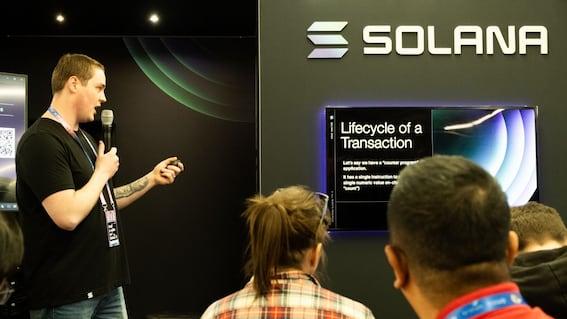
Solana is leading the field in blockchain payments, but the network has scalability issues, the report said. Stablecoins are being adopted for cross-border settlements, Bernstein said. There have been signs of early adoption by payment firms such as Paypal and Visa, the broker said. Stablecoin supply is growing, the report noted. The stablecoin market is growing and these cryptocurrencies are being adopted for cross-border settlements with payments firms, fintech companies and consumer platforms among the early users, broker Bernstein said in a research report on Tuesday. Bernstein notes that stablecoin supply currently stands at $150 billion, with tether (USDT) and USD Coin (USDC) dominating the market with shares of 75% and 22% respectively. A stablecoin is a type of cryptocurrency that’s usually pegged to the U.S. dollar, though some other currencies and assets such as gold are also used. “Stablecoin value settled on the blockchain indicates strong adoption of digital dollar with the crypto trading ecosystem as well as a cross-border payments currency,” analysts Gautam Chhugani and Mahika Sapra wrote, noting that “Q1 2024 annualized value transferred stands at $6.8 trillion, equivalent to 2022 high of ~$7 trillion.” The authors said there have been signs of stablecoin adoption by payments firms such as Paypal (PYPL) and Visa (V) and consumer fintech platforms such as Grab (GRAB) in Singapore and Mercado Libre (MELI) in Latin America. Solana is leading the field in blockchain payments, but has scalability issues, the report said. “The big change this cycle has been the dominant market share of Solana (43% highest share) in value of stablecoins transferred versus prior cycle market leader Ethereum,” Solana is conducting pilots with Visa and Shopify, but it's unclear whether the blockchain can break into more mainstream consumer and business-to-business payments, which would require a massive jump in scalability, the note said. “Scalability requirements for consumer payments would require 15-20 fold growth from here (Solana ~700 TPS versus 10K+ for payment networks), and general purpose blockchains are yet to cross that chasm,” the report added. Read more: Stablecoin USDC Is Making a Comeback: Coinbase https://www.coindesk.com/business/2024/04/09/stablecoins-are-seeing-adoption-as-a-cross-border-settlement-mechanism-bernstein/
2024-04-09 10:36
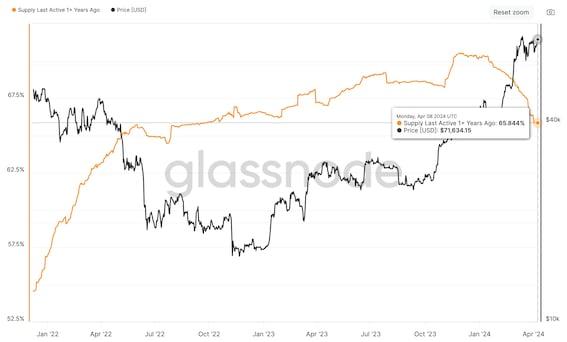
The decline likely represents profit-taking by investors who held coins for one year and over and marks a shift from the holding strategy seen through 2023. The percentage of bitcoin's circulating supply last active at least a year ago has declined from 70% to 65.8% in three months. The decline probably indicates profit-taking by some investors in a rising market. The percentage of bitcoin's circulating supply that last moved on-chain at least a year ago has declined to the lowest since October 2022, according to data tracked by blockchain analytics firm Glassnode. On Monday, 12.95 million BTC, equating to 65.84% of the circulating supply of 19.67 million BTC, remained unchanged for over a year, the lowest percentage since October 2022. The metric peaked above 70% with the debut of nearly a dozen spot exchange-traded funds (ETFs) in the U.S. in mid-January and has been falling ever since. Since late December, the percentage of the circulating supply that has not moved in at least two years has declined to 54.% from 57.4%. The decline likely represents profit-taking by investors who held coins for one year and over and marks a shift from the holding strategy seen through 2023. The urge to sell likely stems from bitcoin's massive 148% price surge since April last year and the 50% rally since the ETFs began trading in the U.S. At press time, bitcoin changed hands at $70,400. However, it's difficult to ascertain the exact percentage of bitcoin that left the inactive supply has been liquidated in the market. According to the data tracking website MacroMicro, a decrease in the percentage of inactive BTC is a "leading indicator for the end of the bull run." Past data, however, show that bull markets tend to peak as the percentage of inactive supply bottoms out and begin rising. https://www.coindesk.com/markets/2024/04/09/bitcoin-supply-inactive-for-a-year-slides-to-18-month-low-of-658/
2024-04-09 09:55
Metaplanet began as Red Planet Japan, a budget hotel operator, before pivoting to become a Web3 developer. Metaplanet's stock rose 90% after adding $6.56 million in bitcoin to its balance sheet in partnership with Sora Ventures and other crypto investors. The move aims to reduce yen exposure and offer Japanese investors crypto access with a preferential tax structure. Metaplanet (3350), a Web3 infrastructure provider, saw its Tokyo-listed stock rise almost 90% in two days after saying it was adding $6.56 million in bitcoin (BTC) to its balance sheet in partnership with Sora Ventures, Morgan Creek Capital's Mark Yusko and others. The company, which started as a budget hotel operator under the name Red Planet before becoming a Web3 software developer, said it is looking to minimize its exposure to the Japanese yen. The yen, the company wrote in an update to shareholders, has been damaged by Japan's generation-long low-interest-rate environment that has eroded its position as a key global currency. In March, the central bank increased short-term interest rates to 0-0.1% from minus 0.1%, the first increase in the rate for 17 years. "The Company’s decision to incorporate Bitcoin into its treasury assets is driven by a multifaceted understanding of its potential as a hedge against inflation, a tool for macroeconomic resilience, and a basis for long-term capital appreciation," it wrote. The strategy also mimics that of Tysons Corner, Virginia-based MicroStrategy, the software developer that in 2020 said it would start building up its holdings of bitcoin. Since then, its stock price has often mirrored the fluctuations in bitcoin's price, reflecting investor sentiment toward the cryptocurrency market. It is now the largest corporate owner of bitcoin, according to bitcointreasuries.net, holding more than 214,000 valued at more than $15 billion. In a post on X, Jason Fang, managing partner and co-founder at Sora Ventures, which participated in the partnership to add bitcoin to Metaplanet's balance sheet, highlighted it as a way for Japanese investors to get exposure to crypto through a publicly traded company instead of holding the asset itself, which is subject to a high tax on unrealized crypto gains. This tax is controversial and has been debated and modified by lawmakers since it was first introduced. In June 2023, Japan's National Tax Agency announced that tokens issued by crypto startups would be exempt from the rules. Bitcoin is currently trading around $70,500, according to CoinDesk Indices data. https://www.coindesk.com/markets/2024/04/09/metaplanet-shares-soar-as-japanese-firm-mimics-microstrategy-on-bitcoin-buying/

2024-04-09 08:42
The tool has made over $5 million since going live in early March, with thousands of tokens issued daily. Pump has generated significant revenue in a short period and zoomed to one of Solana's highest earning applications, showcasing the profitability of offering token creation services in the crypto space. The platform allows users to create tokens with $2 and offers an inbuilt safety mechanism against scams like rug pulls, making it an attractive option for traders interested in meme coins. Selling shovels in a gold rush was one of the surest ways to make profits, and it’s no different today in the digital asset world. Pump, a meme coin generator platform, has earned over $5 million in fees since going live in March amid an ongoing meme coin frenzy on Solana, making it one of the biggest revenue-generating applications in a relatively short period. The platform made $300,000 in the past 24 hours alone on Solana, data shows, contributing a significant chunk to the network’s total generated fees of $2.5 million. Annual revenue projections based on current usage and growth are about $66 million, DefiLlama data shows. Pump lets anyone issue a token for $2 in capital, after which they choose the number of tokens, theme, and meme picture to accompany it. When the market capitalization of any token reaches $69,000, a portion of liquidity is deposited to the Solana-based exchange Raydium and burned. Last week, the platform also extended support to the Blast and Base networks. The draw for traders is a supposed inbuilt safety mechanism: “Rug pulls,” a common crypto scam that sees token issuers drain liquidity, aren’t possible on Pump-issued tokens. “Pump prevents rugs by making sure that all created tokens are safe. Each coin on Pump is a fair launch with no pre-sale and no team allocation,” its site says. The ease of usage means new tokens are created nearly every other second. CoinDesk calculated a total of 35 issuances in a one-minute period in Asian morning hours on Tuesday, although this figure is likely to wildly change based on timezones and interest in new types of memes. While there are likely tens of thousands of tokens that have been released on Pump since its March launch, only a few have reached market capitalizations of more than $10 million. The largest tokens so far are Shark Cat (SC), a cat wearing a shark cap, and Hobbes, named after the cat of popular Solana trader Ansem, with valuations of $100 million and $35 million, respectively. Cat memes are a popular draw for issuers, although popular Pump tokens range from a can of Arizona Iced Tea and Lord of the Rings character Gandalf to a pixelated image of a rubber duck. https://www.coindesk.com/markets/2024/04/09/solana-meme-coin-generator-pump-on-track-for-66m-yearly-revenue/

2024-04-09 08:18
The crypto market faces the U.S. tax season liquidity test around the time the Bitcoin blockchain implements the fourth mining-reward halving on April 20. Bitcoin may face selling pressure in the second half of April as the supposedly bullish impact of halving is already well entrenched, Hayes said in a blog post. U.S. tax payments could suck dollar liquidity from the financial system, fueling risk aversion and a fire sale of risk assets, Hayes said. Gear up for some pain in the digital assets market. Bitcoin (BTC), the leading cryptocurrency by market value, will probably face selling pressure in the days before and after the mining-reward halving due April 20, a supposedly bullish event. That's the message from Arthur Hayes, a co-founder and former CEO of crypto exchange BitMEX and the chief investment officer at Maelstrom. In his latest blog post, "Heatwave," Hayes explained that the bullish halving narrative is "well entrenched," leaving the doors open for a so-called price correction. In crypto, a correction is considered a price drop of at least 10%. The bullish narrative stems from data showing bitcoin tends to chalk out stellar multimonth rallies in the months after the halving, an event that reduces the pace of supply expansion rate by 50% every four years. This time the halving will cut the per-block issuance to 3.125 BTC from 6.25 BTC. "The narrative of the halving being positive for crypto prices is well entrenched," Hayes wrote. "When most market participants agree on a certain outcome, the opposite usually occurs. That is why I believe Bitcoin and crypto prices in general will slump around the halving." Several analysts have argued that the supply slowdown is priced in and the market could correct following the event. Bitcoin has rallied over 65% this year, setting new records above $70,000 well before the halving. Tax payments to suck out liquidity Hayes added that U.S. tax payments, due on April 15, coupled with the Federal Reserve's quantitative tightening (QT) policies, could remove dollar liquidity from the market, leading to broad-based risk aversion and a fire sale of crypto assets around halving. "Given that the halving occurs at a time when dollar liquidity is tighter than usual, it will add propellant to a raging firesale of crypto assets. The timing of the halving adds further weight to my decision to abstain from trading until May," Hayes said. Tax payments typically remove liquidity from the financial system as individuals withdraw cash from bank deposits and market funds to pay their dues. When the dollar's liquidity dries up, it appreciates against other fiat currencies, and borrowers with dollar-denominated loans face higher interest expenses and scale-back exposure to risk assets like cryptocurrencies and technology stocks. The dollar's weakening has the opposite impact. The U.S. dollar, a global reserve currency, plays an outsized role in global trade, non-bank borrowing, and international debt. Liquidity outflows due to impending tax payments could be sizeable, thanks to capital gains from the booming stock markets and interest income from elevated interest rates. In other words, the balance in the Treasury General Account (TGA) is set to rise sharply in the second half of April. The TGA is the government's operating account maintained at the Fed to collect tax revenue, customs duties, proceeds from securities sales and debt receipts and meet government expenses. "When the Treasury receives tax payments, the TGA balance rises. I expect the TGA balance to swell well above the current ~$750 billion level as tax payments are processed on April 15th. This is dollar liquidity negative," Hayes said. "The precarious period for risky assets is April 15th to May 1st." Hayes expects Treasury Secretary Janet Yellen to run down the Treasury General Account after May 1, providing a bullish tailwind to risk assets in months leading up to the U.S. presidential election in November. https://www.coindesk.com/markets/2024/04/09/bitcoin-could-slump-around-reward-halving-time-arthur-hayes-says/

2024-04-09 07:00
The move will allow the crypto payments firm to consolidate its custody technology. BCB has moved its custody operations to Ripple-owned Metaco’s platform. The move will allow the payments firm to consolidate its custody technology. BCB provides crypto payments and trading services for clients, including Gemini and Kraken. Metaco, a Swiss crypto custody firm owned by Ripple, said BCB Group, a crypto payments firm, consolidated governance of its digital asset custody operations onto its flagship platform. London-based BCB Group, having migrated its operations from a third-party digital asset technology provider, is now using Metaco’s custody orchestration platform, the companies said in a statement. The move allows the payments firm to consolidate its custody technology into a single platform to secure and govern its digital asset operations. “We continue to empower new global financial ecosystems, by connecting the global crypto industry,” Oliver Tonkin, BCB's co-founder and CEO, said in the release. “Our collaboration with Ripple, Metaco and IBM Cloud is a paramount step in that direction, as it enables BCB Group to continue delivering superior top tier services to the digital asset ecosystem, in a seamless, secure and affordable way.” Ripple, the enterprise blockchain and crypto products company, acquired Metaco for $250 million in May last year. The Swiss company’s CEO and chief product officer recently left the business, as reported by CoinDesk in February. BCB provides payments and trading services for some of the world’s largest crypto institutions including Bitstamp, Crypto.com, Gemini and Kraken. CORRECTION (April 9, 7:57 UTC): Company removes reference to Galaxy Digital in bullet point, last paragraph, because it is no longer a client. https://www.coindesk.com/business/2024/04/09/bcb-group-moves-custody-of-digital-asset-operations-to-metacos-platform/