2024-04-04 16:21
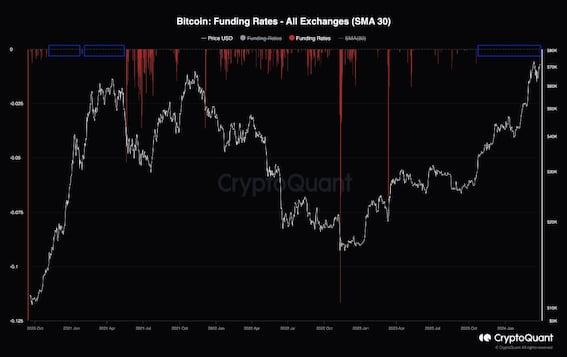
The recent dip in price doesn't appear to have dented optimism from traders betting on a continued bull run. Bitcoin hit a record high above $73,500 about three weeks ago and then quickly retreated to the $61,000 area. It's since retraced to the current $67,600, giving bulls some hope that new records are imminent. At least one sentiment indicator, though, indicates that the price correction has more room to run. The so-called futures funding rate – payments to traders based on the difference between perpetual contract markets and spot prices – is around a record high level, reports CryptoQuant. "Funding rates represent traders' sentiments in the perpetual swaps market and the amount is proportional to the number of contracts," the team explained. Positive funding rates indicate that long position traders are dominant and are willing to pay funding to short traders. Positive funding rates, CryptoQuant continued, suggest long traders – those betting on higher prices – are dominating the market and willing to pay funding to shorts, i.e. those betting on lower prices. The last time funding rates were this high was in April 2021. Bitcoin subsequently collapsed from above $60,000 to below $30,000 just three months later. Interestingly, the CryptoQuant report comes alongside recent data from the U.S. Commodities Futures Trading Commission (CFTC) showing record futures short positions from hedge funds and commodity trading advisors (CTAs). https://www.coindesk.com/markets/2024/04/04/near-record-high-funding-rate-suggests-bitcoin-pullback-not-over/
2024-04-04 13:00
The token will be "100% backed by U.S. dollar deposits, short-term U.S. government Treasuries and other cash equivalents," according to the company. Ripple, the enterprise-focused blockchain service and creator of the XRP Ledger, is introducing its own stablecoin pegged to the price of the U.S. dollar. "The stablecoin market is over $150 billion today and is forecasted to exceed $2.8 trillion by 2028," Ripple said in a statement shared with CoinDesk. "There’s clear demand for stablecoins that deliver trust, stability and utility." The company said the token, which it plans to release "later this year," will be "100% backed by U.S. dollar deposits, short-term U.S. government Treasuries and other cash equivalents." The stablecoin will be deployed onto Ripple's institution-focused XRP Ledger along with the Ethereum blockchain to start out, and it will be based on Ethereum's ERC-20 token standard. Ripple's announcement comes as stablecoins have proven one of the most popular types of digital assets among crypto traders, free (in theory) from the price volatility witnessed in larger cryptocurrencies like bitcoin (BTC) and Ethereum's ether (ETH). "What we think is going to be our differentiator is going to be the fact that the assets are going to be in dollars, Treasuries – rock solid," Ripple CTO David Schwartz told CoinDesk in an interview. "We're not trying to juice the last couple of decimal points out of this. We're looking to conquer the market and be in it for the long term." As for why Ripple – still battling an enforcement case brought by the U.S. Securities and Exchange Commission – has decided to jump into the stablecoin game, Schwartz said that the decision, in part, came down to simple "dollars and cents." "Part of it is just opportunistic. It's a growing market," he said. "You could be a bank that pays no interest. That seems like a pretty good business opportunity." Schwartz said the new stablecoin could also help breathe some life into the XRP Ledger's decentralized finance ecosystem, which has a decentralized exchange but relatively low usage relative to other chains. According to Schwartz, transparency – historically a key point of scrutiny for stablecoin issuers – will be a key focus for Ripple as it rolls out its new token. "We're gonna have public audits on a monthly basis, hopefully by a top-tier accounting firm and will disclose more on that later," said Schwartz. "We're aiming for complete transparency. You know, we'll do whatever we need to do to address those issues." Beyond the promise of transparency, Schwartz emphasized that the potential growth of the stablecoin market – currently dominated by Tether's USDT token and Circle's USDC – serves as a disincentive for Ripple or any other stablecoin provider to act dishonestly. Coinbase, the publicly traded U.S. crypto exchange, is an investor in Circle. "In the early days of Tether, people were expecting it to blow up any day, and they felt like it was really sketchy," said Schwartz. But now, "if you're Tether, it wouldn't make sense for you to run off with people's money," said Schwartz. "Even if that was your plan, you'd wait to do it" because "the market is only growing." In Ripple's case, "we're not trying to squeeze a couple of extra pennies out – we don't need to," said Schwartz. "Our balance sheet is rock solid." The Ripple CTO said his token will be aimed primarily at enterprise customers and banking institutions, organizations for whom "those kinds of practical arguments aren't really prescient because they have to justify their decisions" to "stockholders and to regulators and so on." To satisfy the needs of this market segment, Ripple says it is using U.S. banks to hold its reserves and is taking what it terms a "compliance-first mindset." USDC is currently the market leader among compliance-oriented stablecoin consumers, but Schwartz said he doesn't see it as "a winner takes all" environment. "If we were a solid number three and the market grows 12x, that's not a failure scenario," said Schwartz. "Obviously we would like to do better than that, but that's not a failure case, that's still pretty gosh darn good." https://www.coindesk.com/tech/2024/04/04/ripple-developer-behind-xrp-ledger-enters-stablecoin-fray-vs-tether-usdc/

2024-04-04 12:07
The defendants are said to have committed hundreds of acts of wire fraud, "causing harm to Google and at least approximately 100,000 Google users." Google is suing a group of alleged scammers who are said to have uploaded fraudulent apps to Google Play. Victims were lured to download the apps with promises of high returns that the lawsuit described as "illusory." A Google spokesperson described the lawsuit as a "unique opportunity" to set a precedent for how to deal with bad actors. Google filed a lawsuit against alleged crypto scammers claiming they uploaded fraudulent investment apps to Google Play. The lawsuit filed Thursday in the Southern District of New York alleges that Yunfeng Sun and Hongnam Cheung committed hundreds of acts of wire fraud, "causing harm to Google and at least approximately 100,000 Google users." The defendants made "multiple misrepresentations to Google in order to upload their fraudulent apps to Google Play, including but not limited to, misrepresentations about their identity, location, and the type and nature of the application being uploaded," according to the filing. Victims were lured to download the apps with promises of high returns from investing in crypto and other products, which the lawsuit described as "illusory." When victims attempted to withdraw their balances, they would be asked to pay various fees to recover their investments and purported gains, according to the filing. "This is a unique opportunity for us to use our resources to actually combat bad actors who were running an extensive crypto scheme to defraud some of our users," Halimah DeLaine Prado, general counsel at Google, said in an interview with CNBC. "This [lawsuit] allows us to not only use our resources to protect users, but to also serve as sort of a precedent to future bad actors that we don't tolerate this behavior." Read More: Crypto Users Lost $2B to Hacks, Scams and Exploits in 2023, De.Fi Says https://www.coindesk.com/policy/2024/04/04/google-takes-legal-action-against-alleged-crypto-scammers-for-uploading-fraudulent-apps/

2024-04-04 11:53
Analysts said BTC traders are probably waiting for macroeconomic signals before making a move, referring to the current market lull. Bitcoin Cash (BCH) surged 10% after successfully completing its reward halving event that cut the block reward to 3.125 BCH. The cryptocurrency market remains mostly unchanged, with bitcoin – whose halving occurs later this month – trading at just above $66,300, up 0.3% in the past 24 hours. Bitcoin Cash (BCH) surged 10% after completing its reward halving event, becoming one of the few gainers in an otherwise tepid market as bitcoin (BTC) – whose own halving occurs later this month – remained little changed over 24 hours. BCH changed hands at $660 in European morning hours, a price level not seen since December 2021. The token remains 80% below a lifetime peak of $3,700 set in December 2017. Bitcoin Cash’s block reward is now 3.125 BCH. Halving occurs when the reward for mining transactions is cut by 50%, reducing the rate at which new coins are created and thus lowering the available new supply. Bitcoin’s own halving is expected on April 20, trackers show, and has historically preceded a bull market for the token. The previous halving, in 2020, spurred a 1,000% run to a then-record high of $69,000 roughly a year and a half later. Open interest on BCH-tracked futures swelled to $700 million earlier this week from below $200 million in March, showing an increase in leveraged bets on more expected price volatility, as previously reported. Meanwhile, crypto markets remained little changed in the past 24 hours amid the lack of market-moving catalysts. Bitcoin traded at just above $66,300, up 0.3% in the past 24 hours, and the CoinDesk 20, a broad-based liquid index of major tokens, excluding stablecoins, was down 0.7%. Ether (ETH), BNB Chain’s BNB and Solana’s (SOL) were up 1%, while dogecoin (DOGE), Polkadot’s DOT, XRP and Cardano’s ADA were down as much as 1.2%. Alex Kuptsikevich, a senior market analyst at FxPro, told CoinDesk in an email that the current lull was expected and traders were likely to be waiting for macroeconomic catalysts before making a move. “While Bitcoin's inability to rise is alarming, we saw a weaker dollar and stronger stock indices the day before, which is fuelling risk appetite,” Kuptsikevich said. “The cryptocurrency market's lagging performance can easily be attributed to accumulated overbought conditions and wariness ahead of the monthly labour market report,'’ which is due tomorrow. “At the same time, we regard the current weakness as consolidation within the bull market, almost excluding the risks of a long-term reversal,” he said. https://www.coindesk.com/markets/2024/04/04/bitcoin-cash-spikes-10-after-halving-bitcoin-hovers-above-66k/

2024-04-04 08:57
Most funds may have taken short positions as a part of a "carry trade," one observer said. Leveraged funds held record net short positions in CME's bitcoin futures last week, CFTC data show. Most funds may have taken short positions as a part of a "carry trade," one observer said. Some funds may be preparing for a post-halving price drop. Leveraged funds, which the Commodities Futures Trading Commission (CFTC) describes as hedge funds and commodity trading advisers, held record bearish wagers on the bitcoin (BTC) price at the end of the first quarter as the cryptocurrency's rally stalled near record highs. Hedge funds boosted their net short positions in the Chicago Mercantile Exchange's (CME) standard bitcoin futures contracts to 16,102. That's the most since the futures began trading in late 2017, according to CFTC figures published last week. CME's standard bitcoin futures contracts are sized at 5 BTC. A short futures position is a trading strategy in which a trader sells a futures contract to profit from or hedge against an expected drop in the underlying asset's price. Carry traders or arbitrageurs short futures while simultaneously buying the asset to safely pocket the price differential between the spot and futures market. The record buildup in short positions likely reflects hedge funds' renewed interest in the carry trade, according to Markus Thielen, CEO of 10x Research. "There is a massive demand from hedge funds to put on carry trades. Despite bitcoin’s -10% decline from the all-time high, the futures premium has remained in double digits, and hedge funds are taking advantage of these high rates," Thielen told CoinDesk in an interview. While bitcoin's bullish momentum stalled after hitting record highs above $73,500 in March, CME futures continue to trade at an annualized three-month premium of over 10%, according to Velo Data. In other words, carry trades still yield at least twice as much as the 10-year Treasury note, which offered a so-called risk-free return of 4.36% at press time. That said, some hedge funds may have taken outright bearish bets as recent robust U.S. economic data and hawkish comments from the Fed officials weakened the case for rapid-fire interest-rate cuts in the near term. On Wednesday, Federal Reserve Chairman Jerome Powell emphasized the need to see how inflation evolves in the coming months, keeping the timing of the first-rate cut uncertain. Since the release of upbeat manufacturing data on Monday, the probability of the Fed cutting rates in June has dropped below 50%. In addition, some observers are skeptical that the impending mining reward halving will live up to its bullish reputation. The Bitcoin blockchain's fourth mining reward halving, due later this month, reduces the per-block amount of BTC issued as a reward to miners to 3.125 BTC from 6.25 BTC. Historically, bitcoin has chalked out major bull runs 12 to 18 months after halving, when the reduced per-block emission met demand. If past data is a guide, the path of least resistance is higher. However, according to David Duong, head of institutional research at Coinbase, the small sample size makes it difficult to draw definite conclusions in a market fundamentally altered by the January debut of spot exchange-traded funds (ETFs) in the U.S. "We believe that bitcoin’s market dynamics have fundamentally changed with the advent of U.S. spot BTC ETFs," Duong said in a market update last month. "Their multi-billion dollar net inflows in just two months have irrevocably altered the landscape. With major institutional players now capable of taking exposure through these vehicles, bitcoin's response to the upcoming halving may not necessarily mirror its performance in prior cycles." "We think studies of previous cycles should be interpreted cautiously, as the small sample size makes it difficult to generalize patterns here," he said. The launch of spot ETFs brought lifted bitcoin to record highs ahead of the halving, as opposed to previous cycles. That has left the door open for a post-halving price drop. Analysts at JPMorgan foresee bitcoin falling to $42,000 after the halving hype subsides. At press time, bitcoin changed hands near $66,000. https://www.coindesk.com/markets/2024/04/04/hedge-funds-hold-record-bearish-bitcoin-bets-data-show/
2024-04-04 07:57
The valuation is based on the future expected usage of several layer 2 networks across usecases such as metaverse, banking and gaming. Investment firm VanEck predicts Ethereum layer 2 networks to be valued at over $1 trillion by 2030 but remains “generally bearish” on the long-term prospects of several such networks. The firm evaluated 46 layer 2 networks across five key areas and predicted “thousands” of rollups to eventually emerge. Arbitrum is the most extensive ecosystem, with over $18 billion in locked tokens. VanEck said that transaction pricing, developer experience, user experience, trust assumptions, and ecosystem size, could play into the layer 2 networks' growth. Investment firm VanEck predicts Ethereum layer 2 (L2) networks could be valued at over $1 trillion by 2030 in a base case scenario but remains “generally bearish” on the long-term prospects of several such networks. The firm evaluated 46 L2 networks across five key areas and predicted “thousands” of rollups to eventually emerge. Arbitrum is currently the biggest ecosystem with over $18 billion in locked tokens, data shows, capturing the majority of $36 billion locked across 46 networks. VanEck analysts Patrick Bush and Matthew Sigel estimate that Ethereum will eventually capture 60% of the market share across all public blockchains. They modeled their estimate around the volume of assets within the Ethereum ecosystem. L2s are secondary networks or infrastructure built atop a main blockchain, such as Ethereum, to help with scalability and speed. Rollups are a certain type of scaling system. VanEck said the following factors would eventually come into play for the long-term growth of L2 networks. Transaction Pricing: The cost to users for transacting on L2 networks is a critical factor for attracting users. Differentiation in transaction pricing stems from factors such as data compression, scale, proving costs, and profit margins. Developer Experience: Ethereum Virtual Machine compatibility is paramount for L2 networks to attract developers, ensuring seamless porting of smart contracts and tooling from Ethereum. User Experience: The speed of onboarding assets and withdrawal processes ultimately shapes the user experience. Trust Assumptions: Building trust around data availability on an L2 and steps in place to prevent exploits and hacks. Ecosystem Size: The strength of an L2 network’s ecosystem significantly influences its value. Value locked on an L2 indicates engagement as it indicates money put into the ecosystem to capture opportunities. Risks remain Meanwhile, Busk and Siegel wrote that the firm expects there to be cut-throat competition amongst L2s, stating they were generally bearish on the sector’s outperformance. “We are generally bearish on the long-term value prospects for the majority of L2 tokens,” they said. “The top 7 tokens for L2 collectively already have $40 billion of FDV, and there are many strong projects that intend to launch over the medium term.” “This means there is potentially $100 billion more in FDV in L2 tokens coming to market over the next 12-18 months. It seems a bridge too far for the crypto market to absorb even limited amounts of that supply without massive discounts,” the analysts added. Tokens of the Ethereum L2 category are valued at just over $20 billion, CoinGecko data shows. https://www.coindesk.com/markets/2024/04/04/ethereum-layer-2s-could-rocket-to-1t-base-valuation-by-2030-vaneck-says/