2024-03-25 07:46
Hardly any value is being moved on-chain, a sign nobody wants to sell, one analyst said. The dollar value of the mean onchain transfers on the Bitcoin blockchain remain well below the 2021 peak, data tracked by Glassnode show. That's a sign of investors holding on to their coin stash in anticipation of higher prices, analysts at Blockware Solutions said. Bitcoin's (BTC) price recently rose to new record highs above $70,000. Still, the real economic activity on the Bitcoin blockchain is limping along, not sprinting. The divergence partly represents strong holding sentiment in the market, according to one research firm. "Average on-chain transfer volume (USD Denominated) is well below the 2021 bull market peak. Hardly any value is being moved on-chain," analysts at Blockware Solutions said in the latest edition of the Blockware Intelligence newsletter. "Nobody wants to sell." Data tracking firm Glassnode defines transfer volume as the U.S. dollar value of the total BTC transferred on-chain. The metric considers only successful transfers. At press time, the seven-day and 14-day average mean transfer volume stood below $200,000, a far cry from $1 million and higher during the 2021 bull market, data tracked by Glassnode show. Wall Street's embrace of the Nasdaq-listed spot bitcoin ETFs has been the primary reason for bitcoin's latest rally. In other words, the spot volume has been concentrated in ETFs, which also explains the low on-chain volume. Nevertheless, other metrics also indicate that investors who survived the 2022 bear market are holding onto their coin stash in anticipation of a continued price rally. For instance, the percentage of bitcoin supply that was last active between hree and five years ago continues to increase. Several analysts expect bitcoin's price to rally into six figures in the coming months, eventually peaking well above $150,000. "Once we see the price really start to move, that's when on-chain volume will surge. Older coins will move to exchanges to be sold. Until then, low on-chain volume is a sign of supply-side illiquidity," analysts at Blockware said. Bitcoin changed hands at $67,700 at press time, up 5% on a 24-hour basis. The CoinDesk 20 Index, a broader market gauge, was up 5% as well. https://www.coindesk.com/markets/2024/03/25/nobody-wants-to-sell-btc-analyst-says-as-bitcoins-on-chain-activity-limps/

2024-03-25 06:11
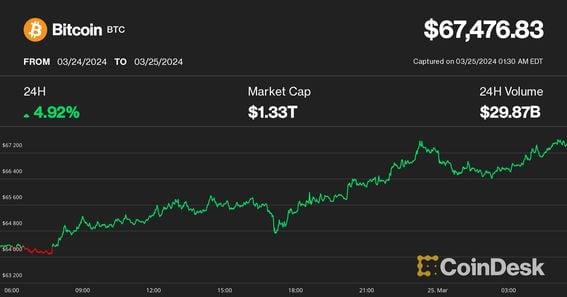
Over $100 million in bitcoin and ether shorts have been liquidated over the past 24 hours. Asia's business week opened with major cryptos well in the green, and the CD20 up 5% This can partially be attributed to a global easing cycle opening up with Swiss National Bank being the first major central bank to cut rates The crypto market began the Asia trading day in the green, as traders cheered BlackRock's foray into asset tokenisation and the beginning of the global central bank easing cycle. Bitcoin (BTC), the world's largest digital asset, traded at $67,300, up 4.9% on a 24-hour basis and ether traded 4.7% higher above $3,400. The CoinDesk 20 (CD20), a measure of the most liquid cryptocurrencies, was up around 5% at press time. Bradley Park, an analyst at CryptoQuant, attributes the gains to the market digesting BlackRock's fund targeting tokenized products on Ethereum called BUIDL. Shorts that bet against bitcoin and ether are seeing significant losses. Data source CoinGlass shows that over $100 million in leveraged futures positions have been liquidated in the last 24 hours, with around $60 million in short BTC positions and $42.8 million in short ether positions. Meanwhile, BTC may be up as selling pressure from the Grayscale Bitcoin Trust (GBTC) has slowed. Analysts point to Genesis' sale of shares as a reason for the uptick in GBTC outflow. Macro factors continue to align bullishly. Last week, the Swiss National Bank (SNB) unexpectedly cut the benchmark interest rate, kicking off a global easing cycle. The Central Bank of Mexico also cut rates, and the Federal Reserve, the European Central Bank, and the Bank of England laid the groundwork for the so-called liquidity easing in the coming months. "Even though a market correction seems long due, the medium term looks pretty upbeat for equities, residential real estate, gold, bitcoin, etc., if this is the case. From this angle, it is unsurprising that #equities and #gold already made fresh all-time highs," founder and manager of the Blokland Smart Multi-Asset Fund, said on X, explaining the onset of the global easing cycle. https://www.coindesk.com/markets/2024/03/25/bitcoin-ether-in-the-green-as-global-easing-cycle-begins/
2024-03-22 19:06
The Ark Invest CEO said the firm has been looking closely at emerging markets, where use cases of the digital asset make her believe that bitcoin is partly a risk-off asset. Ark Invest CEO Cathie Wood called bitcoin (BTC) a “financial super highway,” emphasizing the important use cases for the cryptocurrency in emerging markets. Wood, whose Ark Invest recently became one of the issuers of a spot bitcoin exchange-traded fund (ETF), ARKB, said the asset manager is focused on emerging markets and the macro environment worldwide, which has been “shocked” by the U.S. Federal Reserve’s increase in interest rates, she said during a fireside chat at the Friday Bitcoin Investor Day conference in New York. “There are signals that not all is well in the world,” she said about countries like Nigeria, one of the biggest adopters of bitcoin because of the strong depreciation of the country’s currency. Because of that, Wood sees bitcoin as a risk-off asset and a risk-on asset. Ark’s spot bitcoin ETF has become one of the more successful bitcoin ETFs among the ten funds issued in January. Wood said that with more institutions entering this space, mathematically speaking, bitcoin’s price could easily rise above $3.5 million. However, she wouldn’t give a new specific price target. “Bitcoin has miles to go,” she said instead and pointed out to her previous call of $1.5 million price target. https://www.coindesk.com/business/2024/03/22/cathie-wood-calls-bitcoin-a-financial-super-highway-reiterates-15m-price-target/

2024-03-22 17:43
Known for popularizing the term “singularity,” the cypherpunk writer, who died this week, was prophetic about the age of artificial intelligence and cryptocurrency. Science fiction pioneer and inspiration to many a cypherpunk, Vernor Steffen Vinge, passed away Wednesday at the age of 79 in La Jolla, California. The five-time winner of the prestigious Hugo Award is perhaps best known for popularizing the term “singularity.” Vinge, born Oct. 2, 1944 in Wisconsin, was also a beloved professor of mathematics and computer science at San Diego State University, where he received a PhD in math in 1971. In 2000, he retired from academia to write hard science fiction full time. “A titan in the literary genre that explores a limitless range of potential destinies, Vernor enthralled millions with tales of plausible tomorrows, made all the more vivid by his polymath masteries of language, drama, characters and the implications of science,” American author David Brin said in a farewell message on Facebook. Vinge (pronounced VIN-jee) received Hugo Awards for his novels A Fire Upon the Deep (1993), A Deepness in the Sky (2000), and Rainbows End (2007) as well as novellas Fast Times at Fairmont High (2002) and The Cookie Monster (2004). Perhaps his most well-known work, the 30,000-word novella “True Names” (1981) was an early exploration of cyberspace, transhumanism and hacker culture. As weird as Thomas Pynchon and as prophetic as Nostradomus, Vinge’s writing has major implications for the age of artificial intelligence and cryptocurrency. The technological singularity, a term now in vogue to describe the theoretical moment when AI surpasses human intelligence, is an idea Vinge returned to over and over throughout his career. He explored the concept in the seminal cyberpunk tome, “True Names,” which follows a group of hackers who plug into a virtual reality system called the "Other Plane" to explore a network of computers. In true cypherpunkian style, the hackers (called warlocks), try to keep their “true names” secret. Unfortunately for the protagonist, “Mr. Slippery" (a.k.a. Roger Pollack), the "Great Enemy" (a.k.a. the U.S. government) discovers his real identity and uses that knowledge as leverage to get him to investigate a newly arrived hacker accused of treason known as Mailman. Thus begins a romp that involves a rogue AI “personality simulator” (SPOILER: created by the National Security Agency) that replicates itself, eats all the information stored in databases around the world and causes chaos on- and offline. Written eight years before the launch of the World Wide Web, and inspired by Vinge’s experiences using an early messaging platform Talk, “True Names” anticipated a number of the internet’s runaway effects on society and essentially the entire field of artificial intelligence. ''The import of 'True Names’ is that it is about how we cope with things we don't understand.,” AI pioneer Marvin Minsky wrote in a (since revised) afterword. Nowhere is this more evident than in today’s large language models, which are black boxes to even the researchers who build them. Although he was convinced that technology will eventually outcompete and outperform humanity as a whole (actually saying the singularity would arrive between 2020 and 2040), Vinge was an eternal optimist. And his techno-optimism was infectious. As Minsky wrote: “I too am convinced that the days of programming as we know it are numbered, and that eventually we will construct large computer systems not by anything resembling today's meticulous but conceptually impoverished procedural specifications … Once we learn better ways to tell computers what we want them to accomplish, we will be more able to return to our actual goals–of expressing our own wants and needs.” It’s a point of view that many manifesto writers nowadays may agree with — from the Effective Altruists looking for ways to “align” AI with humanity to the Effective Accelerationists wanting to speed up the rate of technological innovation. We may not know the impact of introducing a new technology, but, as Vinge argued in his 1993 essay titled “The Coming Technological Singularity: How to Survive in the Post-Human Era,” “we have the freedom to establish initial conditions.” Technology is a tool. It is often also frightening. But it is a means to an end, not an end in itself, Vinge may argue. That’s why it matters how technologists and the computer cognoscenti go about building, and why Satoshi Nakamoto, who may have been alarmed by what he/she/it built, should be praised for starting the crypto industry off on the right foot. What comes next is not answerable in this lifetime, but, if you read Vinge, you might want to see it come to pass. "Accused by some of a grievous sin — that of 'optimism' — Vernor gave us peerless legends that often depicted human success at overcoming problems... those right in front of us... while posing new ones! New dilemmas that may lie just ahead of our myopic gaze,” Brin wrote. “He would often ask: 'What if we succeed? Do you think that will be the end of it?'" https://www.coindesk.com/consensus-magazine/2024/03/22/remembering-true-names-author-vernor-vinge/

2024-03-22 16:15
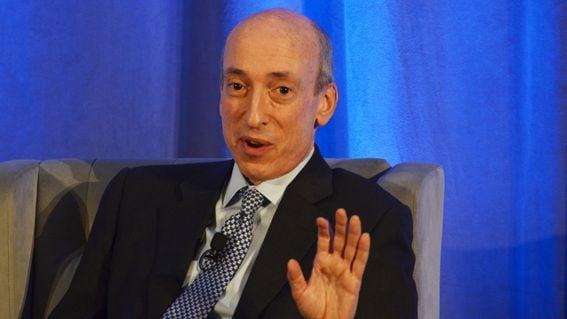
The agency chairman said that the industry could benefit from "disinfectant." U.S. Securities and Exchange Commission Chairman Gary Gensler used a speech on the "public good" of securities disclosures on Friday to point specifically at the crypto industry as a problem area. Gensler, whose tenure atop the agency has been marked by a legal crusade against what he argues is a largely noncompliant industry, suggested that digital assets businesses are among those seeking to "whittle away at the SEC's disclosure regime," which requires companies to register securities and provide information to investors about them. "There are participants in crypto securities markets that seek to avoid these registration requirements," he said in remarks prepared for an event at Columbia Law School. "No registration means no mandatory disclosure." "Many would agree that the crypto markets could use a little disinfectant," Gensler added. The regulator is pursuing several enforcement actions against companies it accuses of failing to register as exchanges and listing unregistered securities, such as Coinbase Inc. and Binance. It's also reportedly investigating Ethereum (ETH), potentially considering classifying that asset as a security – unlike bitcoin. Gensler's rhetoric that crypto platforms need to get registered may be tested soon. The first firm to jump through the hoops as an approved special-purpose crypto broker-dealer, Prometheum, is getting ready to open the business to customers, executives there have said. Meanwhile, Coinbase has asked an appeals court to step in and force the SEC to engage in crypto-specific rulemaking. Read More: U.S. SEC Asking for More Millions, Dozens of Lawyers to Beef Up Crypto Oversight https://www.coindesk.com/policy/2024/03/22/secs-gensler-says-crypto-firms-skip-public-disclosures-by-dodging-registration/
2024-03-22 16:06
U.S.-listed spot bitcoin ETFs are poised for their first week of net negative flows since late January. Bitcoin fell below $63,000 early during the U.S. session Friday amid a broader crypto sell-off. "It will take some time" until bitcoin recovers to $73,000, Galaxy CEO Mike Novogratz said at the Bitcoin Investor Day conference. ETF inflows will return once GBTC selling is completed due to favorable macro conditions, Coinbase analysts said. Volatility in crypto markets continued Friday, with bitcoin (BTC) tumbling below $63,000 at one point from the $67,000 area just hours earlier. A modest rebound since has taken the price back to the current $64,000, down 3.7% over the past 24 hours. The sell-off rippled through the market, with the broad CoinDesk 20 Index was lower by 4.4% over the same time frame, led by layer-1 network Solana's token (SOL) declining more than 10% at one point. It's been more than a week when BTC turned sharply lower from its fresh all-time high price over $73,000 and crypto assets entered a corrective period. While Wednesday's steep, 10% rally on the back of a dovish Federal Reserve promised a quick recovery, the price action since suggests otherwise. "[It] will take some time before we take out that $73,000 again," said Mike Novogratz, CEO of digital asset investment company Galaxy Digital, during a panel discussion at Bitcoin Investor Day in New York Friday morning. The weak price action comes as U.S.-listed spot bitcoin ETFs have suffered what's now four consecutive days of net negative flows. To be sure, nearly all the funds continue to see inflows, but each day this week, they've not been nearly enough to offset massive outflows from the Grayscale Bitcoin Trust (GBTC). On Thursday, GBTC saw $359 million in outflows, leading to $94 million in outflows for the entire fund group. Fidelity's Wise Origin Bitcoin Fund (FBTC) garnered the lowest daily inflow in its history, data compiled by BitMEX Research shows. So far through the week, the spot ETFs have recorded over $830 million outflows, and are on track to endure their second negative week since late January when BTC corrected to $39,000. Analysts at Coinbase Institutional noted that the increased GBTC selling is potentially in part due to Genesis selling shares as part of its bankruptcy process. Once the sales are completed, the report said, inflows to ETFs could pick up again amid favorable macro conditions and favorable central bank policy. "We think the macro environment remains amenable for more spot bitcoin ETF inflows following the Federal Reserve meeting that concluded on March 20," the Coinbase authors wrote. "We expect the current US disinflationary trend to remain intact, financial conditions in the US to continue easing, and markets to be supported by the tapering of the Fed’s quantitative tightening program." Helene Braun contributed reporting https://www.coindesk.com/markets/2024/03/22/bitcoin-slips-to-64k-as-large-grayscale-gbtc-outflows-continue/




