2024-03-22 05:57
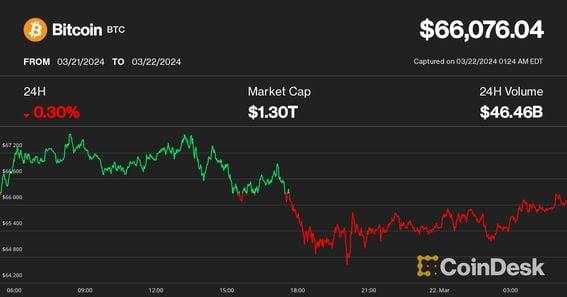
The market might take a breather this weekend, says Singapore's QCP Capital. Bitcoin remains volatile, but some market calm is expected soon. Traders are pricing out the possibility of an ether ETF anytime soon, QCP Capital says. Bitcoin (BTC) tested $66,000 during the Asian trading hours on Friday, as market observers expect the leading cryptocurrency to face more volatility ahead. “Bitcoin remains volatile with the drawdown of 10% we saw this week, with the recent catalyst being driven by spot bitcoin ETF outflows from GBTC of about 300mm on March 20,” Semir Gabeljic, Director of Capital Formation at Pythagoras Investments, said in an email interview. “The drawdown still remains in line with the expected range of 10-20% as we’ve seen historically that happens right before the BTC halving event. More volatility is expected to come going into the BTC halving,” he continued. Meanwhile, the CoinDesk 20 (CD20), a measure of the world’s most liquid digital assets, is down 0.5%. CoinDesk’s Digitization Index (DTZ), which measures the performance of digitization protocols like Ethereum Name Service (ENS), was the best-performing index during Asia trading hours, up 2.7%. In a note sent out Friday morning Asia time, Singapore-based QCP Capital wrote that the market is consolidating with bitcoin and ether trading in a “relatively tight range” and that the market “might take a break this weekend” after last weekend’s pre-FOMC volatility. The trading house also noted that the Grayscale Bitcoin Trust (GBTC) continued to see steep outflows, with $358.8 million leaving the fund. QCP expects a fourth consecutive day of BTC spot exchange-traded fund net outflows. Regarding ether (ETH), QCP says that the market is starting to price out the chances of a spot ether ETF being approved anytime soon. “The Grayscale ETH discount has widened from -8% to -20% over the past two weeks,” QCP noted. Prediction markets also reflect this. On Polymarket, a contract asking if an Ethereum ETF will be approved by May 31 is currently trading with a 21% probability that this will be the case. The Ethereum Foundation is currently being investigated by a state authority, which Fortune says is the Securities and Exchange Commission. The question remains whether the SEC considers ether a security, and the Commission hasn’t been responsive to FOIA requests for key documents that would shed insight into its views on the issue. Blockchain bettors on Polymarket also believe that the second quarter is when ether will hit its all-time high, but a sizable portion of traders also think there will be no all-time highs in 2024. Ether is currently trading above $3500, up 1.2%, according to CoinDesk Indices data. https://www.coindesk.com/markets/2024/03/22/bitcoin-tests-66k-as-analysts-expect-more-volatility-before-calm/
2024-03-22 03:43
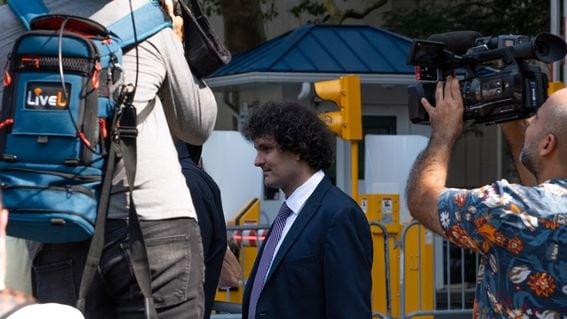
Bankman-Fried was found guilty of fraud last year and will be sentenced on March 28. Sam Bankman-Fried's defense team argued the U.S. Department of Justice was misapplying legal precedent in arguing for a lengthy prison term. The DOJ urged a sentence of 40 to 50 years, as opposed to the defense's request for roughly 6 years, for the former FTX CEO. Sam Bankman-Fried's lawyers have pushed back against some of the legal cases cited by the U.S. government in its sentencing memo, which makes the case for why the Department of Justice think the former FTX CEO should be handed a sentence in the range of 40-50 years, a court filing on Wednesday said. Bankman-Fried's legal team already responded to the Department of Justice's memo in a letter earlier this week, arguing the DOJ was trying to make the former FTX CEO out to be a "super villain." In another letter Wednesday, the defense team took aim at some of the legal arguments presented by the prosecution. Bankman-Fried was found guilty of fraud and conspiracy last year and will be sentenced on March 28. His defense attorneys argue a sentence of no more than 6.5 years is appropriate, given FTX creditors will recoup their losses, while the DOJ has argued for 40 to 50 years. A presentence investigation report recommended 100 years, though this is likely solely due to the loss at the time FTX filed for bankruptcy (north of $8 billion). One of the contentions appears to be about the interpretations of a "precedent-setting" U.S. Supreme Court case, Kisor v. Wilkie, which was at least in part about whether punishment should be based on intended loss or actual loss, the Wednesday filing said. The government argued that Bankman-Fried's attempts to make the sentencing court follow the definition of "loss" based on the Supreme Court’s reasoning in Kisor v. Wilkie should be rejected. "The Second Circuit and district courts within this Circuit have, even after Kisor, consistently applied the commentary on 'intended loss' when calculating the Guidelines range," the DOJ said. Bankman-Fried's legal team retorted by saying that "all the government cites is a single, unpublished, non-precedential summary order from the Second Circuit that quotes a decision from five years before Kisor, that did not consider this Kisor argument, and that ultimately applied actual instead of intended loss." Bankman-Fried's lawyers have argued that the “harm to customers, lenders, and investors is zero” and thus a maximum sentence of 6.5 years in prison should be considered. On Wednesday, current FTX CEO John J. Ray III called that claim that customers lost “zero” money in the exchange’s 2022 collapse, "categorically, callously, and demonstrably false." The question of loss ties to FTX's former customers, who are now the bankrupt exchange's creditors. The exchange's bankruptcy team, which is led by Ray, now estimates that these customers might receive almost all of their assets' value as of the date of FTX's bankruptcy in November 2022. Part of this comes from recoveries Ray's team secured over the past year and a half, while some of that value may be attributed to the recent rise in crypto values. Victim impact statements from FTX customers argue that while they might receive their 2022 values, they will have missed the upside from crypto's price rise over the past year. Losses are just one factor that Judge Lewis Kaplan, who's overseeing Bankman-Fried's case, will have to weigh as he considers what sentence to impose. Other factors include evidence presented at trial, the character reference and victim impact statements submitted by both the defense and prosecution and even possible testimony during next week's sentencing hearing, said Tama Kudman, a partner at Kudman Trachten Aloe Posner LLP. The presentence report, which recommended 100 years, is a "mechanical calculator ... what [the report's writers are] saying is 'in consulting guidelines, this is the conclusion,'" she told CoinDesk. "What the defense is saying to the judge is, 'look, this is a nonsensical, draconian [sentence],'" she said. "Their argument is that this guideline calculation is wrong because there was really no actual loss to the victim, if you look at loss at the time of the crime." Read all of CoinDesk's coverage here. Nikhilesh De contributed reporting. https://www.coindesk.com/policy/2024/03/22/us-governments-legal-precedents-dont-support-lengthy-prison-term-bankman-frieds-defense-argues/
2024-03-21 21:54
The Montenegrin High Court’s decision to extradite Kwon to his native South Korea over the U.S. overstepped the limits of its power, according to the supreme state prosecutor. Terra co-founder Do Kwon’s extradition to South Korea has been halted following a legal challenge from the top prosecutor of Montenegro. Kwon has been in Montenegrin custody since March 2023, when he was arrested and jailed for using fake Costa Rican documents in traveling to Dubai. Montenegrin authorities are weighing competing extradition requests for Kwon from his native South Korea and the U.S., where he also faces criminal charges. Kwon had allegedly been on the run for months following the $40 billion implosion of Terraform Labs and the Terra ecosystem in May 2022. Terraform Labs co-founder Do Kwon’s pending extradition to South Korea has apparently been put on ice following a legal challenge issued Thursday by Montenegro’s top prosecutor. Montenegro’s Office of the Supreme State Prosecutor said that the High Court’s decision to extradite Kwon to his native South Korea instead of to the U.S. – as well as the appellate court’s subsequent confirmation – was done via “abbreviated proceedings” that exceeded the limits of its powers, according to a translated statement published Thursday A decision on permission for Kwon’s extradition is to be made solely by the country’s minister of justice, according to the statement. Kwon was not directly named in the statement, which simply refers to “a citizen of the Republic of South Korea.” Montenegro was inadvertently placed at the center of a tug-of-war between the U.S. and South Korea a year ago, when Kwon and his colleague, Han Chang-joon, were arrested and jailed for attempting to use fake Costa Rican passports en route to Dubai. Kwon’s arrest came six months after Interpol issued a “red notice” for his arrest and 10 months after the $40 billion implosion of his company, Terraform Labs, and the Terra ecosystem. Kwon faces criminal charges in both the U.S. and South Korea, but he's fought extradition since his arrest, appealing several court decisions with varying degrees of success. Han was extradited to South Korea in February, and Kwon looked poised to follow. His Montenegrin lawyer, Goran Rodic, told CoinDesk Kwon was likely to be extradited to South Korea after March 23, but that timeline – as well as Kwon’s ultimate destination – is once again hazy. https://www.coindesk.com/policy/2024/03/21/do-kwons-south-korea-extradition-uncertain-after-challenge-from-top-prosecutor/

2024-03-21 21:35
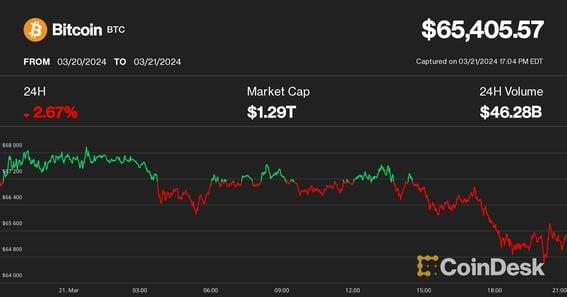
Bitcoin could consolidate first before reclaiming the $69,000 level to reignite its uptrend, one trader noted. Bitcoin slipped 5% below $65,000 Thursday, with the U.S. dollar resurging amid the Swiss central bank's interest rate cut. XRP, FIL and ICP defied the slump, while SOL and AVAX declined. Bitcoin completed its correction by rebounding from $60,000 Wednesday and targeting "much higher levels" in the next phase of the uptrend, Swissblock analyst said. Bitcoin (BTC) slid lower Thursday amid a stronger U.S. dollar, giving up some of the advances from Wednesday's spectacular bounce spurred by a dovish tone from the Federal Reserve. BTC dropped some 5% to as low as $64,600 by late afternoon UTC hours from above $68,000 at the start of the day. The broad-market CoinDesk 20 Index (CD20) declined 3.5% from its daily high, as altcoins generally outperformed bitcoin during the day. Payment network Ripple's native asset (XRP), decentralized data storage platform Filecoin's crypto (FIL) and the Internet Computer's token (ICP) advanced 6%-7% over the past 24 hours. Native tokens of layer 1 networks Solana (SOL), Avalanche (AVAX) and Aptos (APT) lost 2%-3% during the same period. Bitcoin's weak price action was perhaps due to the resurging U.S. dollar after the Swiss central bank, in a surprise move, cut interest rates by 25 basis points, erasing all of Wednesday's steep drop when Fed Chair Jerome Powell hit a dovish tone despite higher-than-expected inflation readings. The U.S. dollar index (DXY), which measures the U.S. dollar's strength against other major currencies and a stronger dollar usually weighs on asset prices. The move was perhaps due to market participants expecting that some other key central banks could start lowering interest rates before the Federal Reserve, macro analyst Michael Kao noted on a social media post. Market analytics firm Swissblock said that bitcoin completed its pullback before Wednesday's bounce, reaching almost their target price of $58,000-$59,000 when they called for an imminent cool-off phase last week. "Now much higher levels (are) coming," Swissblock analyst Henrik Zeberg said in a Thursday market update. He added that altcoins and bitcoin miners will perform "tremendously well" in the next phase of the uptrend. Crypto trader Jelle noted that the bottom for the correction is in until BTC holds the $65,000 level. He added that it could consolidate for a while in the current price range and needs to break above the $69,000 price level – the market cycle peak in 2021 – to reignite its rally to higher prices. https://www.coindesk.com/markets/2024/03/21/bitcoin-slips-to-65k-amid-stronger-dollar-but-analyst-says-the-pullback-is-over/
2024-03-21 19:36
The reported move, if confirmed, could have serious ramifications for the blockchain’s developers. But success for the troubled regulator is far from certain and unanswered questions abound. It came to light yesterday that the U.S. Securities and Exchange Commission (SEC) is likely looking to reclassify Ethereum’s native token, ether (ETH), as a security. Not everyone believes this to be the case, and so far the SEC has deferred answering definitively on whether there is an ongoing probe of the Ethereum Foundation — just like how the agency has punted the can on saying definitively that ETH is or isn’t a security. A number of digital asset lawyers have said the “voluntary inquiry” the Ethereum Foundation copped to in its Github repository is no cause for alarm. Subpoenaing crypto companies is a normal course of business in this industry. And the Ethereum Foundation’s canary — a reference to “canaries in coal mines,” which indicates whether a government has probed a website — had to come down eventually. “It is very difficult to know, from what has been publicly disclosed thus far, the nature of the government inquiry that has been sent to the Ethereum Foundation or whether the Foundation is the target of that investigation,” Preston Byrne, managing partner of Byrne & Storm, P.C., told CoinDesk in an email. Byrne said that it is “unlikely” that the Ethereum Foundation “is the target of the investigation.” However, taking it as a given that there is an ongoing probe, a few questions remain. For instance, it’s not yet clear why exactly the SEC would sue the creators of Ethereum nearly 10 years after its launch and after hundreds of billions of dollars have accrued to the network. Does the investigation pertain to Ethereum’s initial coin offering and token distribution or its switch to the staking security model? How is it that a U.S. securities regulator has jurisdiction over an organization based in Zug, Switzerland? Will the Commodities Futures Trading Commission (CFTC), which oversees a booming ETH futures market, push back? As to why crypto companies are being asked about their dealings with the Ethereum Foundation, Byrne offered two plausible causes: either the SEC is trying to classify ETH as a security to force the hand of U.S. spot exchanges to de-list the token or to support its case for denying much-demanded spot ether exchange traded funds (ETFs). Neither motivation would “necessarily also require the SEC to bring an enforcement action against the foundation,” Byrne added. But say there is a lawsuit. Say ETH is a security (despite good reasons saying no). What exactly happens then? Ethereum is the second-largest blockchain by value ($414 billion at today’s prices), and the home of most of the digital asset industry’s most used tools — classifying ETH as a security would likely cause chaos. With a move this big, it is entirely unpredictable where the cards will ultimately fall. The Demerge … One of the more unlikely responses is that Ethereum, which switched to a proof-of-stake algorithm that rewards tokens to users who lock up their tokens to secure the network, could revert back to the mining model pioneered by Bitcoin. This in itself is unlikely; it took Ethereum developers at and outside of the Ethereum Foundation years to switch to staking. Vitalik Buterin came up with the idea for Ethereum in 2013, and, even back then, he figured the blockchain would likely need to switch to staking, a “consensus model” that was at the time in its infancy. It was only in 2020, five years after the network actually launched, that the first tangible step towards Ethereum staking was taken with the launch of the Beacon chain. Ethereum developers deployed and refigured a number of testnets to experiment with switching to staking over several years, and a “de-merge” would likely take as long. Part of the issue, apart from the scaling and cost benefits of staking is that mining is a purposefully energy-intensive process, and one that developers were happy to say goodbye to. After “the Merge,” it is theorized that Etheruem’s energy consumption declined 99% — shutting down critics of crypto’s environmental footprint. "It’s impossible for me to see any outcome as you point out that would result in something like a merge," Paul Brody, head of blockchain at EY, told CoinDesk. ETH PoW Powered Up Ethereum is Ethereum and Ethereum Classic is Ethereum Classic, even if Ethereum Classic (ETC) actually maintains the “original, unaltered” history of the blockchain. But what if Ethereum Classic, from which Ethereum was forked, becomes the conical chain? This would certainly be an easier solution than the “Demerge,” considering the network is already running. Sure, Ethereum Classic has experienced a number of faith-busting re-orgs, but readopting Ethereum’s lovelorn sibling could answer SEC Chairman Gary Gensler’s apparent concerns over staking. So would the alternative to the alternative Ethereum: EthereumPoW (ETHW), the fork that launched during the Merge to retain proof-of-work. Neither ETC nor ETHW has rallied much on news of the SEC’s potential investigation, indicating their rapid adoption is unlikely. But it’s not impossible. Afterall, Buterin did admit that ETC was “a totally fine chain.” One notable downside of this, among many, is that Etheruem’s founders would likely maintain massive stakes of ETC or ETHW tokens, mirroring the state of their ETH holdings at the time of the two forks. It’s not clear whether or not the SEC is concerned about Ethereum’s token issuance, which distributed valuable tokens to the founding team and the Ethereum Foundation. But the agency has said in the past such disbursements resemble investment contracts. XRP wins? The XRP Army has been waiting for a moment like this for years. Although not as visible a conflict as Ethereum versus Solana or Bitcoin versus Everyone, many XRP stans absolutely despise Ethereum. The history here likely stems from Bill Hinman, the former head of the SEC's division of corporation finance, declaring that ETH was not a security because it was “sufficiently decentralized.” The XRP Army, backing its own project, has seen that intervention as unfairly picking winners in the crypto market, privileging one project for special consideration while downing others that look quite similar. Over the years, XRP champions, including Ripple Labs CEO Brad Garlinghouse, have argued that Ethereum is “Chinese controlled”; that Vitalik Buterin could be co-opted by the Chinese Communist Party; and that the network itself was “cherry-picked” to win by U.S. authorities. Of course, Buterin didn’t win himself any favors when responding to these accusations by calling XRP a “sh*tcoin.” One thing XRP has going for it is that, unlike most cryptocurrencies, there is actually a little legal clarity surrounding that asset after Ripple Labs fought back in court against the SEC, and won a few concessions from the presiding judge. XRP itself is not a security, and exchange trades with it are not securities transactions, though Ripple’s programmatic sales to qualified buyers were investment contracts, the judge ruled. "It is the characteristics of the sale or offer for sale that make something an investment contract, not necessarily which cryptocurrency it is. ETH is sold on public exchanges without advertising," Christa Laser, a law professor at Cleveland State University, told CoinDesk. "The SEC is likely targeting only staking rewards, but it will need to show that there is a central promoter. Gensler’s reputation, tarnished again In fact, one possible outcome of the SEC going after ETH is another major loss for the agency in court. As former CFTC Commissioner Brian Quintenz said yesterday, the SEC already implicitly said ETH was a commodity after it allowed the launch of ETH futures and ETH futures ETFs in the U.S. Further, countless U.S. investors, businesses and individuals have acted on the SEC’s signals over the years that ETH is not a security. Add to this that there is a growing acknowledgment that Gensler’s SEC has been unfair in its legal fight with the crypto industry. Instead of devising comprehensive regulations that actually account for the differences between decentralized protocols and traditional ways of doing business, he has launched lawsuit after lawsuit against companies that add — rather than detract value — from the U.S. economy. This “lawfare” hasn’t always worked out for Gensler. Just recently, a U.S. federal judge called out the SEC’s "gross abuse of the power” for "deliberately perpetuating falsehoods" in its dispute with crypto firm DEBT Box. This is on top of the unprecedented shutdown by a three-judge appeals panel that called out the agency’s yearslong denial of spot bitcoin ETFs “arbitrary and capricious.” In short: If it’s true the SEC is trying to build a case for denying spot ETH ETFs by going after the underlying asset, it better have a good justification. https://www.coindesk.com/consensus-magazine/2024/03/21/what-happens-if-the-sec-classifies-eth-a-security-wrong-answers-only/

2024-03-21 19:34
Ronin's user base has jumped 700% over the past few months, according to Token Terminal. This year's bull market has seen a resurgence of many crypto narratives from yonder cycles, including crypto gaming. In that sector the Ronin network – whose game Axie Infinity reigned over the last gaming moment – is back again. Since the start of 2024, Ronin's user base has ballooned over 700%, according to Token Terminal, growing faster than Solana's meme coin-fueled DeFi landscape as well as TON, the on-chain home for messaging app Telegram's mounting crypto efforts. A single game has fueled Ronin's resurgence: Pixels. The low-fi farming game sees players set up plots of digital land and embark on quests in order to earn digital currencies. In the past month it has seen 1.25 million unique users plug in and play, per DappRadar. Beneath the numbers a wave of energy is flowing into Pixels that matches the mania surrounding Axie Infinity. In the Philippines in particular, play-to-earn gaming has returned as a viable way for people to make a living, according to the New York Times. Its popularity has defied expectations, said Jeffery Zirlin, head of growth for Sky Mavis, the company behind the Ronin blockchain. "Some people thought crypto gaming would only take off when" the industry had studio-quality video games, he said in an interview with CoinDesk. Instead, the top title pumping energy into the sector is a somewhat nostalgic pixelated farming game – hardly a masterpiece like Red Dead Redemption II. Unlike Axie Infinity, Pixels was not built by Sky Mavis for the Ronin network. It started life on Polygon and moved to Ronin last October, before the current bull run caught on. Back then Pixels had maybe 3,000 daily active users, said Zirlin. Now, it can see as many as 750,000. Those numbers still are a fraction of the energy Axie Infinity had at its height. Still, Zirlin said Ronin has an even bigger user base. He said Ronin has 12.7 million wallet downloads. All those people are at least ready (from an infrastructure standpoint) to buy the NFTs that can accelerate gameplay in Pixels. Notably, they don't have to. Pixels differs from Axie in that it does not require users to be crypto-ready from the get-go. They can set up their wallets and start earning later on. Zirlin said Ronin and Sky Mavis continue to bet on crypto gaming despite its "seasonality." Like most everything in this industry, gaming does well (really well) during bull markets and can pitter off during bears. He said the company is equipped to handle the turns and is in fact built for it. "If you plan like that there's no real negative," he said. https://www.coindesk.com/business/2024/03/21/pixels-crypto-game-fuels-resurgent-ronin-blockchain/