2024-03-18 05:52
The country's registered crypto investors also surged to 19 million users last month. The number of crypto investors surged to 19 million in February. The country’s crypto regulator attributes this growth to positive market sentiments fueled by bitcoin's price surge and altcoin rallies. Indonesia reported a surge in crypto transactions, reaching Indonesian Rupiah 30 trillion ($1.92 billion) in February, the country's crypto regulator reported. The number of registered crypto investors in the country also hit 19 million last month, marking an addition of 170,000 users from January, the Commodity Futures Trading Supervisory Agency (Bappebti) said. Bappebti attributes this growth to positive market sentiments fueled by bitcoin’s (BTC) price surge and the rally in altcoin, tokens other than bitcoin. The regulator still aims to match or exceed the transaction volume from 2021, the last bull run, of $51.28 billion, in 2024. Bappebti’s Tirta Karma Senjaya highlighted that, given the downward trend in 2022 and 2023, a 2024 rebound was anticipated, with the upcoming bitcoin halving seen as a key catalyst. The best way to crypto transaction target would be to remove or reduce taxes on crypto. Currently, crypto transactions are taxed at 0.10% for Income Tax and 0.11% for VAT on users, and exchanges are taxed at 0.02% per transaction for the crypto bourse, depository, and clearing house. “I’ve previously said that this industry (crypto) is still in its embryonic stage, so imposing heavy taxes might kill the industry,” Tirta stated at a Reku exchange event earlier. The transfer of crypto oversight to the Financial Services Authority (OJK) in January 2025 could bring about significant changes, possibly reclassifying crypto as securities and revising VAT policies. https://www.coindesk.com/markets/2024/03/18/indonesias-crypto-market-booms-as-transactions-hit-192b-in-february/

2024-03-18 04:10
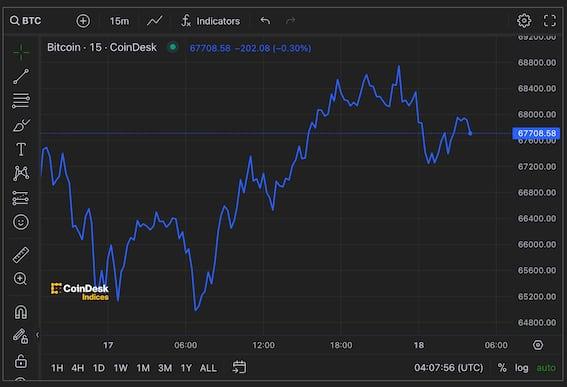
Meme coins soared past $55 billion in market cap, up 11% as traders doubled down on SHIB, WIF, BONK, and newcomer CORGIAI. Bitcoin has rebounded above $67,000K amid pre-FOMC volatility and investor confidence in buying the dip, despite macroeconomic concerns. Meme coins surge, driving the sector's market cap over $55 billion Bitcoin (BTC) changed hands at around $67,800 during Monday's Asian trading hours, as pre-Federal Open Market Committee (FOMC) volatility worked its way through the crypto market, moving major digital assets and pushing up meme coins. "The weekend was filled with both fear and greed as BTC was driven down to $64,500 lows," Singapore-based QCP Capital wrote in a note on Telegram. "BTC has since bounced back above $67,000, and we've seen heavy BTC put selling, which suggests that ‘fear’ has dissipated in BTC, and investors are happy to buy the dip." FOMC risk is also spooking BTC investors, bringing back macroeconomic concern to an asset class buoyed over the last month by optimism over the approval of bitcoin exchange-traded funds (ETFs). Recent U.S. economic data indicated persistent inflation, leading to higher interest rates and a stronger dollar, which fares poorly for risk assets. CME Fed Watch surveys give a 99% chance of interest rates remaining unchanged, while a Polymarket contract suggests the same odds. Meanwhile, meme coins were all the rage over the weekend, pushing the sector's market cap up over $55 billion, an 11% gain, according to CoinGecko data. Top movers included (SHIB), up 10.8%, DogWifHat WIF, up 30%, and CORGIAI up 8.5%. Likewise, the tokens behind the chains these meme coins are issued on are also headed upwards. Solana's (SOL) is up 10.8% to $205, according to CoinDesk Indices data, while Avalanche's {{{AVAX}}} is up 15% to $61. "Solana has once again exploded as the trendiest crypto asset amongst traders with new meme tokens popping nearly every minute," Nick Ruck, COO of ContentFi Labs, said in a note shared with CoinDesk. The CoinDesk SCPXX, which covers smart contract platforms excluding ether, is up 8.2%, beating the CoinDesk 20 (CD20) index, a measure of the largest digital assets, which is up 3.5%. https://www.coindesk.com/markets/2024/03/18/bitcoin-back-above-67k-as-memecoins-push-up-sol-and-avax/
2024-03-18 02:41
The CFTC-regulated platform will let traders bet on how high ETH will go this year and other price outcomes amid renewed interest in both crypto and prediction markets. Kalshi will list prediction markets on crypto price outcomes (e.g. "How high will ETH get in 2024?"). The bets will be settled in U.S. dollars, like all others on Kalshi. Unlike rival Polymarket, Kalshi can do business in the U.S. Kalshi, the lone regulated prediction market platform in the U.S., is moving to grab a piece of the crypto action as digital currencies bounce back from a two-year slump. Starting Monday, the New York-based company will let clients bet on five different cryptocurrency price outcomes, a company spokesperson told CoinDesk. Examples include when bitcoin (BTC) will reach $100,000 and the highest price Ethereum's ether (ETH) will reach in 2024. Additional markets are set to launch on Tuesday. To be clear: While these bets are about crypto, they will be placed in U.S. dollars, like all other markets on Kalshi. Traders on the platform have bet on questions such as how many rate cuts the Federal Reserve will make this year, how many inches of snow will fall in New York in March, and who would win the Oscar for best screenplay. Kalshi's move into crypto comes at the apparent dawn of a bull market for digital assets, as the launch of bitcoin exchange-traded funds and other factors have sent prices soaring. The CoinDesk 20 Index of major digital assets is up nearly 50% this year. Prediction markets' breakout year? The move also coincides with renewed investor interest in prediction markets, which for decades were relegated to a niche activity and academic hobbyhorse. In December, Bitwise Investments researchers forecasted that "[m]ore than $100 million will be staked in prediction markets as they emerge as a new 'killer app' for crypto" in 2024. Former U.S. President Donald Trump has regularly been posting screenshots of his favorable odds for retaking the White House on Polymarket, a crypto-based prediction market. Advocates say prediction markets have a loftier purpose than gambling: By requiring participants to put their money where their mouths are, the argument goes, they reveal what people truly believe, offering a corrective to fallible polls and pusillanimous pundits. Typically, prediction markets are framed as yes-or-no questions about verifiable outcomes within a set time period. For example, on Kalshi's "US bans TikTok this year?" market, "yes" shares were trading Sunday at 25 cents, signaling the market saw a 25% chance of a ban before Dec. 31, and "no" shares were changing hands at 78 cents. Each share pays out $1 if the prediction turns out to be correct, and bupkis if it's wrong. Chasing Polymarket By letting clients bet on crypto, Kalshi is following in the footsteps of a rival prediction market site, Polymarket, which as of Sunday listed nearly 40 markets on crypto-related outcomes. Polymarket is barred from doing business in the U.S. under a settlement with the Commodity Futures Trading Commission. That leaves an opening for Kalshi, which is licensed by the CFTC, to pick up business from U.S. traders who want to speculate on crypto price movements (or hedge positions) without buying or selling crypto. The agency's imprimatur is a double-edged sword. Kalshi is fighting the CFTC in court for the right to list markets asking which party will control each house of the U.S. Congress. PredictIt, a popular site for (dollar-denominated) election betting, operates in the U.S. under a no-action letter, or special exemption, from the CFTC that restricts the platform's growth and activities. It, too, sued the CFTC after the regulator ordered it to shut down. Last week CFTC chairman Rostin Benham said that his agency would propose a rule in the coming months to establish new regulations for prediction markets. https://www.coindesk.com/business/2024/03/12/prediction-market-kalshi-to-take-bets-on-crypto-settled-in-dollars/

2024-03-15 18:32
The U.S. government also recommended an $11 billion fine and forfeiture. U.S. prosecutors urged a federal judge to sentence Sam Bankman-Fried to 40-50 years in prison and $11 billion in fines and forfeiture. The former CEO of the FTX crypto exchange was convicted on seven different counts of fraud and conspiracy in November. U.S. prosecutors recommended that a federal judge sentence FTX founder and former CEO Sam Bankman-Fried to 40-50 years in prison for his conviction on fraud and conspiracy charges tied to the collapse of what was once one of the world's largest crypto exchanges. Bankman-Fried "lied to investors," shared fake documents and "pumped millions of dollars in illegal donations into our political system," adding that a sentence of 40 to 50 years is "necessary," alongside a recommended penalty north of $11 billion and forfeiture, the Department of Justice's Southern District of New York office wrote in a sentencing memo filed Friday. "Bankman-Fried is deserving of a severe sanction, proportionate to his role in this historic fraud," the prosecutors said. "The government urges the court to impose a sentence that underscores the remarkably serious nature of the harm to thousands of victims; prevents the defendant from ever again committing fraud; and sends a powerful signal to others who might be tempted to engage in financial misconduct that the consequences will be severe." Read all of CoinDesk's coverage on the Sam Bankman-Fried trial here. Prosecutors called their request for a $11 billion judgment "a particularly conservative sum" and noted that more than a billion dollars had already been seized. Government efforts to claw back some of Bankman-Fried's money targeted the political contributions he and other FTX executives made in the U.S. elections two years ago – which prosecutors said they believed to be “the largest-ever campaign finance offense.” The document noted 251 candidates had so far returned more than $3 million. The prosecutors included a list of sentences for defendants who'd cost victims more than $100 million in a Ponzi scheme or other kinds of misappropriation, leading off with Bernie Madoff, who was tied to $13 billion in losses and was given a 150-year sentence. A proposed forfeiture order details where the funds would come from, including deposits in U.S. bank accounts that the government has seized, funds in a number of Binance and Binance.US accounts and proceeds from the sale of Robinhood shares. Bribes and other testimony A repeated theme throughout the memo is the idea that Bankman-Fried knew he was committing illegal actions, but acted as if he was not bound by the law, the DOJ charged, walking through the evidence produced during his trial. To support this, the memo referenced testimony and allegations made by witnesses at the trial, including Bankman-Fried's former inner circle. He bribed foreign government officials, the filing said, referencing former Alameda Research CEO Caroline Ellison's testimony, and directed Alameda to take out a massive line of credit on FTX, referencing testimony from former Chief Technology Officer Gary Wang. Bankman-Fried was convicted on seven different counts of fraud and conspiracy last November after a month-long trial tied to the operation and collapse of FTX and Alameda Research, two companies he founded. He's scheduled to be sentenced on March 28. His defense team urged a 6-year sentence in a memo last month, which the prosecution called "woefully inadequate" in Friday's filing. In Friday's memo, prosecutors took aim at the defense team's argument that FTX creditors are likely to recover a majority of their funds, saying Bankman-Fried did not assist with these recoveries and his efforts "in many respects have been counterproductive." Supporting documents Like the defense team, prosecutors included a number of exhibits to support their argument. Unlike the defense team, which mainly provided character references, the DOJ published direct messages sent to Bankman-Fried by FTX customers and selected Google documents. One of them, which appears to have been written after FTX filed for bankruptcy, includes a list of options for how Bankman-Fried could address the bankruptcy situation. The options ranged from blaming the attorneys, appearing on former Fox News host Tucker Carlson's show and "coming out as a Republican" or being interviewed by Michael Lewis (who published a book about him a year later) to sharing a letter with employees and tweeting a thread about his depression medication. Another document appears to detail options for FTX before and through its bankruptcy process. Yet another document seems to be more focused on how he might garner sympathy and share more information about FTX's situation. "He knew what society deemed illegal and unethical, but disregarded that based on a pernicious megalomania guided by the defendant’s own values and sense of superiority," prosecutors wrote in their sentencing memo. Cheyenne Ligon contributed reporting. https://www.coindesk.com/policy/2024/03/15/sam-bankman-fried-should-spend-40-50-years-in-prison-doj-says/

2024-03-15 14:00
Canto will remain a Cosmos layer 1 network rather than shift to the Ethereum ecosystem, as previously announced. Its new Cyclone Stack will include upgrades aimed at scaling and improving performance of the blockchain. Cosmos-based layer-1 blockchain Canto unveiled its "Cyclone Stack," aimed at scaling and improving performance. It is also reversing course on its previously announced plan to shift to an Ethereum layer-2 network. Canto, a blockchain designed for decentralized finance (DeFi) applications, first announced in September that it would become an Ethereum layer-2 network using Polygon’s Chain Development Kit (CDK). The team clarified on Friday, however, that it will continue to function as a Cosmos-based layer-1 network. It will run Polygon's type-1 prover, plugging into their aggregation layer (AggLayer) designed to unify blockchain liquidity. "Over the past few months we’ve been working closely with the polygon team doing research on the integration, and came to conclusion that we’ll be using their Type-1 prover to stay an L1 instead of becoming an L2," a representative for Canto told CoinDesk in an email. "Consensus for this decision was made amongst all of the major contributors of Canto" and the project will tap into Polygon's AggLayer after Canto has finished some other upgrades, the representative added. Canto announced Friday that it is pushing ahead with its new Cyclone Stack update, which will consist of three key upgrades called the Callisto Upgrade, the Kallichore Upgrade and the Elara Upgrade. According to a Canto statement reviewed by CoinDesk, the upgrade is designed to speed up block times, increase storage access speeds and set new standards for execution. Canto says its Cyclone stack will also be fully compatible with all EVM tooling and applications. (EVM stands for the Ethereum Virtual Machine and is the software that executes smart contracts, and helps blockchains like Canto support applications built for compatibility with Ethereum and similar chains). “This comprehensive upgrade suite signifies a big step towards achieving high performance and scalability for Canto,” according to the press release. “Through these innovations, Canto is enhancing its platform for both developers and users alike.” CORRECTION (March 15, 16:18 UTC): Following this story's publication, a Canto representative clarified that the team has reversed course on its plan to transition to an Ethereum layer-2 network powered by Polygon's CDK. Canto will remain a layer 1 blockchain and run Polygon's type-1 prover. The team did not disclose this change publicly or to CoinDesk before publication. https://www.coindesk.com/tech/2024/03/15/cosmos-based-canto-blockchain-unveils-cyclone-stack-in-runup-to-polygon-move/

2024-03-15 13:30
The bank raised its price target for the crypto exchange to $150 from $95. Ether to be a driver of Coinbase earnings, JPMorgan said. The bank also raised its price target for Coinbase to $150 from $95. The impact of ether appreciation is particularly meaningful, the report said. America’s largest bank, JPMorgan (JPM), said the Ethereum network and its token ether (ETH) could be a notable contributor to the wider cryptocurrency ecosystem and a positive driver of Coinbase (COIN) earnings. JPMorgan, while maintaining its neutral rating, raised its price target for Coinbase to $150 from $95 to reflect the crypto market rally and the positive impact that ether has had on the exchange’s revenue. Coinbase shares slipped over 4% in premarket trading to $223. The crypto market has been focused on the net new money going into spot bitcoin (BTC) exchange-traded funds (ETFs) and the positive impact on the bitcoin price, the report noted, adding that it sees the “impact of ETH appreciation also as particularly meaningful.” “Ethereum use cases transcend the crypto ecosystem, and we think create a robust earnings driver near term for Coinbase,” analysts led by Kenneth Worthington wrote in a research report on Friday. “We also see the progression along the Ethereum road map, including the Dencun upgrade, which occurred this week on March 13, as driving crypto development, which is a longer-term positive,” the authors wrote. The longer-term success of Coinbase would be driven by development, with a focus on tokenization and payments, the bank said. https://www.coindesk.com/business/2024/03/15/ether-could-be-a-meaningful-earnings-driver-for-coinbase-jpmorgan-say/