2024-03-05 22:05
Last week's volume record coincided with strong ETF inflows, but Tuesday's action could indicate heavy profit-taking, with traders perhaps deciding to sell shares to lock in gains. U.S.-listed spot bitcoin ETFs had their busiest day ever on Tuesday, surpassing $10 billion in trading volume as BTC's new all-time high turned into a correction. BlackRock's IBIT was the fourth most traded among all ETFs with $3.8 billion volume, Barchart data shows. "These are bananas numbers for ETFs under 2 months old," one analyst noted. U.S.-listed spot bitcoin ETFs had their busiest day ever on Tuesday as bitcoin's (BTC) run for all-time high price turned into a bloodbath, the price tumbling more than 10% after hitting a record above $69,000. The ten ETFs topped $10 billion in trading volume during the session, breaking last week's daily record, according to Bloomberg data compiled by Eric Balchunas, ETF analyst at Bloomberg Intelligence. BlackRock's IBIT, Fidelity's FBTC, Bitwise's BITB and ARKB, co-managed by Ark Invest and 21Shares, all broke their personal volume records, Balchunas noted. BlackRock's IBIT was the fourth most traded among all ETFs, notching over $3.8 billion in volume, Barchart data shows. "These are bananas numbers for ETFs under 2 months old," said Balchunas. Spot Bitcoin ETFs started trading on Jan. 11 in the U.S. Last week, heavy bitcoin ETF trading was the result of strong net inflows, with the funds attracting over $1.7 billion in fresh money. Today's action, however, may indicate heavy profit-taking, with traders either spooked by the heavy volatility, or perhaps deciding to sell ETF shares to lock in bitcoin's 50% price gain over the past month. https://www.coindesk.com/markets/2024/03/05/bitcoin-etfs-smash-10b-trading-volume-record-amid-wild-btc-price-action/

2024-03-05 21:15
The SEC and Binance.US filed a joint status report detailing ongoing discovery efforts on Tuesday. The SEC alleged Binance.US was not abiding by the terms of a consent order in its case against the U.S.-based crypto exchange and its global parent. Binance.US did not prove to the SEC's satisfaction that Binance global employees did not have access to U.S. customers' assets, the regulator said. Binance.US said in the same filing that it had answered all of the SEC's questions, and further requests for discovery were exceeding the consent order's limitations. Cryptocurrency exchange Binance.US is not fully complying with the Securities and Exchange Commission's requests for information about its customers' assets and other matters, attorneys with the U.S. regulator alleged Tuesday in a court filing. The SEC sued Binance Holdings Ltd., BAM Trading Services, BAM Management U.S. and Binance founder Changpeng "CZ" Zhao last year, alleging that Binance Holdings (the entity behind the bigger, global cryptocurrency exchange) and BAM Trading (which does business as Binance.US) are violating U.S. securities laws. The regulator said that Binance.US customer assets could – inappropriately – be controlled by Binance employees outside the U.S. Binance and Binance.US have denied the charges and filed to dismiss the case. In June, shortly after the suit was filed, Judge Amy Berman Jackson signed a consent order directing Binance.US to ensure it has control of its customers' assets and launching expedited discovery. However, Binance.US employees have not produced all of the discovery materials requested, and have been less than helpful in answering questions or otherwise addressing outstanding requests, SEC attorneys said Tuesday in a joint status report. Binance.US, for its part, said in the same joint report that it had complied that it had "complied with its obligations," though the SEC said it needs further discovery to verify this. In one section, the SEC implied Binance.US officials were not being fully forthcoming about whether or not Binance Holdings employees – referring to the global exchange – still had access to Binance.US customer funds. "From the beginning of this litigation, BAM has represented to the SEC and to the Court that it has sole custody and control over its Customer Assets (including Private and Administrative Keys) and related transfers and withdrawals, including to the exclusion of the Binance Entities," the filing said. Binance.US employees pointed to its multikey setup as evidence of this, the SEC said. However, "expedited discovery has cast doubt upon BAM's claims that it exclusively controls the private keys," the regulator went on to add. Binance Holdings employees still control the Amazon Web Services servers that host Binance.US's wallet software, the filing said. The SEC also said Binance.US has not proven that its employees have access to those private keys and customer assets, or that Binance Holdings employees do not have similar access. "Moreover, discovery has revealed that BHL can at least effect transfers of BAM's crypto assets from customer deposit wallets to hot wallets when transfers get 'stuck' while using the PNK system. BAM's Head of Clearing, Tao Zhang, testified that he routinely reaches out to a chat group involving BHL employees that he calls the 'BHL wallet team' when BAM's clearing team has 'technical issues' with respect to asset movement," the filing said. In its response further down in the filing, Binance.US said that the clearing lead "occasionally contacted BHL personnel for technical assistance," but that Binance Holdings employees did not have control over customer assets instead of Binance.US personnel. "The SEC has not provided a modicum of evidence that BHL controls customer assets such that further burdensome discovery on this subject would be merited. Moreover, if the SEC has further questions about BHL's access with respect to asset transfers, it can ask BHL for clarification at its upcoming deposition of a BHL employee," Binance.US said in the filing. The SEC said it had a number of questions about whether Binance.US employees were adequately monitoring transfers tied to Binance Holdings; whether Binance.US employees outside the U.S. had access to the exchange's customer assets and whether those employees were also being paid by the global entity; and who all has access to Binance.US's cold storage and staking wallets. Binance.US pushed back in the filing, saying it had responded to all of the SEC's document requests and that expedited discovery should end. The SEC's continuing requests for information far exceed the consent order, Binance.US said. "There is also no justification for additional depositions given that after 8 months of discovery, the SEC still has not identified the slightest evidence that BAM's customer assets are not secure or have been misused or dissipated in any way," the filing said. Binance Holdings added at the bottom of the filing that Zhao opposes a deposition request by the SEC, given he is no longer Binance's CEO or a director for Binance.US. Read the full filing and exhibits below. https://www.coindesk.com/policy/2024/03/05/binanceus-not-being-totally-forthcoming-sec-complains-in-new-filing/
2024-03-05 19:09
One explanation: Investors are pouring money into spot ETFs while avoiding miners due to risks related to the Bitcoin halving. Investors are "long bitcoin and short miners" as it's safer to put money into bitcoin spot ETFs rather than taking on risk that may arise from holding miners ahead of the upcoming Bitcoin halving. Miners need to prove they can generate strong returns to persuade investors to rotate back into their stocks. Historical patterns suggest mining stocks may rally after the halving, while transaction fees, M&A and other strategies might help them stay profitable. The crypto community is abuzz about bitcoin (BTC) reaching an all-time high on Tuesday. But the share prices of miners – who play a vital role in the Bitcoin ecosystem – have failed to replicate the dizzying rally as investors, wary of upcoming risks from the so-called halving, are instead pouring money into spot bitcoin ETFs. Historically, bitcoin miners were seen as a proxy for bitcoin's price, but with higher returns when BTC rallied. Investors worldwide who couldn't buy bitcoin from exchanges due to restrictions could buy mining stocks to gain exposure. That helped fuel the giant rally during the last bull market cycle in 2021. Unsurprisingly, these stocks slumped significantly during the subsequent bear market and some high-profile miners filed for bankruptcy, too. As the industry emerged from the brutal crypto winter and miners cleaned up their issues, there were hopes that their share prices would recover amid a bitcoin rally. But something else happened: Bitcoin's price is up about 54% this year and just hit an all-time high above $69,000, while the Valkyrie Bitcoin Miners ETF (WGMI), a fund that tracks the performance of publicly traded miners, fell about 21%. This disconnect between BTC and mining stocks gave investors a somber reminder that this bull run is different. The main driver of the rally in bitcoin, this time around, was the Securities and Exchange Commission this year approving spot bitcoin exchange-traded funds in the U.S. Just like the miners' stocks, these ETFs trade on stock exchanges – accessible to just about any American brokerage account. This enabled investors to gain more direct exposure to the digital asset without having to buy them through separate accounts at crypto exchanges. This also ensured that they could hold bitcoin without having to expose their portfolio to the volatile nature of the mining stocks and their corporate risks. "With the approval of Bitcoin ETF products, investors can now access direct exposure to bitcoin price. Prior to the approval of the ETF, public mining stocks were one of the only traditional vehicles through which investors could get exposure to bitcoin price appreciation," Galaxy's mining analysts, led by Brandon Bailey, wrote in a research note. It's possible that retail investors may still buy into mining stocks, but for institutional players – the ones that move the needle in most cases – short-selling mining stocks became the preferred trade. "Institutions are seemingly more likely in the short run to go long the Bitcoin ETFs and short mining stocks, which we've seen start to play out since the beginning of 2024," the report added. Unless the miners can show strong positive cash flow generation, investors will likely shy away from funding some miners, posing "challenges in the equity market for lower margin, higher cost operators with weaker track records for return on capital," the analysts said. Bitcoin halving uncertainty Another roadblock for mining stocks, this time around, is the upcoming Bitcoin halving event in April, which will ramp up the competition for the miners. The halving is part of the Bitcoin network's code to reduce inflationary pressure on the cryptocurrency. Miners are rewarded bitcoin for running the network, but every four years, a halving cuts that reward in half. Read CoinDesk's halving coverage here. Bitcoin soared after the last halving in May 2020, and miners joined in. At the time, there weren't many large-scale miners. This time around, though, the market is crowded with many large-scale miners, who will compete for bitcoin rewards that will be cut to 3.125 from 6.25 bitcoin. On top of that, the difficulty of mining a block has also risen to an all-time high, which will make things even tougher post-halving. This poses a significant uncertainty for investors in mining stocks. "Uncertainty prevails regarding which miners will weather the storm and survive the impending revenue halving," George Kikvadze, executive vice chairman of Bitfury Group, wrote in a blog post. "Consequently, investors seek tangible reassurances amidst this uncertainty and are diverting capital to the perceived safety of Bitcoin ETFs," he added. 'Temporary setback' So, is there any silver lining for the miners? Galaxy's analysts predict that there are few positive trends that can help the miners. One of them is transaction fees, which could be the "biggest wildcard" for mining revenue in 2024. As fees generated by Ordinals – NFT-like assets recorded on the Bitcoin blockchain – have recently helped miners' revenue, and that could help them stay afloat post-halving. "While we might expect hashrate to drop following the halving [as weaker miners shut down their operations], a significant fee spike around the same period could boost revenues sufficiently high, enabling less efficient miners that would otherwise be unprofitable to still mine at the margin," the analysts wrote. Some other options that could also help the miners include hedging their power cost and using the mined bitcoin to hedge pricing volatility. The analysts also predict that mergers and acquisitions will likely ramp up this year as smaller, less efficient miners will likely need to be bought out by larger ones to survive the competition. Meanwhile, Bitfury's Kikvadze said that historical precedent suggests miners will "thrive" after the halving, despite the market's concern. He looked at the performance of publicly traded miners' stocks during the May 2020 halving, which showed "miners underperformed or remained on par with Bitcoin in the months leading up to the halving, they outperformed it during the subsequent 'Bitcoin summer' bull run." So far, miners have underperformed bitcoin's price heading into the halving event. If history holds true, there might be a chance that mining stocks could catch a bid after the halving event, while a rally in bitcoin price past an all-time high might also help. "The current lull in publicly traded Bitcoin miners is a temporary setback, anticipated amidst the halving event. As the dust settles, robust miners will shine, and investors will flock to the sector," Kikvadze wrote. https://www.coindesk.com/business/2024/03/05/bitcoin-soared-to-an-all-time-high-so-why-arent-miners-blasting-off-too/

2024-03-05 18:32
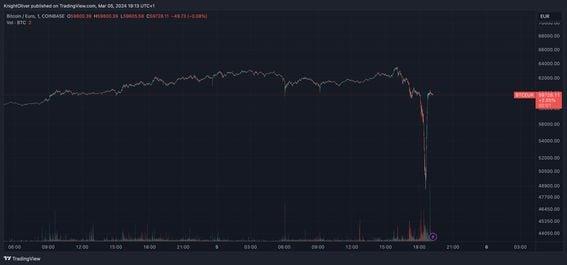
The tumble occurred shortly after bitcoin hit a record high of $69,325. Bitcoin took 10 minutes to return to parity with euro trading pairs on other exchanges. Flash crashes are typically attributed to a lack of liquidity or a "fat finger" trade. Bitcoin (BTC) lost 23.7% of its value against the euro on Coinbase (COIN) Tuesday during the period of high volatility that followed the crypto's surging to a record U.S. dollar high of $69,325. BTC momentarily plunged to €48,529 from €60,000 on Coinbase, while on Kraken, for instance, the price only went as low as €58,400. The reason for the flash crash remains unclear and it took 10 minutes for the price to rebound back to parity with other exchanges. Flash crashes can typically be attributed to a few scenarios, one of which is a lack of liquidity, i.e., the amount of market sell orders was too high for the amount of resting buy orders on the order book and the price thus needing to sink to the nearest point of adequate bids. Another reason, as seen during a flash crash on Binance.US in 2021, is a bug or mistake made by a trader or algorithm, often called a "fat finger" trade. The disparity between euro trading pairs occurred shortly after bitcoin surged to a new record high in U.S. dollar terms of $69,325 and within minutes reversed those gains, sliding to below $64,000 at one point. Coinbase did not immediately respond to CoinDesk's request for comment. https://www.coindesk.com/markets/2024/03/05/bitcoineuro-suffers-flash-crash-on-coinbase/
2024-03-05 18:11
From Coinbase to Reuters and CoinDesk, there's disagreement over BTC's price. Bitcoin just set a record high. But what the hell is it? Amid all the excitement around bitcoin (BTC) setting a new all-time high Tuesday, there's oddness surrounding the auspicious event: little agreement on the new peak price bitcoin got to, or the prior pinnacle that got beat. On Coinbase, the U.S.-based cryptocurrency exchange popular with retail traders, bitcoin got to a new high of $69,325. But Bloomberg says the fresh record is $69,191.94, Reuters says $69,202 and the CoinDesk Bitcoin Index (XBX) says $69,208.79. CoinGecko reports that bitcoin only reached $68,912.84 on Tuesday, which is not a new record, according to its tally. Unsurprisingly, they also don't agree on what the prior all-time high was back in November 2021, ranging from $68,990.90 on the low end from CoinDesk, to $69,044.77 on the high end from CoinGecko. In the end, it probably doesn't really matter very much. Bitcoin is soaring, and whales and small-fry investors alike are getting rich. And, yet, the disparity does underscore that the crypto market is a little rougher around the edges than the conventional financial system it seeks to replace. Arguably, the Coinbase record is the purest of them all: $69,325 is unquestionably a price bitcoin just traded for on that large exchange. The Bloomberg, Reuters, CoinDesk and CoinGecko figures are a blend of data from multiple venues. When the Dow Jones Industrial Average hits a record high, there's zero debate over what the new number is or what the old one was. Whereas one company calculates the Dow, there's no central authority in crypto collecting data and calculating The One True Number. So, the chaos around sorting this important milestone does represent success, in a sense, of a core crypto goal: decentralizing money, markets and finance. https://www.coindesk.com/markets/2024/03/05/bitcoin-soars-to-a-record-but-whats-the-price-and-what-was-the-old-all-time-high/

2024-03-05 16:32
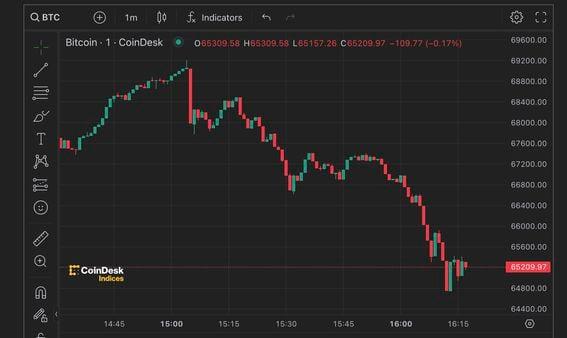
Bitcoin's new all-time high Tuesday quickly turned into a bloodbath, flushing out overzealous leveraged traders. Bitcoin hit a fresh all-time high of $69,200 on Tuesday, then tumbled to as low as $59,700 in a violent sell-off. The correction triggered cascading liquidations, flushing out over $1 billion worth of leveraged derivatives positions across all digital assets, CoinGlass data shows. Bitcoin (BTC) plunged more than 10% from its new all-time high on Tuesday as heavy selling on crypto exchanges capped the price surge beyond $69,000, sending the price below $60,000 at one point. BTC rose to $69,200 earlier during the day, but the order book on crypto exchange Binance showed large sell orders clustered at higher price levels, with over 300 BTC, worth about $20 million, to be sold at $69,000 and more than 500 BTC for sale at $70,000. The selling pressure posed a significant barrier to bitcoin's price, sending the crypto lower. After the CoinDesk Bitcoin Index (XBX) briefly notched an all-time high of $69,208 at 15:04 UTC, BTC tumbled more than $1,000 in a minute. The sell-off then accelerated in waves, with the price first dropping below $65,000, then sinking further to as low as $59,700, CoinDesk Bitcoin Index data shows. At press time, BTC had bounced back to $62,800. The pullback sent BTC down 7% over the past 24 hours, underperforming the broad-market CoinDesk 20 Index's (CD20) 3% decline, which held up better due to the relative strong performance of ether (ETH) and solana (SOL). Other altcoin majors such as Cardano's (ADA), dogecoin (DOGE) and shiba inu (SHIB) lost about 10%-12%. Crypto liquidations soar The wild price action triggered a severe leverage wipeout, liquidating over $1.1 billion worth of derivatives trading positions across all digital assets through the past 24 hours, CoinGlass data shows. Some $870 million of the liquidated positions were longs, or bets on rising asset prices, according to CoinGlass. Liquidations happen when an exchange closes a leveraged trading position due to a partial or total loss of the trader’s initial money down or "margin" if the trader fails to have enough funds to cover the position's losses. When asset prices nosedive, the dynamic can kickstart a cascade of liquidations, exacerbating losses and price declines. Major liquidation events often mark a local top or bottom for the asset's price. Tuesday's action even surpassed last August's $1 billion leverage flush, when bitcoin suddenly dropped below $25,000 from $28,000. The move marked roughly a local low in prices, though it was several weeks before bitcoin actually began moving again to the upside. Will Clemente, co-founder of Reflexivity Research, noted that Tuesday's events reminded him of bitcoin's action around Thanksgiving 2020. At that time, bulls had their eye on an imminent takeout of the $20,000 level, but bitcoin hit $19,500 and cratered, falling in a very short period to roughly $16,000. "Any dips are for shaking out over leveraged apes and buying at this point," Clemente said in an X post. https://www.coindesk.com/markets/2024/03/05/bitcoin-tumbles-6-after-hitting-record-high-as-mounting-sell-orders-cap-price-gains/