2024-03-01 16:37
The asset manager's geographic expansion of the iShares Bitcoin Trust ETF (IBIT) follows its successful introduction in the U.S. in January. BlackRock (BLK) has expanded trading of its spot bitcoin ETF, the iShares Bitcoin Trust ETF (IBIT), to Brazil. The fund started trading on the Brazilian stock exchange B3 on Friday. BlackRock's iShares Bitcoin Trust ETF (IBIT), by far the most successful of the 10 spot bitcoin exchange-traded funds, started trading on the Brazilian stock exchange B3, the company said. The asset manager announced the expansion on Thursday. "This is another opportunity for investors to include exposure to Bitcoin in their portfolios,” Felipe Gonçalves, B3's superintendent of interest and currency products, said in a statement. “The growing interest in the crypto market by investors from all over the world has sparked a search for options in the Brazilian capital market as well.” IBIT has lured over $7 billion in net investment since it and the other nine spot bitcoin ETFs started trading in the U.S. on Jan 11 – the highest inflow in the group. Similar to the U.S.-based product, the Brazilian version of the fund, called the iShares Bitcoin Trust BDR ETF, has a 0.25% management fee, which will be reduced to 0.12% for the first year or until the fund reaches $5 billion in assets. https://www.coindesk.com/business/2024/03/01/blackrocks-spot-bitcoin-etf-starts-trading-in-brazil/

2024-03-01 15:53
A spokesperson for the president later denied an amount had been set, People's Gazette reported. Binance set an unofficial exchange rate and contributed to economic disruption in Nigeria, a presidential spokesperson said. The presidential spokesperson denied an amount had been set, People's Gazette reported later. The news of a potential fine follows the detention earlier this week of two Binance executives who had arrived in the country. Nigeria's government has demanded $10 billion from Binance after central bank Governor Olayemi Cardoso said the largest cryptocurrency exchange by trading volume had enabled $26 billion of untraceable funds to leave the country as it faces a foreign exchange crisis and is looking for ways to restrict capital outflows, the BBC reported. The fine was levied because of the exchange's alleged illegal operations in the country, Bayo Onanuga, a spokesperson for President Bola Tinubu, told the BBC's pidgin language service on Friday. The exchange is setting an exchange rate for the Nigerian naira when only the central bank has that authority, Onanuga said. Onanuga subsequently told Nigerian news service Peoples Gazette his comments had been misrepresented. “I said our government may impose heavy fines on Binance for what happened,” Onanuga told the Gazette. “I never said Binance had been informed about the fines or that it would definitely be $10 billion. I only said the amount may be imposed, which is because nothing has been finalized yet.” Nigerian authorities say Binance, which isn't registered to operate in the country, caused widespread economic disruption and contributed to the naira's 70% weakening in recent months, the BBC reported. On Wednesday, two Binance executives were reportedly detained and their passports confiscated when they flew to Nigeria. The country has been investigating crypto exchanges, the Financial Times reported recently. Neither Binance nor the Nigerian government had responded to requests for comment before publication. https://www.coindesk.com/policy/2024/03/01/nigeria-government-demands-10b-from-crypto-exchange-binance-bbc/

2024-03-01 14:17
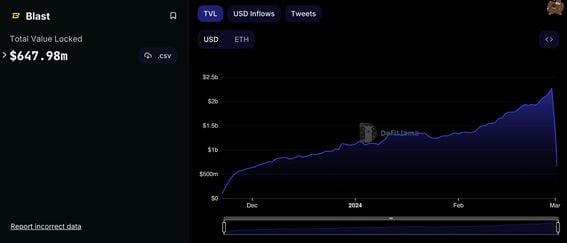
The controversial layer-2 network had taken $2.3 billion in deposits since November as it prepared for launch. What remains is now down to about $350 million, but many of the deposits in the original "farm" contract have now moved into a new Blast address. CORRECTION (19:08 UTC): An original version of this story misinterpreted data from DefiLlama to suggest that most of the funds in the original Blast deposit contract were withdrawn immediately after the network's launch this week. The funds were indeed withdrawn from the Blast contract, but further analysis shows that most of the funds were just moved to a new address associated with Blast's mainnet, not withdrawn from Blast entirely. Investors who had staked ether (ETH) on Blast, a layer-2 network atop Ethereum that launched Thursday, have bridged many of those assets over to another Blast address, "ETH Yield Manager." Early data from DefiLlama data showed that, as of early Friday, some $1.6 billion of assets were moved out of the original Blast deposit contract. The amount remaining in the original contract was down to about $350 million at press time. Blast posted on X on Thursday that "early access users can bridge to Mainnet and use Blast-native Dapps that don’t exist anywhere else." As of early Friday, a new Blast address labeled "ETH Yield Manager" held some $1.8 billion of stETH tokens; stETH tokens represent ether (ETH) that has been deposited into Lido, which "stakes" tokens with Ethereum and rewards interest to users. (Staking tokens is the main part of Blast's strategy for rewarding yields to users.) The movement comes months after Blast, promising on its website to be the "only Ethereum L2 with native yield," announced a deposit-only bridge in November that quickly garnered more than $2 billion in inflows. Depositors received Blast "points" for holding their ETH on Blast, and the assumption is that the points could eventually be redeemed for a token airdrop; in crypto trading, the pursuit of these points is known as "points farming." Backed by the crypto-focused venture firm Paradigm, Blast initially polarized crypto investors, with several observers claiming that it resembled a pyramid scheme due to its controversial one-way bridge. Others simply called out the less-than-ideal optics of a project soliciting deposits and disabling withdraws while its technology remained under development. Yet in spite of skepticism, Blast rapidly became one of the most active layer-2 networks in terms of deposits even before the mainnet had gone live. It attracted $2.3 billion in deposits from 181,000 users, generating an annual yield of $85 million. The Blast ecosystem experienced its first exit scam earlier this week, with a protocol named "RiskOnBlast" disappearing along with $1.3 million worth of ether. Several projects have added Blast integrations, with NFT platform Zora and pricing oracle provider Pyth announcing their support on Thursday. Developers that create decentralized apps (dApps) on Blast are supposed to receive 50% of the upcoming airdrop allocation. https://www.coindesk.com/business/2024/03/01/blast-hyped-layer-2-chain-sees-most-deposits-bridge-to-yield-manager/
2024-03-01 10:48
WLD is considered a proxy bet on OpenAI, the Sam Altman-owned artificial intelligence company. Worldcoin’s WLD token slid in European morning hours on Friday after a report of a lawsuit against related company OpenAI emerged. WLD dropped 2.2% in an hour as Reuters reported technology investor Elon Musk had sued OpenAI and CEO Sam Altman for breach of contract, as per a Thursday filing. Musk accused them of breaching contractual agreements made when he allegedly helped found the company in 2015. Altman is a board member and co-creator of Worldcoin. The controversial project aims to scan everyone’s eyes in exchange for a digital ID and tokens. In the past year, AI tokens have tended to move when there are developments in the broader artificial intelligence industry. In February, several AI tokens rallied after chipmaker Nvidia beat fourth-quarter earnings estimates and OpenAI released a new text-to-video product. https://www.coindesk.com/markets/2024/03/01/worldcoins-wld-slides-as-elon-musk-sues-openai/

2024-03-01 07:51
Never before has the RSI been this overbought alongside an above-$60,000 bitcoin price, analysts at The Market Ear explained. Bitcoin’s RSI signals caution to short-term traders looking to chase the price rally, according to The Market Ear. The overbought reading on the RSI signals the potential for a temporary price correction. Bitcoin (BTC), the leading cryptocurrency by market value, has gained over 40% in four weeks and is trading just 12% short of its record high near $69,000. Such an uber-bullish market condition often has short-term traders and speculators, who missed the early rally, jump in with both feet, using riskier leveraged products like futures to maximize gains and make up for initially sitting on the sidelines. If you are one of those short-term traders, you might want to consider the new information, which suggests chasing the rally now may be risky, according to the news and analysis website The Market Ear. “Bitcoin [14-day] RSI at 88. We have not seen RSI this overbought AND bitcoin trading at these absolute levels, ever,” analysts at The Market Ear said in Thursday’s edition of the newsletter. “Chasing it here looks like a very late trade,” analysts added. RSI, developed by J. Welles Wilder, is a momentum indicator that measures the speed and change of price movements over a set period, usually 14 days or 14 weeks. A reading above 70 reflects overbought conditions or a situation where the asset's price has seen a long run of successively higher prices or rallied a little too fast and may correct lower soon. Never before has the RSI reached this high, alongside plus $60,000 bitcoin price. The indicator peaked between 65 and 75 the last time bitcoin traded above $60,000 in early 2021 and November 2021. Bitcoin’s present value relative to the RSI lends credibility to the overbought signal, calling caution on the part of speculators looking for a long entry at the going market rate. That said, RSI is not the holy grail. Markets often maintain a strong upward trajectory for days and weeks, keeping the RSI above 70 for a prolonged time. As Newton’s law says, “An object in motion stays in motion with the same speed and in the same direction unless acted upon by an unbalanced force.” The overbought reading is of little importance to existing or new long-term investors whose strategy is to buy and hold for long-term growth. Investors typically do not worry about short-term price swings and focus on the big picture. According to analysts, bitcoin’s big picture is bullish, thanks to the halving, which reduces supply expansion by 50% every four years, and Wall Street’s recent embrace of the spot bitcoin ETFs. The consensus is that the cryptocurrency could draw a price of $120,000 and higher by September 2025. https://www.coindesk.com/markets/2024/03/01/bitcoin-bulls-just-joining-the-rally-are-very-late-to-the-party-analyst-says/

2024-03-01 02:36
State attorneys general argue that the SEC is trying to claim jurisdiction that rightfully belonged to states. A group of state attorneys general are arguing that the U.S. Securities and Exchange Commission exceeded its authority in suing the crypto exchange Kraken. State law enforcement officials from Montana, Arkansas, Iowa, Mississippi, Nebraska, Ohio, South Dakota and Texas filed a joint amicus brief – or friend of the court filing – in the SEC's suit against Kraken on Thursday, alongside a number of industry lobbyists and other participants. Saying the SEC's suit might even harm consumers, the state AGs argued that the agency was expanding the definition of an "investment contract," and that cryptocurrencies "are not automatically securities." The filing, which echoed some of Kraken's own arguments – as well as other crypto companies – said the states were not filing in support of the exchange, but rather in opposition to the federal regulator. "States have a strong interest in preventing the potential preemption of consumer protection and other state laws by the SEC’s attempt to regulate crypto assets as securities," the filing said. "... The SEC’s exercise of this undelegated authority puts consumers at risk by potentially preempting state statutes better tailored to the specific risks of non-securities products. Some state laws are more protective of consumers than the federal securities laws." State cases have helped clarify the definition of investment contracts in the past, the filing said. If the SEC wins its suit, it might be able to preempt state consumer protection laws, as well as state regulations around crypto, the filing said. The SEC sued Kraken last fall, alleging the exchange had failed to register as a securities broker, clearinghouse or trading platform. It's a similar complaint the SEC has brought against companies like Coinbase, Binance and Bittrex's U.S. branch. While Bittrex settled, the Coinbase and Binance/Binance.US suits are ongoing. Unlike those other suits, the SEC argued that Kraken was explicitly involved in touting 11 different digital assets it said the exchange listed as unregistered securities. The SEC also alleged Kraken commingled customer and corporate funds. Kraken filed a motion to dismiss last week, arguing the SEC had failed to "plausibly allege" its arguments, and that it was overreaching its bounds – similar arguments to those made by Coinbase and Binance. The case saw a flurry of amicus briefs on Wednesday and Thursday from industry groups like the Chamber of Digital Commerce, the Blockchain Association and the DeFi Education Fund. U.S. Senator Cynthia Lummis (R-Wyo.) also filed a brief, similar to the one her office filed in the SEC's case against Coinbase. https://www.coindesk.com/policy/2024/03/01/sec-overstepped-bounds-in-kraken-lawsuit-state-ags-charge/