2024-02-26 07:03
“Without a bounce from here, we could see a deeper correction begin, potentially as low as $47,000-$49,000,” one trader said. Bitcoin (BTC) prices were little changed in line with a trend of low weekend volatility, with ether and some ecosystem tokens driving gains instead on the back of the relatively new ether (ETH) ETF narrative. Bitcoin hovered around the $51,500 mark in Asian morning hours Monday, while ether regained the $3,100 level. XRP, Cardano’s ADA and Avalanche’s AVAX were down 1% in the past 24 hours, while BNB Chain’s BNB was up 1.2%. Tokens of Ethereum layer-2 platform Mantle {{MNT}} zoomed 30% to set a lifetime peak at 93 cents. There was no immediate catalyst for the price gains, but it came on the back of mantleETH {{mETH}}, a staked version of ether, crossing the $1.5 billion value-locked mark last week. Meanwhile, a trader said that bitcoin could see a short-term correction to as low as $47,000. “The price of bitcoin has fallen below $51K, which is near the bottom of the consolidation range of the last eight days,” Alex Kuptsikevich, FxPro senior market analyst, told CoinDesk in an email. “Without a bounce from here, we could see a deeper correction begin, potentially as low as $47-49K.” “Since Friday morning, crypto has been dominated by selling despite all-time highs in many global equity indices. As a very sensitive indicator, the crypto market may be signaling that investors have become a little more cautious,” Kuptsikevich added. https://www.coindesk.com/markets/2024/02/26/ether-mantle-lead-crypto-majors-as-bitcoin-traders-see-prices-correcting-to-48k/

2024-02-26 06:09
Blast, in an X post, termed the project’s potential as “undeniable,” which may have created a sense of security among investors. Blast ecosystem experienced the first rug pull event as RiskOnBlast, a gambling and exchange platform, disappeared with over 420 ether raised from retail traders. RiskOnBlast’s anonymous team sent nearly $500,000 to ChangeNow, $360,000 to MEXC, and $187,000 to Bybit after raising over $1 million from investors. The well-funded and hyped Blast ecosystem apparently saw its first rug pull event over the weekend as a project went missing after raising over 420 ether (ETH), worth $1.3 million at current prices, from retail traders. A rug pull is a type of exit scam that involves a team raising money from investors and the public by selling a token only to quietly shut down shortly afterward. Blast is an Ethereum layer-2 project that has attracted over $1 billion in capital in the past few months, ahead of going live. RiskOnBlast, purported to be a gambling and exchange platform, raised over $1 million from investors in a seed round last week and was one of the participants in Blast’s Big Bang competition, where it stood to receive funding if it won. But all of its social media accounts were scraped on Sunday. The team itself was anonymous. Onchain researcher @somaxbt said the apparent stolen funds came from over 750 wallets. Nearly $500,000 worth was later sent to the swapping service ChangeNow, $360,000 to crypto exchange MEXC, and $187,000 to Bybit. Blast had previously posted about the project on its official X handle, terming its potential as “undeniable.” While Blast is not directly involved in what projects on its blockchain do, the social endorsement could be taken by investors as a sign of legitimacy. One investor claimed to have lost over $12,500, while market observers criticized the lack of due diligence and irresponsible capital bets on projects that are seemingly spun up overnight. For some, the euphoria marked a sign of the bull market – where valuations can often go crazy and money is freely sloshed around. Meanwhile, Blast said in an X post on Saturday that it had chosen 47 projects as winners of its developer competition from a list of 3,000 applications. These teams will receive a certain amount of unspecified funding in the coming months to help build out an ecosystem on the new blockchain. https://www.coindesk.com/markets/2024/02/26/blast-ecosystem-sees-first-apparent-scam-as-riskonblast-rug-pulls-13m-ether/

2024-02-26 00:01
OANDA Crypto is the summation of last year’s acquisition of a majority stake in FCA-registered crypto firm Coinpass, and will offer trading in over 63 cryptocurrency pairs, including bitcoin, ether, and XRP. Global brokerage firm OANDA is officially opening for crypto trading in the UK. OANDA Crypto will be based in London and comes with FCA registration thanks to last year’s acquisition of Coinpass. U.S.-based forex pioneer OANDA is opening a cryptocurrency trading platform in the UK, registered with the country’s regulator, the Financial Conduct Authority (FCA), based in London and dubbed OANDA Crypto. It’s the summation of last year’s acquisition of a majority stake in FCA-registered crypto firm Coinpass, and will offer trading in over 63 cryptocurrency pairs, including Bitcoin, Ether, and Ripple, with plans to add more tokens and features over the course of the year, the company said. While some crypto-focused companies tend to stay away from places like the U.S. and other heavily regulated jurisdictions, this was an attractive feature for OANDA, said the firm’s head of digital assets Lucian Lauerman. “The UK has a high level of participation and is a very well educated and active market,” Lauerman said in an interview. “What we liked about the opportunity in the UK, when it comes to crypto, is that it’s becoming more aligned with the markets where we’ve traditionally operated. The regulatory bar has been set slightly higher.” OANDA already offers crypto in the U.S. via a partnership with New York State Department of Financial Services-regulated Paxos. The brokerage also refocused its mainland Europe operations away from Malta to Warsaw in Poland, with the acquisition of Polish broker Dom Maklerski TMS Brokers SA, which was rebranded to OANDA TMS. https://www.coindesk.com/business/2024/02/26/oanda-opens-fca-registered-crypto-trading-platform-in-the-uk/
2024-02-23 20:44
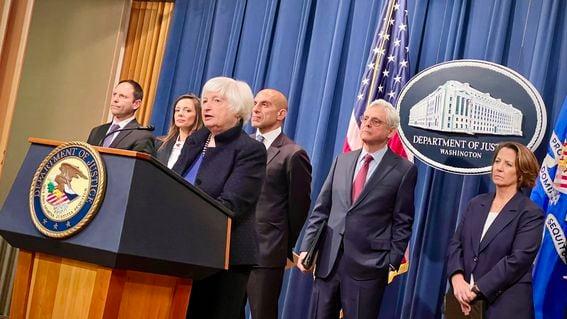
Binance pleaded guilty to violating sanctions and anti-money laundering laws last year. A federal judge has signed off on crypto exchange Binance's $4.3 billion plea deal with the U.S. Department of Justice. During a sentencing hearing Friday, Judge Richard Jones of the U.S. District Court for the Western District of Washington approved the top-line fine itself, though he did not yet sign off on any monitor for the exchange. Bloomberg first reported the news earlier Friday. The DOJ announced the settlement last November, alleging Binance had violated sanctions and anti-money-laundering laws over a years-long period. Under the terms of the settlement, the exchange would pay $4.3 billion, appoint an independent compliance monitor and have its CEO at the time, founder Changpeng Zhao, step down. Zhao pleaded guilty to separate charges and is currently scheduled to be sentenced in late April. In a statement, a Binance spokesperson said the exchange was accepting responsibility through the plea deal, adding that the exchange had improved its know-your-customer and anti-money-laundering compliance in recent years. "We are gratified by the recognition we have received from regulators regarding our cooperation and significantly enhanced compliance," the statement said. "We look forward in the coming months to continuing to build on our efforts to set the industry standard for compliance, security, and transparency." A DOJ spokesperson declined to comment. In a sentencing memo ahead of the hearing, prosecutors wrote that the agreement "reflects the nature and circumstances" of Binance's alleged conduct. "Critically, the agreed-upon sentence will promote specific and general deterrence. As part of its plea agreement, Binance has agreed to take substantial measures to ensure its ongoing compliance with U.S. law. And the significant sentence agreed to here demonstrates to other financial institutions that may seek to break the law under the guise of 'innovation' that there will be serious consequences for their criminal actions," the memo said. https://www.coindesk.com/policy/2024/02/23/judge-signs-off-on-binances-43b-plea-deal-with-us-prosecutors/
2024-02-23 20:40
Of the Web 2 giants, the message board king is arguably most invested in crypto. Its filings to go public have interesting things to say about how a Silicon Valley company views digital asset regulation. Reddit may only hold an “immaterial” amount of bitcoin (BTC), ether (ETH) and Polygon’s (MATIC), but the way it treats crypto is significant. On Thursday, the idiosyncratic message board platform disclosed it held crypto assets as part of its treasury holdings and as a means of payment, in a filing readying it to go public in the U.S. This shouldn’t come as a surprise, given that Reddit is among the few social media giants that started experimenting with crypto tokens, NFTs and blockchain tools in the pandemic-era bull run — and is arguably the Web2 era giant that took crypto most seriously. What is surprising are some of the assumptions Reddit makes about the world of crypto in its U.S. Securities and Exchange Commission filing. First, Reddit announced it has joined a select club of companies that holds both BTC and ETH in its corporate treasury. While a number of native crypto companies hold both leading cryptos in reserve, most are likely to follow MicroStrategy’s “bitcoin-only” approach. So Reddit joins KPMG Canada and Meitu, so what? Well, the company’s reasoning, outlined in its S-1 filing - a long, thorough and highly-vetted legal document - is telling. Based on public statements from the SEC, Commodities Futures Trading Commission and other “high-ranking” regulatory bodies, it has determined Ethereum’s native token is not “likely” a security. While Reddit’s compliance team must have added that line saying “such determinations, however, are risk-based judgments made by us [and] do not constitute a legal standard,” it is significant as an opinion, given the recent hem hawing by the SEC over ETH’s legal standing following Ethereum’s transition to proof-of-stake. This is all the more relevant given that most of Reddit’s discussion of crypto happens in a section disclosing risks. The company notes that human errors and computer malfunctions can result in the loss or destruction of the private keys needed to access their funds, a little bit of insight into why, perhaps, crypto has not exploded in popularity as a treasury asset. Reddit also notes the regulatory risks that may prevent it from accessing or selling its holdings. But more interesting are the ways regulations are already shaping the company’s approach to crypto. Two rules shaping approach Two rules in particular are worth noting: First, the SEC’s controversial Staff Accounting Bulletin No. 121 from March 2022, which provides “guidance” on safeguarding crypto on behalf of users. SAB 121, as it’s commonly called, requires companies to track holding on their balance sheet, and keep an equal amount of assets in reserve as customers hold on the platform — which has been described as an onerous, overly-cautious request. The rule itself doesn’t affect Reddit in a material sense, because Reddit’s crypto experiments were fully non-custodial. “We do not provide custody or safeguarding services, do not maintain the private keys or have the ability to recover the private keys, do not perform recordkeeping … and do not protect from risk of theft or loss,” the company notes. But it is possible, as one of the world’s largest websites, it would have liked to. After less than a year, Reddit decided to sunset its “Community Points” crypto rewards token pilot, which was hailed as a success at launch. While decentralization maxis live by the maxim that “not your keys, not your coins,” the simple reality is that key management is hard and that true self-custody likey can never scale for a platform as big as Reddit. It's possible Community Points would still be around if Reddit had the ability to help users recover keys in the same way they can help recover passwords. At the very least, the existence of SAB 121 will determine the type of crypto projects any company in the U.S. will attempt. Second, there’s the generally accepted accounting principles (GAAP) that impact how Reddit recognizes crypto on its balance sheet. According to the ruleset today, companies that hold crypto can only recognize changes in price when it decreases (aka an “impairment” cost), but not when it rises. This is why during the bear market MicroStrategy and Telsa made headlines for recording losses totaling hundreds of millions as bitcoin decreased. “This accounting treatment may adversely affect our operating results in periods where we have recognized an impairment,” Reddit noted. Impairment costs are treated as a “general and administrative” expense, even if the losses are just on paper, perhaps another reason why more firms haven’t bought bitcoin. Thankfully, the Financial Accounting Standards Board issued new crypto accounting guidance in December 2023 that will allow companies to recognize the fair value of digital assets rather than their cost basis. Either way, it’s clear enough that Reddit sees “significant potential” in crypto, even in as conservatively worded a document as an S-1. Indeed, the legalese itself is useful insight into what even tech-forward corporations think (or are forced to think) about blockchain: “a relatively recent trend,” increasingly synonymous with “improper, illegal, or fraudulent activities” with an unstable legal footing and uncertain consumer demand. Funnily enough, after noting it holds ETH and MATIC for payments, it noted most of those procurements are from Reddit’s product and engineering teams. Who knows if crypto will ever be widespread on Reddit. But, for the time being, it’s safe to bet that R&D teams are having fun with it. https://www.coindesk.com/consensus-magazine/2024/02/23/what-reddits-ipo-filing-says-about-crypto-regulation/

2024-02-23 17:51
The Bitcoin creator saw an irony in the debate between economic liberty and conservation in an email thread with an early collaborator Martii 'Sirius' Malmi. Satoshi Nakamoto warned that Bitcoin could become a significant consumer of energy in 2009 emails. Proof of Work is central to Bitcoin's security but debated for high energy consumption. Satoshi foresaw non-financial uses for blockchain and expressed concerns about legal scrutiny. In a recently released batch of emails posted by Martii 'Sirius' Malmi, an early collaborator on Bitcoin's code, Satoshi Nakamoto warned that the cryptocurrency – now the world's largest digital asset – could become an energy guzzler. The email release comes as Craig Wright is on trial in a case brought by the Crypto Open Patent Alliance (COPA) to determine whether he is indeed Satoshi Nakamoto, the anonymous creator of Bitcoin. "Proof of Work is the only solution I've found to make p2p e-cash work without a trusted third party," Satoshi wrote in May 2009, calling Proof of Work (PoW) "fundamental to coordinating the network and preventing double-spending." PoW is a consensus algorithm used in cryptocurrencies like Bitcoin to secure the network and prevent double-spending by requiring miners to solve complex computational puzzles, which in turn validates transactions and adds new blocks to the blockchain. PoW is at the center of a debate around Bitcoin's energy consumption. While the cryptocurrency industry points to miners' use of clean or orphaned power, which would otherwise go to waste, critics are laser-focused on the raw numbers of energy consumption it generates. As a result, some jurisdictions like New York State or British Columbia have placed moratoriums on Bitcoin mining, citing the high energy consumption. "If it did grow to consume significant energy, I think it would still be less wasteful than the labour and resource intensive conventional banking activity it would replace," Satoshi wrote. "The cost would be an order of magnitude less than the billions in banking fees that pay for all those brick-and-mortar buildings, skyscrapers, and junk mail credit card offers." 2021 research from Galaxy Digital showed that Bitcoin uses half the energy of the banking or gold mining industries. "Ironic if we end up having to choose between economic liberty and conservation," Satoshi continued. Non-financial uses of Blockchain Blockchain serving as a sort of open-source notary was one non-financial use of Bitcoin that Satoshi saw in the technology, which would allow users to securely timestamp documents to prove their existence at a specific point in time. "Bitcoin is a distributed secure timestamp server for transactions," Satoshi wrote. "A few lines of code could create a transaction with an extra hash in it of anything that needs to be timestamped." Legal concerns Satoshi was also concerned that labelling Bitcoin as a sort of investment might bring legal scrutiny from authorities. "There are a lot of things you can say on the sourceforge site that I can't say on my own site," he wrote. "Even so, I'm uncomfortable with explicitly saying, 'consider it an investment' ... That's a dangerous thing to say and you should delete that bullet point. It's OK if they come to that conclusion on their own, but we can't pitch it as that." Indeed, in the time since, the Securities and Exchange Commission (SEC) has engaged in a long campaign of legal warfare around the use of this word and might classify a cryptocurrency as a security and crypto exchanges as dealing with unregistered securities. https://www.coindesk.com/tech/2024/02/23/satoshi-anticipated-bitcoin-energy-debate-in-email-thread-with-early-collaborators/




