2024-02-23 17:50
COPA's trial to find out whether or not Craig Wright is the pseudonymous creator of bitcoin Satoshi Nakamoto has completed its third week. The bitcoin developers' lawyer, Alexander Gunning, presented evidence that Craig Wright had made new edits to his whitepaper, which Wright acknowledged. The Crypto Open Patent Alliance wants to prove that Wright's claim to be the founder of bitcoin is a lie backed by forgeries. Craig Wright admitted to making changes to the version of the bitcoin whitepaper he presented in the Crypto Open Patent Alliance's (COPA) trial while testifying Friday. The trial to prove whether or not Wright is the anonymous creator of the bitcoin white paper completed its third week. COPA wants to prove that Wright's claim to be Satoshi Nakamoto is a lie afforded by "industrial style forgeries," and the bitcoin developers lawyer Alexander Gunning is helping them. On Friday, Gunning showed that Wright made edits to the bitcoin whitepaper in his "LaTeX files," which Wright agreed was accurate. Wright said the edits were simply a demonstration for his representatives at Shoosmiths (his law firm). "You were not showing this to anyone, we know the times you were showing this to Shoosmiths, you were doing it for yourself," Gunning said. "What you are doing is tweaking parameters.. to get them to fit " the layout of the bitcoin whitepaper, Gunning added. The file was uploaded as recently as November 2023, Gunning said. Gunning ended his questioning by asking: "Your claim to be Satoshi Nakomoto is a fraudulent claim isn't it?" which Wright disputed. Week three Wright's testimony capped off the third week of the trial, which saw some of COPA's witnesses take to the stand to face questioning from Wright's lawyers. Zooko Wilcox-O'Hearn, a computer scientist and the founder of Zcash, testified on Thursday where he was questioned on how well he knew Nakamoto. Wilcox said he wouldn't call himself "pals" with the pseudonymous Bitcoin creator. In court documents, he said that he was not sure if he had any private conversations with Nakamoto. Other witnesses were more confident about their interactions with Nakamoto. Computer scientist Marti Malmi spoke on Wednesday, disputing the dates that Wright put forward about Malmi's interaction with Nakamoto. Malmi later released his emails with Nakamoto on X (formerly Twitter). Wright said in his witness statement that Malmi approached Nakamoto in Feb. 2009 but Malmi said in his statement this was "incorrect," and that the date was actually May 1, 2009. Adam Back, the CEO of bitcoin technology company Blockstream, said in his first statement he corresponded with someone purporting to be Nakamoto via email. In his statement he showed an email he received from Nakamoto on Aug. 20, 2008, where he said he planned to cite Back's paper about a proof-of-work system and Back responded by sending more resources. Wright described Back's interactions with Nakamoto as "dismissive," which Back said was inaccurate. Next week expert witnesses will be questioned. https://www.coindesk.com/policy/2024/02/23/craig-wright-admits-to-editing-bitcoin-white-paper-presented-in-copa-trial/

2024-02-23 14:54
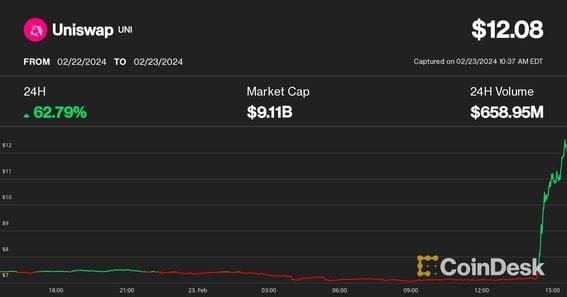
The upgrade would reward UNI token holders who staked and delegated their tokens, according to the proposal. Uniswap's governance token UNI gained 60% after a proposal by a key Uniswap Foundation leader to overhaul the protocol's decision-making. The proposal would distribute protocol fees among UNI holders who stake and delegate tokens to rejuvenate the protocol's decision-making. Decentralized exchange Uniswap's governance token (UNI) jumped Friday as much as 60% after a proposal to overhaul the protocol's governance system, submitted by Uniswap Foundation's governance lead, Erin Koen. The proposal aims to "strengthen and invigorate" Uniswap's governance, and also would reward UNI token holders who staked and delegated their tokens. "I believe we should upgrade the protocol so that its fee mechanism rewards UNI token holders that have staked and delegated their tokens," Erin Koen wrote in an X post. Koen's proposal is a significant development for the largest decentralized exchange by trading volume, marking a departure from last year's initiative to reward token holders with accrued fees. Last June, the Uniswap community turned down a proposal that would have switched on fees for many of the exchange's liquidity pools and distributed a part of the revenue among token holders. In an October move, the exchange started to charge a 0.15% fee on crypto swaps involving ETH, USDC and other tokens initiated on the protocol's interface. Should Friday's overhaul proposal approved in a community vote, it would enable the permissionless and programmatic collection of protocol fees, and distribute them pro-rata to UNI token holders who have staked and delegated their votes. UNI was recently changing hands at $12, up nearly 60% over the past 24 hours and reaching its highest price since April 2022. It vastly outperformed the mostly flat price action of bitcoin (BTC) and the broad-market CoinDesk 20 Index (CD20). https://www.coindesk.com/markets/2024/02/23/uniswaps-uni-jumps-50-on-proposal-to-upgrade-governance/
2024-02-23 13:31
Block finalization started to resume on Friday afternoon after developers released a software update that resolved a faulty logic in the code. Avalanche suffered a major outage Friday, failing to produce blocks for more than four hours. Developers released a software patch disabling logic that permitted an "excessive amount of gossip" to take place between validators. Avalanche's interruption followed a five-hour outage earlier this month from rival blockchain Solana. Layer-1 blockchain Avalanche resumed finalizing blocks on Friday, four hours after an outage took the network offline due to a software bug, according to its status page and block explorer. Avalanche stopped adding blocks at 11:13 UTC, according to the status page, which noted that developers for the network had already begun investigating the issue. At 15:59, developers released a software upgrade for Avalanche nodes that disabled logic which led to an "excessive amount of gossip" between validator nodes. Validators are entities spread around the world that manage blockchain nodes, securing the network and processing transactions. The software patch addressed an issue where more information was passing between the nodes than necessary, which placed a strain on the network and ultimately brought it offline. "Avalanche Validators provision a stake-weighted bandwidth allocation for each peer and this buggy logic led to each node saturating their allocation with useless transaction gossip," an official Avalanche status report explained. "This dynamic prevented pull queries issued by the validator from being processed in a timely manner and led to consensus stalling." According to the Avalanche status page, block finalization on the primary network resumed at 16:36 UTC after validators updated their node software to the patched version. Kevin Sekniqi, the co-founder of Avalance developer Ava Labs, speculated earlier in the day that the issue seemed "related to a new inscription wave" that had launched on Avalanche an hour before the outage. Inscriptions are a way of recording arbitrary data on a blockchain without smart contracts. They initially emerged on Bitcoin, allowing users to mint non-fungible tokens (NFTs) on the blockchain for the first time. Sekniqi clarified in a follow-up tweet, however, that the inscriptions were not ultimately the main culprit and "did not effect performance." The network’s native token (AVAX) dropped 3% since the outage occurred, underperforming the broad-market CoinDesk CD20 Index, which was slightly up within the same period. Rival blockchain Solana had a five-hour outage earlier this month as it suffered under heavy congestion. https://www.coindesk.com/business/2024/02/23/avalanche-suffers-outage-fails-to-produce-block-for-almost-two-hours/

2024-02-23 10:07
The former U.S. president had previously said he was "not a fan" of cryptocurrencies and called central bank digital currencies dangerous, vowing not to allow them if elected. Asked about bitcoin before the South Carolina primary, Donald Trump said "I can live with it." That may indicate his stance is softening. In 2019, the then-president said he was "not a fan" of cryptocurrencies. Former U.S. president and Republican front-runner Donald Trump said bitcoin (BTC) has "taken a life of its own" and will probably need some regulation. Trump was speaking to Fox News during a town hall event in South Carolina on Tuesday ahead of the state's Republican primary. Nikki Haley, the former South Carolina governor, remains the only other contender and has vowed to remain in the race even if she loses the Saturday primary. Bitcoin has "taken a life of its own," Trump responded to Fox News anchor Laura Inghram's question about whether the next logical step for the U.S. is to embrace bitcoin. "You probably have to do some regulation. But many people are embracing it. More and more I'm seeing people wanting to pay bitcoin. ... I can live with it one way or the other." That sounds like he may be easing his stance. Back in 2019, when he was president, Trump tweeted that he was "not a fan" of cryptocurrencies, saying they were "not money." And, he reiterated Tuesday: "I always liked one currency ... I like the dollar." Trump has called central bank digital currencies (CBDCs) dangerous and vowed not to allow them if elected. Read More: Donald Trump Is the Latest Republican to Use CBDCs as a Dog Whistle https://www.coindesk.com/policy/2024/02/23/trump-bitcoin-has-taken-on-a-life-of-its-own-will-probably-need-some-regulation/
2024-02-23 09:51
If the court does not intervene, the companies will be "immediately and irreparably harmed," the filing said. The Texas Blockchain Council (TBC) and Riot Platforms sued the U.S. Department of Energy for demanding information without giving respondents sufficient notice. If the court does not intervene, the companies will be "immediately and irreparably harmed," the filing said. The Texas Blockchain Council (TBC) and Riot Platforms (RIOT), one of the largest crypto miners in the state, sued the U.S. Department of Energy for "illegally" demanding information from many of the council's members, including Riot, according to a Thursday court filing. The TBC and Riot also sued Secretary of Energy Jennifer M. Granholm, the U.S. Energy Information Administration (EIA) and the Office of Management and Budget (OMB) and other officials. "This is a case about sloppy government process, contrived and self-inflicted urgency, and invasive government data collection," the filing says. The civil lawsuit says the EIA requested an emergency review and clearance from the OMB of a planned collection of proprietary energy information from the mining companies. The EIA determined that if such a collection were not authorized, public harm was reasonably likely. That's because the bitcoin (BTC) price's recent rally would incentivize more mining activity, leading to high electricity demand just as a major cold snap hit parts of the country. The EIA is demanding the information by Feb. 23 "under the explicit threat of criminal fines and civil penalties." That doesn't follow the Paperwork Reduction Act’s standard clearance processes, which requires giving companies 60-day notice, the filing said. If the court does not intervene, the companies will be "immediately and irreparably harmed by being forced to divulge confidential, sensitive, and proprietary information," the filing said. "The EIA's actions represent an alarming precedent of government intrusion into private industry operations without just cause or proper process," TBC President Lee Bratcher said in a statement. Debates about the impact of mining on electricity are not new, and Texas legislators have backed at least two bills signaling support for the industry. CoinDesk has emailed the EIA, DOE and OMB for comment. Read More: Bitcoin Mining and the Politicization of a Once Reputable Federal Agency https://www.coindesk.com/policy/2024/02/23/texas-blockchain-council-riot-platforms-sue-dept-of-energy-omb-over-emergency-survey/

2024-02-23 07:46
Interest in ether bets rose significantly after the approval of spot bitcoin ETFs in January sparked optimism among ETH traders. Ether spot-exchange traded funds (ETFs) may increase institutional investment in Ethereum's token but are unlikely to create major price surges, according to some market observers. While interest in ether bets has risen significantly, an ETF could create sustained growth rather than explosive growth in the ether market. Ether (ETH) spot-exchange traded funds (ETFs) may increase institutional investment and power the world’s most-used blockchain, but is unlikely to create euphoric price surges, some market observers opined. Interest in ether bets rose significantly after the approval of spot bitcoin (BTC) ETFs in January, which sparked hope among ether traders. Last week, Ethereum’s native token crossed the $3,000 mark for the first time since April 2022, rising 15% in a week and beating bitcoin’s relatively modest 8% rally in the same period. Crypto circles on social application X expect such price action to continue after the expected issuance of ether ETFs later this year. The narrative is that these inflows could later find their way to the broader Ethereum ecosystem. However, some believe an ETF could create sustained, rather than explosive, growth in the ether market. “Ethereum ETFs won’t cause bubbles,” Jag Kooners, head of derivatives at Bitfinex, told CoinDesk in an email. “Despite concerns, institutional investment through an ETF could stabilize the Ethereum market, as seen with bitcoin and gold ETFs, fostering sustained growth.” “Ethereum’s Layer 2 solutions enhance scalability by enabling faster, cheaper transactions outside the main blockchain, fostering growth,” he added. “Unlike bitcoin’s security focus, Ethereum’s L2 solutions prioritize rapid expansion, potentially attracting institutional investment and broadening application scope.” However, an ether ETF still faces regulatory headwinds. “Ether’s classification as a security or commodity remains a key hurdle despite ongoing regulatory discussions,” Kooners said. Some traditional finance firms say there is a 50% chance of an ether ETF approval by May, as reported, with ether considered the “only digital asset other than bitcoin” to get spot ETF approval in the U.S. As of Friday, Franklin Templeton, BlackRock, Fidelity, Ark and 21Shares, Grayscale, VanEck, Invesco and Galaxy, and Hashdex have all submitted applications for an ether ETF. https://www.coindesk.com/markets/2024/02/23/ether-etfs-unlikely-to-cause-a-bubble-traders-say/




