2024-02-22 19:47
Marathon will be the first publicly traded miner to offer such a service by utilizing its own mining pool. Slipstream will help expedite the processing of "non-standard" Bitcoin transactions. Marathon will be the first publicly traded miner to offer such a service by utilizing its own mining pool. Bitcoin miner Marathon Digital (MARA) to roll out Slipstream - a new offering that will help expedite the processing of complex transactions. Slipstream will make the confirmation of large or "non-standard" bitcoin transactions easier, cutting out the delay and complication users often face during such process, the company said in a press release. If a complex transaction meets Marathon's minimum fee threshold and conforms to the network's consensus rules, the miner will add the transaction to the members pool or mempool for mining, the miner said. Mempools are essentially waiting rooms for Bitcoin transactions. "By default, Bitcoin nodes frequently exclude large and non-standard transactions from Bitcoin’s mempool, even if these transactions adhere to the Bitcoin network’s consensus rules," said Marathon. "As a result, complex Bitcoin transactions are often delayed or unprocessed. To encourage experimentation and development on Bitcoin and to enable and expedite the processing of large or complex transactions that comply with Bitcoin’s protocol, Marathon has launched Slipstream." Marathon will be the first publicly traded mining company to offer such a product and be able to do so, given that it owns its own mining pool - MARA Pool. "Because it is the only publicly traded Bitcoin mining company that operates its own mining pool, Marathon is also the only known publicly traded Bitcoin miner currently capable of offering such services," the company said. As Marathon can operate as the sole miner in its own mining pool, the company says it's able to customize its pool's settings to accept more "diverse" transactions. However, such customization brings the question of censoring user transactions. The topic has been hotly debated recently, as some mining pools have been accused of censoring. Marathon said that transactions submitted through Slipstream will be subject to certain terms of service, which "prohibit unauthorized copyrighted material and objectionable material." The need for such service exists as other mining pools currently don't offer similar products "in a standardized, accessible manner," the company said in a separate statement. Some pools may accept these transactions, but those often happen through channels such as email or direct messaging on social media platforms, Marathon added. "Marathon is uniquely capable of offering these services because of our scale, our mining pool, and our team’s technological expertise. We believe Slipstream is mutually beneficial for the industry and for our organization," said Fred Thiel, Marathon’s chairman and CEO. The miner has been actively experimenting on its mining pool, which hasn't always gone smoothly. Last year, Marathon mined an invalid block due to an unexpected bug, which raised some questions among the community members as to the security of the network. However, the event was cited by Marathon as an example of the resilience of the Bitcoin network. https://www.coindesk.com/tech/2024/02/22/bitcoin-miner-marathon-to-start-slipstream-to-make-complex-btc-transactions-faster/

2024-02-22 17:40
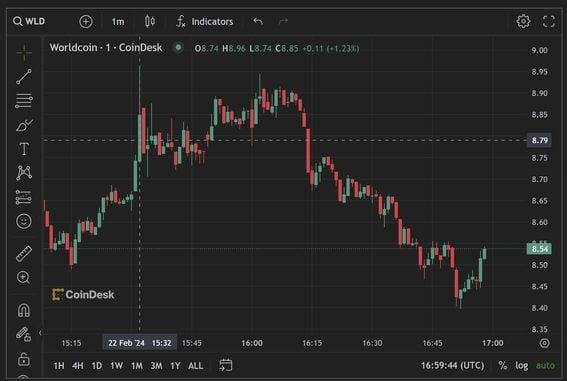
The sector was up as Nvidia's earnings results spurred broader optimism surrounding artificial intelligence. OpenAI CEO Sam Altman’s Worldcoin (WLD) token hit record highs on Thursday alongside a broader rally in artificial intelligence (AI)-related tokens. AI cryptocurrencies initially jumped in price Wednesday evening after chipmaker Nvidia (NVDA) beat lofty fourth-quarter earnings and first quarter guidance expectations and the move has gained strength since. Taking the lead in terms of gains is Worldcoin’s WLD, which is up 40% on the day and almost 170% over the past 7 days. The token touched a new all-time high of $8.85 earlier and was trading at $8.54 at press time. Worldcoin was co-created by OpenAI founder Sam Altman and thus often associated with AI-related projects. SingularityNET {{AGIX}}, a decentralized AI marketplace, saw its token climb 43%. FetchAI {{FET}} was up 18%. Other tokens associated with AI moving on Thursday included the Graph’s (GRT) which was up 17% and Render’s (RNDR), jumping 23%. According to Strahinja Savic, head of data and analytics at FRNT Financial, there’s a number of reasons behind the recent AI-related token pump. “The launch of [OpenAI's] Sora [and] Nvidia’s impressive sales forecast are fuelling broader optimism surrounding AI that is spilling over into crypto," said Savic in an interview with CoinDesk. "We’ve seen this in crypto in the past, where metaverse-related tokens rallied when Facebook changed its name to Meta.” Savic posed the question of how effective exposure is to artificial intelligence via these AI-themed tokens as most don’t actually have a direct connection to the adoption being driven by OpenAI or Google’s Gemini. Gemini is Google’s family of AI models, similar to OpenAI’s ChatGPT. “The use of blockchain tech for the purposes of AI remains unclear and at this point is highly experimental," continued Savic. "Having said that, buying AI-themed cryptocurrencies is more exposure to niche blockchain-based AI derivatives, rather than exposure to the mass adoption that has received so much attention recently." Savic also noted that there’s a possibility that the demand for AI tokens is coming from investors in areas that don’t have access to U.S. equities. “It is conceivable that for an investor not able to buy stocks like NVDA, AI-themed tokens may be the next best thing,” he added. Worldapp, which is Worldcoin’s first wallet built for the project, surpassed 1 million daily users earlier this week, according to the company. https://www.coindesk.com/markets/2024/02/22/worldcoin-gains-40-hits-record-high-as-ai-tokens-surge-on-nvidia/
2024-02-22 16:49
The 10 spot funds attracted only 500 bitcoin on Wednesday, the least since Feb. 6. Inflows into the 10 spot bitcoin exchange-traded funds (ETFs) dropped to a two-week low on Wednesday, with the group attracting only about a net 500 bitcoin (BTC), some $25.5 million, data collected from the issuers' websites shows. That's the least since Feb. 6, when the funds saw roughly $100M in outflows, and a stark drop from the inflows seen since then. In the five days ended Feb. 16, for instance, net inflows averaged about 7,000 bitcoin a day, roughly $350 million worth. Wednesday's transactions were dominated by heavy flows out of Grayscale’s Bitcoin Trust (GBTC), which had about 2,652 bitcoin removed from its fund. Meanwhile, BlackRock’s iShares Bitcoin Fund (IBIT) and Fidelity’s Wise Origin (FBTC), which continue to be the dominant issuers, added just shy of a combined 3,000 bitcoin. Five of the funds, including Bitwise’s Bitcoin ETF (BITB) and VanEck’s Bitcoin Trust (HODL), saw no net movement. Flows have been on a rollercoaster in recent weeks, ranging from outflows of as much as 6,900 bitcoin on Jan 24. to days like Feb. 13, when inflows hit 12,400 bitcoin. https://www.coindesk.com/markets/2024/02/22/bitcoin-etf-net-inflows-slow-to-a-trickle-as-price-flattens/

2024-02-22 13:35
Options dealers likely bought ETH in spot/futures market to hedge their short positions in call options, adding to bullish momentum, BloFin's Griffin Ardern said. Options dealers likely bought ETH in spot/futures market to hedge their short bets in call options, adding to bullish momentum, BloFin's Griffin Ardern said. A similar pattern played out in the bitcoin market in November, accelerating price gains above $36,000. Dealer hedging, a market dynamic that accelerated bitcoin's (BTC) uptrend in late 2023, is now influencing ether's (ETH) price. Ether, the native token of Ethereum’s blockchain, peeped above $3,000 early Thursday. The breakout above the psychological barrier was partly aided by the hedging activities of market makers or dealers from the ether options market, according to Griffin Ardern, head of options trading and research at crypto financial platform BloFin. Per Ardern, dealers or entities tasked with providing liquidity to order books recently sold many calls or bullish bets at $3,000, leaving them with a so-called negative gamma exposure. So, as ether rallied close to the said level, dealers bought ether in the spot/futures market to hedge upside risks and keep their overall market exposure direction neutral. The hedging activity added to the bullish momentum, lifting ether past $3,000. A similar pattern played out in the bitcoin market in November, accelerating price gains above $36,000. Market makers are entities tasked with providing liquidity to the order book. They are always on the opposite side of clients' trades and constantly buy and sell the underlying asset to maintain an overall market-neutral book. "A large amount of negative dealers' gamma is concentrated around $3,000, so market makers need to hedge the risk here. Negative gamma means that the market maker sold many calls at the $3k strike," Ardern told CoinDesk. "To deal with this, market makers must trade in the direction of the price move – buy ether as prices rise." "The hedging program took effect at around 6:48 a.m. UTC early today," Ardern added. Ether topped $3,000 at around 08:55 UTC, rising to a high of $3032 by 09:50 UTC, data from charting platform TradingView show. Back in mid-2023, market makers in both BTC and ETH options markets held a positive gamma exposure and constantly traded against the price direction, thereby arresting price volatility. Dealer activity, however, became a positive force for bitcoin in the final quarter as ETF optimism fueled investor demand for calls, exposing market makers to price rallies. More recently, Ethereum's impending Dencun upgrade and spot ETF narrative have done the same in the ether market. https://www.coindesk.com/markets/2024/02/22/ethers-3k-breakout-partly-fueled-by-dealer-hedging-analyst-says/

2024-02-22 09:00
The club will reinvest the proceeds from being a validator into buying back PSG fan tokens. French soccer giant Paris Saint-Germain said it will become a network validator for the Chiliz Chain blockchain that hosts its PSG fan tokens, and use the money it generates to buy them back on a regular basis. Sports clubs have dipped their toes in crypto over the years through the creation of fan tokens, which can be used for sports memorabilia and experiences, however this is the first time a club is getting involved as a blockchain validator. Validators are entities that manage blockchain nodes, securing the network through functions including transaction verification and smart-contract authorization. In exchange, validators generate revenue from running a node. The club, currently leading France's Ligue 1 competition, introduced its fan token in September 2018. The token now has a market cap of $28 million, according to CoinMarketCap data. The buy-back program will allow PSG to "regularly refresh" its fan token reserves and help build a sustainable digital economy around them, Chiliz said. "We will optimize our future engagements for network effects, amplifying the value and revenue each stakeholder can generate and experience within this new digital economy," Pär Helgosson, Paris Saint-Germain's head of Web3, said in a statement. The Chiliz native token (CHZ) rose by 10% to $0.133 on the news with its market cap rising to $1.15 billion, according to CoinMarketCap. Other big-name soccer clubs with tokens on Chiliz include FC Barcelona, Manchester City, Juventus, Arsenal, Inter Milan and AC Milan. Paris Saint-Germain also announced that it will host a hackathon event at its Parc Des Princes in the coming months in an event that will be co-hosted by Chiliz. https://www.coindesk.com/business/2024/02/22/paris-saint-germain-becomes-first-soccer-team-to-validate-a-blockchain/

2024-02-22 07:57
In 2023, crypto users lost an estimated $2 billion to hacks and scams, with Ethereum experiencing the highest losses due to its extensive ecosystem and high-profile projects. Ethereum co-founder Vitalik Buterin suggested using AI to improve code audits and reduce bugs in blockchain projects. AI-assisted code audits can adapt and learn from new information, making them more effective than current automated tools. Human inspection can be combined with AI systems to create a strong system for detecting vulnerabilities, developers said. In 2023, crypto users lost an estimated $2 billion to hacks and scams, with Ethereum experiencing the highest losses due to its extensive ecosystem and high-profile projects. Code audits may present a possible application for artificial intelligence (AI) projects looking to use the new technology, Ethereum co-founder Vitalik Buterin said in a tweet earlier this week amid a surge in AI-related tokens. “One application of AI that I am excited about is AI-assisted formal verification of code and bug finding,” Buterin said. “Right now ethereum’s biggest technical risk probably is bugs in code, and anything that could significantly change the game on that would be amazing.” The AI sector has reemerged as an investment narrative in the past weeks amid new product releases by OpenAI and market-beating results of chipmaker Nvidia (NVDA). Prices of some AI tokens have more than doubled in the past week on the hype, CoinGecko data shows. AI broadly refers to the simulation of human intelligence using programs that think and act like humans. Popular applications for this technology have so far been limited to chatbots, self-driving cars, optimizing search in online marketplaces and image-generation software. Buterin’s idea of using AI for code audits could bolster security in an industry known for exploits and scams, two Ethereum-focused developers told CoinDesk this week. How can AI help code audits? Blockchain projects already conduct smart contract audits with the help of various automated tools, but a major limitation of these programs is that they are not capable of adapting to new information in the way an AI tool can, one developer explained. “AI can be trained to recognize and adapt to new information and context, making it more effective at identifying vulnerabilities that may not be covered by static analysis rules,” a TokenFi developer who wished to stay anonymous told CoinDesk in an interview. TokenFi, a sister project of meme coin Floki, is building an AI-assisted code auditing platform. “AI tools can be updated with new datasets and patterns, and this adaptability is crucial in the rapidly evolving landscape of smart contract security, where zero-day vulnerabilities can emerge, and existing ones can be exploited in novel ways,” they added. “AI’s ability to learn and improve over time, combined with its capacity for deep analysis and pattern recognition, positions it as a powerful tool for pushing the limitations for human-assisted audits,” the developer explained. Another developer believes that AI systems could predict vulnerabilities based on historical and forecast data. AI examination, along with human inspection, could ultimately create a strong system check mechanism. “We can speed up the process by teaching AI systems what to look for based on previous experiences, allowing us to detect potential concerns before they escalate,” explained RJ Ke, developer at Ethereum layer-2 Taiko, in a Telegram chat. “AI may assist with highly technical tasks such as ensuring that the code behaves as expected under various conditions.” “This combination of artificial intelligence and human inspection not only strengthens our code but also offers us hope for even more exciting advances in the Ethereum ecosystem this year,” Ke noted. Extent of losses Crypto users lost an estimated $2 billion to hacks and scams in 2023, as reported, with a large majority of these losses stemming from protocol exploits or attacking poorly coded systems. Ethereum, the biggest blockchain by active users and value locked, experienced the highest losses, with about $1.35 billion erased in an estimated 170 incidents. This figure is indicative of Ethereum’s appeal to malicious actors due to its extensive ecosystem and high-profile projects. The largest exploit was July’s $230 million attack on the cross-chain platform Multichain. https://www.coindesk.com/tech/2024/02/22/vitalik-buterin-floats-idea-of-ai-based-code-audits-ethereum-project-developers-back-him-up/