2024-02-22 07:29
Ether rose above $3,000 earlier this week, the highest level since April 2022. Ether’s weekly chart shows an ascending triangle breakout. The triangle pattern presents an upside target of $5,200, according to technical analysis by Kraken OTC. Ethereum’s native token ether (ETH) may have found a path to a new record high of $5,200 after breaking out an “ascending triangle” price pattern, according to technical analysis by Kraken OTC. ETH, the second-largest cryptocurrency by market value, topped the $3,000 mark early this week, establishing a foothold above the horizontal trendline connecting August 2022 and April 2023 highs. The trendline, along with the upward-sloping bottom line connecting June 2022 and November 2022 lows, comprised an ascending triangle formation on the weekly price chart. In other words, bulls have pushed through a long-standing resistance, regaining market control after a series of higher lows showing a gradual decline in bears’ strength. “ETH has not dipped below $2,141, the key pivot on the weekly chart and the upper boundary of an ascending triangle formation. The implied target from this formation is approximately $5,200, which would be a new all-time high for ETH,” Kraken OTC said in a newsletter shared with CoinDesk on Wednesday. Ether toyed with the upper boundary of the ascending triangle several times since early December, briefly rallying to a high of $2,700 in early January. Prices, however, soon retreated to the breakout point (the upper end of the triangle) to test the dip demand, and to the cheer of the bulls, the former resistance-turned-support held ground, reinforcing the bullish trend change. According to Kraken OTC, other indicators like the Ichimoku cloud also paint a bullish picture. Ichimoku cloud, created by Japanese journalist Goichi Hosada in the 1960s, comprises five lines: Leading Span A, Leading Span B, Conversion Line or Tenkan-Sen (T), Base Line or Kijun-Sen (K) and a lagging closing price line. The difference between Leading Span A and B forms the cloud. A bullish cloud is green, while a bearish one is red. Crossovers above and below the cloud are taken to represent bullish and bearish trend changes. As of writing, ether traded well above the Ichimoku cloud on the weekly chart. “According to the weekly Ichimoku Cloud model, ETH is in a firmly bullish posture, trading above the Tenkan-sen, Kijun-sen and the Ichimoku Cloud itself. The critical level to watch is $2,141 – a close below this would invalidate the ascending triangle pattern,” Kraken OTC added. The bullish posturing on the charts is consistent with a positive fundamental supply outlook. Per some analysts, ether has seen a notable active reduction in its supply since Ethereum switched to a proof-of-stake consensus mechanism and is ripe for a move higher. https://www.coindesk.com/markets/2024/02/22/ethers-triangle-breakout-could-push-it-to-new-all-time-high-of-52k-kraken-otc/

2024-02-22 06:50
The haphazard price action caused over $200 million in liquidations of crypto-tracked futures, of which $150 million were longs, or bets, against higher prices. Bitcoin fell to as low as $50,700 late Wednesday, while ether dropped just under $2890 before reversing losses early Thursday. Some traders said the sell-offs were expected and not indicative of a broader market trend, citing price-action analysis. The crypto market hit multi-month highs earlier this week, declining a bit, before recovering early Thursday, as traders took profits and market observers looked to the earnings report of chipmaker Nvidia (NVDA) as a catalyst for movements. Bitcoin (BTC) fell to as low as $50,700 late Wednesday, while ether (ETH) dropped just under $2890 before reversing some losses. Polygon’s MATIC led losses among crypto majors, slipping 7%, while Cardano’s ADA and XRP were down as much as 5%. Meanwhile, the CoinDesk 20 Index (CD20), a benchmark for the biggest and most liquid cryptocurrencies, dropped 1.2%. Markets slumped in anticipation of Nvidia’s fourth-quarter earnings reports, which beat expectations and spurred a rally in artificial intelligence (AI) tokens. AI tokens saw a surge in activity last week on the back of OpenAI introducing its Sora product. The total market cap of AI tokens crossed $15 billion, with Worldcoin’s WLD hitting an all-time high. The haphazard price action caused over $200 million in liquidations of crypto-tracked futures, of which $150 million were longs or bets on higher prices. Shorts, or bets on lower prices, were later impacted as the market recovered following the Nvidia report. As such, some traders said the sell-off was expected and not indicative of a broader market trend, citing price-action analysis. “Bitcoin has managed to avoid a sell-off without replicating the upward momentum observed in recent days,” said Alex Kuptsikevich, FxPro senior market analyst, in an email. “Technically, Ethereum’s pullback to $2700 is a correction of this month’s rally and should not cause much alarm. “A break below these levels could be a cause for concern for these assets,” he added. However, some market participants are predicting the start of the alt season, but some remain cautious. Markus Thielen, head of 10x Research, pointed to the continued dominance of bitcoin with a 51% market share in a report earlier this week. Thielen said dominance “needs to fall below 45%” for the altcoin season to begin. Bitcoin dominance represents the ratio between the market capitalization of bitcoin and the market capitalization of all other cryptocurrencies. Historically, falling dominance has indicated a migration of capital toward other tokens, which is favorable for altcoin investors. https://www.coindesk.com/markets/2024/02/22/bitcoin-back-over-51k-crypto-market-recovers-as-nvidia-earnings-rejuvenates-ai-tokens/
2024-02-22 00:01
Gauntlet co-founder John Morrow said his team "found it difficult to navigate the inconsistent guidelines and unwritten objectives" of Aave's "largest stakeholders." Blockchain risk management firm Gauntlet has broken off its four-year-long relationship with the decentralized lending platform Aave, citing difficulty working with the decentralized autonomous organization (DAO) that governs the protocol. In a post in the Aave forums, Gauntlet co-founder John Morrow said his firm was terminating its relationship with the lender because his team "found it difficult to navigate the inconsistent guidelines and unwritten objectives" of Aave's "largest stakeholders." Gauntlet is a key player in decentralized finance (DeFi), its risk management services used by several of the largest crypto protocols and DAOs. Gauntlet served as a "Risk Steward" for Aave, which involved overseeing the platform's risk levels, providing regular updates to the Aave community, and manually setting certain lending and borrowing parameters. Morrow said in his post that Gauntlet would begin "working with other contributors to find a replacement" Risk Steward so as not to leave the DAO high-and-dry. Aave, which initially launched on Ethereum in 2017 and has since expanded to other ecosystems, is one of the largest decentralized lending platforms. The protocol has $11 billion locked in its system, which investors use to borrow and lend cryptocurrencies without middlemen. Holders of the AAVE token are collectively referred to as the "Aave DAO" and are tasked with voting on key decisions governing the platform, such as setting interest rates and managing risk. The DAO offloads some of these responsibilities to professional partners like Gauntlet, which handle certain day-to-day operations on behalf of the DAO, actively engage with the DAO community and formulate governance proposals for key parameter changes. Partners like Gauntlet are paid by the DAO's treasury, and contracts are proposed and approved via formal Aave DAO governance votes. Gauntlet's decision to terminate its relationship with Aave was met with swift backlash from some members of the Aave community. "[P]ersonally I’m disappointed about the trust that the Aave DAO put on Gauntlet being broken in the middle of the engagement," Ernesto Boado, Aave's former CTO, said in a forum post responding to Gauntlet's exit announcement. "I obviously respect the decision if other business considerations exist, but simply can’t agree that Aave mistreated Gauntlet." Marc Zeller, a major figure in Aave's governance community who previously fought against renewing Gauntlet's service agreement with the protocol, suggested Gauntlet was "looking into external business opportunities" and called its stated rationale for leaving the protocol a "poor excuse." Zeller's characterization of Gauntlet's motives was disputed in a reply from Nick Cannon, Gauntlet's vice president of growth. "What everyone is missing in the resignation post, is the community wants exclusivity from Gauntlet without paying for it," Cannon added in a direct message to CoinDesk on X. "Chaos, our risk counterpart, doesn’t have the same restrictions." Gauntlet's decision to separate from Aave was made to "optimize growth and continue our mission," said Cannon. https://www.coindesk.com/tech/2024/02/22/risk-manager-gauntlet-terminates-relationship-with-aave-citing-dao-dysfunction/

2024-02-21 21:55
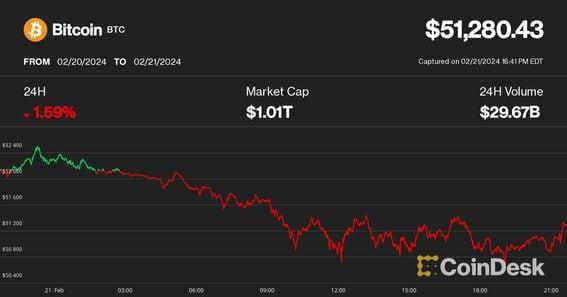
Lee took note of fresh demand via the new spot bitcoin ETFs, the halving and expected monetary policy easing as being catalysts for higher prices. Bitcoin can reach as high as $150,000 this year fueled by ETFs, halving and Fed rate cuts, Fundstrat's Tom Lee said. Bitcoin's rally has recently stalled below $53,000 and prices may cool for a while, other analysts suggested. Bitcoin (BTC) may have stalled over the past week, but FundStrat head of research Tom Lee doubled down on his bullish outlook and said it could reach as high as $150,000 this year. "You have demand improving with the new ETFs, you have supply shrinking with the halving, and if monetary policy eases which we expect, that's supportive for risk assets," Lee told CNBC on Wednesday. Lee's comments came as bitcoin's rally appeared to lose some steam following a 35% gain over the past couple of weeks to $53,000, its highest price in 26 months. It was recently changing hands at $50,900, down 1.8% over the past 24 hours, holding up slightly better than the broader-market CoinDesk20 Index's (CD20) 3% decline during the same period. Lee isn't worried. "Bitcoin's been holding up ," he said "I do not think a drawdown is going to start that soon." However, other analysts suggested that BTC may cool down for a while. Joel Kruger, market strategist at LMAX Group, suggested caution in the short term, noting potential volatility due to shifting central bank policies and fallout from global macro weakness, which could temporarily impact crypto markets. He added that any downturn would provide an opportunity for taking strategic positions. Analytics firm Swissblock said in a Wednesday market update that bitcoin's big picture is still bullish, but may experience a pullback to lower prices first before resuming its uptrend. "While the prevailing sentiment suggests a potential continuation of the upward trajectory, the current scenario may necessitate a period of consolidation or even a retracement to the $47.5k support level," Swissblock analysts said. "This adjustment would serve to alleviate excess volatility and reinforce market stability before potential further upside moves." https://www.coindesk.com/markets/2024/02/21/bitcoin-could-hit-150k-this-year-says-fundstrats-tom-lee/
2024-02-21 21:37
AI tokens outperform the CoinDesk 20 index, as crypto traders bet on solid Nvidia earnings and outlook. Giant chipmaker Nvidia (NVDA) beat its already lofty fourth-quarter earnings expectations, boosting the broader equity markets and artificial intelligence (AI) - related tokens. Nvidia said on Wednesday that its fourth-quarter earnings per share were $5.16, beating the average analyst estimate of $4.59 per share, according to FactSet data. The chipmaker also posted revenue of $22.1 billion, which came in higher than Wall Street's expectation of $20.4 billion. AI Tokens surged after Nvidia's earnings. SingularityNet (AGIX) was up over 20%, while FetchAI's (FET) is up over 10%, and Render's (RNDR) is up 8%. The overall marketcap of AI tokens has surpassed $16.5 billion, according to CoinGecko data. In comparison, the CoinDesk 20 (CD20), a benchmark for the biggest and the most liquid cryptocurrencies, is down 2.7%. “Accelerated computing and generative AI have hit the tipping point. Demand is surging worldwide across companies, industries and nations,” said Jensen Huang, founder and CEO of NVIDIA. Nvidia also forecast first-quarter revenue of $24 billion, beating analysts' estimate of $22.2 billion. The beat comes as shares of the maker of chips that have fueled the artificial intelligence (AI) revolution surged more than 200% over the last year, taking the market cap of the company to nearly $1.7 trillion at one point, topping the value of tech giants Amazon and Google. The rally has been so hot that Goldman Sachs even called it "the most important stock on planet earth." The shares of the chipmaker rose more than 7% in post-market trading on Wednesday, while S&P 500 futures gained 0.5% and bitcoin (BTC) was down 1.2%. https://www.coindesk.com/business/2024/02/21/nvidias-earnings-beat-estimates-boosting-broader-market-and-ai-tokens/
2024-02-21 20:28
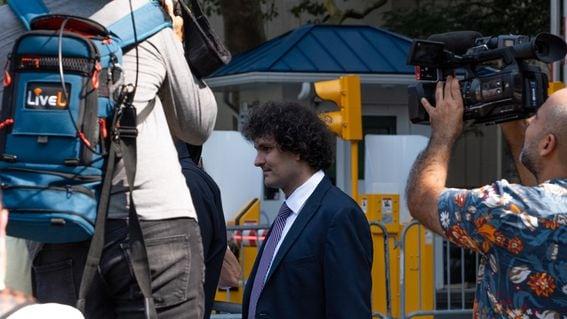
Bankman-Fried replaced his former lawyers, Mark Cohen and Christian Everdale, as he’s headed into sentencing negotiations. Sam Bankman-Fried entered court in his first appearance since his conviction last fall on fraud and conspiracy charges, to confirm he was okay with his new attorneys. Mark Mukasey, his new lead counsel, also represents former Celsius CEO Alex Mashinsky. The convicted former crypto CEO said Mark Cohen and Christian Everdell, his trial attorneys, would be stepping down from his case. Sam Bankman-Fried, in his first appearance in court after being found guilty of defrauding billions of dollars from FTX customers, said his trial attorneys would no longer represent him as he heads towards sentencing. Instead, his newly hired lawyer, Marc Mukasey, will represent him over the next month. Bankman-Fried, who was found guilty on seven different counts of fraud and conspiracy last November, will be sentenced in late March. Mukasey also represents bankrupt crypto lender Celsius founder Alex Mashinsky, who is accused by the Department of Justice of securities fraud, commodities fraud and conspiracy to manipulate the price of the company’s token CEL, among others. Mashinsky is set to go on trial this fall. In a hearing in the U.S. District Court for the Southern District of New York on Wednesday, Judge Lewis A. Kaplan, who oversaw Bankman-Fried’s criminal trial in October, asked the former crypto billionaire a series of questions about potential conflicts and other issues arising from sharing lawyers with Mashinsky. The conflict of interest comes from the fact that Celsius had worked with FTX and Alameda Research, before both companies went bankrupt. Bankman-Fried was already represented by his new lawyer, and informed Judge Kaplan that he was no longer using Mark Cohen and Christian Everdell's services after Kaplan asked if they were "out of this now" at the start of the hearing. Mashinsky also said he had no problems with his attorneys representing Bankman-Fried during a hearing on Tuesday. Read all of CoinDesk's coverage here. First appearance Bankman-Fried looked uneasy as he entered room 21B in the Manhattan courthouse on Wednesday afternoon, the same building where he was found guilty of several criminal charges that could put him behind bars for decades. It could’ve been the way he was dressed – very differently from the suit and tie he wore for the duration of his trial in October, with the brown and beige prison jumpsuit he wore during his first few appearances after his bond was revoked last year. He also wore ankle cuffs, which made him appear to be limping as he walked into and out of the court room surrounded by guards. Several other things changed from his previous days at SDNY. Unlike most days during his trial, Bankman-Fried did not walk into the room smiling at the gallery. Instead, he glanced around briefly before he sat down next to Mukasey and his co-counsel Torrey Young. When both stepped away for a minute to greet familiar faces in the room, Bankman-Fried turned around, however, and looked at the gallery, which counted roughly a dozen observers. He smiled and nodded, as if to say "hello." His parents, who had been in the courtroom nearly every day during his 8-week long trial in October, were not present on Tuesday. https://www.coindesk.com/policy/2024/02/21/sam-bankman-fried-replaces-trial-lawyers-ahead-of-sentencing/