2024-02-21 06:46
The tokens started trading at around $5 apiece, exchange data shows, and fell ahead of significant token unlocks planned in the months ahead. STRK tokens slumped more than 50% on their first day of trading, indicating many recipients may have sold as soon they received their allocations. Starknet's token unlock schedule for the development team and investors has come under criticism from market observers. Starknet’s STRK tokens lost half their value after going live for trading on Tuesday, while the team faces ongoing criticism around a 2022 token generation event. Data shows that STRK has been down 55% in the past 24 hours, with over $1.2 billion in trading volumes. Only $3 million worth of STRK futures were liquidated, suggesting most of the selling pressure was spot-driven. Some 728 million STRK were distributed to around 1.3 million addresses based on predetermined criteria, such as participation on the blockchain and in its community. The selling pressure suggests that recipients likely sold tokens as soon as possible. Starknet is an Ethereum rollup platform that allows applications to scale using zero-knowledge proof technology to prove the veracity of a set of data without revealing the data itself. Over 100,000 wallets have claimed upward of 220 million STRK as of Tuesday, the team said on X. To be sure, many tokens drop in the hours after issuance. Arbitrum's ARB lost nearly 50% from initial prices when it was launched on Mar. 23, 2023 and Curve's CRV slumped to $11 from $61 on its first day of trading in August 2020. On the other hand, the recently launched JUP from Solana-based exchange Jupiter, rallied 50% in the first 24 hours after it became available on Dec. 31, 2023. The price movements are determined by airdrop recipients who either hold or buy tokens on upcoming catalysts, or chose to take profits. A large part, 50.1%, of STRK’s supply has been allocated to the Starknet Foundation for community airdrops, grants and donations. 24.68% of STRK’s total supply will be distributed to early contributors and investors, while 32% has been assigned to developer StarkWare’s (its developer) employees, consultants and developer partners. The tokens will be unlocked every month for 31 months, starting from April, adding to possible selling pressure. However, the schedule for team and investor unlocks has created criticism among some in crypto circles. In the past week, market observers seemingly discovered that Starknet’s actual token generation event took place in November 2022, initially having a one-year vesting period that was later pushed to April 2024. Starknet developers say the generation event was mentioned and documented in its technical papers, but it was one that the market seemed to have missed. Some critics consider it an obfuscation of facts – one that may benefit insiders more than the community, observers say. Ideally, such a vesting period begins after tokens go live on exchanges or are issued closer to their trading date. In STRK’s case, the issuance occurred almost two years before a public announcement of the tokens, an unusual step. That means core contributors and investors will see 13.1% of the supply unlocked in April 2024 and more each month beyond this. The initial unlock could be worth more than $2.6 billion at current prices, data from Token Unlocks shows. Starknet has followed its decision so far and has not changed the vesting date as of Wednesday. CORRECTION (Feb. 21, 9:18 UTC): Corrects date of unlocking in penultimate paragraph. An earlier version of this story had it as April 2023. https://www.coindesk.com/markets/2024/02/21/starknets-strk-drops-53-amid-token-issuance-criticism/

2024-02-21 03:48
Circle cited its “risk management” framework as part of the decision, among other factors. Circle is phasing out suppport for USDC on the Tron network, with minting of the stablecoin stopping immediately. The company said the move is to ensure "USDC remains trusted, transparent and safe." Some $300 million of USDC exists on Tron, compared with $22 billion on Ethereum. Major stablecoin USD Coin (USDC) will no longer be supported on the Tron blockchain, issuer Circle said in an announcement early Wednesday. “Circle is discontinuing support for USDC on the TRON blockchain in a phased transition. Effective immediately we will no longer mint USDC on TRON,” it said. Customers’ transfers of USDC to other blockchains will be supported through February 2025, while retail users and other non-Circle customers can move their USDC on TRON using exchanges. Circle cited its risk management framework as part of the decision. “This action aligns with our efforts to ensure that USDC remains trusted, transparent and safe - characteristics that make it the leading regulated digital dollar on the internet,” it stated. Stablecoins are a type of cryptocurrency that is pegged to a fiat currency, commonly U.S. dollars, and are supported by a basket of underlying assets, such as cash or bonds. USDC is the second-largest stablecoin after tether (USDT) with over $26 billion worth of tokens in supply. Data shows over $22 billion of this amount exists on the Ethereum blockchain, followed by $1.4 billion on Solana and $530 million on Polygon. A relatively small $300 million in USDC exists on Tron, the data shows. Tron's native (TRX) tokens remained steady as of Asian morning hours on Wednesday, changing hands at 13 cents. https://www.coindesk.com/markets/2024/02/21/usdc-stablecoins-issuer-circle-dumps-tron-network-trx-steady/

2024-02-21 00:39
Bloomberg exchange-traded funds analyst Eric Balchunas noted a particular uptick in volume for HODL and BTCW Bitcoin (BTC) exchange-traded funds posted the most trading since their debut in the U.S. last month. Volume amounted to nearly $2 billion, the highest total since the first day of trading on Jan. 11, Bloomberg Intelligence senior ETF analyst Eric Balchunas noted on X. VanEck's HODL ETF posted just under $400 million in volume, WisdomTree Bitcoin Fund (BTCW) saw $221.9 million in trades and BitWise's had $178.29 million. Balchunas posted that VanEck's HODL "is going wild today with $258 million in volume already, a 14x jump over its daily average." "And it's not one big investor (which would make sense) but rather 32,000 individual trades, which is 60x its average," he continued. It has been suggested that the reason for the spike could be that U.S. markets were closed on Monday for Presidents' Day, and trades over the weekend were settled on the first day of the workweek. As for the price of bitcoin itself, it's changing hands just above $52,200, according to CoinDesk Indicies data, as the U.S. ends its trading day. “The strong Bitcoin ETF inflow by institutional investors indicates risk-on sentiment. Meanwhile, Gold ETFs have seen a net outflow. The outflow of gold ETFs might be due to global investors’ rising demand for US equity," Greta Yuan, head of research at VDX, a regulated Hong Kong exchange, wrote in an email interview. Gold ETFs have experienced significant outflows since the launch of 10 spot bitcoin ETFs on Jan. 11, with nearly $10 billion in inflows into the two largest bitcoin ETFs, although this does not necessarily imply a direct migration of funds from gold to bitcoin, CoinDesk previously reported. "While U.S. equity keeps going higher, led by AI stocks, we will likely see BTC, ETH keep reaching higher ahead of bitcoin halving,” she continued. https://www.coindesk.com/markets/2024/02/21/bitcoin-etf-trading-spikes-to-busiest-session-since-january-debut/
2024-02-20 22:07
"If I don't walk another 4,400 steps I'll lose $333." With a new app called Moonwalk, you get daily lessons in economics – and maybe healthier, too. An early-stage app called Moonwalk lets users boost the stakes for their fitness goals. Customers contribute cryptocurrencies to join a challenge, and if they fail to meet their daily step goal, they surrender money to a prize pool shared by the other participants. SALT LAKE CITY — It was sometime around dinner as I was drinking a jungle juice that the bad news dawned on me. I texted my boss: "If I don't walk another 4,400 steps I'll lose $333." Such are the economics lessons you get when you turn your daily steps into fodder for the group building a crypto-based fitness game called Moonwalk. The premise is this: People are more likely to hit their fitness goals (say, a daily step count) when there's some external force holding them accountable. Perhaps it's their friends or a financial reward. In Moonwalk, it's both. On a chilly Utah Wednesday, someone from the 8-month-old startup convinced me and three other attendees of mtnDAO – the month-long coworking space in Salt Lake City full of developers building apps for the Solana blockchain – to essentially bet on ourselves in the step-counting game. We were to be among the first-ever outside testers of their platform, in which players pool their assets, commit to hitting a daily step goal and then hope – I guess – that the other players miss theirs. The buy-in for our three-day challenge was $1,000 of the USDC stablecoin. Each of us had to walk 10,000 steps a day; every day we miss that goal, we'll surrender $333 to the prize pool. At the end of the challenge, those who meet the daily goal split that pool. We each have full control of our original deposits; as long as we walk 10,000 steps a day, we'll get that money back. "It will trick you into getting fit so you don't lose money," Marbius, a pseudonymous product manager working on Moonwalk from mtnDAO, told a potential player. Another player, the pseudonymous Grove St, summed it up this way: "I like to make money. I've been making money so far." We send our deposits to Moonwalk's omnibus deposit address and link our on-chain accounts with health profiles that source step-counting data from iPhones and Androids. Every 10 minutes, the app pulls step data from Google Fit, updating our game's leaderboard. I got a taste of life as an early-stage tester when, after sending my money to the address, I did not appear immediately on the leaderboard. Marbius assured me this was a "known bug" that happens when players reload their web pages while their deposits are in transit. Sure enough, I showed up shortly. I felt the need to start walking immediately. Now I had money on the line. I took a quick stroll in the winter weather. It would get dark in a few hours. I'd better get my steps in soon. Moonwalk's ambitions stretch beyond step-counting and into many different areas of fitness, founder KW told me. He plans to "make more games incentivizing positive behavior change." For now, though, it's limited to steps. Over the course of three days, I and six other players logged tens of thousands of steps in our rush to avoid losing our stablecoins. Only one player screwed up. Twice he missed his 10,000-step goal, losing $666 to be divided up by the rest of us. That was just as well for me. When everything was said and done, I walked away with $111 in prize money. "I think Moonwalk just makes it more fun and engaging to do something simple," said Anders, the intern at Mrgn Research. "It makes it more competitive, too, which makes it more enjoyable." He estimated he'd won around $800 in just over a week. "I definitely plan on continuing to have a game open for a while." Meanwhile, I'm behind on today's steps. https://www.coindesk.com/business/2024/02/20/how-to-make-or-lose-hundreds-of-dollars-betting-crypto-on-your-fitness-goals/

2024-02-20 21:30
MicroStrategy is up billions on its bitcoin bet, but Executive Chairman Michael Saylor told Bloomberg TV there’s no reason to sell the cryptocurrency. Bitcoin maximalist Michael Saylor is not selling any of his company's bitcoin anytime soon. "There's no reason to sell the winner and buy the losers," he said in an interview with Bloomberg TV on Tuesday. Bitcoin competes with far larger asset classes like gold, real estate and the S&P, but it's the superior product, argued Saylor. Michael Saylor doesn’t plan to sell any of MicroStrategy' (MSTR)s bitcoin (BTC) anytime soon, or potentially ever, he said in an interview with Bloomberg TV on Tuesday. "The spot ETFs have opened up a gateway for institutional capital to flow into the bitcoin ecosystem," said Saylor. "[The ETFs] are facilitating the digital transformation of capital, and every day hundreds of millions of dollars of capital is flowing from the traditional analog ecosystem into the digital economy." Saylor's MicroStrategy held 190,000 bitcoins at the end of January which it bought for an average of $31,224 per coin. With bitcoin now trading at roughly $52,000, the company’s holdings are worth about $10 billion, with $4 billion of that profit. Many investors might be considering an exit at this point, but not Saylor. “Bitcoin," he told Bloomberg, "is the exit strategy.”. Bitcoin’s value, currently just over a trillion dollars, is competing with asset classes such as gold, real estate or even the S&P index – all of which have market capitalizations many multiples higher than bitcoin, said Saylor. And bitcoin, argued Saylor, is superior to all of them. “We believe capital is going to keep flowing from those asset classes into bitcoin because bitcoin is technically superior to those asset classes and that being the case, there’s just no reason to sell the winner and to buy the losers,” he said. MicroStrategy first started purchasing bitcoin in August 2020 and has since consistently added to its portfolio. The software firm alongside its fourth quarter earnings report rebranded itself a “bitcoin development company,” doubling down on its commitment to the cryptocurrency. MSTR shares are up 11.8% year-to-date. https://www.coindesk.com/business/2024/02/20/michael-saylor-on-exiting-bitcoin-bitcoin-is-the-exit-strategy/

2024-02-20 21:19
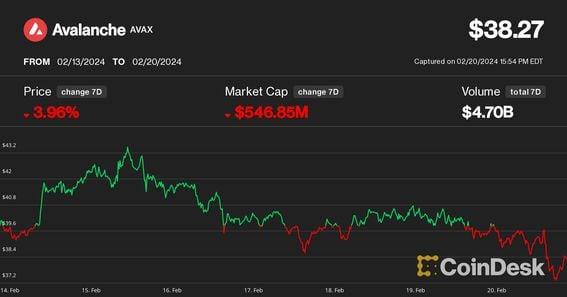
In crypto, large unlocking events usually lead to price declines as the increase in the token's supply outpaces investor demand, a previous study shows. Avalanche's native token AVAX underperformed the crypto market over the past week ahead of its token unlocking event, CoinDesk data shows. Some $365 million worth of locked-up tokens will be released Thursday from vesting and will be added to circulation, according to Token.Unlocks data. The native cryptocurrency of the Avalanche (AVAX) network underperformed most digital assets as the token undergoes a $365 million unlocking event this week that will increase the token's supply. AVAX dipped more than 3% over the past week, while most cryptocurrencies – 148 of the 173 constituents of the broad-market CoinDesk Market Index (CMI) – gained in price. The CoinDesk20 Index (CD20), which tracks the performance of the largest and most liquid crypto assets, advanced 6% during the same period. At press time, AVAX changed hands at $38, some 23% lower than its December high. The underperformance happened as some 9.5 million of previously locked-up AVAX tokens, worth $365 million, will be released on Thursday, increasing the asset's circulating supply by roughly 2.6%, according to data from Token.Unlocks. Some 4.5 million tokens will be transferred to team members, 2.25 million to strategic partners, 1.67 million to the ecosystem development foundation, while 1.13 million are earmarked for airdrop. Approximately 58% of all of AVAX's tokens have been unlocked, on-chain data shows. Token unlocks translate to an increase in the asset's supply, releasing previously locked-up coins from a vesting period, including to early investors. Large unlocking events usually lead to price declines within two weeks due to the supply increase outpacing investor demand for the asset, a report by crypto analytics firm The Tie found last year. https://www.coindesk.com/markets/2024/02/20/avalanches-avax-underperforms-ahead-of-365m-token-unlock/