2024-02-20 17:48
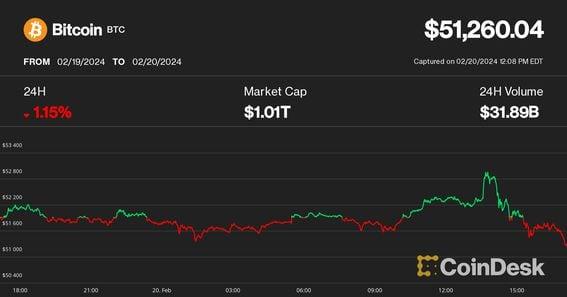
For the third time in a week, prices quickly pulled back after testing the $53,000 level. Bitcoin ran into heavy resistance again at $53,000 Tuesday, a key level that capped prices in the second half of 2021. The rejection may foreshadow more consolidation for BTC below $53,000, coinciding with the weekly Ichimoku Cloud top, a technical pattern that kept a lid on price rallies in prior market cycles, one analyst noted. Bitcoin (BTC) once again ran into heavy resistance at the key $53,000 level Tuesday, suggesting that the largest crypto will continue to consolidate before its next big move. Following a quiet three-day weekend in the U.S., bitcoin Tuesday morning U.S. hours quickly rose from $51,600 to just a few dollars shy of $53,000 before selling pressure quickly forced a reversal, with prices tumbling to as low as $50,700. The price has recovered somewhat since, trading at $51,260 at press time, down 1.15% over the past 24 hours and roughly in line with the broad-market CoinDesk20 Index (CD20) performance. Ether (ETH), the second-largest crypto asset by market capitalization, suffered a similar fate, tumbling to $2,900 after earlier crossing above $3,000 for the first time since April 2022. Bitcoin's sell-off mirrored price action from Thursday and Friday when intraday rallies above $52,500 reverted almost immediately. Zooming out a bit, prices have roughly traded in a range of $51,000 to $52,500 for the past week. Continued sideways action ahead? The failed attempt to break above $53,000 could foreshadow further consolidation in the current range, with prices taking a breather after rising over 30% since late January's post-bitcoin ETF correction. This price range represents a crucial resistance area on long-term charts, which capped rallies in the second half of 2021. "The current price level is an important technical level for BTC, coinciding with both the peak of the September 2021 'El Salvador' rally and the resistance ahead of the December 4 crash of the same year," Vetle Lunde, senior analyst at K33 Research, wrote in a Tuesday market update. Analysts at crypto analytics firm Swissblock noted Friday that bitcoin's stalling momentum may foreshadow a deeper pullback and a potential buying opportunity. The $53,000 area is also marked by the previous market cycle top of the weekly Ichimoku Could, a momentum and trend indicator, which posed major resistance for BTC's price in 2016 and 2019, while breakouts in early 2017 and late 2020 cleared the path for new all-time highs, crypto technical analyst CryptoCon noted. According to CryptoCon's chart posted on X, bitcoin's price reverted first at similar levels during the prior two bull markets, followed by a lengthy consolidation period, while breakouts to higher prices happened at later stages in bitcoin's market cycle, after the quadrennial Bitcoin halving event. "The top of the cloud has twice marked the mid-top, a point of steep rejection and a long sideways period," CryptoCon said in the post. "A break of this point now would be almost an entire year earlier than usual." https://www.coindesk.com/markets/2024/02/20/bitcoin-suffers-swift-reversal-at-53k-suggesting-more-consolidation-ahead/
2024-02-20 17:40
The "Protocol 20" upgrade, which adds support for Ethereum-style smart contracts to the decade-old payments-focused blockchain, had been delayed by three weeks due to precautions after a bug was found. The Stellar blockchain moved forward with its "Protocol 20" upgrade, initiating phased rollout that will see the payments network add Ethereum-style smart contracts under the long-planned Soroban project. The Stellar Development Foundation, which supports the blockchain's ecosystem, confirmed the "new era for the Stellar smart contracts tech stack" in a blog post on Tuesday, noting that the move came after validators voted for the mainnet upgrade. "Gradually, validators plan to increase limits for Soroban transactions, building up to full capacity," according to an email from the team. "As the increases happen and we enter phase 1, the 160-plus builders and projects already building on testnet will begin to deploy on mainnet. Later, once projects are deployed, the network has been stress-tested, and the ecosystem is satisfied, dApps will launch for all to use." Stellar is one of the oldest blockchains, created as a fork of the Ripple protocol in 2014, and the project is upgrading to add the programmability that Ethereum and its "smart contracts" are known for. Some traders may be speculating whether the facelift could put fresh energy into the project's native XLM tokens, also known as "lumens." Over the past year, XLM has gained 21%, while the benchmark CoinDesk 20 of large-cap digital assets gained 67%. The upgrade, overseen by the Stellar Development Foundation's Tomer Weller, was initially targeted for Jan. 30, but a few days before the date, a bug was found in the Stellar Core v20.1.0 software, prompting developers and validators behind the project to opt for a delay. https://www.coindesk.com/tech/2024/02/20/stellar-starts-phased-rollout-of-soroban-smart-contracts/

2024-02-20 16:57
LockBit hit more than 2,000 different victims, who forked out north of $120 million in payments, according to a DOJ press release. The Office of Foreign Asset Control named two Russian nationals and identified 10 bitcoin and ether addresses after an international operation gained control of the organization's website. Law enforcement agencies said they will distribute decryption keys to victims. The U.S. Treasury Department's sanctions watchdog added nearly a dozen bitcoin and ether addresses to its global blacklist, alleging they were used by ransomware purveyors. The Office of Foreign Asset Control (OFAC) named Artur Sungatov and Ivan Kondratyev, two Russian nationals indicted on charges tied to the deployment of ransomware, and identified 10 bitcoin and ether addresses (none of which containing any funds as of press time), in a statement on Tuesday, banning U.S. entities from providing any kind of financial services to the two. According to OFAC and the U.S. Department of Justice, they are part of the LockBit ransomware group, one of the world's most prolific ransomware distributors accused of stealing more than $120 million from over 2,000 victims in the past few years. Ransomware attacks let malicious actors lock victims out of their computers and networks unless they pay a fee, often in cryptocurrency. An international effort by the DOJ, Europol, the U.K. National Crime Agency and agencies in several other countries seized LockBit's website and various pages earlier this week in an effort dubbed Operation Cronos. The law enforcement agencies announced they would be distributing decryption keys to victims, allowing them to regain access to their devices. According to a press release from Europol, more than 200 cryptocurrency accounts tied to LockBit have been frozen, while authorities in the U.S., U.K. and EU have all seized various parts of the ransomware group's infrastructure. Some of the addresses listed by OFAC on Tuesday were deposit addresses for KuCoin, Coinspaid and Binance, according to data from Arkham Intelligence. LockBit's victims included municipal entities and private companies around the world. "The LockBit ransomware variant, like other major ransomware variants, operates in the 'ransomware-as-a-service' (RaaS) model, in which administrators, also called developers, design the ransomware, recruit other members — called affiliates — to deploy it, and maintain an online software dashboard called a 'control panel' to provide the affiliates with the tools necessary to deploy LockBit," the DOJ press release said. https://www.coindesk.com/policy/2024/02/20/us-bans-crypto-addresses-tied-to-lockbit-ransomware-group-from-financial-system/

2024-02-20 13:49
A potential spot ETH ETF approval would boost the second-largest crypto's appeal among more conservative, institutional investors. The price of ether (ETH), the native token to the Ethereum network, rose past $3,000 for the first time since April 2022 on Tuesday, continuing a recent hot streak. Ether's price rose about 1.6% over the past 24 hours and has risen over 12% in the past week, outpacing other cryptocurrencies, according to data from CoinGecko. Bitcoin's price was on the move as well, ahead more than 2% over the past 24 hours and nearing $53,000. The broader CoinDesk 20 Index (CD20) was ahead 0.65% over the same time frame. Cryptocurrencies at large have had a green 2024 so far, with major tokens' prices well above where they were in 2023. ETH surged nearly 30% since the beginning of the year, outperforming BTC's 22% advance. ETH's rally could continue, with traders targeting $3,500 as the next resistance level as market participants anticipate that spot-based ETH exchange-traded funds (ETF) could be next in line for U.S. regulatory approval. "We are very close in this move to levels around $3,150-$3,300," said Kenny Hearn, SwissOne Capital’s chief investment officer, in an interview with CoinDesk. "The next level after that would be $3,600 and we think this is quite easily attainable in the next month or so as the alts continue to play catch up." A potential approval would boost ETH's appeal among more conservative, institutional investors, just as the new bitcoin ETFs that debuted last month have attracted massive allocations. Bernstein, a broker, said Monday that there is about a 50% chance of a spot ETH ETF approval by May and a near-certain probability of approval within the next 12 months. https://www.coindesk.com/markets/2024/02/20/ether-hits-3k-for-first-time-in-nearly-2-years-amid-rising-eth-etf-excitement/
2024-02-20 12:10
Fully diluted value of STRK reached as high as $50 billion with an initial market cap of $3.64 billion. Ethereum rollup Starknet has initiated the distribution of 728 million tokens to around 1.3 million addresses in what is being dubbed the largest airdrop of the year. Starknet token’s STRK pre-launch perpetual futures were trading at $1.80 on decentralized futures platform Aevo. The token traded as high as $5 on Kucoin minutes after it was released and has since slumped back to $3.50 in a volatile opening. With an initial total supply of 10 billion tokens, the fully diluted value (FDV), the theoretical market capitalization if the entirety of its supply were in circulation, of STRK stands at $35 billion. However, the actual market cap, which is the current circulating supply multiplied by the current price, is at $2.32 billion. 50.1% of STRK’s supply has been allocated to the Starknet Foundation for community airdrops, grants and donations. 24.68% of STRK’s total supply will be distributed to early contributors and investors, while 32% has been assigned to StarkWare employees, consultants and developer partners. The tokens will be unlocked every month for 31 months, starting from April. Starknet is a layer-2 network that makes use of zero-knowledge cryptography, allowing decentralized applications operating on top of it to scale the Ethereum blockchain. It does this by bundling transactions off-chain into a proof that is submitted to Ethereum, which in turn is supposed to process the transaction faster and lower fees for computing them. Layer 2s are networks built on top of a base blockchain, layer 1, to reduce bottlenecks. Starknet first went live in November 2021. Since then, Starknet has amassed nearly $55 million in total value locked (TVL), according to DefiLlama. https://www.coindesk.com/business/2024/02/20/starknet-token-strk-begins-trading-at-5-after-mammoth-airdrop/

2024-02-20 12:00
New liquid restaking platforms like Puffer and Ether.Fi have attracted billions of dollars in deposits, but they've birthed a speculative "points" frenzy that carries some risks. Decentralized finance (DeFi) on Ethereum has seen a resurgence with the rise of "liquid restaking tokens," or LRTs. LRTs are built on top of EigenLayer, the "restaking" protocol that lets networks tap into Ethereum's security apparatus. More than $2 billion has poured into liquid restaking protocols like Ether.Fi and Puffer, which allow users to actively trade deposits into EigenLayer via LRTs. Some experts warn that restaking carries risks, and that "points" incentives offered by liquid restaking platforms are highly speculative. Decentralized finance on Ethereum is seeing a big resurgence, with the familiar promise of high yields returning thanks to a new breed of crypto asset: the "liquid restaking token," or LRT. In the past month alone, billions of dollars have flooded into new Ethereum-based liquid restaking projects like Ether.Fi and Puffer. The upstart platforms are in a heated turf battle to supplant Lido's staked ETH (stETH) token as the asset of choice for decentralized finance (DeFi) traders. The entire trend pivots off the development of a new protocol named EigenLayer, which launched a first-of-its-kind "restaking" system to Ethereum last June. The platform is building a solution to let blockchain apps and networks borrow Ethereum's security system, and it drew more than $1 billion in new deposits in a single 24-hour period this month. Now, the total amount is over $7 billion, meaning the platform has singlehandedly amassed more than 1.5% of all ether (ETH) tokens in circulation, according to DefiLllama. Restaking offers a way of securing blockchain protocols and networks using security borrowed from Ethereum's proof-of-stake network. ETH deposits in EigenLayer could be "restaked" to these other protocols, meaning they won't have to build their own proof-of-stake networks. Investors have piled into EigenLayer because it promises higher interest on deposits than conventional ETH staking. Still, the platform owes much of its recent growth to a group of third parties – "liquid restaking protocols" like Ether.Fi, Puffer and Swell that purport to simplify the restaking process on behalf of users. These liquid restaking platforms serve as middlemen between users and EigenLayer: The platforms "restake" user deposits with EigenLayer, and they hand out newly generated LRTs in exchange – so users can keep trading even if their deposits are being used for restaking. The LRTs represent a user's EigenLayer deposit, meaning they can accrue staking interest and can be exchanged back for their underlying value. LRTs can also be used in DeFi, meaning people can lend and borrow them to earn even bigger rewards. Besides the convenience of LRTs, the real draw for liquid restaking platforms recently has been "points" – a type of rewards that might entitle users to future token airdrops. While points have nebulous monetary value, they have given rise to an entirely new ecosystem of additional platforms, like Pendle, which let users maximize them through trading strategies that often involve high leverage. The convoluted point systems, high yields and risky trading strategies all feel a bit reminiscent of 2021 – when "yield farming" and the chase for high returns led to a DeFi boom and bust that the sector has yet to recover from. While some experts are wary of liquid restaking's risks, the tech's boosters insist there's real substance beyond the hype. Staking 101 Liquid restaking builds on two years of growth for Ethereum's staking industry. Ethereum is operated by more than 900,000 validators – people around the world who lock-up ETH tokens in an address on the network to help keep the chain secure. Staked tokens accrue a steady stream of interest, but they can’t be used for anything else – think: loans or other kinds of investment – once they’re tied up running the network. This limitation helped fuel the rise of “liquid staking.” Services like Lido, the biggest liquid staking service on Ethereum,” stake tokens on behalf of users and then give them “liquid staking tokens” (LSTs) representing their underlying deposit. LSTs like Lido’s staked ETH (stETH) tokens earn interest like regular staked ether (currently around 3%) but they can also be used in DeFi – meaning investors can lend and borrow the tokens to earn additional yields on top of their staking interest. The liquid staking sector has boomed over the past couple of years. Lido, the biggest liquid staking protocol by far, boasts more than $25 billion in deposits. Its stETH token frequently sees higher trading volumes than regular ETH on the network’s biggest borrowing and lending protocols. From Liquid Staking to Liquid Restaking A similar liquid staking trend is now hitting EigenLayer, the buzzy new Ethereum protocol that introduced restaking to Ethereum. "EigenLayer is basically building a tool that allows other networks to bootstrap using Ethereum security," explained Omni Labs CEO Austin King, who is building a bridge protocol powered by restaking. Investors have turned to EigenLayer to earn extra rewards on their ETH: interest for securing Ethereum, and additional restaking interest for securing so-called AVSs or “actively validated services” that use EigenLayer to borrow Ethereum's security. According to EigenLayer, those AVSs will eventually include Celo, a layer 1 blockchain that's transitioning into an Ethereum-based layer 2 network; EigenDA, EigenLayer's own data availability service; and Omni, which is building bridge infrastructure to help disparate blockchain networks communicate with one another. But the system also comes with downsides, and a key one is that tokens restaked via EigenLayer can’t be used in DeFi after they’re deposited. For investors looking to maximize their returns, this lock-up mechanic is a major bummer. Enter liquid restaking, which is essentially just liquid staking but for Eigenlayer. Liquid restaking protocols accept deposits (e.g. stETH), restake them with EigenLayer, and then hand out “liquid restaking tokens,” or LRTs, like pufETH, eETH and rswETH that can be used in DeFi to earn additional points and other rewards. "It's basically the value proposition of staked ETH, where you can get the yield of staking your ETH without having to go through the hassle of setting up a validator – It's that plus the compensation of whatever rewards come out of these AVS networks," explained King. Incentive Games Puffer's pufETH, Ether.Fi's eETH, Swell's rswETH and other LRTs are jostling to compete with Lido's stETH to become the next big asset in DeFi. To do so, they've turned to DeFi's incentive model du jour: points. Although EigenLayer has already accepted billions in deposits, none of its AVSs are live yet, meaning depositors aren't receiving any interest on their deposits. The main incentive for depositing tokens into EigenLayer today is restaking points, a nebulously-defined tally that investors hope will entitle them to a future, yet-to-be-confirmed EigenLayer airdrop. "EigenLayer is not live yet, it doesn't have any restaking." Puffer Finance CEO Amir Forouzani noted in an interview last month with CoinDesk. "Their only incentive now is their points, essentially, and I guess speculation of what those points will become in the future." The leading liquid restaking protocols – including Puffer – have all begun offering their own points on top of EigenLayer's as a sweetener for early investors. New services have also built up around the exchange of points, popularizing risky new trading strategies that involve staking the same tokens repeatedly – levering up one's exposure to a protocol in exchange for higher future rewards. One such protocol is Pendle, which splits up liquid staking tokens into two separate tokens – yield tokens and principal tokens – to unlock leveraged trading. One of Pendle's products accepts deposits of Ether.Fi's eETH tokens and, according to the site's advertising, can net depositors 45x Ether.Fi points and 15x EigenLayer points. While points remain highly speculative, they appear to have been a boon for liquid restaking deposits. Ether.Fi, the current market leader, has $1.2 billion in deposits, according to DeFiLlama, five times more than it had a month ago. Puffer Finance is nipping at Ether.Fi’s heels with $970 million in deposits, a ten-fold increase in the past three weeks alone. Slashing risk As liquid restaking deposits have surged, so have the trend's risks. On one hand, there’s the general risk with EigenLayer that comes any time money is poured into a Rube Goldberg system of layered protocols: As the web of interconnected AVS networks gets more complicated, bugs will inevitably become more likely. The biggest risk with these bugs will be the prospect of “slashing,” where a staker is financially penalized for breaking a network's rules or for using faulty software to connect to the network. Liquid restaking protocols frequently feature "anti-slashing" features in their marketing, but their promises won't be tested in the wild until AVSs go live. In the context of EigenLayer restaking, slashing happens on the AVS level: each AVS will set its own slashing rules, and liquid restaking providers will be able to hand-pick which AVS protocols they want to validate for their users. If a liquid restaking platform chooses to validate a network with malicious (or buggy) slashing parameters, it puts its users at risk of having their deposits slashed. "We're gonna have a similar reputation system for the broader restaking ecosystem," as there is in the conventional staking system, Riad Wahby, CEO of key management service Cubist predicted in an interview with CoinDesk. "If I'm gonna put money into an operator, I'm presumably going to choose an operator that gives me the right balance between risk and reward." Speculative risks The most obvious risk to liquid restaking is that despite billions of dollars in deposits, the practice is currently highly speculative. There's a chance that AVSs might fail to reward as much interest to depositors as they expect, which could send investors fleeing the system for more lucrative bets. With all the excitement around points, there's also some possibility that their accompanying airdrops might flop or never happen, rendering the points and the new markets built on top of them all but worthless. The risk of such an outcome is amplified by the fact that points are not typically issued on blockchains and are tracked instead directly by their issuers. This means it is difficult to know how many points of a given type are in circulation, making it even more difficult to discern their value. The speculative appeal of liquid restaking points harkens back to the days of yield farming. In 2021-22, as the DeFi sector was in its heyday, deposits flooded into projects like Olympus and Terra, which promised market-leading yields to users in exchange for trust in their convoluted systems. Critics accused the projects of inventing worthless tokens and printing them willy-nilly in a scheme to artificially prop up yield numbers, and those critiques ultimately proved prescient after the platforms collapsed. Whatever the surface-level similarities, EigenLayer has entered the Ethereum developer zeitgeist in a way yield farming's worst offenders never did, and liquid restaking's proponents say it has the potential to support the development of apps and infrastructure outside of the narrow realm of points and gamified speculation. Margaux Nijkerk contributed reporting. https://www.coindesk.com/tech/2024/02/20/liquid-restaking-tokens-or-lrts-revived-ethereum-defi-can-the-hype-last/