2024-02-13 19:04
On Tuesday, he once again faced questions about a public blog post he'd signed cryptographically to prove he was Bitcoin inventor Satoshi Nakamoto that experts have since debunked. Craig Wright's cross-examination in the trial that could decide if his claims of having invented Bitcoin hold true continued Tuesday. Wright insisted that the possession of private keys doesn't prove he's Satoshi, but his knowledge and work do, as he was asked why he'd failed to provide valid cryptographic proof. Craig Wright on Tuesday lashed out at "experts" who "cannot verify their work" as he faced cross-examination in a trial that questions his claim of having invented Bitcoin – a claim the crypto industry has for years accused him of failing to verify. "I hate that. I loathe it," Wright continued his passionate tirade until presiding Judge James Mellor intervened and asked the "lady in the back row," who was "nodding and shaking her head," to "just keep still" or risk removal. Things got tense as the Australian computer scientist faced his sixth day on the witness stand while counsel for the Crypto Open Patent Alliance (COPA) probed documents and other material critical to Wright’s defense of being Satoshi Nakamoto, the pseudonymous inventor of Bitcoin. On Tuesday, he was once again questioned about a public blog post he’d purportedly signed cryptographically to prove he was Satoshi that experts had since declared a hoax. One question was whether the "signing sessions" might be invalid because the keys Wright used could be obtained by someone other than Satoshi. ("Not at all," Wright replied) He insisted that "identity" – say, that he’s Satoshi – cannot be proven by "possession" of the keys. "You don't prove by having identity through possession of something. You prove by knowledge. Who you are. What you create," Wright said. When asked by COPA counsel Jonathan Hough to agree that producing "a signed message" as planned to prove he was Satoshi would not have posed a security risk of the private keys in question being figured out by others, Wright said: "The security risk is the security of my work, undermining the whole value of everything I've created. Not that the key will be taken." The cross-examination continued for another full day, with Mellor intervening several times, including warning Wright that if he doesn’t answer a question, he’s going to "assume" he has no answer for it. COPA tried to point out irregularities in Wright’s evidence and testimony provided in previous cases. In one instance, Wright changed his story on whether or not Dave Kleimann (someone Wright himself previously said was key to the invention of bitcoin – but disputed that claim Monday) was a trustee at Wright’s company Tulip Trading. Wright will testify again on Wednesday, after which an expert witness for the defense may take the stand. The trial will continue for a few weeks more. https://www.coindesk.com/policy/2024/02/13/craig-wright-blasts-experts-who-cant-verify-their-work-at-trial-over-satoshi-claims/

2024-02-13 18:11
It's been a successful launch, but things could get really interesting once much of the wealth management industry comes on board, which could be sooner than thought. The first month of spot bitcoin exchange-traded funds (ETFs) saw daily net inflows of about $125 million per day. Even though Grayscale's Bitcoin Trust (GBTC) has seen heavy outflows, it's still a major player among the new products. U.S. wealth managers and Registered Investment Advisors (RIAs) are yet to come in, but it could happen sooner than expected. Excitement was high about one month ago, when TradFi finally got the regulatory go-ahead to launch an entirely new investment vehicle for crypto. The process of bringing to the U.S. market a spot bitcoin ETF took more than a decade, but on Jan. 11, 10 such products finally began trading. It’s been a hell of a ride since. “These ETFs have done very, very well,” said Brian D. Evans, CEO and founder of BDE Ventures. “We’re seeing big inflows now, and the euphoria phase is certainly kicking in now.” The new ETFs have added on average a net $125 million worth of bitcoin (BTC) each day over the past four weeks. This is despite heavy outflows – more than $6 billion in total – out of the Grayscale Bitcoin Trust (GBTC), which has far higher fees than the other bitcoin ETFs. In just a month, the bitcoin funds ex-GBTC have accumulated over $11 billion worth of bitcoin, with three of the ETFs – BlackRock's IBIT, Fidelity's FBTC and Ark 21's ARKB – topping the $1 billion mark in assets under management. In fact, as of the end of Monday, IBIT was nearing $5 billion in AUM and FBTC was just shy of $4 billion. BlackRock’s fund has even made it in the top five of all (including non-crypto) ETFs based on 2024 inflows, putting it on similar levels with industry-leading indexing giants like the iShares Core S&P 500 ETF (IVV) and the Vanguard S&P 500 ETF (VOO). “[IBIT] is rubbing elbows with the biggest and the best," said Bloomberg Intelligence's Eric Balchunas. The fast accumulation is affecting bitcoin's price, which – after a brief "sell the news" tumble in the days following the first day of trading on Jan. 11 – has rebounded of late, carving out a multi-year high above $50,000 on Monday. Whither GBTC? In existence as a closed-end fund for many years prior to its conversion to a spot ETF last month, Grayscale's GBTC has seen sizable and steady outflows ever since, with its AUM having been whittled down from about $30 billion to just under $24 billion as of Monday. Many investors who bought the fund before it listed as an ETF are currently making over a 100% profit by selling it, a report by Falcon X noted. Grayscale notably set the management fee on its converted ETF at 1.50%, more than one percentage point, or 100 basis points, higher than the most expensive of its nine competitors. In addition to profit-taking, the fund is surely seeing the exit of some money seeking lower costs. “I don’t see GBTC going anywhere,” Matt Sheffield, senior vice president of trading at Falcon X, said in the report. “They ushered in the space, pioneered a lot of the way here, and have a strong following of crypto natives as a result.” “We are proud that GBTC has blazed a path forward for all spot Bitcoin ETFs to come to market, and we are optimistic about the continued growth and maturation of Bitcoin and the robust ecosystem around spot Bitcoin ETFs,” a spokesperson for Grayscale told CoinDesk. What’s next for bitcoin? The high demand that’s made the spot bitcoin ETF launch so successful could cause some headaches in the near future. Net inflows of late are necessitating the purchase of thousands of bitcoin per day, multiples higher than the 900 fresh tokens mined each day, a number that will be reduced to 450 when the Bitcoin halving event occurs in April. Read More: How Miners Are Preparing for the Next Bitcoin Halving Add to this the fact it’s still only been a month since the spot ETF launch and many if not most major wealth management platforms have yet to offer the products to their clients. The success so far of the ETFs has come “with one hand tied behind their back,” as ETF Store President Nate Geraci put it, suggesting that a lot more demand will come once distribution increases. “As firms begin covering the name, putting portfolio strategists to work determining allocations for different investor bases, the inflows are likely to exceed any ETF product before it,” Falcon X’s Sheffield wrote. ETF insiders are well aware a large amount of U.S. wealth managers and Registered Investment Advisors (RIAs) are yet to come in, as these networks are bound by fiduciary standards to a defined period of due diligence. This period of observance would normally mean 90 trading days to pass from the launch of a novel product like a bitcoin ETF, as well as various volume threshold and AUM criteria, amounting to about six months of lag time. However, in this case, the wait is looking like it will be much shorter, according to Sui Chung, CEO of CF Benchmarks, an crypto indexing specialist that works with a number of spot bitcoin ETFs including BlackRock's IBIT fund. (CoinDesk Indices competes with CF Benchmarks in the crypto index industry.) Chung told CoinDesk his firm has been contacted by a couple of large RIA networks and wealth management companies, located in U.S. retirement hotspots like Florida and California, who are seeking to do due diligence now. "We are talking about platforms who individually count assets under management and assets under advisory in excess of a trillion dollars," he said. The relative success of the ETFs so far means that the people who actually gather the information to put in risk packs are doing that now, Chung said. "They know that come the 90th day these products will cross all the thresholds, and there are advisers that wish to allocate," he said. "A very big sluice gate that was previously shut will open, very likely in about two months time." https://www.coindesk.com/business/2024/02/13/bitcoin-etfs-first-month-is-in-the-books-heres-how-it-went/
2024-02-13 15:03
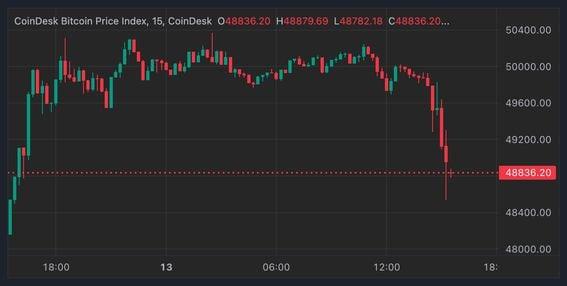
The January CPI reading reduced expectations for interest-rate cuts in the next months, weighing on risk assets such as crypto. Bitcoin dropped to $48,800 as the January Consumer Price Index report showed 3.1% annual inflation, higher than analyst forecasts. Expectations of a rate cut in May fell to 34% from 52%, CME FedWatch Tool shows. "Nasty" inflation was short-term damaging, but won't "dampen the mood" in crypto markets, OANDA's Craig Erlam said. Bitcoin (BTC) fell below $49,000 Tuesday after a hotter-than-anticipated U.S. inflation reading weighed on interest-rate cut expectations. The largest crypto by market capitalization slipped about 2% to $48,700 from slightly above $50,000 earlier in the day, while the broad-market crypto index CoinDesk 20 (CD20) lost 2.4%. Later in the day, cryptocurrencies pared some of the declines with BTC recovering to $49,100, but most of the CD20 constituents were still down 2%-3% over the past 24 hours. Solana's native token (SOL) held up better, gaining over 1% during the same time, while BTC was down 1.5%. U.S.-listed cryptocurrency-focused stocks tanked when markets opened, but has recovered part of their losses later in the afternoon. Shares of Coinbase (COIN) and MicroStrategy were down roughly 3% from Monday's closing price, while large BTC miners Marathon (MARA) and Riot Platforms (RIOT) 5% and 2%, respectively. The drop in prices happened after the January Consumer Price Index (CPI) report showed 3.1% year-on-year inflation, faster than analysts' 2.9% forecast. Market participants now see only a 34% chance of the Federal Reserve cutting interest rates in May, down from 52% a day ago, according to the CME FedWatch Tool. The lower chance of imminent rate cuts weighed on traditional markets as well. The 10-year U.S. Treasury bond yield advanced 12 basis points, while the S&P 500 equity gauge and the tech-heavy Nasdaq Composite Index declined as much as 2%. "This is not the inflation report that the Federal Reserve wanted to see and markets have responded accordingly," Craig Erlam, senior analyst at online brokerage platform OANDA, said in a Tuesday note. He pointed out that traders now price in only three rate cuts (75 basis point) for 2024, a significant drop from 175 basis points at some point last month, but suggests that fears about inflation might have swung overly pessimistic. "While markets appeared to be positioned too optimistically last month, I wonder whether the pendulum has now swung too far in the other direction," Erlam said. "We have still seen substantial progress on inflation and I expect we'll see more over the coming months." Erlam noted that the "nasty" inflation reading came at an unfortunate time for bitcoin and "rug-pulled" its rally just when it broke above the $50,000 level on Monday for the first time since December 2021. "While damaging in the short run, I don't think it will dampen the mood in the crypto space too much," he added. https://www.coindesk.com/markets/2024/02/13/bitcoin-drops-2-on-hotter-than-expected-us-inflation/
2024-02-13 15:00
Standard Custody & Trust Co., which has a New York charter, will be the latest acquisition to grow Ripple's regulatory qualifications. Ripple's acquisition plan to grab a company with a New York trust charter will expand the business it's allowed to conduct in the U.S., potentially letting it move beyond its well-known role as a payments network. The deal – Ripple's second recent purchase of a custody business – must still be approved by the New York regulator. Ripple struck a deal to acquire Standard Custody & Trust Co., the company said Tuesday, in order to secure a New York trust charter in an ongoing expansion of its U.S. regulatory licensing. Despite Ripple's overseas focus and its high-profile legal clash with the U.S. Securities and Exchange Commission (SEC), which has so far mostly gone against the regulator, the global payments company is still trying to stretch its capabilities in the U.S. The limited purpose trust charter held in New York by the company Ripple is buying will let it offer more in-house services, including to financial firms seeking to tokenize assets. The company is trying to push beyond the payments network it's known for and into other financial products in which their institutional customers can benefit from blockchain technology. "We want to offer more and more of these infrastructure pieces to these financial institutions," said Ripple President Monica Long in an interview with CoinDesk. "We see this as giving us a lot of flexibility." She called it a long-term project, and she said Ripple is also still seeking to complete the rest of its U.S. money transmission licensing. The deal with Standard Custody & Trust, for which Ripple has declined to disclose terms and which is still awaiting approval from the New York Department of Financial Services, adds a crypto custody and settlement business to Ripple's stable. That would let customers maintain custody with Ripple instead of having to go to an outside partner. Ripple is known in the U.S. for going toe-to-toe with the SEC in federal court over the regulator's accusations that XRP was a security. Though one judge has largely ruled on Ripples' side, the case will continue to be fought in higher courts. Long said the company's hesitation about the U.S. isn't as much about that specific clash as it's about the regulatory uncertainty over digital assets. "But the U.S. is a major market, and we believe it's possible for the U.S. to emerge as a leader in driving innovation," she said. This latest Ripple acquisition follows a deal last year in which Ripple bought another cryptocurrency custody firm, Metaco. Read More: Ripple-Owned Crypto Custody Firm Metaco's CEO and Head of Product Depart https://www.coindesk.com/policy/2024/02/13/ripple-to-buy-new-york-crypto-trust-company-to-expand-us-options/
2024-02-13 14:58
The new token type claims to solve some of the drawbacks with ERC-404s, an experimental standard that launched last week – to such popularity that it's already driven up congestion on the Ethereum blockchain. The sudden hype over ERC-404 tokens has spurred millions of dollars in trading volumes since its start in early February, but has seemingly caused Ethereum network fees known as "gas" to spike to eight-month highs. Developers of DN-404, however, say they have created a new structure that uses two contracts to achieve similar objectives as ERC-404, minus the issues. Both contracts are experimental and “unofficial.” A group of Ethereum application developers on Monday started a new token contract to solve the apparent drawbacks linked to the experimental standard known as ERC-404s, which has exploded in popularity, adding to network congestion and driving up fee rates. DN-404, short for “Divisible NFT-404,” is a token implementation based itself on existing token standards ERC-20 and ERC-721 and claims to offer “full compliance” with these frameworks. On Ethereum, ERC-20 is the agreed-upon framework for token issuance, while ERC-721 is for non-fungible tokens (NFTs). Developers of DN-404 say they made this framework after ERC-404 caused gas fees to spike due to how the latter operated. ERC-404s spurred millions of dollars in trading volumes, but seemingly caused Ethereum fees to spike to eight-month highs since its start in early February. Partly because of the ERC-404s, transactional fees shot up to as much as $840 for a transaction (on a certain project), they flagged, which would have “normally cost $50.” As of Tuesday, trackers show the average gas fee for swap transactions is at $20, compared to $5 at the start of this month. Some, like DN-404 developer @PopPunkOnChain have attributed this spike to the growth and use of ERC-404 contracts. Gas refers to the fees Ethereum users pay to ensure their transactions are included in the earliest block by network validators. These validators are incentivized to include transactions that pay the highest fees instead of a first-come-first-serve basis – meaning fees on popular tokens can often run to thousands of dollars. A spike in gas fees over the weekend to as much as 360 gwei (a unit of ether) sparked concerns among market observers about their long-term utility and causing a sharp sell-off among popular projects. Experimental and Unofficial ERC-404 is not an officially recognized Ethereum token standard – the 404 is a nod to the “404 not found error” message on websites. However several projects latched onto the ERC-404 narrative after its launch, collectively spurring a $209 million market capitalization in a few days, as per data tracked by CoinGecko. ERC-404 has also caused criticism among Ethereum developers for attaching ERC to its name. However, in messages to CoinDesk, the team explained that the naming helped it gain popularity and gained a following around what it intended to do. ERC-404 allows multiple wallets to directly own a single NFT, and, in the future, create a use case where that specific exposure can be tokenized and used to take out loans or stake holdings. In simple terms, it can be thought of as combining tokens and NFT ownership in a way that can create liquid markets for a project’s tokens and related NFT collections. DN-404 achieves the same objective by using two contracts that track and handle user balances and NFTs differently. As of Tuesday, neither DN-404 nor ERC-404 were officially recognized by the non-profit Ethereum Foundation, but they can still be be freely used within the network. ERC-404 developers say that they are actively working on an Ethereum Improvement Proposal (EIP) for the official recognition of the experimental token standard. EIP is the process of introducing a new feature or functionality to Ethereum. The EIP process can take a while and isn’t quick to do, developers added. “We also put out a tweet calling on the developer community to review and contribute their ideas as we’d like to have a transparent, open, and collaborative effort to reach consensus on a standard that works,” said @Hohenheim0x, an ERC-404 developer, in a direct message. “In addition, we’re in the early stages of exploring a foundation to further develop the standard, help drive adoption, and support the ecosystem of builders that have rapidly formed to take advantage of this new tech,” he added. https://www.coindesk.com/tech/2024/02/13/ethereum-developers-create-dn-404-tokens-after-erc-404s-send-network-fees-surging/

2024-02-13 10:51
The trader had bought the Yes side shares of the now-expired Polymarket-based betting contract "Will BTC hit $50,000 in February?" Bitcoin's move above $50,000 on Monday brought windfall gains to holders of the Yes side of Polymarket's now-expired "Will BTC hit $50,000 in February?" contract. Pseudonymous trader u/MeLLoN98 made 550% and is now betting on the bitcoin price reaching a record high by the end of the first quarter. Gone are the days when making big money in the crypto market required taking directional bets in the spot or futures markets or setting up complex decentralized finance strategies. Some traders are now generating market-beating returns through the decentralized prediction platform Polymarket. A recent example: The pseudonymous u/MeLLoN98, a core contributor on Reddit's r/CryptoCurrency community, earned a staggering 550% return on investment after buying more than 90,000 shares in the Yes side of Polymarket's now-expired betting contract "Will BTC hit $50,000 in February?" The contract resolved to Yes on Monday after bitcoin (BTC) rose past $50,000 on the Nasdaq-listed Coinbase (COIN) exchange, hitting the highest since December 2021. Speculators on Polymarket can buy or sell outcome shares, which can be redeemed for $1 if the outcome is correct. "I converted 110,000 Moons to 14,000 USDC on Kraken and bought 91,409 shares on Polymarket at an average price of about 15 cents. So I paid $14K and got $91.4K," u/MeLLoN98 told CoinDesk in an interview conducted over X. MOON is the native token of the r/CryptoCurrency community, which has 7.4 million users. MOON ERC-20 tokens are distributed as rewards to community members for their posts or comments in the subreddit and can be freely traded and spent in the community for various purposes. USDC is the world's second-largest dollar-pegged stablecoin, with over $27 billion in market capitalization. In other words, u/MeLLoN98 used his free MOON tokens to bet on the bitcoin price and won over $91,000. u/MeLLoN98 said he is planning to accumulate more MOON with the amount won. "Moons are getting on Arbitrum One next month with a partnership with Celer Network, so more liquidity is coming," the trader said, explaining his plans to buy more MOON. Polymarket has several other betting contracts tied to bitcoin and ether. One, floated in December, allows traders to speculate on whether the BTC price will rise to a record high on Binance on or before March 31. As of writing, shares in the Yes side of the contract traded at 18 cents, representing just an 18% probability of bitcoin climbing above $68,789 by the end of the first quarter. u/MeLLoN98, which goes by the name RedditMoons-10$ on Polymarket, has purchased more than 230,000 shares of the Yes side of the contract. "This bet is a lot more crazier. I paid approximately $27k and if it happens I'll get $230k," u/MeLLoN98 said. https://www.coindesk.com/markets/2024/02/13/moon-holder-makes-550-on-predictions-platform-polymarket-as-bitcoin-moves-above-50k/