2024-02-09 11:04
ERC-404 allows multiple wallets to directly own a single NFT and, in the future, create a use case where that specific exposure can be tokenized and used to take out loans or stake holdings. Pandora’s the first of a framework that tries to make tokens and NFTs work simultaneously. ERC-404 isn’t an “official” token standard, but that hasn’t stopped other developers from emulating Pandora’s success a week after its launch. The first token based on a new, unofficial, and experimental type of Ethereum standard has given rise to a new multi-million sub-asset class in the crypto market. Pandora {{PANDORA}}, the first of the so-called “ERC-404” tokens, traded as high as $32,000 on Friday morning from a low of $250 in just under a week. It has a supply of only 8,000 tokens and traded some $76 million in volumes in the past 24 hours. Several projects have already latched on to the hype and issued their own versions of ERC-404 tokens. Some of these have airdropped a small part of their token supply to Pandora holders, boosting demand for the token while also creating hype for their own projects. While, some have launched on other blockchains, such as Arbitrum and Solana, in a bid to be the first mover in an entirely different ecosystem. Prominent exchanges OKX and Binance have announced support for ERC-404 tokens on their Web3 wallets, adding legitimacy to the standard and further boosting hype. What is ERC-404? ERC-404 combines the popular ERC-20 and ERC-721 standards – for token issuance on Ethereum and non-fungible tokens (NFTs), respectively – into one that lets developers create fractionalized NFT collections that can be freely traded and used in the open market. In their current form, NFTs exist as a one-for-one asset, unlike tokens, where holders can buy a fraction of a whole. While fractionalized NFTs do exist, they typically depend on an entity that locks up those NFTs in a wallet and issues tokens that represent that NFT. Those fractionalized tokens are freely traded and may not accurately match the locked NFT’s value. That’s one of the key problems ERC-404 sets out to solve. It allows multiple wallets to directly own a single NFT, and, in the future, create a use case where that specific exposure can be tokenized and used to take out loans or stake holdings. “People in crypto hate friction,” ctrl, one of the developers of Pandora and ERC-404, told CoinDesk in a Telegram message. “Every solution before ERC-404 had too much friction and was usually a wrapping solution that abstracted the original NFT that people wanted to fractionalize or make liquid,” he said. “Collectors hated this, and it limited adoption significantly. ERC-404s have these functions by default and don’t rely on confusing third-party protocols and solutions,” he added. ERC-404 developers say on their GitHub page that while the two standards it combines “are not designed to be mixed,” the project “strives to do so in as robust a manner as possible while minimizing tradeoffs.” “This standard is entirely experimental and unaudited, while testing has been conducted in an effort to ensure execution is as accurate as possible,” developer 0xacme said on Github. “The nature of overlapping standards, however, does imply that integrating protocols will not fully understand their mixed function.” EIP in play to become official However, ERC-404 is not an officially recognized Ethereum token standard, a set of rules and protocols that define how digital tokens should behave and interact within a specific blockchain ecosystem. The team is actively working on an Ethereum Improvement Proposal (EIP) for the token standard. EIP is the process of introducing a new feature or functionality to Ethereum. The EIP process can take a while and isn’t quick to do, developers added. “We really need to make sure we get it right and approach this with a bulletproof proposal,” ctrl said. “Considering we’re this weird nascent thing that’s spawned from a very informal side of the market.” If approved, the standard will be an “official” one recognized by the Ethereum Foundation, a nonprofit that maintains the Ethereum blockchain, for use within the Ethereum ecosystem as an agreed-upon framework that is compatible with Ethereum-based applications. https://www.coindesk.com/tech/2024/02/09/what-is-erc-404-the-experimental-standard-whose-first-token-has-rocketed-12000-in-one-week/

2024-02-09 11:01
Bitcoin climbed over $46,000 for the first time in nearly a month early Friday, extending its gain for the week to nearly 10%. Crypto stocks such as COIN, MSTR and mining firms CLSK, RIOT and MARA all ticked upward in pre-market trading on Friday. Bitcoin surpassed $46,000 for the first time in nearly a month during the Asian morning. Mining firm CleanSpark led the way, up nearly 20%, also thanks to positive results for Q3 2023 announced Thursday. Cryptocurrency-related publicly traded companies showed healthy gains in pre-market trading on Friday as bitcoin {{BTC}} extended its rally, topping $46,000 for the first time in nearly a month and boosting its advance for the week to almost 10%. Bitcoin has added just over 4% in the last 24 hours, while the CoinDesk 20 Index, which measures the overall performance of the digital asset market, rose around 2.6%. Bitcoin miner CleanSpark (CLSK) led the way, climbing almost 20% as of 10:15 UTC. The company reported fiscal first-quarter profit of $25.9 million on Thursday compared with a $29 million loss the year before. Riot Platforms (RIOT) and Marathon Digital Holdings (MARA) also rallied, adding 7% and 8% respectively. Mining stocks are a recommended entry point for bitcoin exposure ahead of the forthcoming halving, in which the reward miners earn for new coins is cut by 50%, broker Bernstein said. The firm picked out CLSK and RIOT as its preferred stocks in a research report on Thursday. Cryptocurrency exchange Coinbase (COIN) and software company MicroStrategy (MSTR), which holds around 190,000 BTC on its balance sheet, both showed gains in the region of 5%. BlackRock's bitcoin exchange-traded fund (IBIT), the first of the new spot BTC ETFs to reach $2 billion in assets, added around 2.75%. Read More: Bitcoin ETFs (Ex-GBTC) Now Hold More BTC Than MicroStrategy https://www.coindesk.com/markets/2024/02/09/crypto-stocks-rally-pre-market-as-bitcoin-tops-46k/

2024-02-09 10:00
Industry groups argue they see inconsistencies in regulatory plans by the Bank of England and the Financial Conduct Authority. The Bank of England and the Financial Conduct Authority need to reconsider certain proposals to regulate stablecoins, multiple industry groups say. Lobbying groups argue the proposals treat stablecoin issuers unfairly and harm their ability to earn revenue. Crypto industry groups in the U.K. say local regulators’ proposals for supervising stablecoins need reworking. In November, the Bank of England (BoE) and Financial Conduct Authority (FCA) published discussion papers on their plans for regulating crypto pegged to the value of fiat currencies or other steady assets. The industry’s responses to the consultation reveal crypto advocates have mixed feelings about the proposals, saying that there are some good points, but a number of aspects need to be reconsidered. Both regulators plan on supervising stablecoins. The FCA will regulate the issuance and custody of fiat-referenced stablecoins as well as the use of these as a means of payment. The BoE will oversee systemic payment systems involving stablecoins, which refers to stablecoins that are circulated widely enough to affect financial stability should their issuers go bankrupt. Misaligned Crypto advocates are concerned that the two regulators may not be aligned on their treatment of stablecoin firms, particularly with regard to issuers’ ability to earn interest on reserve assets that back the tokens in circulation. The FCA has acknowledged in its discussion paper that stablecoin issuers earn most of their revenue by investing reserve assets and earning interest. “We propose that, under our regime, regulated stablecoin issuers can continue to retain, for their own benefit, the revenue derived from interest and returns from the backing assets,” the FCA said in its proposals. The BoE, by contrast, suggests issuers of systemic stablecoins should hold backing assets in central bank reserves, which would restrict their ability to earn interest. "The FCA is working with the way of the market and the way the market is developing, whereas the Bank of England is actually saying, 'No, you need to come up with an entirely new business model,'" said Paul Worthington, head of regulatory affairs at Innovate Finance. If a stablecoin firm that was previously under the purview of the FCA grows to become systemic, then the issuer is faced with an entirely new regime, Worthington said. "Suddenly, you can't earn revenues from the assets; you can't earn interest. So you have to totally pivot your entire business model," Worthington said."But that's not a model for growth." Su Carpenter, director of operations at Crypto UK, also said that the lobbying group supports having the benefit of interest and that the differing approach between the FCA and BoE would be "problematic in the future." Reserves Industry advocates are also concerned by both regulators’ proposals on what assets should back the stablecoins. The FCA's proposal suggested limiting acceptable assets to government treasury debt instruments with maturities of one year or less and short-term cash deposits. "Our members feel that limiting the acceptable backing assets will be an impediment to issuers wanting to run a stablecoin in the U.K.," advocacy group The Payments Association said in its response to the consultation. "Making returns on the funds backing a stablecoin is one of the key revenue drivers for potential issuers and so more flexibility is needed." CryptoUK, in its response, echoed the drive for more options. “A higher degree of flexibility in backing assets will increase diversification and reduce the risks facing issuers, and by extension, the risks that consumers face by investing into this sector,” the group said, comparing U.K.’s proposal to Singapore’s reserve requirements, which say stablecoins can be backed by “highly liquid and low-risk assets,” including cash and cash equivalents. Another industry group, UK Finance, also noted it wants fiat-referenced stablecoins to have as much flexibility as e-money, which generally allows for "secure and liquid" assets – including money market funds or longer-term government debt – to make up reserves. "As e-money appears to create a similar risk to stablecoins, it is difficult to understand why a similar risk would not be regulated in a similar way," UK Finance said in its response. Meanwhile, the BoE's approach is for backing assets to be restricted to central bank deposits only. The Digital Pound Foundation said this approach would also be "extremely limiting." Compensation The FCA also proposed not including stablecoin providers under its Financial Services Compensation Scheme. FSCS allows the FCA to compensate customers up to £85,000 ($107,300) when a company that has gone bust is unable to pay customers what they are owed. "In all honesty, we don't agree with that, and if stablecoins are going to fall within the regulated perimeter, then if – for example – fraud is taking place, then why shouldn't it be covered by the FSCS?" Carpenter said. On the other hand, The Payments Association contended that issue may need further review. "It is difficult to apply FSCS at this nascent stage of the crypto asset market, as it is unclear what the size of the market will be and how many issuers will seek authorization in the U.K.," the organization said. "It is therefore impossible to calculate levies and conduct a cost-benefit analysis." The FCA will now review responses to its proposals and draft a handbook of rules for consultation. https://www.coindesk.com/policy/2024/02/09/uks-planned-stablecoin-rules-need-reworking-crypto-advocates-say/

2024-02-09 09:08
The cryptocurrency has performed well before the halving and is likely to sustain momentum for the rest of the year, leading to new highs, the report said. Bernstein recommends buying mining stocks to gain bitcoin exposure. Riot Platforms and CleanSpark are the broker’s top picks. Positive ETF flows provide an additional tailwind for bitcoin. Bitcoin (BTC) mining companies appear to have bottomed out following the approval of spot bitcoin exchange-traded funds (ETFs) in the U.S. last month, and broker Bernstein advises buying its preferred stocks in the sector ahead of the next reward halving, it said in a research report Thursday. The world’s largest cryptocurrency has performed well ahead of the halving, in which the reward miners earn for their efforts is slashed by 50%, and will probably sustain momentum for the rest of the year, Bernstein said. The cut is expected to take place in April. The bitcoin price broke out after each of the three previous events, and this time is already strong ahead of the catalyst, it said. Bitcoin rose to $46,000, a one-month high, early Friday in Europe. Bernstein recommends achieving bitcoin exposure through mining stocks, and outperform-rated Riot Platforms (RIOT) and CleanSpark (CLSK) are the broker’s top picks in the sector. "Given the positive ETF flows momentum, resilient BTC price action and healthy miners adding capacity into the halving, we feel comfortable recommending investors to enter here for our preferred names," analysts Gautam Chhugani and Mahika Sapra wrote. "The institutional narrative led by bitcoin ETFs is driving demand, and bitcoin being the reflexive asset, we expect higher price will bring higher ETF inflows, leading to new highs in 2024." Normally halving is a "risk-off" event for the sector as the market "looks to clear out high-cost miners, operating at unsustainable costs," the report said. The broker expects 15% of the bitcoin hash rate to shut down after the halving, but if prices remain strong, the decline could be more muted. "At $44,500 bitcoin price, most of the U.S. listed miners look relatively well positioned, even if their costs double post halving." ETF flows have also turned positive, giving the world’s largest cryptocurrency an additional tailwind. "Consistent net ETF inflows means the overall market will lean bullish and reflexivity should ensure a higher price-higher inflows feedback loop," the report said. https://www.coindesk.com/markets/2024/02/09/bitcoin-miner-shares-offer-good-entry-point-ahead-of-halving-event-bernstein/

2024-02-09 07:18
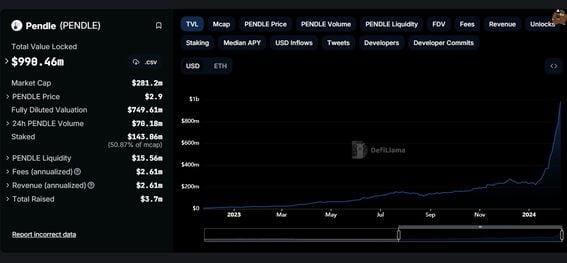
Pendle crossed the $100 million TVL mark in mid-June 2023. Pendle has almost reached $1 billion in total value locked, with most of that value locked in within the last six months. This surge in interest comes as the market looks for more opportunities for liquid restaking tokens. Pendle recently added support for the BNB chain and real-world assets (RWA) Pendle, a decentralized finance (DeFi) platform that offers yields in the form of tradable digital tokens, has reached $990 million in total value locked (TVL), according to DeFiLlama data. Pendle operates as a price discovery tool by separating DeFi investments into principal tokens (PTs) and yield tokens (YTs), allowing for the trading of future yields and principal on the open market, thus enabling investors to speculate on and lock in future yield rates. “The influx of interest in [Liquid Restaking Tokens] has been the main driver behind Pendle’s recent growth,” Pendle developer RightSide said in an interview on Telegram. Liquid restaking token finance (LRTFi) is a new DeFi field that allows for the liquidity of staked assets through the issuance of liquid restaking tokens (LRTs), enabling users to earn rewards while their original assets are locked up for securing network services. “Pendle’s one of the earliest pioneers of LRTfi, offering a unique proposition for users to speculate on EigenLayer yields and points," Pendle continued in a Telegram interview. Recently, Pendle expanded to the BNB chain and has begun offering products that allow users to leverage real-world assets (RWA). https://www.coindesk.com/markets/2024/02/09/defi-platform-pendle-nears-1b-in-total-value-locked/
2024-02-09 06:35
Over the next few days, East Asia will celebrate the start of the year of the dragon, which is considered to be one of the luckiest and most prosperous animals in the Chinese Zodiac. Bitcoin has historically seen gains around the Chinese New Year period. Sources of selling pressure from ETF holders and miners have eased in the past week while BTC prices have increased, suggesting demand. Bitcoin (BTC) crossed $46,000 early Friday, as the CoinDesk 20 Index (CD20), a measure of the biggest cryptocurrencies, jumped over 2%. The largest crypto by market cap reached a one-month high as East Asia ushered in its biggest festive of the year, celebrating the start of what’s believed to be one of the luckiest periods as per the Chinese Zodiac. In Mandarin Chinese, the word for dragon is pronounced similarly to “long,” boosting memetic value among crypto traders. Bitcoin could rise to as much as $48,000 in the coming days as the asset historically shows gains around the Chinese New Year period, 10X Research said in a Thursday note, predicting a gain of at least 11%. The asset has added nearly 15% in the past two weeks, data shows, easing losses as the anticipated bitcoin exchange-traded funds (ETFs) turned out to be a sell-the-news event. The rise to its highest level since Jan. 12 came as the S&P500 and Nasdaq-100 indices hit all-time highs on Thursday. Several ETFs have since absorbed more than a billion dollars worth of bitcoin selling pressure in the past few weeks, indicating demand. Elsewhere, on-chain analysis firm CryptoQuant said in a Thursday note that bitcoin movements out of miner wallets – which signify selling – seemed to slow. Meanwhile, some traders said recent bitcoin price action stemmed fears of a further sell-off, citing strength in weekly movements. “Bitcoin rose above its 50-day moving average late Wednesday, confirming the bullish medium-term trend and easing fears of a deeper correction,” said Alex Kuptsikevich, FxPro senior market analyst, in an email to CoinDesk. “On a weekly basis, bitcoin and the broader crypto market have gained strength after a long period of consolidation and are now poised to make new highs.” https://www.coindesk.com/markets/2024/02/09/bitcoin-crosses-46k-as-year-of-long-begins-easing-etf-selloff/