2024-02-07 14:58
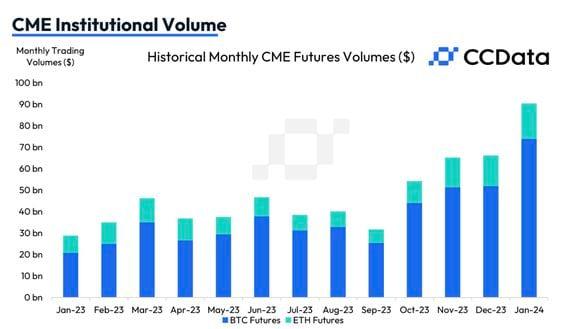
The total derivatives trading volume on CME rose 35% in January to $94.9 billion, the highest since October 2021. Derivatives giant Chicago Mercantile Exchange (CME) witnessed a surge in trading volume in January as the U.S. saw spot bitcoin exchange-traded funds (ETFs) win Securities and Exchange Commission (SEC) approval. The total derivatives trading volume on CME rose 35% in January to $94.9 billion, according to data provided by CCData. This is the highest recorded trading volume for the exchange since October 2021. January saw the much-anticipated approval of spot bitcoin ETFs in the U.S, an important milestone for institutional investors as the products offer them exposure to the world’s largest cryptocurrency by market value. CME is a Chicago-based firm whose business covers a wide span of financial, commodity and agricultural futures and options. Large institutions use CME to trade bitcoin futures. Futures are a type of derivatives contract that requires buyers to purchase bitcoin at a predetermined price at a later date. They’re essentially a hedge against a future price movement. The trading volume for bitcoin futures rose 42% to $73 billion in January. “This comes as institutional traders wound down their positions after the approval of the spot bitcoin exchange traded funds (ETF) in the United States,” said a report by CCData. The exchange also recently saw the volume of bitcoin futures open interest (OI) – the number of existing contracts – surpass Binance (the world’s largest centralized exchange by trading volume). However, CCData notes that this trend has reversed, and open interest has fallen 8.50% to $4.42 billion. Bitcoin options on the exchange also fell, dropping almost 30% to $1.57 billion. “The rise in the futures volume and the decline in the options volume hints at the deleveraging and end of speculation for institutional investors who speculated on the spot bitcoin ETF approval catalyst,” said the report. Ether futures trading volume on CME rose 15.6% in January after attention shifted briefly to a possible ether ETF approval as various applicants are waiting for the SEC to make a decision later this year on whether spot ether ETFs will trade in the U.S. Ether options traded on CME rose by 27%, the second-highest monthly trading volume for this instrument on the exchange. https://www.coindesk.com/markets/2024/02/07/cme-trading-volume-reached-highest-in-3-years-after-bitcoin-etf-approval/
2024-02-07 13:35
The much-debated crypto broker says it's poised to start its SEC-compliant custody with ETH, then will soon add other names and begin a trading operation within months. Prometheum is seeking to blaze a new trail as an SEC-compliant crypto firm, beginning with a custody operation that intends to start its business by holding customers' ETH. The company's executives say the firm will follow with a number of other tokens before launching its trading operations, targeting the second quarter of 2024 to open its doors. Prometheum Inc. – still standing alone as the only U.S.-registered crypto securities platform – has disclosed that the first digital asset it'll handle for clients will be Ethereum's ether (ETH). The company, which has been a target of industry criticism and debate, hasn't yet taken in any revenue after having only very recently cleared the final regulatory hurdle to open its custody operation. But co-CEOs Aaron and Benjamin Kaplan said they'll take on custody of customers' ETH by the end of next month. "We want to be able to service the largest market cap and most liquid token," said Aaron Kaplan in an interview with CoinDesk. "Ethereum is first, and there should be many more thereafter." Prometheum represents a high-stakes test case in U.S. crypto. It's the first firm to attempt to go through all the U.S. Securities and Exchange Commission's compliance hurdles to set itself up as a special-purpose broker-dealer and crypto custodian through the Financial Industry Regulatory Authority. And next quarter, Prometheum's executives said they intend to open the doors of their alternative trading system – a kind of U.S. trading venue that is similar to a full-fledged exchange but with fewer compliance requirements. At that point, the company will either be proving the claims of its executives that crypto can be handled in the U.S. in a way that appeases the securities watchdog, or proving the naysayers who argue that it's impossible to meet the SEC's expectations. The stakes aren't just high for Prometheum and the rest of the industry, but also for the government agency that has claimed for years that there's a proper way for crypto firms to "come in and register" to do business in the U.S.; Prometheum came in and registered but what happens next is unclear. And while it tests these murky waters, it may also help establish whether the SEC intends to view ETH as a security. Prometheum's choice of ETH as its opening asset could come with its own complications. Unlike bitcoin (BTC), which the SEC has openly declared isn't a security and is therefore none of the agency's business, the commission has been more coy about whether ETH is among the digital tokens that should be considered securities that fall under its jurisdiction. Its sister agency, the Commodity Futures Trading Commission, hasn't been so shy about declaring that ETH is definitely a commodity. Prometheum is registered to custody crypto securities and isn't in the commodities business. Ben Kaplan said the firm will go with whatever the SEC's word is on ETH. "The CFTC is not our regulator," he said. "When the SEC says to us, 'It's not a security,' then we'll be troubled." The startup, which Aaron Kaplan has said has about 50 employees, is seeing "immense interest" in its service as a so-called "qualified custodian," though it hasn't yet confirmed any institutional names that may do business there. It intends to service asset managers, hedge funds, investment advisers, banks and other financial institutions. "A lot of people got burned in 2022," he said, referring to the turmoil involving the under-regulated U.S. industry. Prometheum may get a tremendous shot in the arm if the SEC follows through with a rule it proposed to require registered investment advisers only be allowed to park their customers' crypto assets with qualified custodians. That list typically includes registered broker-dealers and banks, but SEC Chair Gary Gensler has argued it probably doesn't include today's major crypto exchanges. The rule is on the agency's public agenda to be finalized by April, though such agendas often prove overly ambitious. Whether the SEC finishes the rule or not, Aaron Kaplan contended that traditional financial firms will want to deal with a service that's properly registered and "speaking the same compliance language." He argued that the company could also benefit from the trend toward asset tokenization, because that practice needs a firm that can trade, clear and settle in one place. The outcome of Prometheum's business plan and whether the SEC stays silent or attempts to intervene isn't the only uncertainty facing the firm. As with the rest of the sector, its future could be steered by ongoing court cases that promise answers on how crypto securities will be defined. If courts side with the recent Coinbase arguments in its case with the SEC that cryptocurrencies traded on a secondary market don't carry explicit contracts and aren't securities, such a decision could affect the universe of securities Prometheum can host on its platform. Read More: Prometheum Earns Final Regulatory Nod to Try Hand at Fully-Compliant Crypto https://www.coindesk.com/policy/2024/02/07/prometheum-the-only-us-registered-crypto-platform-picks-ether-as-its-first-product/

2024-02-07 10:58
As of Wednesday morning, validator “Big Brain Staking” holds over 35% of staked DYM tokens – attracting criticism from DYM holders for its large network influence. The start of Dymension’s much-hyped token was marred by transactional errors, delays, and delegation issues as the new token clocked a massive $5.2 billion fully diluted valuation on the first day of going live. Fully diluted valuation is the theoretical market capitalization of a coin if the entirety of its supply is in circulation, based on its current market price, according to Coingecko. DYM, the token of the rollup platform, was highly anticipated within crypto circles and was distributed to users of Celestia, Solana and Ethereum blockchains based on certain criteria. It airdropped $390 million worth of tokens to these users. Dymension is a so-termed modular settlement layer that provides all the tools and infrastructure needed to easily launch “roll apps.” In cryptocurrency terms, modular blockchains try to specialize in a few specific applications, such as gaming or trading, while roll-ups process transactions on another, faster blockchain (known as a layer 2), and then port the transaction data back to the parent blockchain. But Tuesday’s start was less than ideal. Users claimed the blockchain was unable to process transactions for at least five hours. Some were unable to add the blockchain to crypto wallets as RPCs – which point blockchain data to user wallets – took several minutes to update. Validators failed to achieve consensus in the early hours of the network as Chorus One, a large validator, experienced node issues. The team addressed these issues in an X post, stating its large token holdings likely contributed to the “failed launch.” “A couple of other validators and us had an (as yet unknown) issue with the network node software,” Chorus One said. “We staked our significant holdings in the genesis block. We are early Dymension supporters. Other early-stage investors didn’t stake to genesis, which led us to have 34% power in the failed launch.” Validator Concerns As of Wednesday morning, validator “Big Brain Staking” holds over 35% of staked DYM tokens – attracting criticism from DYM holders for its large network influence. Validators are entities that maintain any blockchain network and process transactions. A single validator yielding large influence over a network increases risks of collusion and may, as in Dymension’s case, lead to slower transaction times. This is due to an overload of transactional requests to a single or small group of entities. DYM traders have shaken off the technical hurdles, however, with some $380 million in trading volumes over the past 24 hours. Users have staked over 123 million DYM to various validators, the protocol’s staking monitor shows, with annualized rewards currently hovering around 70%.\ CORRECTION (Feb. 7, 11:10 UTC): Corrects headline and lede to clarify that $5.2 billion is the fully diluted valuation of the token. https://www.coindesk.com/tech/2024/02/07/rollup-platform-dymensions-dym-reaches-52b-market-cap-after-botched-start/

2024-02-07 10:35
The new consumer protection rules will take effect in July 2024. Crypto criminals will face life imprisonment in South Korea when new consumer protection rules take effect this July, the country's financial regulator said Wednesday. In December, the Financial Services Commission (FSC) proposed a consumer protection framework called the Virtual Asset User Protection Act. The rules take effect on July 19 and cover market manipulation, illegal trading and other violations leading to criminal punishment or fines, depending on the severity. "In the case of criminal punishment, a fixed-term imprisonment of more than one year or a fine equivalent to three to five times the amount of unjust enrichment is possible," the FSC said. If proceeds from crime exceed 5 billion won ($3.8 million), the perpetrators can face a life sentence, the notice added. South Korea has been strengthening its oversight of the digital assets sector, particularly targeting consumer protection. Approved initiatives so far compel companies and public figures to disclose crypto holdings. https://www.coindesk.com/policy/2024/02/07/crypto-crime-could-mean-jail-for-life-in-south-korea/

2024-02-07 09:38
LINK is one of the year's top-performing tokens, driven largely by hype around the tokenization of real-world assets. One of crypto’s hottest narratives – the tokenization of real-world assets – has sparked a nearly 40% jump in the price of Chainlink’s (LINK) over the past 30 days, with some crypto wallets apparently picking up over $50 million worth of the tokens. On-chain analysis tool Lookonchain said one large investor, colloquially known as a "whale," withdrew 2.7 million LINK tokens from crypto exchange Binance using 49 new wallets in that period, while the price climbed to a 22-month high and market cap touched $10 billion. One of the wallets has transferred more than $9 million in LINK tokens from the exchange in the past 10 days, Lookonchain said. A public database created by the firm shows the wallets hold anywhere from $230,000 to $3.5 million in LINK each. CoinDesk was unable to verify whether the wallets belong to a single owner. They are not labeled as linked to any particular custodian service or exchange on tracking applications Akrham and CryptoQuant. Bullish drivers In January, analysts at K33 Research said LINK was "the safest way to profit" from the ever-strengthening tokenization of real-world assets (RWA) narrative. Tokenization allows assets like gold, stocks, and real estate to be represented and traded as digital tokens on a blockchain. According to Boston Consultancy Group, tokenized RWAs could be worth $16 trillion by 2030. Last month, Chainlink connected its Cross-Chain Interoperability Protocol (CCIP) with stablecoin company Circle’s Cross-Chain Transfer Protocol (CCTP) to make it easy for users to transfer the USDC stablecoin across chains. The deal allows developers to build cross-chain applications involving Circle's USDC, including payments and other DeFi interactions, further boosting LINK’s fundamentals. The dollar value locked in open futures contracts tied to LINK has more than doubled to a record $520 million in the past few months, according to data source CoinGlass. In cryptocurrency terms, open interest has surged 62% to nearly 30 million LINK. An increase in open interest represents an influx of new money into the market. A rise in price alongside growth in open interest is said to confirm the trend. LINK prices fell 3.3% to $18.43 in the past 24 hours, Coingecko data shows. Bitcoin was little changed as traders likely took some profits from the price bumps. https://www.coindesk.com/markets/2024/02/07/whales-grab-50m-in-chainlinks-link-as-price-climbs-40-in-a-month/

2024-02-07 08:00
The liquidity provider is expanding to Luxembourg in a bid to widen its EU presence six months after gaining a license to operate in France. Liquidity provider B2C2 secured regulatory approval in Luxembourg as a virtual asset service provider (VASP) as the London-based firm looks to expand its presence in the European Union. Approval allows B2C2 to offer over-the-counter (OTC) spot crypto services to institutional clients. It becomes the the 12th VASP to be registered Luxembourg's Commission de Surveillance du Secteur Financer’s (CSSF) public register. The company already has a license from France's Autorité des Marchés Financiers (AMF), acquired when it bought Paris-based Woorton in August last year. The moves come as the EU prepares to implement its Markets in Crypto Assets (MiCA) regulation this year. Once it kicks in, the 27-nation trading bloc will be the first major jurisdiction worldwide to introduce comprehensive, tailored rules for the sector. Former Bank of England supervisor, Denzel Walters, will lead the Luxembourg team. B2C2 last month appointed Thomas Restout as CEO. "As B2C2 prepares for MiCA regulation to come to force, obtaining VASP registration in Luxembourg is a further milestone for B2C2, as Luxembourg is home to a rapidly expanding virtual asset community,” Restout said in a press release. Japanese financial group SBI Holdings acquired B2C2 in 2020, becoming the first major financial group to own a crypto trading firm. https://www.coindesk.com/markets/2024/02/07/b2c2-gains-luxembourg-virtual-asset-license-as-eus-crypto-rules-set-to-kick-in/