2024-02-06 06:22
Conifex, a B.C.-based cryptocurrency mining company, challenged B.C. Hydro's 18-month moratorium on mining. British Columbia’s provincial power utility, B.C Hydro’s, moratorium on crypto mining projects was ruled as reasonable by a provincial supreme court judge, according to a ruling posted on Monday. The moratorium was being challenged by Conifex Timber, a forestry company that had branched out into crypto mining. Conifex was planning a mining operation with Tsay Keh Dene Nation, an indigenous tribe. In the ruling, Justice Michael Tammen said that the moratorium, first enacted in December 2022, was reasonable, not discriminatory, and within the bounds set out by the province’s Utilities Commission Act. Justice Tammen wrote that B.C. Hydro’s ban was grounded on a cost-of-service basis, which considers the unique, substantial energy demands of cryptocurrency mining and aims to preserve affordable energy access for the broader population. READ: The Bitcoin Mining Debate Is Ignoring the People Most Affected “The evidence amply establishes that cryptocurrency mining centers have unique electricity consumption characteristics... The total amount of megawatt hours that would have been required to service all the interconnection requests from cryptocurrency operations in 2023 grossly exceeded the projections of BC Hydro,” the Judge wrote. For its part, Conifex highlighted that it believed the continued ban was a missed opportunity for the province. “Conifex continues to believe that the provincial government is missing out on several opportunities available to it to improve energy affordability, accelerate technological innovation, strengthen the reliability and resiliency of the power distribution grid in British Columbia, and achieve more inclusive economic growth,” Conifex said in a public statement to the press. In November 2022, New York State imposed a two-year moratorium on crypto mining. British Columbia is home to a number of zero-carbon footprint mining projects that exist off-grid such as Ocean Falls Technology, which utilizes orphaned power from a hydroelectric plant in an abandoned mining town. https://www.coindesk.com/policy/2024/02/06/british-columbia-court-backs-ban-on-crypto-mining-in-canadian-province/

2024-02-05 23:28
Despite government crackdowns and widespread reports that crypto is outlawed in China, crypto trade is still very much alive. How is that possible? Despite countless Western media outlets describing China’s crypto “ban,” crypto trade is very much alive on mainland China. In just one month last year, Binance reportedly did $90 billion in Chinese crypto trade, making China the largest market for the world’s largest exchange. How is this possible? It’s tempting to turn this into a story about the power of decentralized money to elude government control, and there is certainly some truth in that. But that’s only part of the story. Crypto hasn’t disappeared in China because crypto isn’t completely banned there. This is very different from the impression you’d get from Western media outlets, which commonly refer to China’s crypto ban or its ban of crypto trade. There are too many examples to list here – just do a basic search of those terms to see what I mean. Yet when I asked several Chinese industry insiders if they thought it was accurate to say that crypto is banned in China, the answer was overwhelmingly no. Their general understanding was that it’s not illegal for individuals to hold or trade crypto, but their activities would not be protected by law. This interpretation isn’t limited to informal conversations. An article written by authors from a court in Fujian province notes that “administrative laws and policies do not completely prohibit virtual currency transactions.” A Chinese law firm published a detailed post on the topic that says, “currently, our country has no laws or administrative regulations prohibiting Bitcoin trading activities.” Reading between the lines It’s not hard to understand why many assume that crypto is fully banned in China. Chinese authorities have clearly cracked down on the crypto industry, and there are many crypto-related activities that are indeed not allowed. But in China, what is not said often takes on a special importance. People tend to pay attention to what is not explicitly restricted. Then they find room to maneuver in those relatively blank spaces. So let’s just take a moment to go through some of the more well-known crypto crackdowns and what they actually said. In 2013, China restricted financial and payment institutions’ involvement with Bitcoin. In 2017 China famously banned initial coin offerings, or ICOs. China also made clear that virtual currency exchanges were no longer welcome to openly operate there. Before the 2017 crackdown, China was the dominant player in bitcoin volume. The crackdown did not stamp out mainland crypto trade, but it certainly pushed it into a gray area. BTCC, China’s longest running Bitcoin exchange, closed down its mainland Chinese trading operation in 2017. An even more extensive crackdown came in 2021. This document, signed by 10 Chinese official bodies, has a wide range of restrictions. It says that virtual currency does not have the same legal status as fiat currency. In other words, Bitcoin is not legal tender. It says that virtual currency-related business activities are considered to be illegal financial activities. Exchange businesses should not act as central counterparties to buy and sell virtual currencies, and it is illegal for overseas virtual currency exchanges to provide services to Chinese residents through the Internet. There is other restrictive language as well. In 2021 China also cracked down hard on domestic crypto mining. But, even amid all these restrictions, there are notable gaps. The 2021 regulations, for example, do not appear to restrict people from holding cryptocurrency. Nor do they appear to restrict peer-to-peer trading between individuals. Another important passage in the 2021 document perhaps sheds more light on China’s official attitude toward crypto. The passage describes the legal risks involved in participating in virtual currency investment and trading activities. It notes that if someone invests in virtual currencies and violates public order and good morals, the relevant civil legal actions are invalid, and the resulting losses are borne by individuals. In other words, if you lose your life savings on some meme coin, don’t go crying to the government about it. Individual crypto activities are not necessarily protected by law, but that’s not the same thing as being banned. Social stability The above passages may look like splitting hairs. One might argue that Chinese regulations make it so difficult to trade crypto that it amounts to an effective ban. But in order to understand the real situation, you have to look not just at the rules themselves, but at how the rules are – or not – being enforced. It’s no secret that China’s crypto crackdown did not stop crypto trade. Chinese traders got a net $86 billion from crypto activity between July 2022 and June 2023, according to Chainalysis. In some cases, people continued to use accounts that they had opened on overseas exchanges. Sometimes they needed a virtual private network, sometimes they did not. Peer-to-peer trading via social media apps like WeChat or Telegram has also been possible. There are stories of people setting up companies abroad through intermediaries, and then using that overseas company to complete institutional know-your-customer (KYC) identification on crypto exchanges. It’s notoriously difficult for a government to contain a decentralized currency like Bitcoin. But the common Western media narrative — that people are furtively trading crypto behind the backs of Chinese authorities – is not quite right. Put another way: If Binance was doing $90 billion of trade in China, Chinese authorities probably knew something about it. In fact, that same WSJ article noted that local law enforcement worked closely with Binance to identify criminal activity among the exchange’s more than 900,000 active users. After checking online crypto exchanges and interviewing retail investors, Reuters found that “access to bitcoin isn't that difficult on the mainland.” The fact that so much crypto trade survived the “ban” suggests that China never intended to wipe crypto off the map. Instead, the main goal was to raise the barrier to entry. In this sense, the new rules were extremely effective. Making trade more inconvenient helps prevent crypto from reaching masses of unsophisticated investors. The last thing Beijing wants is for those same investors to take to the streets to protest their losses. It all comes down to one of the key principles in Chinese policy: Preserving social stability. China has reason to be wary of crypto. It doesn’t want people to use it to evade its capital controls, for example. At the same time, China has long embraced the potential of blockchain technology, and Beijing even issued a Web3 white paper. The country has ambitious plans for its central bank digital currency. It is possible that authorities want to keep the door slightly open to crypto itself, just in case. That theory would help explain what’s happening in Hong Kong. The city has made very public steps to establish itself as a digital asset hub of Asia, if not the world. Hong Kong and China operate as "one country, two systems," and Hong Kong’s relatively welcoming stance toward crypto has at least some degree of approval from Beijing. Letting crypto thrive in Hong Kong, if not the mainland, is a way for China to stay in the game while mitigating the risks. In China, you need to look not just at what the rules say, but at how people interpret them. Referring to China’s policy as a blanket crypto ban oversimplifies the situation in one of the most important markets in the world. https://www.coindesk.com/consensus-magazine/2024/02/05/china-never-completely-banned-crypto/

2024-02-05 22:57
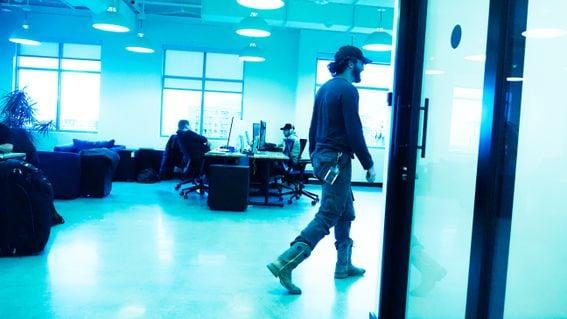
This year's mtnDAO is flush with cash and short on monitors. SALT LAKE CITY — "We're going to need a bigger boat." So said Barrett, the host of Solana's largest community-run coworking meetup, after surveying his fast-filling WeWork in Salt Lake City on Monday. His cowboy boots clopped past rows of desks and laptops and crypto developers at the seasonal retreat. Some 50-odd out-of-towners had already arrived and another 150 were on their way, putting his supply of monitors in jeopardy of proving too small. He made the tough call: "Pretty soon everyone with a Vision Pro is going to have to work from the couch." For the next three weeks the social center of the Solana ecosystem will be Utah. There's NFT enthusiasts, market makers, crypto-payments wonks, validator operators, decentralized governance philosophers and plain-old degenerates mingling and talking and coding for Solana. MtnDAO has ballooned well past the two dozen or so familiar faces that migrated to the past four editions. It's bolstered this February by sponsorship funding from the Solana Foundation and a handful of representatives. That lent an air of officiality to what had called itself "Solana's most notorious hacker house." But make no mistake: Barrett still runs this town. He literally owns the monitors. His people decide what local restaurant to get catering from each Monday through Friday. At least on the fourth floor, the WeWork site managers defer to him. He and his co-host Edgar Pavlovsky of MarginFi and their intern Anders will ultimately decide who wins mtnDAO. CoinDesk will be filing regular dispatches from mtnDAO, capturing the vibes, the conversations and profiling the startups chasing the $150,000 in prize money that will go to the best in show. https://www.coindesk.com/business/2024/02/05/solanas-most-notorious-hacker-house-is-bigger-than-ever/
2024-02-05 22:56
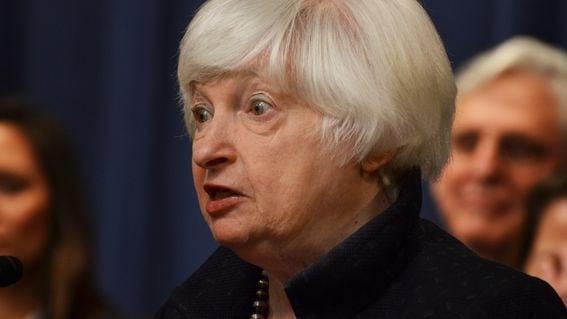
Yellen is set to tell U.S. lawmakers that the FSOC is especially wary of stablecoins and the potential for digital asset runs. U.S. Treasury Secretary Janet Yellen is set to tell Congress that the crypto industry poses several potential hazards to the financial system, including the dangers of stablecoins, runs on crypto platforms and volatile prices, according to a brief portion of her testimony posted Monday. Yellen is appearing before the House Financial Services Committee on Tuesday to explain the latest work of the Financial Stability Oversight Council (FSOC), a group of U.S. financial agency heads that the secretary leads. The council, which is meant to head off the next financial crisis before it happens, has paid special attention to crypto risks in recent years, putting them among the top categories of potential worry. "The council is focused on digital assets and related risks such as from runs on crypto-asset platforms and stablecoins, potential vulnerabilities from crypto-asset price volatility, and the proliferation of platforms acting outside of or out of compliance with applicable laws and regulations," she said in the testimony prepared for delivery, which was posted on the committee's website. Yellen said she'll keep working with Congress on crypto legislation. "Applicable rules and regulations should be enforced, and Congress should pass legislation to provide for the regulation of stablecoins and of the spot market for crypto-assets that are not securities," she said. Her brief remarks don't reveal any new interest or initiative, but the fact she included digital assets as one of her key issues keeps the crypto sector in the spotlight of the U.S. government's financial concerns. Read More: A Backdoor Regulatory Option Haunts U.S. Crypto https://www.coindesk.com/policy/2024/02/05/treasury-secretary-janet-yellen-warns-of-crypto-risks/
2024-02-05 22:36
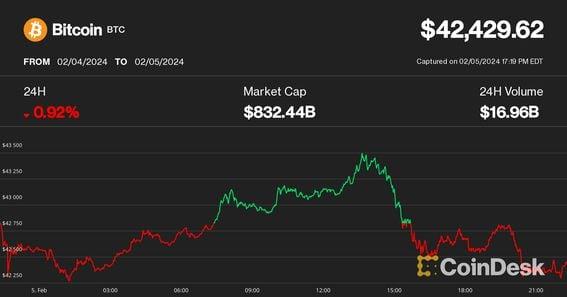
Federal Reserve Chair Jerome Powell reiterated his hawkish stance on rate cuts in a Sunday interview, weighing on risk assets. Cryptocurrencies slid lower Monday with bitcoin nearing $42,000 as soaring U.S. interest rates amid strong economic data, hawkish Powell weighed on prices. Bitcoin could rise to $70,000 by year-end benefitting from favorable macro environment, Markus Thielen said. Crypto markets slumped on Monday as U.S. interest rates continued to soar on strong economic data and Federal Reserve Chair Jerome Powell reiterating his hawkish stance from last week. Bitcoin (BTC), the largest crypto by market capitalization, slipped to $42,200 late Monday from as high as $43,400 earlier in the day. At press time, it was lower by 1.2% over the past 24 hours. Almost all cryptocurrencies endured similar or greater losses during the day, highlighted by the broad-market crypto index CoinDesk20's {{CD20}} 1.3% decline, with 18 assets in that gauge declining. Native token of Chainlink (LINK), a software platform that connects blockchains with the outside world, was the biggest gainer among CD20 constituents with a modest 2% advance during the day. The slump in crypto prices happened as the 10-year U.S. Treasury bond yield jumped another 14 basis points during the day, extending its two-session rise to 30 basis points. Fueling the move was a Sunday night 60 Minutes appearance by U.S. Federal Reserve Chair Jerome Powell at which he confirmed that the Fed has little intention of cutting rates in March, as markets had previously expected. And following Friday's blowout employment numbers, there was more solid economic news on Monday, with the ISM Services index unexpectedly rising to 53.4 in January versus December's 50.5. Key U.S. stock indexes, the S&P 500 and the tech-centric Nasdaq 100, both closed with small declines. Bitcoin to $70K by year-end Despite today's loss, BTC was still holding up above $42,000, a significant support level for prices with buyers stepping in, but risk appetite is currently low as crypto markets lack fresh investment narratives, SwissBlock analysts said in a Monday report. "Exclusive drivers for the crypto market, such as BTC ETFs, have already played out, leaving players waiting for the next significant signal," the report noted. On the longer term, 10x Research analyst and Matrixport head of research Markus Thielen sees the largest crypto to rally to $70,000 by the end of 2024, some 65% higher than current prices. "Supported by the macro environment, monetary tailwinds, the U.S. election cycle, and gradually increasing demand from TradFi investors allocating to bitcoin ETFs, a bitcoin rally to $70,000 appears plausible,” Thielen wrote Friday. https://www.coindesk.com/markets/2024/02/05/bitcoin-slips-towards-42k-as-interest-rates-soar-chainlinks-link-defies-crypto-slump/
2024-02-05 20:26
All 3,000 of the "Quantum Cats" digital images were claimed by the end of Monday's public mint, selling for a fixed price of 0.1 BTC ($4,265) each – despite severe technical issues that had delayed the process by a full week. Bitcoin Ordinals project Taproot Wizards saw robust uptake for its inaugural "Quantum Cats" digital-art sale on Monday, despite severe tech issues that delayed the planned mint three times last week. All 3,000 of the NFT-like collectibles in the series had sold by the end of a public mint on Monday, at a fixed price of 0.1 BTC ($4,265) each – for total revenue of nearly $13 million. Such proceeds easily exceeded the $7.5 million that Taproot Wizards raised last year from investors, amid a wave of enthusiasm for the Ordinals inscriptions, sometimes referred to as "NFTs on Bitcoin." Most of the images were sold to whitelisted investors who were given access during a five-hour exclusive buying window on Monday, and then 313 of them sold out during the first two seconds of the public mint, according to the team. The Quantum Cats sale kicked off last Monday but was paused due to technical problems that prevented buyers from completing their purchases, causing frustration and leading to widespread complaints on a Discord channel for the project. Taproot Wizards officials, led by co-founders Udi Wertheimer and Eric Wall, postponed the resumption of the mint twice more, saying that despite having fixed the issues, more time was needed for additional testing. Based on the results, the collectors – or speculators – appear to have been undeterred by the inauspicious start. "We knew that the demand was high," Wertheimer told CoinDesk told Monday in a Telegram chat. "We’re just pleased we’re able to provide a smooth experience for our community today." The Ordinals protocol and its "inscriptions" – launched in early 2023 by creator Casey Rodarmor – effectively allows NFTs to be minted and stored on the Bitcoin blockchain. While the Bitcoin community is somewhat divided on the potential ramifications of the surging minting activity, which at times has created congestion on the network and driven up fees, many crypto experts argue that the trend has brought a newfound energy to the pace of development on the oldest original blockchain. Read More: Casey Rodarmor: The Bitcoin Artist https://www.coindesk.com/tech/2024/02/05/taproot-wizards-recovers-from-tech-marred-debut-selling-11m-of-bitcoin-nfts/