2024-02-02 20:44
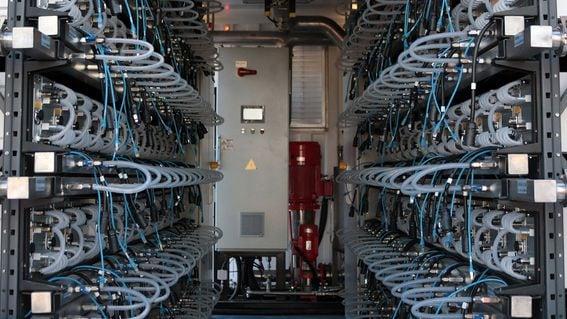
A Department of Energy survey to collect data about crypto's energy consumption could be used to justify the stance that blockchain poses a “public harm.” The U.S. Department of Energy (DOE) is taking a closer look at bitcoin {BTC} mining. Is this cause for alarm? More specifically, the Energy Information Administration (EIA), a statistics agency under the DOE, will survey the electricity use of selected U.S.-based miners over the coming six months starting next week, after putting out an “emergency collection of data request.” Given the phrasing of an “emergency” order and the current administration’s crypto-critical stance, many are worrying that the information collected will be used to inform potentially harmful policies to the mining industry. In its public filing, the EIA cites the possibility of “public harm” from crypto mining for collecting the data. “EIA is policy neutral agency that does not create policy, implement policy, enforce policy or comment on policy. EIA spokesperson Morgan Butterfield told CoinDesk in emailed responses. “Results from the data we collect will help inform our path forward regarding a regular three-year clearance during the next six months.” But being policy-neutral doesn’t necessarily mean the survey won’t influence policy. There’s reason enough to believe that simply by running this survey the EIA is asking questions about the larger purpose of Bitcoin and whether it benefits society, and already has an answer in mind. For instance, the justification for the emergency order, granted by the Office of Management and Budget, was the recent crypto price rally, which saw bitcoin climb over 50% in a matter of months, which the EIA said would “incentivize more cryptomining activity, which in turn increases electricity consumption.” “Given the emerging and rapidly changing nature of this issue and because we cannot quantitatively assess the likelihood of public harm, EIA feels a sense of urgency to generate credible data that would provide insight into this unfolding issue,” it said. Butterfield said 82 firms, operating approximately 150 facilities, were selected to represent the ”universe of cryptocurrency companies” across the country. The agency pointed to a cold snap that hit Plattsburg in 2018, to justify the risks crypto poses to the public. “The combined effects of increased cryptomining and stressed electricity systems create heightened uncertainty in electric power markets, which could result in demand peaks that affect system operations and consumer prices,” it wrote. Since then, New York State has passed a two-year moratorium on opening new crypto mining facilities unless they are powered entirely by renewable energy. Texas, which was a major benefactor after China passed a nation-wide crypto mining ban, has also sought to slow down the mining industry. Crypto miners in Texas work directly with the state-owned grid operator and get paid to power down during periods of peak demand or moments of network stress. To be fair, a public version of the survey shows the EIA is asking fairly routine questions of mining firms, including how many and what type of chips they’re running, their electricity consumption at the facility and how much goes directly towards mining. “We will specifically focus on how the energy demand for cryptocurrency mining is evolving, identify geographic areas of high growth, and quantify the sources of electricity used to meet cryptocurrency mining demand,” the agency said in a statement. The reports are due on the last Friday of the month until the end of July, after which it may be renewed. Further, there’s an argument to be made that having high-level statistics like this will benefit the country and the industry, given that it’s more detailed information, straight from the horse’s mouth. At the moment, the best data we have for the mining industry’s footprint come from the Cambridge Bitcoin Electricity Consumption Index, which gives hypothetical lower- and upper-bound estimates of the Bitcoin network’s daily energy consumption, essentially by extrapolating out from the current hashrate. But you have to ask, why run the survey now? Why was the most recent run-up in bitcoin prices a cause for an emergency but not others? It’s worth noting that the Biden administration has prioritized reducing the country’s carbon footprint. And that crypto-critical Senator Elizabeth Warren (D-Mass.) asked federal regulators to have crypto miners disclose their emissions and energy use. Bitcoin mining will likely become a popular topic of debate in the media in the run-up to halvening event, the programmatic reduction in the “bitcoin subsidy” paid to miners that happens every four years. It’s not yet clear how the halvening will impact the mining sector beyond making less-efficient mining equipment unusable in the short-term. Some are expecting the crypto carbon footprint to grow in the coming years, while others see it shrinking. Moreover, in recent months, there has been something of a public reckoning on Bitcoin’s environmental cost, particularly after the second-largest network, Ethereum reduced its energy consumption by 99% through a single upgrade. While some organizations like Greenpeace are pushing for Bitcoin to abandon energy-intensive mining, some are starting to see the sector as a boon to environmentalism. For instance, Cambridge recently revised down its estimates for Bitcoin’s annual energy use, and institutions including MIT and KPMG have put out reports arguing the network could help “balance” electricity grids, subsidize renewable energy development and be useful in greening the economy. Mining is an energy-intensive process — the cryptographic algorithm Bitcoin runs, proof-of-work (POW), was designed by computer scientists to disincentivize spam, Sybil and denial-of-service (DoS) attacks on networks by adding costs to interacting with a server, typically in the form of computer processing time put towards solving a mathematical puzzle. Some observers opposed to the mining process, often describe bitcoin mining as “wasted” energy, but it’s not — the energy is purposefully spent as a sort of token or a form of proof. The problems bitcoin miners compete to “solve” don’t mean anything in that they don’t add to the body of human knowledge or contribute to something productive like Folding@home, but they do have value - securing the network. And that’s the tricky part: valuing Bitcoin. What is bitcoin worth? The standard response is to look at how the market values it, which at time of writing is around $42,000. But most of the real debates around Bitcoin’s intense energy footprint have little to do with bitcoin’s price; rather they center around Bitcoin’s costs and benefits. I wish I could say the EIA’s survey would help us better understand those costs and benefits. However, the survey writers seem to have already answered their own question about whether Bitcoin poses risks to the general public and are looking for data to support that conclusion. https://www.coindesk.com/consensus-magazine/2024/02/02/the-us-government-seems-to-be-closing-in-on-bitcoin-mining/
2024-02-02 15:40
The digital asset investment firm has become the first of the ETF providers to diversify custody of its coins by tapping BitGo's expertise in addition to Coinbase Valkyrie, one of the providers of the spot bitcoin exchange-traded funds (ETFs) now trading in the U.S., has added BitGo as a second custodian for its Bitcoin Fund (BRRR). The digital asset investment firm has become the first of the ETF providers to diversify custody of its coins by tapping BitGo's expertise in addition to Coinbase. Mike Belshe, CEO of BitGo, described the partnership as a "huge win," in a post on X, adding that Valkyrie is "leading the industry with the best approach to mitigate risk in ETF custody." Commentators have echoed the sentiment, predicting that other ETF providers will also look to add supplementary custodians in the near future. Bloomberg analyst James Seyffart wrote that he "wouldn't be surprised to see some other funds to something similar." Nate Geraci, president of The ETF Store, said in an X post that other fund issuers are talking to Gemini, Kraken, BitGo and others to serve as secondary custodians. Read More: BlackRock and ProShares' Bitcoin ETFs Surpassed GBTC's Daily Volumes https://www.coindesk.com/markets/2024/02/02/bitcoin-etf-provider-valkyrie-adds-bitgo-as-second-custodian-in-risk-mitigation-move/

2024-02-02 13:38
The latest update on the labor market came less than two days after the Fed's Jerome Powell poured cold water on market hopes of a rate cut in March. Labor market strength continued in a big way in January, with the U.S. adding 353,000 jobs versus economist forecasts for 180,000 and against December's 333,000 (revised from an originally reported 216,000), according to the government's nonfarm payrolls report released Friday morning. The unemployment rate held steady at 3.7% versus expectations for a rise to 3.8%. The price of bitcoin (BTC) fell about 0.5% in the minutes following the report, now trading at $42,800. This morning's read on the labor market is of particular interest in that it comes less than two days since the Federal Reserve's January monetary policy meeting. The results of that meeting and Chairman Jerome Powell's post-meeting press conference made clear the U.S. central bankers were in no hurry to cut rates even though markets had already nearly fully anticipated such a move at the Fed's next meeting in March. Checking other data from the report finds average hourly earnings up a large 0.6% in January. That's double expectations for 0.3% and above December's 0.4%. On a year-over-year basis, average hourly earnings were higher by 4.5% versus 4.1% expected and 4.4% previously. If there was any softness to the report, it was average weekly hours, which slipped to 34.1 versus 34.3 expected and 34.3 previously. The news has sent traditional markets lower, with Nasdaq futures now higher by 0.5% against a gain of more than 1% prior to the report. S&P futures are now up by just 0.2% versus nearly 1% earlier. The 10-year Treasury yield has shot higher by 10 basis points to 3.98% and gold has dropped by 0.6% to $2,059 per ounce. https://www.coindesk.com/markets/2024/02/02/us-added-353k-jobs-in-january-blowing-past-estimates/

2024-02-02 12:41
GBTC has led bitcoin ETF volumes, mostly in outflows, since the products started trading in early January. BlackRock’s IBIT and ProShares’ BITO became the first bitcoin (BTC) exchange-traded funds (ETF) to cross Grayscale’s GBTC trading volume on Thursday. IBIT ended Thursday with $306 million in trades placed, while BITO traded $298 million. GBTC saw a relatively lower $291 million in trades, data from multiple sources show. Thursday was also the first time daily ETF volumes were below $1 billion, Bloomberg Intelligence analyst James Seyffart said on X. These figures did not include after-hours trading. Grayscale has led trading volumes among all bitcoin ETFs since their listing in early January. Most of these volumes have contributed to selling pressure in the past few weeks as GBTC investors took profits and shifted to other providers, some banks have previously stated. Bankrupt crypto exchange FTX has sold over $1 billion worth of GBTC, as previously reported. Other providers, however, have seen gradual inflows and all ETFs hold a combined $28.6 billion worth of bitcoin as of Thursday. https://www.coindesk.com/markets/2024/02/02/blackrock-and-proshares-bitcoin-etfs-surpassed-gbtcs-daily-volumes/

2024-02-02 10:54
One of the most-anticipated airdrops faced social media ire over its novel token distribution plan. Jupiter’s JUP tokens have racked up billions of dollars in trading volumes and amassed thousands of holders, days after a massive $700 million airdrop to users within the Solana ecosystem that raised some concerns around its distribution mechanism. At the time of writing, the token exchanged hands at 60 cents, giving it a market capitalization of just over $800 million, data shows. Jupiter is a decentralized exchange (DEX) that routes orders to several other Solana-based exchanges and executes the best available price for an asset. On Wednesday, the DEX rewarded its users by airdropping them JUP tokens, based on their activity on the platform. It also offered the tokens on the open market using a trading pool, so that investors could buy JUP and airdrop recipients could sell their newly-minted tokens. The trading pool allowed Jupiter to offer tokens in a specific price range, where the price action is driven by market forces and how much liquidity the platform attracts over time, technical documents show. However, this tactic drew the ire of some crypto market observers as they likened the pool sales to an initial DEX offering (IDO), instead of an airdrop. In an airdrop, a platform rewards its users by giving them tokens, whereas in an IDO, the developer team typically sells their holdings to market participants. Jupiter's trading pool tactic is being criticized for being an IDO disguised as a fair market pool, with some observers claiming that the developer team sold over $200 million worth of JUP tokens through the market pool. The drama caused prices to slide as low as 56 cents on Thursday, price data from Birdeye shows. But most of these allegations have been dismissed as “blatantly false” by Jupiter founder @weremeow, who said over multiple posts on X that the sale’s mechanism had been mischaracterized. Another rumor later made the rounds that Jupiter could remove the liquidity it was providing seven days following issuance, causing some to term it a “rug pull.” However, this rumor was quickly quashed. “The launch pool is there for 7 days to absorb any selling pressure from airdrops or buyer's remorse, which I believe to be sufficiently long,” meow said Thursday. “Conversely, new buyers have confidence that there is a buffer for selling pressure as well.” All tokens in the pool would remain in the team treasury or be used for further liquidity provision in the future, he said in a separate X post. The sale itself acted as a testing bed for Jupiter’s LFG launchpad, a planned platform that would let the project issue tokens to Solana users in the future, meow said. Meanwhile, the Solana community has mostly expressed support for the token sale process and design – citing transparency and the lack of venture capitalists holding tokens as two key benefits. https://www.coindesk.com/markets/2024/02/02/jupiters-jup-rallies-on-with-solana-supporters-leading-the-charge/

2024-02-02 10:43
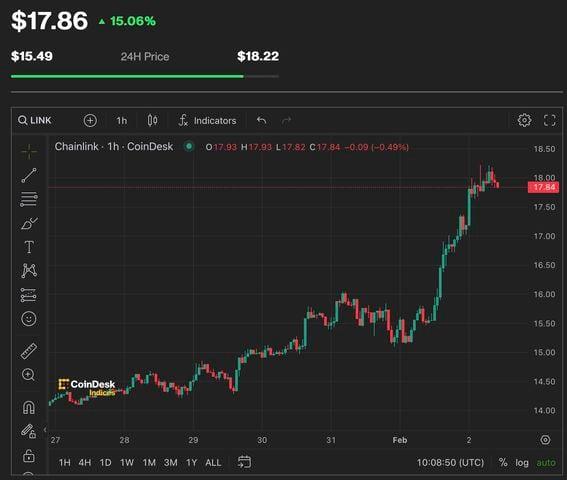
Analysts consider LINK as the safest bet to profit from the tokenization narrative. Chainlink's (LINK) surged to a 22-month high Friday, ending a three-month bull breather for the token of the leading decentralized oracle network. The world's 13th largest cryptocurrency peeped above $18 during European hours, the highest since April 3, 2022, registering a 15% gain on a 24-hour basis, according to CoinDesk data. The LINK price has risen nearly 30% in a week, beating major cryptocurrencies including bitcoin (BTC) and ether (ETH). The rally marks a bullish breakout from the three-month range that's seen it stuck between $13 and $17, and signals a continuation of a comeback from June 2023 lows near $5. Over the years, Chainlink has emerged as a critical component of the crypto industry infrastructure, connecting blockchains with data from the outside world through its oracles and a wide range of partnerships. Its blockchain-agnostic infrastructure ensures compatibility with different blockchains and facilitates the seamless and secure transfer of coins from one blockchain to another. "Traditional financial institutions need data, compute, and cross-chain capabilities to adopt blockchains and tokenized RWAs at scale. Only the Chainlink platform provides all three," Chainlink said on X early this week. Last month, analysts at K33 Research said LINK is the safest way to profit from the ever-strengthening tokenization of real-world assets (RWA) narrative. Tokenization allows assets like gold, stocks, and real estate to trade as digital tokens on a blockchain. According to Boston Consultancy Group, tokenized RWAs could be worth $16 trillion by 2030. Influx of new money The dollar value locked in the number of open futures contracts tied to LINK has more than doubled to a record $490 million, according to data source CoinGlass. In cryptocurrency terms, open interest has surged 62% to 27.51 million LINK. An increase in open interest represents an influx of new money into the market. A rise in price alongside an uptick in open interest is said to confirm the trend. Meanwhile, funding rates in perpetual futures contracts remain positive, but well below highs reached in December, a sign the market is not yet overheated on the bullish side. https://www.coindesk.com/markets/2024/02/02/chainlinks-link-token-taps-22-month-high-of-18-ending-three-month-breather/