2024-02-01 07:22
The optimum allocation is up from 0.5% in 2015 and 6.2% in 2022. Bitcoin (BTC) is an effective diversifier and counterbalance to traditional asset classes, and an optimal allocation in one's investment portfolio is just under 20%, Cathie Wood's ARK Invest wrote in its annual Big Ideas report for 2024. "Over the last seven years, Bitcoin has registered an annualized return far surpassing that of major asset classes, with an optimal allocation rising to 19.4% in 2023," the firm wrote. "Our analysis suggests that allocating 19.4% to Bitcoin in 2023 would have maximized a portfolio’s risk-adjusted returns." The optimum allocation was 0.5% in 2015 and 6.2% in 2022. "Bitcoin is not just a new investment option but a vital component for diversifying investment portfolios, offering unprecedented growth potential among digital assets," the firm added. Bitcoin's low five-year correlation of 0.27 with traditional assets underscores its diversification benefits, and even minimal allocations by institutional investors could notably influence its price, given the vast $250 trillion global investable asset base, ARK writes. The leading cryptocurrency by market value is up 77.8% over the last year, according to CoinDesk Indices data. In a recent report, JPMorgan attributed bitcoin's recent outperformance and year-high to increased institutional demand, highlighted by significant inflows into large wallets and a spike in CME bitcoin futures used predominantly by institutions. However, this institutional-driven rally might be coming to a close. The Guppy indicator, which sparked a 70% Bitcoin rally in late 2023, is now signaling a potential bearish downturn. The ARK report also notes that most of the 2022-2023 crypto winter crises have come to a close. FTX recently announced that it plans to fully re-pay creditors, while Celsius will be distributing $3 billion and equity allocation in a new venture as part of its bankruptcy resolution. https://www.coindesk.com/markets/2024/02/01/ark-invest-says-optimal-bitcoin-portfolio-allocation-for-2023-was-194/
2024-02-01 07:18
Expectations were low for a change in the stiff taxes on crypto transactions: a 30% tax on profits and a 1% TDS on all transactions. India has not introduced any changes to its controversial tax deducted at source (TDS) policy that is affecting the crypto industry. The nation's finance minister Nirmala Sitharaman revealed the budget in parliament on Thursday as usual. Expectations were low for a change in the stiff taxes on crypto transactions, which include a 30% tax on profits and a 1% TDS on all transactions. However, there was a glimmer of hope because of efforts from the domestic crypto industry and a study from a think tank pushed hard for a reduction in the TDS. In general, this budget had lower expectations in terms of the financial sector as India is headed for general elections in the next two months. Sitharaman announced no changes in taxation - both direct and indirect. In the election year, the finance ministry doesn't usually present a full budget but an interim one to fund its expenses for a short time. A full budget is usually expected in July after the results. Prime Minister Narendra Modi and his Bharatiya Janta Party are expected to return to power, according to polls. India's crypto industry has urged the government to reduce the 1% TDS to 0.01% ever since it was first announced two years ago. Indian crypto exchanges have been in survival mode, trying to extend their runways in response to the 1% TDS. Dilip Chenoy, the chairman of the Bharat Web3 Association, the policy body advocating for India's Web3 sector, said given this is an interim budget we didn't expect any big movement but "we are eagerly anticipating changes to be announced post-elections." "High TDS and income tax rates continue to be hurdles which have caused both creators and consumers to move out of India," Chenoy said. "This migration has significantly affected the prospects of Web3 in India. We have and will continue highlight such concerns to key stakeholders.” The taxes by India's government have prompted as many as five million crypto traders to move their transactions offshore, costing the government a potential $420 million in revenue since it was introduced in July 2022, according to a study by the Esya Centre. “Digital public infrastructure and the PM’s aspiration for [innovation] will benefit from integrating provisions for long-term financing of domestic crypto projects given how India is at a pivotal phase in the crypto revolution,” said Rajagopal Menon, vice president of cryptocurrency exchange WazirX. “We expect these developments to factor in the government’s agenda along with our existing requests for a reduction in TDS rates to 0.01% and offset of losses for traders.” While the government hasn't reduced the tax in the past two years, last month it took action against offshore crypto exchanges, which in turn brought crypto activity back to Indian exchanges. Read More: India Won't See Crypto or Web3 Bill for Another 18 Months, Senior Lawmaker Tells CoinDesk https://www.coindesk.com/policy/2024/02/01/india-keeps-stiff-taxes-on-crypto-as-interim-budget-is-revealed-in-election-year/

2024-02-01 06:41
Bitcoin's monthly chart Bollinger bandwidth resembles a pattern seen before the near-vertical rallies of 2020 and 2016. Just over three months ago, an indicator called "Bollinger bandwidth" based on bitcoin's weekly price changes signaled a volatility boom. Sure enough, volatility picked up prior to the recent debut of spot BTC ETFs in the U.S. Now, the monthly chart Bollinger bandwidth has carved out a pattern that preluded Bitcoin's near-vertical rallies of 2016 and late 2020. Created by John Bollinger in the 1980s, Bollinger Bands comprises three bands. The middle one is the 20-period simple moving average of the asset's price. The upper band is two standard deviations above the middle band and the lower band is two standard deviations below it. The Bollinger bandwidth refers to the spread between upper and lower bands measured as the percentage of the moving average. A narrow width is akin to a tightly compressed spring about to make a big move in either direction. Since inception, 1% has been a major low for bitcoin's monthly chart Bollinger bandwidth, with subsequent upturns coinciding with prolonged price rallies or bouts of upside volatility. The bandwidth has recently bounced from 1% in a positive development for bitcoin bulls. Though the latest bandwidth pattern resembles developments before previous bull runs, the indicator, by itself, only signals that a major price move is due but doesn't tell us anything about the direction. In other words, past results do not guarantee future performance, and the possibility of a large move to the downside cannot be ruled out. That said, most analysts are bullish on the cryptocurrency, expecting the recently launched spot ETFs to accelerate adoption and lift prices to new record highs above $69,000 in the next 12 months. https://www.coindesk.com/markets/2024/02/01/it-may-be-time-for-bitcoin-traders-to-focus-on-john-bollingers-price-bands-again/

2024-02-01 00:32
"We've got lawyers coming at me from every angle," the brash crypto influencer said Wednesday. Ben Armstrong, the brash crypto influencer whose precipitous rise as the "Bitboy" vlogger came crashing down under corporate and personal scandal, is stopping his daily livestream after three years. In an emotional video posted to his personal Youtube channel, Armstrong said his daily shows in which he discussed crypto trends were no longer financially viable and were burning $25,000 a week to produce. He said he is spending "about $100,000 a month" on legal bills. "We're barely making it out here, guys. We've got lawyers coming at me from every angle," he said in the 10 minute video that had garnered 18,000 views late Wednesday. "Everyone I know is coming after me right now." Armstrong was better known as "Bitboy," the hard-charging, fast-talking crypto personality who from 2018 on published polished price prediction and news videos with headlines like "Make IMPOSSIBLE Gains with Bitcoin SUPERCYCLE" that garnered tens of thousands of views. His content was a hit in one corner of the crypto trading public, who followed the channel for advice as well as entertainment. It led to Armstrong creating his own cryptocurrency called $BEN coin in mid-2023. But he was ousted from the BitBoy world shortly after that token's launch over "serious and personal allegations," according to Decrypt. Armstrong later sued the company that owns the brand. That began a series of messy events that included the revelation Armstrong was having an affair with the CEO of BEN Coin and his arrest at the home of a former business partner – both of which happened on the same livestream. https://www.coindesk.com/business/2024/02/01/bitboy-ben-armstrong-is-stopping-daily-crypto-show-after-3-years/

2024-02-01 00:03
The distribution will be made through PayPal and Coinbase. Celsius will be shipping out more than $3 billion to its creditors as the firm's bankruptcy is officially closed. Apart from the cash, creditors will get a stake in the newly formed Ionic Digital Inc. mining operation, the company said in a statement on Wednesday. About 98% of Celsius Network’s creditors signed off on the plan after 18 months in bankruptcy court. Ionic is expected to become a publicly traded company once it clears approvals. “When we were appointed in June 2022, everyone assumed Celsius would disappear completely like the other crypto lenders that were filing bankruptcy around the same time,” said David Barse and Alan Carr, members of the special board committee that steered the bankruptcy, in a statement. They said they managed to secure the platform’s cryptocurrency, negotiate a deal with creditors, reorganize the part of the company that could continue and settled cases with the U.S. Department of Justice, Securities and Exchange Commission and Commodity Futures Trading Commission. Matt Prusak, the chief commercial officer of Hut 8, the company managing Ionic’s mining, has been named Ionic’s CEO. In a separate filing, the firm said PayPal and Coinbase will distribute the cryptocurrencies. Celsius will make no distributions through the debtors’ mobile or web applications, which will be shut down on or around Feb. 28. Crypto lender Celsius’s bankruptcy process also saw it make a $4.7 billion settlement with U.S. authorities over fraud allegations. Former CEO Alex Mashinsky – who had resigned in September, 2022 – was arrested on fraud charges for allegedly manipulating the price of the lender's CEL token, an allegation he has denied. Mashinsky was released on a $40 million bond, and a court ordered his banking and real estate assets frozen. His trial is scheduled for September 2024. https://www.coindesk.com/policy/2024/02/01/celsius-to-distribute-3b-crypto-to-creditors-as-firm-emerges-from-bankruptcy/

2024-01-31 22:28
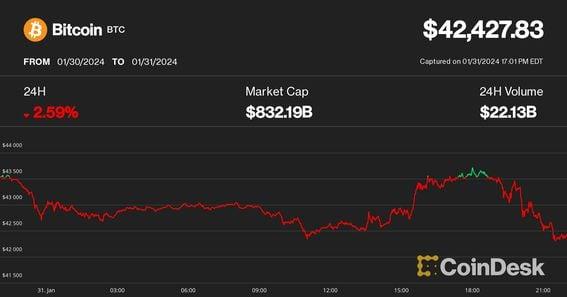
"The market has gotten ahead of itself on the rates side," said one analyst. Federal Reserve chair Jerome Powell tempered expectations of an imminent interest rate cut in March during Wednesday's FOMC press conference. Bitcoin dipped to $42,300, while crypto majors ETH, ADA, DOT fell 3%-4% with Solana's SOL tumbling over 6%. Bitcoin remains in a channel consolidating without clear direction between $42,000 and $44,000, Swissblock said. Cryptocurrencies tumbled lower Wednesday with bitcoin (BTC) sliding below $43,000 as Federal Reserve Chair Jerome Powell's hawkish comments cooled hopes about an imminent rate cut. In a universally anticipated move, the Fed left its benchmark fed funds rate range unchanged at 5.25%-5.5% following the first Federal Open Market Committee meeting of the year. Market participants were more keen to monitor clues about when the Fed might start lowering rates, with many observers expecting it to happen as soon as the next meeting in March. "Based on the meeting today," said Powell at his post-meeting press conference, "I don't think it's likely that the committee will reach a level of confidence by the time of the March meeting to identify March as the time to [cut]." Risk assets including cryptos turned sharply lower in the immediate aftermath of that remark. BTC fell to $42,300 from its daily high of $43,700 and was down 2.3% over the past 24 hours. The CoinDesk 20 {{CD20}} index, a broad crypto market benchmark that covers some 90% of the total market value of digital assets, declined nearly 3% during the same time. Other major cryptocurrencies such as ether (ETH), Cardano's ADA, Avalanche's AVAX and Polkadot's DOT dropped 3%-4%, while Solana's SOL lost over 6% during the day buckling below $100. In traditional markets, the Nasdaq tumbled 2.2% and the S&P 500 1.6%. "The market has gotten ahead of itself on the rates side," Alex Krüger, macro analyst and co-founder of Asgard Markets, said in a X post. "Cuts starting in May or June, not March." Indeed, the odds of a March rate cut have been trimmed to a current 34.5% from about 65% prior to today's developments, according to the CME FedWatch Tool. Ruslan Lienkha, chief of markets at Web3 fintech platform YouHodler, said that "any possible hawkish rhetoric about the longer-than-expected time of high rates may trigger a correction in the stock market and as a consequence, capital outflow from risk assets such as bitcoin." However, bitcoin's move to downside could be limited as the largest crypto appears to be consolidating between $44,000 and $42,000 without clear direction, Swissblock analysts said in a Wednesday market report. The $42,000 area and below the $40,000 level could act as key support levels for the price where buyers might step in, the report added. https://www.coindesk.com/markets/2024/01/31/bitcoin-dips-to-424k-as-feds-powell-pours-cold-water-on-march-rate-cut/