2024-01-23 08:45
FTT was up 11% in the past 24 hours as the broader market tracked by CoinDesk 20 slumped 4%. Hopes of creditor repayments led to FTT, the tokens of the now-defunct FTX exchange, rising by 11%, with claims rising to 80 cents on the dollar. FTT trading volumes jumped to $90 million from Sunday’s $22 million, CoinGecko data shows. The tokens allowed holders to access certain benefits on the Sam Bankman-Fried-owned FTX exchange before it collapsed in late 2022. The tokens have largely remained a speculative instrument since FTX's collapse. But plans of an FTX restart, or creditor repayments, have previously caused brief price spikes. The price action came after CoinDesk reported that FTX’s bankruptcy estate had dumped 22 million shares of Grayscale’s GBTC bitcoin exchange-traded fund (ETF). These were worth nearly $1 billion and accounted for almost half of all GBTC sales since the product went live earlier in January. As such, claims on FTX deposits over $1 million have continued to increase. Market prices as of Jan.12 are up 2 points from the prior week. The prices continue to increase in anticipation of an upcoming Claims Estimation Hearing, as per Claims Markets, which tracks bankruptcy claims. FTT was among the only gainers on Tuesday morning. Bitcoin slumped 3.5% to $39,500 in Asian afternoon hours, while the CoinDesk 20, which tracks the highest tokens by market capitalization, was down nearly 5%. https://www.coindesk.com/markets/2024/01/23/ftt-bucks-market-turmoil-as-ftx-estate-revealed-to-be-behind-gbtc-sales/

2024-01-23 08:01
Savvy traders are looking for signs of capitulation in the spot and perpetual futures market, and renewed demand for calls when calling market bottom and trend reversal higher. Savvy traders are looking for a surge in spot and perpetual futures volume and negative funding rates when identifying capitulation and price bottom. The bitcoin market shows no such signs, with the option market reflecting persistent fears of an extended downside move. Bitcoin (BTC) has declined by 18% to $40,000 since spot ETFs began trading in the U.S. on Jan. 11. Traders looking for clues on the eventual bottom or the lowest price marking a renewed bullish trend change may want to scan the market for signs of actual and emotional capitulation and positioning in the options market. Actual capitulation Capitulation means surrender. In financial markets, it is a point where traders throw in the towel, liquidating their bullish bets in both spot and perpetual futures markets, leading to a dramatic surge in volumes in a falling market. The mass unwinding of bullish perpetual futures leads to a negative basis identified by sub-zero funding rates. Negative basis or funding rates represent a situation where perpetuals trade at a discount to the underlying asset’s price, indicating seller dominance. The exit of short-term traders typically represents peak bearishness and paves the way for a market bottom and a renewed move higher. “For me to be convinced that we reached the local bottom, I would want to see high volume prints with a negative perps basis,” pseudonymous trader ByzantineGeneral said in a post on X. At press time, the bitcoin market showed no signs of surrender. Data from the charting platform TradingView shows that while trading volumes in bitcoin perpetual and spot markets have picked up, they remain well below recent highs. Meanwhile, per Coinglass, funding rates remain positive, representing the leverage is still skewed on the bullish side. Emotional capitulation Market bottoms usually involve extreme fear of holding assets and an increased preference for cash. Savvy traders prefer to buy when sentiment indicators like Alternative.me’s Crypto Fear & Greed index signal extreme fear and scale back exposure when the index signals greed. As the old saying goes, “It is wise to be fearful when others are greedy and to be greedy when others are fearful.” The current market sentiment is neutral, with the index hovering at 50, down from the above-75 readings early this month, which reflected greed. A reading below 20 indicates extreme fear and has mostly coincided with peak selling in the past. Options market positioning Changes in how options are priced have been reliable indicators of trend exhaustion and trend changes in the past. Options are derivative contracts that give the purchaser the right to buy or sell the underlying asset at a predetermined price at a later date. A call conveys the right to buy and allows the purchaser to profit from or hedge against price rallies, while a put does otherwise. The seven- and 30-day call-put skews, measuring the pricing for calls relative to puts, dropped below zero a couple of days before ETFs went live, hinting at post-launch price correction. The key metrics remained negative at press time, indicating fears of a continued price slide. The 60-day gauge signaled a neutral market sentiment. https://www.coindesk.com/markets/2024/01/23/bottom-fishing-in-bitcoin-here-are-the-key-signs-to-watch-for/

2024-01-23 07:58
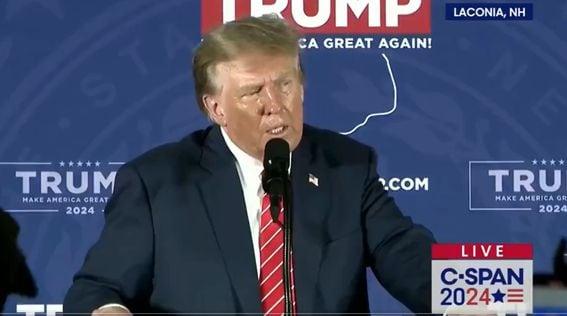
The Republican frontrunner credited former candidate Vivek Ramaswamy for the policy. Donald Trump has doubled down on his opposition to central bank digital currencies (CBDCs) at a rally in Laconia, New Hampshire Monday Night. “Vivek wanted this: I will never allow the creation of a Central Bank Digital Currency,” Trump said, referring to crypto-friendly candidate Vivek Ramaswamy, a critic of CBDCs, who recently suspended his campaign after a disappointing showing in Iowa. Trump has shared the same message at prior campaign stops. “This would be a dangerous threat to freedom, and I will stop it from coming to America,” he has previously said. “Such a currency would give a federal government, absolute control over your money. They could take your money, and you wouldn’t even know it was gone.” Recently, Florida Governor Ron Desantis, another CBDC critic, also suspended his campaign and endorsed Trump. “It’s clear to me that a majority of Republican primary voters want to give Donald Trump another chance,” he said in a video posted online. “I signed a pledge to support the Republican nominee, and I will honor that pledge.” With DeSantis and Ramaswamy out of the primary, crypto might now take a back seat, CoinDesk’s Jesse Hamilton recently wrote. Digital assets have not been a central issue in the 2024 U.S. presidential race but have kept reappearing in the spotlight as a peripheral topic by Republican candidates, but with recent candidate dropouts and Nikki Haley’s lack of focus on crypto, its prominence in discussions may further diminish. Regardless, CoinDesk reported last year that for DeSantis’ office in Florida – as Governor, not the Republican primary candidate – CBDCs were one of the hottest topics, suggesting that voters might want to hear more. https://www.coindesk.com/policy/2024/01/23/trump-reiterates-anti-cbdc-stance-credits-vivek-ramaswamy-for-policy-guidance/
2024-01-23 06:21
Hong Kong's Hang Seng Index and the CSI 300 both responded to Beijing's plan to reboot China's domestic stock market, but bitcoin remains in the red. Authorities in China are considering a 2 trillion RMB ($278 billion) plan to reboot the ailing stock market, but the impact of the plan – which pushed markets in Hong Kong and the mainland into the black – doesn’t seem to have trickled down into the price of bitcoin (BTC). At the time of writing, bitcoin was down 2.3%, sputtering below $40,000, according to CoinDesk indices data, and the CoinDesk 20 Index (CD20) is down 2.5% by mid-day Hong Kong time. Bloomberg said that Beijing is planning to use state-owned enterprises’ offshore accounts and local funds to invest in onshore shares through the Hong Kong exchange link and other yet-to-be-announced measures. Local stock market indices responded positively to the news, with Hong Kong’s Hang Seng index up 2% and the CSI 300, an index of mainland China shares, up 0.15%. The Hang Seng index is down 31% over the past year, while the CSI is down 23%. This reported method of injecting offshore funds into the mainland stock market aims to boost liquidity and confidence. Bloomberg also reported that additional, yet-to-be-detailed support measures ranging from regulatory changes to financial interventions pending top leadership approval. Recently, Chinese Premier Li Qiang emphasized the need to establish more forceful measures to reboot the economy. Bitcoin, for its part, is seeing its market dynamics being more affected by inflow into exchange-traded funds (ETF) products and record outflow from the Grayscale Bitcoin Trust (GBTC), CoinDesk previously reported. In addition, some analysts think that measures by the People’s Bank of China to support the yuan amid a stock market slide and increased dollar strength could negatively impact bitcoin’s price due to its inverse correlation with the USD. “China is incentivized to keep a lid on BTC to maintain a relative veil of currency stability and discourage capital flight. Past episodes when the Yuan has come under pressure have coincided with BTC underperformance,” David Brickell, head of international distribution at Toronto-based crypto platform FRNT Financial, previously told CoinDesk in an interview. However, some market observers have a more optimistic take. “The rebound of the Chinese economy will have profound implications for the global economy, and any stimulus or accommodative policy will be an encouraging sign to investors. The crypto market will also perceive such policies as risk-on and, therefore, be more willing to innovate and active in market expansion," said Greta Yuan, Head of Research at VDX, a regulated exchange in Hong Kong, in a note. Meanwhile, India has surpassed Hong Kong as the world’s fourth-largest stock market as corporate earnings remain strong in the country. https://www.coindesk.com/markets/2024/01/23/bitcoin-unphased-by-chinas-stimulus-plan/

2024-01-22 22:13
The lion's share of Ethereum's validators rely on the same piece of software to power their operations. According to some experts, this could be a big risk. Ethereum just had one of those moments where the big story is what didn't go wrong. A bug in Ethereum's Nethermind client software – used by validators of the blockchain to interact with the network – knocked out a chunk of the chain's key operators on Sunday. It was a manageable incident, but the episode revived a long-simmering debate in the Ethereum ecosystem around the need for "client diversity." Some experts took the opportunity to point out how bad things could have been if another client software, Geth, the chain's most popular execution client, had gone out; the question is whether Ethereum could have kept going since Geth stands out as a possible single point of failure for the network. Nethermind powers around 8% of the validators that operate Ethereum, and this weekend's bug was critical enough to pull those validators offline. Ethereum stayed up and running despite the issue, and Nethermind's developers released a patch fixing things within hours. The main consequence of the bug was that modest financial penalties fell onto some Nethermind-based validators, but the Nethermind incident followed a similar outage earlier in January that impacted Besu, the client software behind around 5% of Ethereum's validators. The back-to-back outages have reignited a spirited discussion on X, the platform formerly known as Twitter, around Ethereum's persistent problem with client diversity. The idea is that the network becomes more resilient if it's not dependent on any single client software. Around 85% of Ethereum's validators are currently powered by Geth, and the recent outages to smaller execution clients have renewed concerns that Geth's dominant market position could pose grave consequences if there were ever issues with its programming. Geth, which stands for "Go Ethereum," is primarily developed and maintained by the Ethereum Foundation, the main nonprofit that supports Ethereum development. Geth hasn't been totally immune from bugs (no software is), but it has never suffered from a critical outage like the ones that hit Nethermind and Besu. If it did, the consequences would be far more serious for Ethereum. Depending on the nature of the bug, a Geth glitch could halt the entire network, rendering it impossible for validators to add new blocks to the blockchain. Ethereum is also programmed to penalize validators that fall offline or break the network's rules, meaning thousands of Geth-based validators could be held financially liable in the event of a bug, and the penalties could get even bigger if the bug proves difficult to patch. Notably, some of the leading services that stake Ethereum on behalf of users – effectively turning people into validators with less of a headache – rely on Geth to power their operations. Cygaar, a crypto educator, noted in an X post that "Ethereum has terrible client diversity," adding that, "A critical issue in Geth can lead to potentially millions of ETH being destroyed from validators running Geth." Cygaar cited data from the website execution-diversity.info noting that popular crypto exchanges like Coinbase, Binance and Kraken all rely on Geth to run their staking services. "Users who are staked in protocols that run Geth would lose their ETH" in the event of a critical issue," Cygaar wrote. DCinvestor, a pseudonymous crypto investor with a large social media following, claimed in an X post that they were pulling their staked funds from Coinbase until the company switches its validator operations to a system that relies less on the Geth client. "I can't ignore the risks of what appears to be a single client staking setup (reliant on Geth) at this time," DCinvestor wrote, adding that "I could stand to lose a large percentage of my deposit" if things go wrong. For Daniel Hwang, a validator expert who helms the Kintsugi Tech incubator, the attention on Ethereum's client diversity stems in part from the fact that the network is held to a higher standard than competing chains. "Almost all other chains don't have the type of client diversity that Ethereum has," Hwang told CoinDesk in an interview. "Most are just running on one client." "I think perhaps the bar is just held higher for Ethereum because it is the dominant smart contract chain," he said. While Geth has a strong record of reliability, Hwang says many of Ethereum's validators just default to using it (rather than alternatives like Nethermind) out of laziness. In his experience, validators are "not doing their own research" into the strengths and weaknesses of competing client software. The Ethereum Foundation urges validators to help improve client diversity, and Dankrad Feist, one of its researchers, was widely-cited this week for a 2022 article imploring validators not to use majority clients. Nethermind's development was also funded, in part, by a 2018 grant from the Ethereum Foundation. Hwang likened Geth's dominance despite all this to an old business adage: "Nobody gets fired for buying IBM." In other words, if everyone else is using Geth, then it would be hard to blame an upstart validator for using it, too – even if things eventually go awry. Counterintuitively, Hwang sees a silver lining in the recent Nethermind and Besu bugs. "I don't want to say it's great that a client suffered a bug, but I think it's great if it begins to get people thinking about responsibilities," he said. "Validators should have been checking this s–t for themselves instead of just picking it off a supermarket shelf, and then raising their hands when things go wrong." https://www.coindesk.com/tech/2024/01/22/bug-on-ethereums-nethermind-software-sparks-discussion-of-client-diversity-risks/

2024-01-22 20:32
The sale of the digital image from the Taproot Wizards project came as popularity surges for the NFT-like creations minted atop the Bitcoin blockchain's Ordinals protocol. All in, some 19 lots sold by Sotheby's raked in a combined $1.1 million. "Genesis Cat," a digital art image minted atop the Bitcoin blockchain's Ordinals protocol by the Taproot Wizards team, has sold for $254,000 in a Sotheby's auction. The image was a special edition 1-of-1 piece by the Taproot Wizards artist Francisco "FAR" Alarcon, featured as part of a broader sale of Ordinals inscriptions by Sotheby's. The auction started on Jan. 12 and concluded on Monday. The sale price for Genesis Cat was more than 12 times the estimated $15,000 to $20,000 for the lot, and comes after Sotheby's last month sold three pixelated images from the "BitcoinShrooms" collection for a combined $450,000. The cat image was sold as part of the "Ordinals Curated Sale," consisting of 19 lots from 11 different artists. Collectively they raked in about $1.1 million, Sotheby's spokesman Derek Parsons told CoinDesk in an email. Lot 17 from the Sotheby's auction, "Black Rare Sat 20,159,999,999,999," pulled in $165,100, according to Parsons, which he said he understood was a record for a so-called "Rare Satoshi," which are seen as having unique features that make them more highly sought-after. The eye-popping numbers for these Ordinals inscriptions – sometimes referred to as "NFTs on Bitcoin" – has drawn comparisons to the NFT frenzy that consumed the Ethereum blockchain a few years ago. Transactions related to Ordinals have contributed to congestion on the Bitcoin blockchain while drawing the ire of some purists who would like to see the world's largest blockchain's bandwidth kept clear for financial payments. According to the Sotheby's description of the auction lot for the Genesis Cat image, Alarcon is "an artist and engineer exploring the intersection of visual arts and technology." "His research delves into the material history of computer-generated graphics, examining digital imaging from historical and conceptual perspectives," said Sotheby's. "He investigates computer simulations and visualizations, focusing on their impact on our understanding of the physical world through film, video games, and virtual worlds." The Genesis Cat piece was the anchor of a series of 3,333 "Quantum Cats" minted by Taproot Wizards, in its first sale since the Ordinals "NFTs on Bitcoin" project raised $7.5 million last year from investors. The Quantum Cats collection is designed to honor a Bitcoin improvement proposal known as OP_CAT, according to a press release from Taproot Wizards. Dan Held, chief marketing officer for Taproot Wizards, told CoinDesk that the price for Genesis Cat is the amount that will be paid back to the project, including the artist, who was a co-founder. The Sotheby's fee is charged on top of the winning bid price, according to Held. https://www.coindesk.com/tech/2024/01/22/bitcoin-based-digital-art-image-genesis-cat-sells-for-254k-in-sothebys-auction/