2024-01-22 06:41
DOGE has the tendency to surge on payments-related developments at any Elon Musk-owned companies, such as X or Tesla. Floki, named after Musk’s dog, moves as a beta bet among midcap traders. Dog-themed meme tokens Dogecoin (DOGE) and floki (FLOKI) rose as much as 12% before retreating, as an @xpayments profile on social app X sent adoption hopes flying among crypto circles. Trading volumes for both tokens shot up 200% over the weekend, CoinGecko data shows, even as broader crypto volumes remained relatively lower amid little volatility. Elsewhere, futures tracking the tokens saw open interest rise to a cumulative $430 million from $200 million, indicative of rising bets. DOGE has the tendency to surge on payments-related developments at any Elon Musk-owned companies, such as X or Tesla. Floki, named after Musk’s dog, moves as a beta bet among midcap traders. “The speculation is that advertisers could be able to pay DOGE for ads and for other uses on Twitter,” Simon Schaber, CBDO of Spool DAO, explained to CoinDesk in a Telegram message last July. “We have seen the same happening when Tesla revealed the ability to pay for its goods with DOGE. So the speculation could be around Musk’s businesses and stakeholdings starting to accept crypto, as Tesla does,” Schaber added. The @xpayments account has already garnered over 100,000 followers since its late Friday setup. Earlier in January, X said in a blog post that it would launch peer-to-peer payments capability on the application this year, and Musk has previously stated it could feature cryptocurrencies. There has been no official communication on whether DOGE will feature as a payment option, compared to bitcoin (BTC) or ether (ETH), but such speculations aren’t entirely unfounded. In April 2023, Musk teased DOGE payments on Twitter in a tweet, proposing dogecoin as one of the payment options for Twitter Blue, the site’s subscription service with premium features. Musk’s electric car company, Tesla, already accepts DOGE payments for merchandise purchases in the Tesla Store. https://www.coindesk.com/markets/2024/01/22/dogecoin-floki-bullish-bets-rise-on-x-payments-speculation/

2024-01-22 04:20
Terraform Labs recently lost a case when a U.S. judge ruled that LUNA and MIR are securities, and is currently facing a class action lawsuit in Singapore. Terraform Labs Pte. has filed a voluntary petition in Delaware for Chapter 11 bankruptcy, according to documents filed on Jan. 21. The embattled cryptocurrency firm behind the failed stablecoin TerraUSD declared in the filing it has between $100 to $500 million in estimated assets and the same amount in liabilities. TerraUSD, a dollar-pegged cryptocurrency and Terra's LUNA token collapsed in May 2022, destroying billions of dollars in investor wealth. "The filing will allow TFL to execute on its business plan while navigating ongoing legal proceedings, including representative litigation pending in Singapore and U.S. litigation" Terraform Labs said in a statement. Amongst the list of unsecured creditors are TQ Ventures, a U.S.-based digital assets investment fund, and Standard Crypto, a San Fransisco-based venture fund. Terraform Labs and its founder, Do Kwon, currently face the prospect of a class action suit in Singapore as well as a trial in the U.S. from the Securities and Exchange Commission (SEC) regarding the collapse of TerraUSD. Separately, in late December, Kwon and Terraform Labs lost a case regarding the status of LUNA and MIR when a U.S. judge ruled that they are securities. https://www.coindesk.com/policy/2024/01/22/terraform-labs-declares-bankruptcy-in-delaware/

2024-01-19 20:59
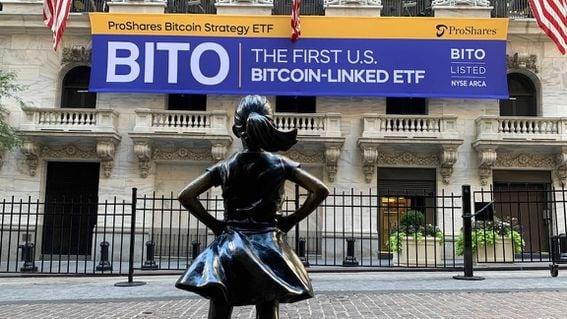
Response to the latest article misunderstanding bitcoin. Jeff Sommer, a weekly finance columnist for the New York Times, doesn’t seem to like bitcoin ETFs. Joke’s on him, though, because everyone else seems to. Up-to-date info isn’t available, but it’s now known that investors have poured at least $1.9 billion into the new crypto-tracking exchange-traded funds in their first three days of trading. The most bullish estimates expect up to $100 billion flowing into bitcoin funds by the end of the year. That’s a lot of pent-up demand, beating the last record inflows of $1.2 billion within three days in 2021 … which also went into a bitcoin-based product, ProShares Bitcoin Strategy ETF (which tracked bitcoin futures rather than its spot price), Reuters reported. A number of marquee financial firms including BlackRock, Fidelity and Franklin Templeton lined up to launch bitcoin ETFs, and are now also considering ether (ETH) funds. And yet, Sommer seems ready to write all of this off. "FOMO is the main reason for putting money into Bitcoin, which remains highly speculative, difficult to categorize and without an immediately identifiable economic function,” the NYT columnist wrote in his latest edition of the “Strategies” newsletter, referencing the U.S. Securities and Exchange Commission’s (SEC) anti-FOMO bulletin. FOMO, aka the fear of missing out, is certainly a part of crypto investing. For instance, it’s the main driver behind degens chasing the highs of meme coins like BONK or dogwifhat, which truly serve little economic function beyond speculation. But to write off bitcoin simply as a turn of the roulette wheel with $800 billion on the table is to willingly mislead oneself. You don’t have to personally believe what bitcoiners believe to take their arguments seriously, for fear of mockery or ostracization (FOMOO) by your crypto-skeptic peers, Jeff. To be fair, Sommer did tip his hat to the technology behind Bitcoin, i.e. b l o c k c h a i n, to hedge his own argument. To wit: “Bitcoin is a serious proposition, in terms of its underlying structure. The use of blockchain, the decentralized, peer-to-peer structure and the complex mathematical code demand respect. Concepts embedded in Bitcoin and other so-called cryptocurrencies could have real-world importance at some point…” This was not Sommer’s only completely original and novel thought, he also steadfastly argued that cryptocurrency is a “misnomer” because cryptocurrencies, despite maybe one day having “real-world” utility somewhere, are not really “currencies.” And, he said, the comparison between bitcoin and gold is off because gold has historical “cache.” As the great and powerful Satoshi Nakamoto once said, “If you don't believe me or don't get it, I don't have time to try to convince you, sorry.” At this point it’s not even worth addressing these extremely tired arguments, which seem to be carried out by seasoned journalists everytime crypto notches some victory. But considering that they’re brand new, I’ll try to do Sommer a solid and get him up-to-date on why interest in bitcoin ETFs is more than FOMO. Why bitcoin ETFs First, there is Bitcoin’s philosophical proposition — the idea that there ought to be a global, stateless monetary network available to all. Often called a libertarian wet-dream, the Bitcoin vision is so simple it actually slots neatly into a range of political philosophies — from globalizing neoconservatism to historical Marxism, just not anything truly authoritarian. Again, you don’t have to buy into the rising trend towards populism to take an interest in it. Many people are feeling with the spread of corporate and governmental surveillance; rising economic inequality; and other geopolitical issues that something like Bitcoin, which empowers everyone without asking for anything of any particular user in return, is a powerful symbol at the very least. Second, there is the fact that bitcoin is one of the most successful economic investments on record. It may not be the best performing asset every year, and certainly many people have lost money trading it, but there is no denying bitcoin’s meteoric gains over the past decade and a half. This is where the idea of “hodling” comes in, which recommends people buy and hold bitcoin over a long time horizon, because even if the always-volatile bitcoin dips, those are only paper-losses until you sell. Bitcoin ETFs help a larger swath of retail and institutional buyers access BTC, typically through vehicles like retirement accounts or corporate treasuries that will likely hodl for years if not decades. True, bitcoin is not guaranteed to rise in price and could even drop to $0. And true, as Sommer points out, there are other ways to gain exposure to crypto via traditional routes, like buying other indexes that invest in crypto-related stocks, like Coinbase, MicroStrategy or the many publicly listed mining companies. Simply put, there is something powerful to the idea of actually owning an asset that cannot be seized. Spot bitcoin ETFs are a poor approximation of that since buyers of the ETFs never actually get their hands on bitcoin. But Sommer is shutting himself off to that idea early, and trying to convince his readers that the massive interest in bitcoin that was just demonstrably proven via the launch of 11 bitcoin ETFs this month is all just FOMO. The sad thing is, the argument works just as well in reverse: Even if demand for bitcoin is just a matter of social contagion, then so is skepticism, because you need to hear about something to turn away from it. So, check your sources. CORRECTION (JAN. 19, 2024): Removes reference to in-kind redemptions, which were not part of the SEC process. https://www.coindesk.com/consensus-magazine/2024/01/19/the-new-york-times-still-doesnt-get-bitcoin/
2024-01-19 13:07
Some traders bought bitcoin calls at strikes $45,000 and $46,000 during Thursday's U.S. trading hours, according to over-the-counter institutional cryptocurrency trading network Paradigm. Bitcoin (BTC) options now look cheap and some traders are taking advantage of the same to raise bullish bets. Options are derivative contracts that give the purchaser the right to buy or sell the underlying asset at a predetermined price at a later date. A call gives the right to buy and allows traders to profit from or hedge against price rallies, whereas a put option does the opposite. Traders consider options cheap when implied volatility, one of the key determinants of options prices, slides below its long-term average or under the asset’s realized volatility. Implied volatility is the one standard deviation range of the expected movement of the underlying asset’s price over a year and tends to be mean-reverting. Realized volatility is the price movement that has already happened. Bitcoin’s implied volatility (IV) peaked with the launch of spot ETFs in the U.S. last week and has dropped below the realized volatility, stoking demand for calls at strikes $45,000 and $46,000 during Thursday’s North American trading hours, according to over-the-counter institutional cryptocurrency trading network Paradigm. “We saw a large buyer of Feb $44k straddles and some outright call buying in the $45k /$46k strikes,” Paradigm said in a Telegram broadcast. “BTC implied volatility now trades well under-realized volatility, so we are not surprised to see Paradigm customers playing for a sharp rally back in spot and vol.” The word outright call buying implies that calls purchased were likely standalone trades, betting on renewed upside price volatility in bitcoin and not a part of a complex strategy. Since early 2023, bitcoin’s price and implied volatility have been mostly positively correlated. A straddle is a non-directional strategy involving the simultaneous purchase of call and put options at the same strike price. Its purpose is to profit from an expected spike in implied volatility and the resulting rise in options prices. Bitcoin has dropped over 15% since the ETF debuted on Jan. 11, with prices briefly falling below $41,000 late Thursday. https://www.coindesk.com/markets/2024/01/19/bullish-bitcoin-bets-rise-as-implied-volatility-slides/

2024-01-19 07:49
An additional $1.5 billion could exit GBTC, putting more pressure on the bitcoin price in the coming weeks, the report said. Bitcoin BTC) has dropped over 15% since the inaugural launch of spot exchange-traded funds (ETFs) last week with $1.5 billion flowing out of the Grayscale Bitcoin Trust GBTC, financial giant JPMorgan (JPM) said in a research report on Thursday. “It looks like GBTC investors who over the past year had been buying the GBTC fund at a significant discount to NAV to position for its eventual ETF conversion, have been taking full profit post-ETF conversion by exiting the bitcoin space entirely rather than shifting to cheaper spot bitcoin ETFs,” analysts led by Nikolaos Panigirtzoglou wrote. Before being uplisted to an ETF from a trust, GBTC was one of one of the only ways for stock traders in the U.S. to gain exposure to the price movements of bitcoin without the need to purchase the actual cryptocurrency. That made it the largest regulated bitcoin fund in the world by AUM. The bank had previously estimated that up to $3 billion had been invested in GBTC in the secondary market during 2023 to exploit the trust’s discount to NAV. If this estimate is correct, and given that $1.5 billion has already exited, there could be an additional $1.5 billion to exit the space via profit-taking on GBTC, which will put further pressure on bitcoin prices in the coming weeks. These outflows are also putting pressure on GBTC to lower its fees, the report said, adding that the “GBTC fee at 1.5% still looks too high compared to other spot bitcoin ETFs risking further outflows.” “A lot more capital, perhaps an additional $5 billion-$10 billion, could exit GBTC if it loses its liquidity advantage,” the bank cautioned. As of Friday, GBTC is the most expensive ETF among counterparts, with some charging zero fees for the first six months or until a certain assets under management (AUM) target is reached. JPMorgan says other spot bitcoin ETFs, minus GBTC, attracted $3 billion of inflows in only four days, and this is comparable to the inflows seen during previous bitcoin product launches. Most of this $3 billion of inflows reflects a rotation from existing bitcoin vehicles such as futures-based ETFs, the report added. https://www.coindesk.com/markets/2024/01/19/bitcoin-exposed-to-possible-15b-in-future-gbtc-sales-jpmorgan-says/
2024-01-19 07:38
The network’s MANTA token went live on Thursday and has reached a $550 million capitalization. Upstart blockchain Manta Network was hit by a distributed denial of service (DDoS) attack as it issued its MANTA token, leading to longer-than-expected withdrawal times and a slow network. “The network has accumulated a large queue of recent transactions,” Manta developers said in an X post. “This is leading to longer transaction times and impacts on gas fees. We are aware of this issue and are working to resolve it.” DDoS is a common attack vector in which the attacker floods a server with internet traffic to prevent users from accessing connected online services and sites. The attack occurred close to Manta’s initial token issuance event, co-founder Kenny Li said in a post. He noted communication between the blockchain and native applications was “severely limited” but that all funds were safe and the blockchain operated normally otherwise. Manta is the latest in a rising cohort of new blockchains that offer faster transactions at lower costs than popular networks, such as Ethereum. These newer networks are usually backed by prominent funds and extensively market their blockchain in crypto circles on X and other social media platforms, hoping to capture market share and fees, which bolsters the value of their tokens. MANTA zoomed as much as 25% after Thursday’s issuance, giving the network a market capitalization of nearly $550 million as of Friday. Manta had earlier attracted nearly $1 billion worth of ether (ETH) for its layer-2 network New Paradigm – driven by an airdrop program to those who transferred funds to the platform. CORRECTION (Jan. 19, 10:31 UTC): Corrects headline and lede to clarify that the attack occurred during the token issuance. https://www.coindesk.com/tech/2024/01/19/manta-network-hit-by-ddos-attack-day-after-token-issuance/