2024-01-18 08:50
The CD20/USDC perpetual futures traded at a premium to the index price early Thursday, indicating a bullish broader market sentiment. Crypto traders’ outlook for the broader market remains constructive even though bitcoin (BTC), the leading digital asset by market value, has lost over 10% in market value since the debut of spot ETFs in the U.S. a week ago. That’s the message from the Bullish exchange’s perpetual futures market tied to the CoinDesk 20 Index (CD20), where funding rates were positive early Thursday. Bullish is the owner of CoinDesk. Perpetuals are futures with no expiry, with a funding rate mechanism that involves periodic payments between long (buy) and short (sell) traders to ensure the price of perpetual aligns with the underlying index price. A positive funding rate means perpetual contracts are trading at a premium to the index price, with longs paying funding fees to shorts, signifying bullish market expectations. A negative rate suggests otherwise. At 06:50 UTC, the funding rate in the USDC-denominated CD20 perpetual futures was 0.0175%, implying leverage is skewed on the bullish side. Crypto exchange Bullish calculates the funding rate every hour, debiting or crediting the amount from users’ accounts according to their positions. CoinDesk Indices, a subsidiary of CoinDesk, introduced the CoinDesk20 index on Wednesday. The CoinDesk 20 is a broad crypto market benchmark, representing over 90% of the total value. While bitcoin and ether (ETH) account for just over 50% of the index, other tokens like filecoin (FIL), stellar's XLM, aptos' APT, XRP, dogecoin (DOGE), and others make for the rest, making it an S&P 500-like gauge. Since its inception, Bullish’s CD20 perpetual contracts have registered a trading volume of nearly $18.11 million. (the amount is arrived at by multiplying the 24-hour volume by the index price). The positive sentiment reflected by the CD20 perpetual futures is consistent with the positioning in perpetual futures for individual cryptocurrencies. According to Velo Data, the annualized funding rates in perpetual futures tied to the top 25 cryptocurrencies by market cap and traded on major exchanges like Binance have been consistently positive, hovering around 10% to 12% since last Thursday. Binance and several other exchanges collect funding fees every eight hours. A similar pattern is seen in mid-cap tokens. https://www.coindesk.com/markets/2024/01/18/crypto-market-sentiment-remains-optimistic-despite-bitcoin-weakness-coindesk-20-perpetual-futures-show/

2024-01-18 06:49
Several on-chain metrics and indicators still suggest the price correction may not be over or at least that a new rally is still not on the cards, one firm said. Headwinds for bitcoin (BTC) continues to linger and could contribute to prices falling lower in the coming days, despite the apparent early successes of several U.S. listed spot exchange-traded funds (ETFs). Bitcoin prices fell as low as 15% after the much-awaited ETF listing last week, with outflows from Grayscale’s Bitcoin Trust product said to be contributing to the downward pressure. ETF volume data provided by BlackRock (BLK), Fidelity and Bitwise cumulatively crossed the $500 million mark earlier this week – indicating demand from regulated funds and professional traders. Coinbase (COIN), the custodian for several ETF providers, saw record-high OTC desk transfer volumes. But further downside risks remain, on-chain analysis firm CryptoQuant said in a Thursday note shared with CoinDesk. “Several on-chain metrics and indicators still suggest the price correction may not be over or at least that a new rally is still not on the cards,” CryptoQuant analysts said. “Short-term traders and large bitcoin holders are still doing significant selling in a context of “risk-off” attitude. “Additionally, unrealized profit margins have not fallen enough for sellers to be exhausted,” it added. The firm was among the few to take a contrarian view of the bitcoin ETF approvals, one that many traders expected would lead to price gains after they went live. Crypto traders shared the sentiment, pointing out that any strength in an upside was dampened as spot sales seemed to occur. “Although bitcoin's intraday range exceeded 3.5%, reaching the highs of the recent trading range triggered a methodical sell-off early on Wednesday,” said Alex Kuptsikevich, FxPro senior market analyst, in an email to CoinDesk. “Intraday dynamics instead point to methodical selling near local highs, while bounces are occurring sharply and with less volume. This is a cautionary observation but not at all a verdict on the cryptocurrency bull market,” Kuptsikevich added. https://www.coindesk.com/markets/2024/01/18/bitcoin-downside-risks-remain-despite-early-success-of-spot-etfs-observers-say/

2024-01-18 05:53
Kazemian expects Fraxtal to debut with a bang, attracting at least several hundred million dollars worth of crypto assets in the first month. Decentralized finance (DeFi) protocol Frax Finance, home to one of the world’s largest stablecoins, is looking to roll out its layer 2 blockchain, Fraxtal, in February, CEO and founder Sam Kazemian told CoinDesk in an interview. “The current timeline is the first week of February. Etherscan will support it on day 1 with Fraxscan, and a huge slew of projects will debut soon after launch. It will surely be one of the biggest rollup releases of the year,” Kazemian said. The new offering will add to Frax’s existing product suite, which comprises FRAX, a fully collateralized algorithmic stablecoin, a lending platform, an automated market maker, an inflation-linked stablecoin, FPI, and the liquid staking token frxETH. As of the time of writing, FRAX has a market cap of $647 million, the seventh-largest stablecoin in the world, per CoinGecko. The decentralized stablecoin-focused decentralized exchange Curve has already proposed to deploy its exchange functionalities on Fraxatal. Layer 2 is a secondary framework or protocol built on top of an existing blockchain to address bottlenecks and improve transaction speed. The race to launch layer 2s gathered steam after Ethereum network congestion issues came to the fore during the bull market of 2021. Fraxtal will use rollups technology, which executes transactions off the Ethereum mainnet, batches the data, compresses it, and sends it back to the mainnet. Frax's liquid staking token frxETH will power layer 2 and act as a gas for the chain. Gas in blockchain refers to the fee paid to execute a transaction. Kazemian expects Fraxtal to debut with a bang, attracting at least several hundred million dollars worth of crypto assets in the first month. “We expect at least a 9-figure total value locked in the first month and $1 billion plus for Q1. That should put us in the top 5 chains soon thereafter if our innovations are well received,” Kazemian said. Kazemian added that Fraxtal’s blockspace incentives feature, called Flox, makes it stand out among other layer 2s. Blockspace refers to the limited amount of data that can be stored in each block on the blockchain. Users and developers using the chain and paying for the blockspace stand to earn a constant yield through the incentive program and the weekly FXTL point gauge system. https://www.coindesk.com/tech/2024/01/18/frax-finances-layer-2-fraxtal-to-debut-in-february-founder/

2024-01-18 05:12
Former President Donald Trump joins Ron DeSantis as a critic of CBDCs. Former President and front-runner in the Republican leadership race, Donald Trump, has promised to ban the creation of a central bank digital currency (CBDC) during a campaign stop in New Hampshire. "As your president, I will never allow the creation of a central bank digital currency,” Trump said on stage, joined by crypto-friendly former candidate Vivek Ramaswamy, who recently suspended his campaign. “This would be a dangerous threat to freedom, and I will stop it from coming to America,” he continued. “Such a currency would give a federal government, absolute control over your money. They could take your money, and you wouldn’t even know it was gone.” CBDCs are digital versions or tokenized versions of cash that are issued and regulated by central banks that may or may not use blockchain as an underlying technology. Read More: Donald Trump's New Bit NFTs Have Limits Normal Ones Don't Trump, once a critic of crypto, owned over $2.5 million in ether according to an August 2023 disclosure. While there's currently no proposal from the Federal Reserve to introduce a CBDC, this hasn't stopped it from becoming a hot issue in U.S. politics, particularly on the campaign trail. CBDCs have emerged as one of the hottest issues for Florida Governor Ron DeSantis' office, generating more public interest than the usual wedge issues of gun rights and abortion, CoinDesk reported last May. "If CBDCs are the encroachment on our civil liberties that the majority of people believe they are, we don't have time to wait,” Samuel Armes, of the Florida Blockchain Business Association, said at the time. “At the end of the day, if the Feds want something, they're going to try to get it. So it's our job to try and stop it.” Armes and the Florida Blockchain Business Association helped draft Florida's anti-CBDC bill, which recently passed the state's Senate. In a November report, Bank of America said that while central banks are exploring CBDCs globally, the issuance of a U.S. digital dollar by the Federal Reserve is unlikely in the near term. https://www.coindesk.com/policy/2024/01/18/donald-trump-promises-to-never-allow-central-bank-digital-currencies-cbdc-if-elected/

2024-01-17 21:38
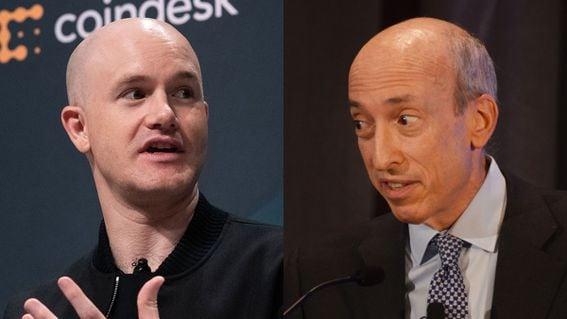
The federal judge must now weigh what a Coinbase lawyer characterized as "a pure question of law," and her answer could have big consequences on the crypto sector. A judge in the U.S. District Court for the Southern District of New York is now deciding whether or not to toss out the Securities and Exchange Commission's case against Coinbase. The ruling will hinge on whether the transactions in any of a dozen crypto tokens should be classified as an unregistered security. The U.S. Securities and Exchange Commission (SEC) case against Coinbase delves into a ton of complexity, but before anything else, a judge has to decide whether transactions in about a dozen tokens traded on the U.S. exchange were securities. Both sides – the SEC and Coinbase – agreed in a Wednesday court hearing that the tokens themselves aren't securities. The SEC lawyers argued that each trade amounted to an investor buying into a token ecosystem in which the purchaser is hoping to share in its gains, and as long as a single one of those transactions could be considered an investment contract, Coinbase has broken securities law. But the company said these are secondary-market trades in which no contract is in place, so they can't be securities. Coinbase is seeking to talk Judge Katherine Polk Failla of the U.S. District Court for the Southern District of New York into throwing out the SEC's accusations that it's breaking the law. Failla decided against making a decision from the bench and didn't explicitly reveal which way she'll rule as she went through 14 pages of questions that challenged the positions of both the regulator and the business over more than four hours. Her eventual decision – expected in the coming weeks, though she didn't hint at a timeline – will join a mixed bag of other recent rulings from her fellow judges in the same court. It'll either reinforce the SEC's pursuit of crypto platforms as unregistered exchanges dealing in unregistered securities, or it'll add to the agency's legal losses on this front and further strengthen the industry's view that the regulator is overreaching. Either way, similar SEC cases against such exchanges as Binance and Kraken could also turn on Judge Failla's view. "It's the same computer code no matter which one of us has it," said Patrick Costello, a lawyer with the SEC arguing that the purchaser is getting a contract however they obtain the digital assets. "The token is the key that gets you into the ecosystem. The token is worthless without the ecosystem." William Savitt, an attorney with Wachtell, Lipton, Rosen & Katz representing Coinbase, contended that an "investment contract" – a security defined by the so-called Howey test – actually requires a contractual obligation to be in place between the token issuer and the buyer. "There has to be a statement that is meant to convey an enforceable promise," Savitt said. "If you don't have that, then you don't have a contract." He called this "a pure question of law." The judge was careful not to signal her view, just acknowledging at one point, "This is a hard question." Costello also sought to counter warnings that the SEC's position could expand the definition of securities to collectibles such as art or trading cards, saying those assets are missing the central ecosystem. "Collectibles have their own value," he said. "There's no way for somebody to make a baseball card more valuable." Judge Failla addressed a couple key rulings on SEC crypto cases, including the agency's loss against Ripple and its win in the Terraform Labs action. She said Judge Jed Rakoff's finding in Terraform that crypto asset transactions were securities was "not a shock to me." But that didn't involve the tokens being listed on a secondary exchange. "Terraform is quite different from the facts of this case." Failla also admitted some signifiant hesitation about invoking the "nuclear option" of the so-called Major Questions Doctrine that Coinbase contends should head off the SEC's actions until Congress has had a chance to establish crypto laws. Crypto insiders embraced the judge's seeming skepticism of some of the agency's views at the hearing. "This entire hearing has been very skeptical of the SEC’s claims," Justin Slaughter, the policy director at Paradigm, posted on X. "This is a fairly extreme case of a regulator wanting to have its cake and eat it too," Dave Rodman, founder and managing partner at Rodman Law Group, told CoinDesk. "After all, the SEC deemed Coinbase sound enough to list on a US stock exchange, and it appears that it is backpedaling." Read More: Coinbase's SEC Clash Faces First Major Test as Judge Weighs Longshot Dismissal https://www.coindesk.com/policy/2024/01/17/coinbase-and-sec-dig-in-with-us-judge-on-whether-securities-law-applies-to-listings/
2024-01-17 21:04
Total assets grew even as Grayscale's GBTC saw sizable outflows as investors cash in following its conversion to a spot ETF. With three full days of trading in the books as of the close of business on Tuesday, net inflows into the newly approved spot bitcoin exchange-traded funds appear to be about 21,000 bitcoin (BTC), or $894 million at the current price of $42,600. Of the new money, BlackRock's iShares Bitcoin Trust (IBIT) leads the way by adding 16,362 bitcoin, followed by Fidelity's Wise Origin Bitcoin Fund (FBTC) with 12,112 bitcoin. Sizable exits from Grayscale's Bitcoin Trust (GBTC), which has lost about 25,000 bitcoin, brought down the overall industry inflow. Until the U.S. Securities and Exchange Commission blessed bitcoin ETFs last week, GBTC had existed as a closed-end fund. It was converted into an ETF as the other new products from the likes of BlackRock debuted last week. GBTC had charged customers a 2% management fee and held about 630,000 bitcoin prior to the spot ETF approvals. While the ETF version of GBTC charges a reduced management fee of 1.5%, that is still at least 100 basis points more than its new competitors. In addition, its conversion to an ETF meant the fund no longer traded at a discount to net asset value (NAV). Combined, these two factors have given GBTC holders good reason to sell and the early returns suggest that's occurring. Nonetheless, the new money coming into the ETFs overshadowed that, leading to the net inflows into ETFs overall. Price action has been far quieter this week, with bitcoin mostly settling into the $42,000-$43,000 range. At press time, it's lower by just over 1% over the past 24 hours, slightly underperforming the 0.6% drop in the CoinDesk 20 Index, which tracks the world's largest and most liquid cryptocurrencies. Bitcoin ETFs: Bust or not? The debate has now shifted to whether the bitcoin ETF launch was a success or a bust. For the ETF world in general, the new products have been a rousing success, argued Bloomberg's Eric Balchunas, noting $10 billion in trading volume for the new funds in their first three days. He said there were 500 ETF launches in 2023 and, combined, they did just $450 million in volume during the whole year. The bust crowd points to the lame price action since launch (bitcoin is lower by nearly 10%), the sizable proportion of selling action seen from GBTC and early net inflows that, while sizable, have fallen short of some bullish forecasts in the billions. "Markets make opinions," said Richard Russell, the late editor of "Dow Theory Letters." If prices remain flat to lower for much longer, the "bust" contingent will likely claim victory, but if bitcoin goes on to take out $50,000 this year and perhaps challenge its all-time high above $65,000, the ETFs will surely be thought of as a major success. https://www.coindesk.com/markets/2024/01/17/bitcoin-etf-net-inflows-near-1b-after-three-days/