2024-01-17 07:43
Developers said the missed finalization was likely due to an expected lack of participation and older network validators. Ethereum’s much-awaited Dencun upgrade went live on the Goerli testnet earlier Wednesday but failed to finalize in the expected time. The upgrade was pushed at 6:32 UTC, blockchain data shows, but did not reach consensus and was not finalized on the testnet. Developers expect the apparent issues to be fixed in the coming days. These likely occurred due to low participation and validators not upgrading parts of their software that would have helped with finalization. Finality refers to irreversibility once a transaction has been confirmed and added to a block in a blockchain network. A testnet is a network that mimics real-world blockchains and is used to test applications and important upgrades before they can be pushed live on a mainnet. Dencun’s implementation of Goerli is part of a three-phased approach to eventually enacting a new, less costly method of storing data on the main Ethereum blockchain. That method, “proto-danksharding,” is a mechanism that will add capacity for data availability as well as help reduce the cost of transactions for layer-2 blockchains. These auxiliary networks have proliferated in the past year as an alternative to processing transactions on the main Ethereum blockchain, but analysts say their growth is hampered by the steep data costs under the current setup. The next phase will happen sometime in the next few weeks, with an upgrade to the Sepolia testnet, followed by the Holesky testnet. Dencun will be the biggest upgrade – technically a “hard fork” in blockchain terminology – for Ethereum since the Shapella upgrade last March, which enabled the withdrawals of staked ether stETH. That milestone marked the second step for Ethereum’s transition to a proof-of-stake blockchain, away from the more energy intensive proof-of-work chain that it was before the Merge. https://www.coindesk.com/tech/2024/01/17/ethereums-dencun-upgrade-goes-live-but-fails-to-finalize-on-testnet/

2024-01-17 07:37
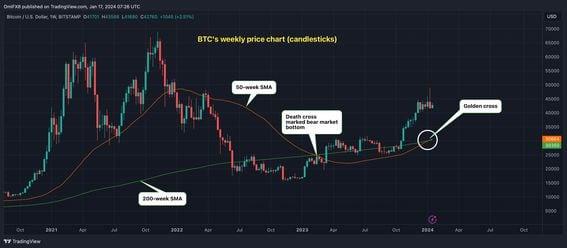
The 50-week simple moving average (SMA) of bitcoin's price has crossed above the 200-week SMA for the first time on record. Market enthusiasts call it a "golden cross," indicating a positive shift in asset prices, and now this marker has finally appeared on the bitcoin (BTC) weekly price chart. The 50-week simple moving average (SMA) on bitcoin has crossed over the 200-week SMA for the first time on record, confirming the golden cross. The phrase and its counterpart, "the death cross," in which the short-duration SMA dips below the long-duration SMA, originated in Japan, per some technical analysis textbooks. Many traders see crossovers as forward-looking indicators, with the golden version signaling a long-term bull market ahead. The bullish interpretation could be challenged because averages are based on past data and tends to lag prices. In other words, averages represent what happened in the past, and the first golden cross on the weekly chart results from bitcoin rallying over 70% to $42,700 in four months. Thus, seasoned traders consider crossovers as lagging indicators, often coinciding with trend exhaustion. For instance, the weekly death cross confirmed in early 2023 marked the bottom of the bear market. Bitcoin's daily chart golden and death crossovers have a mixed record of predicting bullish and bearish trends. Bitcoin's rally has already stalled, with the cryptocurrency trading 10% lower from highs near $49,000 registered after 11 spot exchange-traded funds (ETFs) began trading in the U.S. last Thursday. Per observers, the bullish momentum has waned due to early ETF flows failing to match the sky-high market expectations. "The Net flow of funds for the ETFs has been $965M (including seed funds), a strong start thus far. However, the spot price is down from the launch-driven euphoria as investors set unreasonably high launch expectations," Greg Cipolaro, global head of research at NYDIG, said in a newsletter Tuesday. https://www.coindesk.com/markets/2024/01/17/bitcoin-sees-its-first-ever-weekly-golden-cross/
2024-01-17 06:55
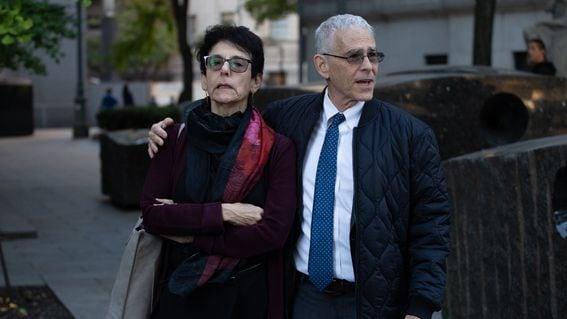
Bankman and Fried, both professors at Stanford Law School, argued that Bankman did not have a fiduciary relationship with FTX . Joseph Bankman and Barbara Fried, the parents of Sam Bankman-Fried, have asked a court to dismiss a lawsuit by the bankrupt cryptocurrency exchange FTX seeking to recover funds it alleges were fraudulently transferred. FTX sought to "recover millions of dollars" from Bankman and Fried in September 2023. Less than two months later, their son, Bankman-Fried, was found guilty on all seven charges of defrauding customers and the United States. His sentencing is expected in March. Bankman and Fried, both professors at Stanford Law School, argued that Bankman did not have a fiduciary relationship with FTX and did not serve "as a director, officer, or manager," and even if a fiduciary relationship existed with FTX to plausibly allege a breach, according to a Jan. 15 court filing. Significantly, the court filing argued that it is not enough for FTX to plead that the parents "knew or should have known." Instead, the filing argued that FTX should have produced specific facts showing "actual knowledge" that the parents "knew certain actions would result in a breach of fiduciary duty." In the September 2023 lawsuit filing, FTX did not state the total amount Bankman and Fried may have misappropriated, but it did provide certain line items: Bankman received an annual salary of $200,000 for his role as a senior adviser to the FTX foundation, more than $18 million for the property in the Bahamas and $5.5 million in FTX Group donations to Stanford University, which the university has said will be returned. Read More: FTX Bankruptcy Estate Sues Sam Bankman-Fried's Parents, Joseph and Barbara, to Claw Back 'Misappropriated Funds' https://www.coindesk.com/policy/2024/01/17/sam-bankman-frieds-parents-ask-court-to-dismiss-ftxs-lawsuit-seeking-to-recover-funds/
2024-01-17 05:54
Klyatn and Finschia Foundation have proposed to merge the two blockchains to create a Web3 powerhouse in Asia. Smaller cryptocurrencies are having their moment as bitcoin (BTC) trades listless in the wake of the recent debut of spot ETFs in the U.S. Of particular note are CHZ, the native token of the Chiliz network used to purchase Fan tokens on Socios.com and KLAY, the utility token of Layer 1 blockchain network Klaytn, which is backed by Korean internet giant Kakao. In the past 24 hours, CHZ has rallied 10%, topping $0.11 for the first time since May last year, and KLAY has rallied 14.7% to $0.228, CoinDesk data shows. Bitcoin has been primarily directionless, exchanging hands between $42,500 and $43,500. On Tuesday, Chiliz’s CEO, Alexandre Dreyfus, said on X that Chiliz will pursue an aggressive merger and acquisition (M&A) strategy this year to create enormous ecosystems combining existing tokens and networks. Meanwhile, Klaytn and Web3-focused Finschia Foundation proposed to merge the two chains to create an Asian Web3 powerhouse. Finschia is a public mainnet successor to the LINE blockchain. “The proposed merger will bring together South Korea and Japan’s leading blockchains to form an ecosystem of over 420 DApps. The new blockchain will inherit Klaytn and Finschia’s integration with Kakaotalk and LINE, creating a user base of over 250 million across Asia," Klaytn said in a social media post on Tuesday. Holders of KLAY and Finschia’s FNSA token will be able to swap their holdings for a new coin to be created upon completion of the merger, Klaytn added, noting the new coin will have low inflation, a burning mechanism and a zero reserve strategy. (FNSA token has dropped 6% in the past 24 hours). https://www.coindesk.com/markets/2024/01/17/chiliz-klaytn-tokens-surge-over-10-on-ma-hopes-bitcoin-listless/
2024-01-16 20:25
A federal U.S. judge will hear arguments about whether or not to toss the case based on legal arguments that the regulator was in the wrong when it sued the exchange. Coinbase is poised to argue with the Securities and Exchange Commission over whether its business model is violating U.S. law. A federal judge in New York will hear a lengthy four hours of oral arguments in the case, and the crypto industry will see whether her eventual decision about throwing out the SEC's case will help or hurt its momentum against the regulator. Coinbase is about to make its case in a federal courtroom that the U.S. Securities and Exchange Commission (SEC) is wrong about its legal arguments that the crypto exchange has been trading unregistered securities. What the New York judge does next could have serious consequences for the wider industry's clashes with the regulator. The company has asked Judge Katherine Polk Failla of the U.S. District Court for the Southern District of New York to throw out the case – a longshot request, but one that she may be taking very seriously. She's booked four hours of back-and-forth with Coinbase and the SEC on Wednesday – an unusual depth of oral arguments for such a motion, which often tends to favor the government side in this kind of enforcement case. "When the government is suing people they usually don't lose on summary judgment motions," said Patrick McCarty, a financial consultant and former SEC lawyer who teaches crypto classes at Georgetown Law. "But it's possible – very possible." Judge Failla could give significant momentum to either side when she rules on the motion – probably not this week, but within the next couple of months. She'll either land in the camp of fellow SDNY Judge Analisa Torres, who ruled – also in summary judgment – that the SEC strayed in some of its claims about XRP being a security in the case against Ripple, or Judge Jed Rakoff, who just gave the SEC a win in its action against Terraform Labs. Read More: Coinbase Poised to Make Final Pitch in Bid to Kill SEC Accusations Quickly The SEC interprets the key law on identifying securities – known as the Howey test – as saying that a digital asset purchaser who has been guided to expect profit from that purchase is likely buying a crypto security. But Coinbase contends that the tokens being traded on its popular platform aren't securities if there's no formal obligation that says the issuer owes the purchaser a share of profits or income. The case could be thought of as the first major action that "brings into focus this debate about whether – in fact – these things are investments contracts or securities transactions under the Howey test," McCarty said. He said this current motion puts Failla in an interesting position, "kind of caught between Judge Torres and Judge Rakoff," both judges in the same court that handles so much of the SEC's caseload. Each side will have two hours to make its case directly to Failla, which McCarty noted was an especially long time. If the judge isn't convinced that Coinbase has justified an early resolution in the company's favor, the dispute will proceed toward trial, in which case the company could pursue SEC internal documents revealing conversations among officials as they decided whether to go after the exchange. The agency and the company aren't generally arguing over the facts of what's happening, but on how existing law should treat it. Deciding where Howey fits in is "going to contribute to the continuing development of legal precedent," said Chris Odinet, a professor at the University of Iowa College of Law whose research has a focus on digital assets. "The stakes are extremely high, because they're so inherently tied to the business model," Odinet said. However, he doesn't necessarily interpret the lengthy four hours of scheduled discussion as a sign pointing in either direction, because he said the issues are highly technical and may require that much questioning. But whatever happens on this motion, the dispute over crypto transactions in the secondary market will almost certainly be elevated to the appeals courts. "It's not like this is going to end the debate," McCarthy said. "It's just going to be another chapter." Coinbase's arguments this week also come on the heels of the SEC's capitulation in the spot bitcoin exchange-traded fund (ETF) approvals, which agency Chair Gary Gensler granted came out of the SEC's court loss against Grayscale. While that was a different legal question, the regulator was declared by a federal court to be taking "arbitrary and capricious" actions against a crypto firm, and Coinbase is prepared to make a similar claim here. The judge has previously differed with SEC leaders in at least one significant crypto point: She said last year that ether (ETH) is a commodity, not a security. While SEC officials once suggested that may be the case, they've more recently narrowed their position to bitcoin (BTC) being the only token that's definitely outside SEC jurisdiction. https://www.coindesk.com/policy/2024/01/16/coinbases-sec-clash-faces-first-major-test-as-judge-weighs-longshot-dismissal/

2024-01-16 18:39
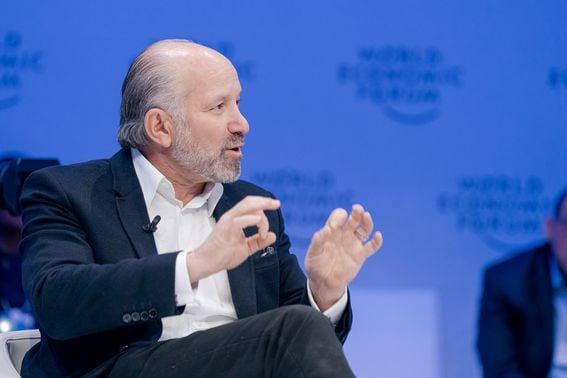
Tether's $95 billion stablecoin has been dogged by questions around whether it actually holds the assets it says are backing USDT. Cantor Fitzgerald's Howard Lutnick, whose firm manages money for Tether, says it does. Cantor Fitzgerald CEO Howard Lutnick vouched for stablecoin issuer Tether's legitimacy on Tuesday, addressing what has been one of the big questions in crypto over the years as its stablecoin, USDT, has grown into a behemoth: Does Tether have the money it says it does. "They have it," he said during an interview with Bloomberg TV. That's strong validation for Tether coming from a prominent and influential Wall Street figure. Lutnick's Cantor Fitzgerald is among the best-known bond trading houses on Wall Street and one of 25 primary dealers for U.S. Treasurys, allowing direct trade with the Federal Reserve. The stablecoin issuer has long been under the microscope for its backing of USDT, which, with over $95 billion in market capitalization, remains the most widely used stablecoin in the world. "I manage many of their assets," said Lutnick, who brought up crypto in the interview that was streamed live from Davos, Switzerland. "From what I've seen – and we did a lot of work – they have the money they say they have." Lutnick seemed to refer to Tether's latest attestation report, which showed that it held $86.4 billion of assets in reserves as of Sept. 30 against $83.2 billion in liabilities. For years, a big chunk of Tether's reserves were locked up in commercial paper, which worried some observers. However, its latest attestation report shows USDT is mostly backed by U.S. Treasuries, widely considered among the safest assets in the world, and there are no longer any commercial paper holdings. Still, the industry isn't completely convinced about the quality of Tether's assets. Most recently, credit rating agency S&P Global's poor score for the stablecoin, which judges characteristics such as "the quality of the asset backing the stablecoin" as well as "weaknesses in other areas, including regulation and supervision, governance, transparency, liquidity and redeemability, and track record" reinforced those concerns. Users of USDT are also still waiting for an official audit that would paint a much more precise picture of a company than an attestation. Lutnick has previously voiced that he is a fan of Tether. Cantor Fitzgerald is a custodian for the stablecoin issuer's Treasuries. When asked about a more prominent topic in crypto news currently – the approval and listing of over a dozen spot bitcoin exchange-traded funds (ETFs) – Lutnick questioned the real value of bitcoin and stablecoins for Americans and argued that crypto currencies are attractive as speculative assets in this country, whereas people in other nations, such as Argentina, Venezuela and Turkey, hold crypto for more substantial reasons. "This is a speculative asset for us but for countries like Argentina, Venezuela, Turkey, these crypto assets matter, stablecoins matter in those countries," he said. "It's a way to hold on to the dollar." https://www.coindesk.com/business/2024/01/16/big-wall-street-ceo-addresses-controversy-around-tethers-stablecoin-assets-they-have-the-money/