2024-01-11 18:05
ARK Invest's CEO previously predicted the price would reach $1 million by 2030. ARK Invest CEO Cathie Wood said on CNBC Thursday that bitcoin (BTC), the world's largest cryptocurrency by market value, could reach $1,500,000 in price by 2030 in a bullish scenario, raising her estimate by 50% from a previous prediction of $1 million. "We think the probability of the bull case has increased with this SEC approval. This is a green light," said Wood on CNBC. On Wednesday, spot bitcoin ETFs were finally approved in the U.S. after a decade of trying. The Securities and Exchange Commission gave the green light Wednesday to key filings from the markets seeking to list the groundbreaking products. The ARK Invest CEO also said a bear case would see the price rise to $258,500 and a base case of $682,800. ARK backed up the previous $1 million price prediction by pointing to a higher hashrate, long-term holder supply, and addresses with a non-zero balance compared to the prior downturns. The SEC's approval of the spot ETFs has likely added to the bullish thesis. For full coverage of bitcoin ETFs, click here. ARK Invest is among the asset managers approved by the SEC to roll out bitcoin ETFs, which started trading on Thursday. On Thursday, the price of BTC briefly topped $49,000 for the first time since December 2021. However, it gave up all its earlier gains and is now trading near $46,322. ARK isn't the only one expecting a massive jump in bitcoin prices. Standard Chartered Bank recently predicted that the price of bitcoin could rise to levels closer to $200,000 by the end of 2025, comparing the bitcoin ETF to the first U.S.-based gold exchange-traded product, which launched in November 2004. Following this, the price of gold rose over 4x in the seven years it took for gold ETP holdings to mature. https://www.coindesk.com/markets/2024/01/11/cathie-wood-sees-bitcoin-price-reaching-15m-by-2030-after-etf-approval/

2024-01-11 17:51
They make the asset class "less of a scary concept" to mainstream audiences, bitcoin advocate Jameson Lopp said. As the first batch of bitcoin spot ETFs starts trading, crypto advocates grapple with its implications. While some view crypto's linking up with traditional finance as a positive and inevitable part of going mainstream, others worry it spells bad news for the promise of decentralization. It's official. The U.S. securities watchdog on Wednesday made history by begrudgingly approving a batch of bitcoin spot exchange-traded funds (ETF), energizing markets that were for months trembling with anticipation. These hard-won approvals are largely viewed as a leg-up for an industry hoping to rebuild its reputation after 2022's spectacular market collapse fueled by Sam Bankman-Fried and others. But for long-time crypto advocates, considerations may go beyond market recovery. Some fear that fraternizing with crypto's original enemy – traditional finance (TradFi), Big Banks and Wall Street, which early fans of the Bitcoin blockchain had in their sights – threatens to break its original promise of decentralizing financial services. Others contend that bitcoin (BTC), the cryptocurrency, was intended for the masses, and that some form of alignment with TradFi was unavoidable – with benefits to both parties. "It was always an inevitable part of the process of going mainstream," Jameson Lopp, software engineer and bitcoin advocate, said during an interview, speaking about crypto and TradFi colliding through the creation of bitcoin ETFs. "Wall Street wants a cut of the action." However, these bitcoin ETFs will "accelerate the flywheel of adoption" and make the asset class "less of a scary concept" to mainstream audiences, he added. Spot ETFs allow investors to take advantage of the popular cryptocurrency's volatile price movement sans the hassle of having to learn about strange-sounding concepts like self-custody, blockchain and private keys. Erik Voorhees, one of crypto's earliest entrepreneurs, said on social media platform X that the "most important result" of bitcoin ETFs would be dissuading governments from treating the crypto harshly. "When 50 million boomers own bitcoin passively, the political and economic damage from a ban will be significantly less palatable. It's no longer just an asset for shadowy super coders," Voorhees said. "And it's absolutely a Trojan Horse about to be pulled through gates of Troy." Threat of corruption If Satoshi Nakamoto releasing the Bitcoin white paper 15 years ago was an almighty act of rebellion against TradFi – like the Greek god Zeus fighting his titan father Cronus to avoid being eaten up like his siblings – then bitcoin was supposed to be the people's weapon against the unchecked power of big banks, whose irresponsibility and greed brought the global economy to its knees in 2008. It's unsurprising, then, that to some purists on both sides, the ETF approvals not only represent the convergence of two worlds designed to be rivals, but the potential corruption of both. "The approval of bitcoin ETFs will inevitably turn out to be a very bad thing for Bitcoin decentralization," said Proof of Decentralization podcast host Chris Blec on X. While ETFs will see new institutional and retail money flowing into crypto, Nicky Gomez, senior partner at XReg Consulting, warns they will also influence more centralization moving bitcoin "further away from its true value and potential." "Ultimately, this will spur a larger divide with the crypto purists," Gomez said in a statement shared with CoinDesk. On the TradFi side, economic security nonprofit Better Markets criticized the SEC approvals on X, saying bitcoin and crypto "remain the preferred product of speculators, gamblers, predators and criminals." SEC commissioner Caroline Crenshaw called the development "unsound and ahistoric" in a Wednesday statement. Though he doesn't think bitcoin ETFs are good or bad for crypto, Lopp hopes huge fund inflows and mainstream interest won't change the protocols of networks like Bitcoin. "Hopefully, the ETF issuers won't care much about the properties of the protocol because they won't actually be interacting with it – their custodians will handle all the heavy lifting," Lopp said. As for whether ETFs will work against the idea of self-custody championed by crypto, Lopp said keeping control of one's assets was always an optional thing. "If someone prefers the convenience of an ETF over holding the actual asset, that's their choice. One could make similar arguments with regard to any commodity that is traded via ETFs. Few folks want to take custody of barrels of oil, for example," he said. A case for the inevitable Like Lopp, CoinDesk columnist and equity researcher J.P. Koning makes a case that crypto mingling with TradFi was inevitable. "Since bitcoin was first introduced in 2009, adoption has always relied on close integration with traditional finance, so a bitcoin ETF is nothing new, really; it represents just one more upgrade of the very old linkage between the two," Koning said. A rather straightforward view would be that, at the end of the day, it all comes down to price. "I don't see bitcoin ETFs as clashing with what original proponents of crypto hoped for, because from the very start even the most idealistic strains of bitcoinism were always twinned with the raw desire to make money," Koning said. "For the number to go up, more funds must be drawn in, which requires not only relying on the linkages already forged to traditional finance, like the integration with the card networks, but new forms of interconnection." "After the ETF has begun to trade, the bitcoin community will go on to pushing for the next big bond to TradFi, because that's what will drive the price even higher," he said. https://www.coindesk.com/policy/2024/01/11/bitcoin-etfs-stir-optimism-ambivalence-and-dread-among-cryptos-staunchest-supporters/
2024-01-11 17:24
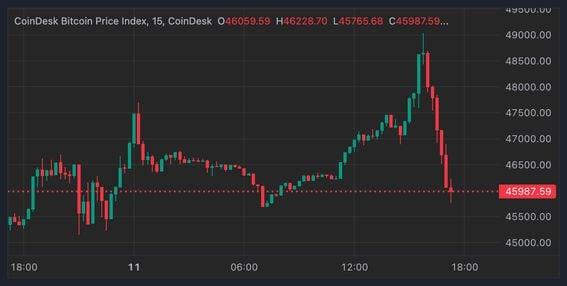
Cryptocurrency-focused stocks such as Coinbase and bitcoin miners are also down significantly since Thursday's market open. Bitcoin (BTC) on Thursday briefly topped $49,000 for the first time since December 2021 as U.S.-listed spot bitcoin exchange-traded funds (ETF) commenced trading amid heightened anticipation. The largest crypto asset by market capitalization climbed from below $46,000 earlier today to over $47,000, then accelerated, hitting a $49,042 during early U.S. trading session, according to CoinDesk Indices data, which collects pricing from multiple exchanges. Then, it gave up all its gains and buckled below $46,000. After the roundtrip, BTC was still up 1% over the past 24 hours, trading slightly above $46,000. For full coverage of bitcoin ETFs, click here. Cryptocurrency-focused stocks such as Coinbase (COIN) also declined, erasing their pre-market gains. Coinbase (COIN) dropped 5% since trading opened, while bitcoin miners Marathon Digital (MARA) and Riot Platforms (RIOT) both endured over 10% losses. Earlier, Mizuho Securities, with an underperform rating on Coinbase shares and a $54 price target, said spot ETF approval is a “pyrrhic victory for COIN,” and potential upside to revenue from bitcoin ETFs may be more muted than thought. The highly anticipated debut of the eleven bitcoin ETFs unleashed significant volatility in the asset's price, while investors are watching closely how much interest the eleven funds will attract by the end of the day. So far, BlackRock's IBIT is leading among the newly issued ETFs by trading volume with $500 million by 10:50 U.S. Eastern Time, according to BitMex Research. Grayscale's GBTC, the world's largest bitcoin investment fund that was uplisted from a closed-end fund to an ETF, recorded over $700 million in volumes in the first hour of trading. https://www.coindesk.com/markets/2024/01/11/bitcoin-briefly-tops-49k-before-selling-off-as-etf-trading-frenzy-commences/
2024-01-11 15:16
Here's a ranking of the 11 newly trading bitcoin ETFs, in terms of first-day trading volume. CORRECTION (Jan. 11, 2024, 16:11 UTC): An earlier version of this story had an incorrect ranking. Bitcoin ETFs have been eagerly anticipated for years. They finally got approved in the U.S. on Wednesday and began trading Thursday. The Grayscale Bitcoin Trust (GBTC), an incumbent product since it has existed for years but in a less-desirable format, saw the most volume at $2.3 billion, according to data posted on X by Bloomberg Intelligence analyst James Seyffart. BlackRock's iShares Bitcoin Trust (IBIT) came in second place with $1 billion, his data showed, followed by the Fidelity Wise Origin Bitcoin Fund (FBTC) at $712 million. Overall volume exceeded $4.6 billion. While Grayscale's GBTC led, this is likely due to existing investors selling shares, Bloomberg analyst Eric Balchunas explained in an X post. GBTC, introduced in 2013, is the world's largest bitcoin investment fund and was converted into an ETF from a closed-end structure after Wednesday's regulatory approval. In the case of the 10 freshly started ETFs, the volume is coming from buyers, he added. In comparison, ProShares' futures-based bitcoin ETF (BITO) amassed $1 billion volume on its first day in October 2021. The largest-ever first day volume for an individual ETF launch was $2.1 billion, Balchunas pointed out. Bitcoin ETFs that can directly hold the underlying asset (as opposed to the bitcoin futures ETFs like BITO approved in 2021) have been eagerly anticipated in the U.S. following a decade-long struggle to seal regulatory approval. For full coverage of bitcoin ETFs, click here. Bitcoin (BTC) topped $49,000, hitting a fresh two-year high during the day as the ETF trading frenzy commenced, then sold off, dropping to $46,000. https://www.coindesk.com/markets/2024/01/11/grayscale-blackrock-are-volume-leaders-as-bitcoin-etfs-debut/

2024-01-11 13:10
The number of shares to be offered and the price range for the proposed offering have not yet been determined. Circle Internet Financial, the issuer of the USDC stablecoin, filed to sell shares to the public for the first time. The company filed a confidential draft S-1 document to the U.S. Securities and Exchange Commission (SEC), it said in a statement. The number of shares to be offered and the price range for the proposed offering have not yet been determined, according to the filing. USDC is the second-largest stablecoin, with a market cap of about $25 billion. Tether, the largest, has a market cap around $95 billion, CoinMarketCap data show. Circle's move to become a publicly listed company comes one day after the SEC approved a series of spot bitcoin ETFs. The initial public offering is expected to take place after the SEC completes its review process, subject to market and other conditions, the company said. Circle planned to go public via a special purpose acquisition company (SPAC) deal in 2021, with a February 2022 valuation reported at $9 billion. However, Circle CEO Jeremy Allaire said that the deal fell through after his firm didn't complete the SEC's "qualification in time." The company laid off a portion of its workforce last year during a bear market that was spurred by the collapse of FTX, Celsius and Three Arrows Capital. Shares in Coinbase (COIN) became publicly traded in April 2021, with a listing on Nasdaq at a valuation of $85.8 billion. https://www.coindesk.com/business/2024/01/11/stablecoin-issuer-circle-internet-files-for-ipo/

2024-01-11 11:13
Bets on Ethereum tokens may spark a reversal of fortunes for ETH investors, especially as the token underperformed bitcoin in 2023. The approval of spot bitcoin ETFs has sparked optimism among ether traders, who are hoping for a spot ether product as well. BlackRock has already filed a prospectus for its iShares Ethereum Trust, a spot ether exchange-traded fund, with the SEC. The potential approval of an ether ETF could increase investment and interest in Ethereum-based projects and layer 2 networks, leading to more innovation and growth within the ecosystem. The historic U.S. approval of spot bitcoin (BTC) exchange-traded funds (ETF) on Wednesday has buoyed ether (ETH) traders, who are betting the token that powers the Ethereum network could be next in line. The ETH price has jumped 10% in 24 hours, while bitcoin added 1.3%. Tokens of layer 2 networks, which operate as individual blockchains but are ultimately built atop Ethereum, surged as well. Arbitrum’s ARB and Mantle’s MNT both gained more than 20%. Other Ethereum ecosystem tokens, ranging from meme coins to those that power Ethereum-based applications, rose 14% on average, the category tracked by CoinGecko shows. “The largest smart money inflows” were directed toward the Ethereum ecosystem in the past 24 hours, Nansen analyst Martin Lee said in a Telegram message. Nansen defines smart money as wallets that trade or invest in a way that is considered experienced or well informed and are usually profitable. The process for a spot ether ETF has already started. Ark 21Shares and VanEck, both sponsors of approved bitcoin ETFs, filed the paperwork with the Securities and Exchange Commission (SEC) back in September. And BlackRock, the world's largest asset manager and also a bitcoin ETF sponsor, filed an S-1 prospectus for its iShares Ethereum Trust in November. Some traders told CoinDesk that an ether ETF could bolster the growth of Ethereum-based financial applications, whose use cases range from on-chain trading and lending to issuance of real-world assets, or tokenization, on the blockchain. “A potential approval of an ether ETF could further legitimize Ethereum's standing in the mainstream financial world, leading to increased investment and interest in Ethereum-based projects and layer 2 networks,” said RJ Ke, a researcher at Ethereum rollup service Taiko. “The anticipation could foster more innovation and growth within the Ethereum ecosystem as well.” Bets on Ethereum-based tokens may spark a reversal of fortunes for ETH investors, which underperformed bitcoin in 2023. Bitcoin, the largest cryptocurrency by market cap, climbed more than 150% last year while ether, the No. 2, added about 90%. “The approval of the Bitcoin ETFs by the SEC has opened the door for other cryptocurrencies,” said Lucy Hu, a senior analyst at Metalpha, in an email. “The market is now paying close attention to Ethereum ETF applications ... As the ETH spot ETF deadline is coming close, we believe more institutional investors will allocate more ETH in their portfolios this year to capture more returns.” https://www.coindesk.com/markets/2024/01/11/ether-etf-hopes-drive-smart-money-bets-after-historic-bitcoin-etf-approval/