2024-01-09 18:02
Analysts from Standard Chartered, Galaxy and Corestone predict that a spot bitcoin ETF could see over $1 billion in inflows over just the first quarter. As the market awaits a decision from the U.S. Securities and Exchange Commission over spot exchange-traded fund filings, analysts are predicting that bitcoin ETFs may see well over $1 billion in inflows over the next three months, and potentially more than $100 billion by the end of the year. Standard Chartered Bank, which has also predicted that bitcoin will rise to $100,000 by year-end, is expecting significant inflows into the funds if the SEC approves the products. For full coverage of bitcoin ETFs, click here. The bank predicts in a report that there will be inflows of $50 billion to $100 billion this year if there's a win for the asset managers who have applied to issue spot bitcoin ETFs. This means between 437,000 and 1.32 million new bitcoins would be held in U.S. ETFs by the end of 2024. If the inflows materialize as expected, bitcoin could rise to levels closer to $200,000 by the end of 2025, said the bank. Standard Chartered compared the potential bitcoin ETF to the first U.S.-based gold exchange-traded product, which launched in November 2004. Following this, the price of gold rose over 4x in the seven years it took for gold ETP holdings to mature. Bitcoin gained around 155% over the last year and is up 6% since the start of 2024, according to data from Messari. Standard Chartered said that following an approval, bitcoin could witness similar gains to what gold did, but over a shorter time period (one to two years). "Our view is the BTC ETF market will develop more quickly," said the report. Will McDonough, chairman and founder of Corestone Capital, is also predicting heavy demand for a bitcoin ETF if it's approved. McDonough thinks there will be approximately $1 billion worth of inflows by the end of the first quarter of this year. "The obstacle of self custody has kept many investors out of the asset class, through approving a 40 Act structure that can give investors exposure in their traditional brokerage accounts, means the demographic of investors that can allocate even just 1% of their portfolio to this growing alternative asset class is exponential, and I think price activity (given the fixed supply of Bitcoin) will be just as big," McDonough said. Galaxy Digital predicted in an October report that ETFs would attract at least $14.4 billion of inflows in the first years of issuance. "The inflows could ramp up by $27 billion by the second year and $39 billion by the third year," said the report. There are also a number of asset managers who have filed for spot ether ETFs with a final deadline for a decision in May. Standard Chartered said in the report that it expects the SEC to allow ether ETFs. https://www.coindesk.com/markets/2024/01/09/bitcoin-etfs-could-see-up-to-100b-in-inflows-if-sec-approves-standard-chartered/

2024-01-09 17:10
Valkyrie, Invesco and Bitwise lowered their fees further just hours after all rivals finally revealed their fee plans. Just hours after all wanna-be bitcoin ETF issuers finished revealing how much they'll charge investors who own the products, some are cutting their planned fee – a sign of just how brutal the battle to accumulate assets will be if these products get approved this week. But Grayscale, which already offers a bitcoin investment product the newcomers are chasing, is standing firm with its far-costlier fee – and the distance grew with Tuesday's cuts. For full coverage of bitcoin ETFs, click here. Valkyrie cut its fee nearly in half to 0.49% from 0.8%, and it will charge nothing for three months. Even with the change, though, the crypto asset manager is at the higher end of the spectrum, closer to competitors Invesco, which also lowered its fee by 20 basis points to 0.39%. Bitwise, which was already the lowest-cost option at 0.24%, decided to go down even further, to 0.20%, widening its gap to competitors 21Shares and Ark and VanEck, who have so far stuck with their initial fees of 0.25%. WisdomTree went down 20 basis points, to 0.30%, while Fidelity updated its fee to 0.25%, as well. With the recent changes, nine applicants – the overwhelming majority – will potentially be charging investors less than 0.5% of the net asset value of the fund. Meanwhile, Grayscale is significantly higher at 1.5%. But experts say that they wouldn't be surprised if the crypto asset manager makes some changes as time goes on. "It's trivial for them to drop the fee, but difficult to raise it after conversion," former Davis Polk attorney and GP at Van Buren Capital, Scott Johnsson wrote on X. "Seems to me that if they're trying to find the sweet spot of minimizing asset under management (AUM) declines and maintaining fees, it's not so outrageous to start out at a "high" level and then adjust." The Grayscale Bitcoin Trust (GBTC), which the company wants to convert into an ETF, currently charges 2%, so 1.5% is a reduction. It may also justify its high price because it has a significant competitive advantage over others because of its size. The asset manager has more than $27 billion of AUM lined up even before potential approval and launch. The others are essentially starting at zero. https://www.coindesk.com/business/2024/01/09/amid-bitcoin-etf-fee-war-grayscale-stands-its-ground-with-priciest-product/

2024-01-09 16:23
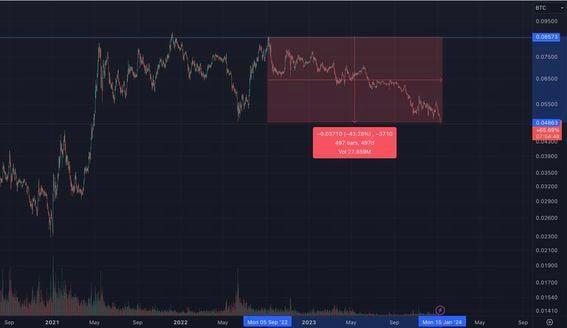
Ether has lost 43% of its value against bitcoin since Sept. 7. Ethereum's ether (ETH) has slumped to its lowest price versus bitcoin (BTC) since April 2021 as crypto investors obsess over the expected approval of bitcoin ETFs in the U.S. ETH has lost 43% of its value against BTC since Sept. 7, falling from a price of 0.08566 BTC to 0.0482 BTC. In U.S. dollar terms, ether has risen by 41% in the same period, but that is dwarfed by bitcoin's 81% gain. For full coverage of bitcoin ETFs, click here. In another sign of enthusiasm about bitcoin ETFs and how they might transform the crypto market, bitcoin dominance, which measures bitcoin's share of the entire cryptocurrency industry's market capitalization, has risen from 39% to 54% in the past 14 months. Bitcoin's increase against altcoins like ether can be attributed to the emergence of two narratives: hopes that a spot bitcoin ETF will be approved in the U.S. and the upcoming "halving," or reduction in the reward given to miners who create new BTC. While ether is being earmarked for future exchange-traded products, bitcoin is expected to experience "tens of billions of dollars worth" of fresh inflows if the U.S. Securities and Exchange Commission approves a spot ETF this week. Bitcoin will also undergo a block reward halving in April, an event that has previously coincided with a series of bull markets as newly mined supply is reduced. Ethereum, meanwhile, has fallen from the spotlight following its hyped transition to a proof-of-stake blockchain in 2022. Total value locked across all Ethereum protocols is less than it was in April last year, despite the price being 10% higher. https://www.coindesk.com/markets/2024/01/09/bitcoin-etf-fever-drives-ethereum-to-32-month-low-versus-btc/
2024-01-09 11:38
The filings indicate that the two entities were among the prospective issuers that the U.S. Securities and Exchange Commission (SEC) sent comments in the past 24 hours. BlackRock (BLK), VanEck, Invesco and Galaxy, ARK 21Shares, Grayscale and other prospective issuers among 13 hoping to launch bitcoin (BTC) exchange-traded funds (ETFs) in the U.S., have filed updated documents on Tuesday. The filings indicate that the entities were among the prospective issuers that the U.S. Securities and Exchange Commission (SEC) sent comments in the past 24 hours. CoinDesk reported earlier that the SEC sent comments to a set of prospective issuers of the spot-bitcoin ETFs just hours after the companies filed documents detailing fees for their proposed products on Monday. Among the changes in the latest updated filing on Tuesday is wording that seeks to mitigate damage to shareholders in the event of insolvency and avoid a conflict of interest between the ETF’s authorized participants. For full coverage of bitcoin ETFs, click here. Invesco and Galaxy's updated filing saw them reduce the fee they plan to charge to 0.39% from the earlier 0.59%. The latest filings show an almost unprecedented engagement between the SEC and prospective issuers, with filings following SEC responses and then updated filings within a short span of 24 hours. The SEC is widely expected to approve all the applications this week as it faces a Jan. 10, 2024 deadline – i.e. this Wednesday – for one of the applications by Ark and 21 Shares and may want to approve all together in the spirit of fairness. Read More: SEC Hustles to Answer Latest Bitcoin ETF Filings: Source https://www.coindesk.com/policy/2024/01/09/blackrock-vaneck-update-bitcoin-etf-filing-within-hours-of-quick-sec-response/

2024-01-09 06:40
Futures tracking crypto markets saw some $155 million in shorts liquidated in the past 24 hours after a sudden uptick in prices in U.S. hours. Traders betting against higher bitcoin (BTC) prices lost over $100 million in the past 24 hours as expectations of a spot bitcoin exchange-traded fund (ETF) approval in the U.S. neared the finish line. BTC surged as high as 9% Monday, before giving back some gains, as prices jumped over $47,000 for the first time since March 2022. Traders on the crypto exchange OKX took on the most losses at $84 million, followed by Binance at $71 million. For full coverage of bitcoin ETFs, click here. Open interest, or the number of unsettled futures contracts, jumped over 8% in the past 24 hours, suggesting traders opened more bets after the liquidation event as they likely expect volatility to continue. Liquidation refers to when an exchange forcefully closes a trader’s leveraged position due to a partial or total loss of the trader's initial margin. It happens when a trader is unable to meet the margin requirements for a leveraged position (fails to have sufficient funds to keep the trade open). Large liquidations can signal the local top or bottom of a steep price move, which may allow traders to position themselves accordingly. Such data is beneficial for traders as it serves as a signal of leverage being effectively washed out from popular futures products – acting as a short-term indication of a decline in price volatility. Monday’s market moves came as potential issuers ranging from BlackRock (BLK) to Grayscale filed their offering fees to the U.S. Securities and Exchange Commission (SEC) on Monday, marking one of the final steps before the first-ever bitcoin ETF can be floated in the U.S. Thirteen proposed ETFs are awaiting SEC approval, and the battle for customers is seemingly heating up already – some issuers are charging no fees for the first six months or $5 billion in assets under management (AUM). A final decision on the approvals, or denials, is expected on Wednesday. Meanwhile, SEC officials are said to have sent comments to a set of prospective issuers addressing minor details in the amended S-1 forms whose filings are to be expected on Tuesday, a source familiar with the matter told CoinDesk. https://www.coindesk.com/markets/2024/01/09/bitcoin-etf-approval-expected-soon-bears-lose-100m/
2024-01-09 05:35
The 40-day correlation between the two has declined to zero. Bitcoin (BTC) has decoupled from Nasdaq (NDX), having moved in tandem with Wall Street's tech-heavy equity index for most of the past four years. The 40-day correlation between bitcoin and Nadaq now stands at zero, indicating a lack of relationship between the asset classes, according to data tracked by research provider Fairlead Strategies. The correlation value is determined with the help of a mathematical formula based on the index and BTC's price movements over time. An above-0.5 correlation represents a moderately strong positive relation where the two assets are in unison, with above -0.70 readings indicating a robust relation. Negative figures of 0.5 or lower suggest otherwise. The correlation between bitcoin and Nasdaq has been consistently positive since early 2020, peaking at 0.8 during the 2022 crypto bear market. The latest decoupling from the two can be explained by the fact that the crypto market, since October, has been squarely focused on expectations for a spot bitcoin ETF launch in the U.S. The Securities and Exchange Commission is likely to decide on nearly a dozen spot ETF applications by Jan. 10, potentially opening doors for widespread adoption of the asset class. The breakdown of correlation also means bitcoin can now act as a portfolio diversifier. Fairlead Strategies expects bitcoin to remain agnostic to Nasdaq for some time. "We think correlations for bitcoin and the NDX will likely remain low in the coming months given the opportunity for events such as a spot bitcoin ETF approval and the halving in April," analysts at Fairlead, led by founder and managing partner Katie Stockton, said in a note to clients on Monday. "Also, risk assets generally see lower correlations in bull markets than bear markets," the analysts added. https://www.coindesk.com/markets/2024/01/09/bitcoin-decouples-from-nasdaq-amid-etf-speculation/