2024-01-05 07:47
Staking TIA on native platforms is yielding between 15% to 17%, minus fees, to users, boosting demand for the cryptocurrency. Celestia’s TIA token gained over 22% in the past 24 hours, bucking the muted broader market trend, as investor interest in staking TIA gained momentum alongside rising hype for the blockchain's underlying technology. TIA traded at just under $17 in the early Asian morning hours Friday before giving back some gains. It recorded nearly $800 million in trading volumes in the past 24 hours, its highest to date, data from CoinGecko shows. Staking involves locking coins in a cryptocurrency network in return for rewards. Doing so with TIA on native platforms yields between 15% to 17% annually, minus fees, to users. The unusually high yield compared to the so-called U.S. risk-free rate of 4% offered by the U.S. 10-year Treasury note seems to be drawing demand for the cryptocurrency. As of Friday, the market capitalization of TIA is just under $2 billion – meaning as valuations likely grow further in a bull market, participants could make money from both the inflated value of rewards and the initial staked capital. There are also expectations of future airdrops to stakers from projects building on the Celestia blockchain. Earlier this week, multi-layer blockchain protocol Dymension airdropped its DYM tokens to a range of market participants, including TIA stakers. In a bull market, the possible outsized valuations of airdropped tokens means participants sit on large gains simply by staking TIA – which is likely boosting its current appeal. Airdrops refer to the unsolicited distribution of tokens to blockchain users, usually those participating in network-related activities or using native applications. “Modular Era” The so-termed modular blockchain Celestia rolled out its mainnet beta in October and issued TIA tokens to an estimated 580,000 users. Initial trading started at around $2.30 on exchanges such as Binance and OKX. Modular blockchains are designed to solve scalability issues by using specific channels for speed and execution, unlike monolithic blockchains, which can scale only at the expense of decentralization or security. Celestia also uses data availability sampling (DAS), a way of verifying all data that is available on a blockchain. The combination is said to help increase the speed at which data is transferred. "It's the start of a new era," the Celestia Foundation, which supports development on the network, wrote in a blog post at the time. "The modular era." The term has since gained hype – almost as a meme – in crypto circles. "The future is modular," several posts on X from the past 24 hours say. Such narratives are paramount in the crypto market and often drive massive gains for early investors. In November, a memecoin-led frenzy on the Solana and Avalanche blockchains yielded hundreds of thousands in gains for part-time traders, while the Metis network saw inflows of over $50 million in the past weeks as an upcoming grant created hype among users. https://www.coindesk.com/markets/2024/01/05/celestias-tia-token-pops-22-as-staking-modular-narrative-gains-favor/

2024-01-04 22:38
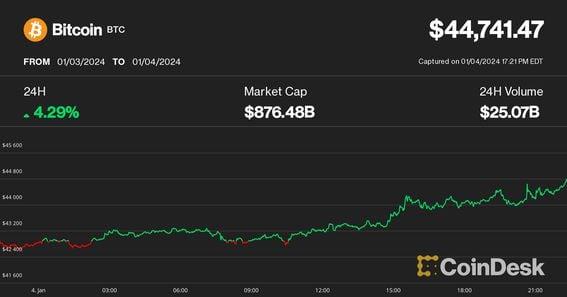
Reports swirled Thursday that the SEC was giving final comments to issuers and may approve multiple spot-based bitcoin ETF applications very soon. BTC recovered almost all losses from Wednesday's flash crash amid reports that a spot ETF approval could be imminent. A survey showed only 39% of financial advisors expected an bitcoin ETF approval this year but 88% would be interested in buying BTC after approval. Investors could switch focus to ether once the bitcoin ETF approved, Matrixport's Marcus Thielen said. Bitcoin (BTC) Thursday rebounded to $44,500 as investors shrugged off yesterday's flash crash and remained optimistic a U.S. spot BTC exchange-traded fund (ETF) approval is around the corner. While a Wednesday Matrixport report warning about a potential rejection may have helped trigger a quick 10% tumble in bitcoin, the majority of observers continue to expect the U.S. Securities and Exchange Commission (SEC) to approve applications, possibly as soon as Friday. Bloomberg ETF analyst Eric Balchunas said during U.S. afternoon hours that the agency was providing final comments on the applications, with prospective issuers then to update their filings accordingly. Shortly after, TechCrunch reporter Jacquelyn Melinek said that the SEC will soon approve multiple applications, citing sources "extremely close to the matter." BTC was up 4% over the past 24 hours and trading at $44,500 at press time, erasing nearly all of yesterday's decline to below the $41,000 level. The anticipation of spot-based bitcoin ETFs that directly hold the underlying asset have been a boon to the crypto market since Wall Street giant BlackRock filed paperwork in June to list one in the U.S. – a move soon followed by a plethora of other applicants. These vehicles are considered superior to already listed futures-based offerings and bulls are betting they will attract significant inflows to the largest cryptocurrency. However, a survey released Thursday by Bitwise and VettaFi curiously found that only 39% of financial advisors expected a spot BTC approval this year. Perhaps more interestingly though, the same survey showed 88% of those advisors see the spot ETF as a major catalyst and would be interested in buying bitcoin after approval. Bitwise is among those asset managers with spot bitcoin ETF applications awaiting word from the SEC. Ether may come next Matrixport research head Markus Thielen, author of yesterday's report calling for a potential rejection or delayed approval, clarified Thursday in a CoinDesk podcast interview that he ultimately expects the U.S. agency to allow spot-based ETFs, but bitcoin may fall to lower prices in the coming weeks as technical indicators signal the uptrend is faltering. Thielen also said that once spot BTC ETFs get the green light, investors will quickly switch their focus to Ethereum's ether (ETH), the second-largest cryptocurrency, with a decision for spot-based ether ETF applications likely due around May. "We would expect then we're going to see some large outperformance of ETH over BTC," Thielen predicted. https://www.coindesk.com/markets/2024/01/04/bitcoin-rebounds-above-44k-as-spot-btc-etf-approval-looks-increasingly-likely/
2024-01-04 12:13
Receipts Depositary Corp. aims to address the institutional desire for bitcoin investments that may not be satisfied by a spot ETF. A group of former Citigroup executives plans to offer bitcoin-backed securities they say don't need to be approved by the U.S. Securities and Exchange Commission (SEC). Receipts Depositary Corp. (RDC) will offer depositary receipts similar to the American depositary receipts (ADRs) that represent foreign stocks on U.S. equity exchanges. The "BTC DRs" will be offered to institutions and cleared through the Depository Trust Company (DTC), according to a press release on Thursday. RDC will offer bitcoin depositary receipts to investors in transactions exempt from registration under the Securities Act of 1933. The offering will start in the coming weeks, according to the statement. "There are many benefits to using depositary receipts, such as their tried and true structure, providing direct ownership of the underlying asset and easy inclusion in institutional products," Ankit Mehta, co-founder and CEO of RDC, said in the release. RDC aims to address the institutional desire for bitcoin investments that may not be satisfied by a spot exchange-traded fund (ETF). The SEC is expected to approve the listing of a spot BTC ETF in the U.S. in the very near future. Whereas shares in bitcoin ETFs would be redeemed for cash, depositary receipts would offer direct ownership of bitcoin, Mehta told Bloomberg, which reported the news earlier. Anchorage Digital Bank National Association will provide custody of the underlying bitcoin. Read More: Bitcoin ETFs Could Spark Huge BTC Trading. The Market Appears Up to the Task https://www.coindesk.com/business/2024/01/04/citi-alumni-founded-startup-to-offer-bitcoin-securities-that-dont-need-green-light-from-sec-bloomberg/

2024-01-04 11:00
Market makers, like trading firm DRW, have been preparing for months to be able to provide the necessary liquidity to ensure sufficient liquidity should the SEC approve bitcoin exchange-traded funds in the U.S. A flood of investment money looks poised to pour into the cryptocurrency market if the U.S. Securities and Exchange Commission does as expected and approves bitcoin ETFs from a dozen or so firms in the next few days, as virtually everyone – crypto-savvy or not – gets easier access to the world of bitcoin (BTC). That would force ETF issuers to scramble to buy potentially tens of billions of dollars worth of the original cryptocurrency to satisfy a surge in demand from mom-and-pop investors (grandma, grandpa and baby, too). The current biggest bitcoin investment vehicle, a relatively hard-to-buy product called the Grayscale Bitcoin Trust, has $26 billion of assets, giving some sense of the appetite for BTC even before the floodgates open. Is the industry up to the task? Yes, according to key market players, who believe bitcoin trading is liquid enough to easily accommodate such giant purchases from issuers including BlackRock, Grayscale, Fidelity and Galaxy/Invesco. To make sure that any large amount of capital trades efficiently, two key players have to step in: Trading firms called authorized participants (APs) and market makers. APs create and redeem ETF shares, directing investor money into and out of the fund; while that may sound mundane, it's a vital part of ensuring the price of an ETF remains closely linked to the value of the fund's underlying holdings. With Grayscale's trust, shares cannot be redeemed. That can lead to there being an oversupply of trust shares, putting downward pressure on their price. And, indeed, the trust has wandered far below its so-called net asset value in recent years – part of why Grayscale wants to turn it into an ETF. While the work of APs is considered the "primary" market, another key player, market makers, is needed in the "secondary" market, for example on exchanges, where most of the trading is done. Market makers build on the role APs fill by buying ETF shares when others want to sell them, and vice versa. If prices get out of whack, they can earn a profit by trading to nudge them back in line. In some cases, market makers also play the role of the AP. Several large Wall Street firms have agreed to serve as APs for bitcoin ETFs: JPMorgan Chase, Jane Street and Cantor Fitzgerald. Others are likely. Trading firm DRW is one of the biggest liquidity providers in the world. Its crypto division, Cumberland DRW, has been preparing for bitcoin ETFs by onboarding issuers and sourcing bitcoin to make sure it's ready when orders come in from APs if and when the new investment vehicles are on the market, the company told CoinDesk. While it might seem like billions of dollars of bitcoin orders would be too much for the market to handle, traders are certain that the market is efficient enough to absorb this kind of trading volume. "If there is demand, there'll be supply," Rob Strebel, Cumberland DRW’s head of relationship management, said in an interview. “I would be surprised if the issuers and regulators would allow this product to launch if it wasn’t confident about being able to source liquidity. I think it’s in everyone’s best interest to make sure that liquidities all lined up, and I’m confident that we’re going to be able to provide the liquidity that’s needed.” ETFs are appealing products for investors because they're relatively easy to access. In the U.S., conventional brokerage accounts let customers buy essentially any of the thousands of stocks and ETFs that are listed in the nation. A bitcoin ETF would be just as easy to purchase as Apple's stock. Another selling point: They tend to closely track the value of the asset they hold. Gold ETFs, for instance, generally move in lockstep with the price of the gold they own. How? Authorized participants dynamically create and redeem ETF shares to keep the fund's price tied to the underlying asset. The bustling bitcoin market Over the past 45 days, daily bitcoin trading has averaged about $22 billion on major exchanges, though there have been spikes to around $40 billion on some days, according to CoinMarketCap.com data analyzed by CoinDesk. Observers believe that's enough to meet demand from bitcoin ETF issuers. "The market can absorb that new layer of demand for the ETF market," Laurent Kssis, director at financial services firm CEC Capital and former managing director at 21Shares, said in an interview. Though the new wave of money is potentially positive for the overall health of the market, it is unclear whether it'll have an impact on the price of bitcoin itself, which would depend on the demand for the ETF and how fast it comes, she added. "Not all ETFs will get that kind of traction," she said. "I strongly believe the investment demand will be skewed towards BlackRock." https://www.coindesk.com/business/2024/01/04/crypto-market-can-easily-handle-bitcoin-etf-trading-volume-which-could-be-worth-billions-of-dollars/

2024-01-04 10:28
Major tokens solana (SOL), ether (ETH) and Cardano’s ADA started to stabilize early Thursday after dropping more than 10% in the past 24 hours. Bitcoin (BTC) traded just above $43,000 in European morning hours Thursday, recovering some losses after a leverage flush sent it down as much as 7% on Wednesday as markets reacted to analyst reports. The largest cryptocurrency could rally to as high as $50,000 this month, said Lucas Kiely, the chief investment officer of wealth platform Yield App. Kiely said he expects the U.S. Securities and Exchange Commission (SEC) to approve a spot bitcoin exchange-traded fund (ETF), dismissing analysis that indicated it will not. Major tokens solana (SOL), ether (ETH) and Cardano’s ADA started to stabilize early Thursday after dropping more than 10% in the past 24 hours. The CoinDesk Market Index (CMI), a broad-based gauge tracking the market, slumped 6% in the same period, its biggest loss in recent weeks. Meme coins dogecoin (DOGE) and shiba inu (SHIB) fell more than 12%. Sei Network’s SEI was one of the few gainers, bolstered by rising hype. A futures unwinding late on Wednesday caused upward of $600 million in liquidations – the most in a year – while open interest, or the number of unsettled futures contracts, fell by $5 billion, the steepest drop in recent months. Wednesday's dump started at the same time research firm Matrixport said it expected "the SEC to reject all proposals in January" for a spot bitcoin ETF. Options analyst GreeksLive shared the outlook, saying that "weakness in crypto mining stocks, and the sell-off in several crypto-related U.S. stocks" had reinforced the market's skepticism. Yield App's Kiely took the opposite position, telling CoinDesk in an email that reports that the SEC won’t approve a bitcoin spot ETF this month should be ignored. "I think it’s still likely that we see an approval from the SEC in January," Keily said. "There is too much pressure and expectation from the world's biggest asset managers for Gary Gensler and the rest of the approval committee to keep kicking the can down the road," referring to the regulator's chairman by name. "I don’t expect to see a massive sell-the-news event as some have predicted. Rather than falling as low as $32,000, I think that bitcoin will take $50,000 by the end of January and we will see a record print of BTC this year," he said. Firms such as on-chain data provider CryptoQuant say they expect bitcoin to drop to as low as $32,000 next month following the potential approval of a spot ETF – stating that traders' unrealized profits are currently lingering at a level that historically precedes a so-called correction, which for cryptocurrencies typically refers to a decline of 10% or more. https://www.coindesk.com/markets/2024/01/04/bitcoin-could-rally-to-50k-as-gensler-faces-pressure-to-approve-etf-traders-say/

2024-01-04 09:35
Coinbase's Nasdaq-listed stock fell 2.96% Wednesday as the crypto market's rally halted. Cathie Wood's ARK Invest sold over $25 million worth of Coinbase (COIN) shares from two of its exchange-traded funds (ETFs) on Wednesday. The investment firm sold a total of 166,183 COIN shares from its Innovation ETF (ARKK) and Next Generation Internet ETF (ARKW), a value of $25.3 million at the crypto exchange's closing price. Coinbase's Nasdaq-listed shares fell 2.96% to $152.24 on Wednesday as the crypto market's rally halted and bitcoin slumped, partly due to a leverage flush as the market became overheated. ARK's ETFs have a target weighting whereby no individual holding exceeds 10% of the fund's total value. Having more than doubled in price in the last three months of 2023, COIN has consistently held above that threshold in both ARKK and ARKW, leading to regular sales of the crypto exchange's stock by Cathie Wood's firm. Read More: Cathie Wood's ARK Invests in ProShares Bitcoin ETF After Dumping Grayscale Holdings https://www.coindesk.com/markets/2024/01/04/cathie-woods-ark-invest-offloads-25m-of-coinbase-shares/