2023-12-26 06:56
Bitcoin's dominance by futures open interest has declined to 38% from nearly 50% two months ago. Crypto traders are increasingly looking to alternative cryptocurrencies as 2023 draws to a close. The dollar value locked in the number of active futures contracts tied to bitcoin now accounts for 38% of the market-wide notional futures open interest of $30.45 billion. That's the lowest in at least two years, according to data tracked by Coinalyze. "Seems 'all' the money is going into alts now," Coinalyze told CoinDesk, explaining the decline in BTC's dominance by open interest in futures. The data show renewed risk appetite in the crypto market typically observed after a notable bitcoin uptrend. Bitcoin, the leading cryptocurrency by market value, has surged over 60% to $43,100 since Oct. 1, mainly due to dwindling Treasury yields and expectations that the U.S. Securities and Exchange Commission would soon approve one or more spot BTC ETFs. As of writing, BTC was up 161% on a year-to-date basis, and ether, the second-largest cryptocurrency, traded 88% higher. BTC's dominance by futures open interest has declined from nearly 50% in late October to 48%. ETH's dominance has remained steady at nearly 21%, while the share of altcoins has increased from 32% to 41%. https://www.coindesk.com/markets/2023/12/26/bitcoin-futures-open-interest-slides-as-altcoin-profits-allure-traders/
2023-12-25 11:01
Prime Minister Fumio Kishida’s government has been considering submissions on how best to encourage the industry's development, which it sees as a pillar of economic reform. The Japanese cabinet approved a proposal by the ruling Liberal Democratic party to end taxation of unrealized cryptocurrency gains in a move that is likely to boost the development of the country’s Web3 industry, CoinDesk Japan reported. The proposal, which needs to be debated in the Diet, Japan’s parliament, will end corporate taxation on the difference between the market and book values of crypto assets issued by other companies. It it became law, the Dec. 22 approval would end a discrepancy in the treatment of third-party issued assets and those issued by holders, who are not taxed on mark-to-market values. The tax has hindered Web3 businesses in the country, CoinDesk Japan said. Prime Minister Fumio Kishida’s government has been considering submissions from industry associations such as the Japan Crypto Asset Business Association (JCBA) and Japan Blockchain Association on how best to encourage the industry's development, which it sees as a pillar of economic reform. Having politicians drive policy development is a departure from traditional practice in a country where that role is usually taken by the bureaucracy. Web3 companies have been moving overseas because they became liable for tax even before making profits from their activities, Gaku Saito, chairman of the JCBA's tax review committee, told CoinDesk Japan in an interview. Companies were having to pay tax on unrealized gains, forcing them to sell their assets and stifling business development. https://www.coindesk.com/policy/2023/12/25/japans-cabinet-proposes-scrapping-corporate-tax-on-unrealized-crypto-gains/

2023-12-23 19:47
Meme coin traders and airdrop farmers are bringing more attention to Solana. The Solana blockchain's native token SOL broke $100 Saturday, reclaiming a price level not seen since the eve of Terra's collapse a year and a half ago. At press time SOL was valued at around $102 a coin. It has increased in value more than tenfold in 2023 and is up over 70% in December alone, according to CoinDesk Indices. Saturday's price action capped weeks of frenzied trading that have – at least temporarily – vaulted the Solana blockchain up the leaderboard for on-chain activity. Solana-based decentralized exchanges are nearing Uniswap's multibillion-dollar trading volumes for the first time, according to DefiLlama. Much of that energy is being driven by rampant speculation. Some of the most popular crypto assets being traded on Solana right now are dog-themed meme coins. But airdrops, too, are prompting droves of traders to test out Solana-based lenders, bridges and other infrastructure. Solana is a smart contracts platform that supports fast and cheap crypto transactions. It has been compared to Ethereum, which despite Solana's ascendence, is still the most popular and best-known place for crypto traders to play on-chain. https://www.coindesk.com/markets/2023/12/23/solana-sol-rallies-past-100-continuing-torrid-month/

2023-12-22 20:42
Tokens from Injective, a layer-1 blockchain in the Cosmos ecosystem, and Render, a GPU rendering network that migrated this year to Solana from Ethereum, dominated the year's return rankings among the CoinDesk Market Index (CMI) benchmark index of 184 digital assets. Sure, we love to geek out about blockchain technology, and wonder if all of this might someday serve as the foundation for an entirely new-built infrastructure of digital finance. But hey, what about the money end? A cornerstone of capitalism is letting investors bet on the emergence of new technologies, and one thing that's notable about blockchain is that the industry has developed its own markets to bet on blockchain winners and losers. (Whether these markets pass muster with regulators is an entirely separate question; in the meantime you won't find Solana's SOL token trading on Wall Street.) With that in mind, what better prism is there on the performance of digital-asset markets during 2023 than the benchmark CoinDesk Market Index (CMI), accompanied by a breakdown of year-to-date returns for the various industry sectors? Below please find six charts highlighting some of the biggest takeaways from 2023. CoinDesk's Bradley Keoun, founding editor of The Protocol newsletter, wrote this article, based on charts prepared by Tracy Stephens of CoinDesk Indices. CoinDesk Market Index (CMI) has 5x'd the S&P 500 this year The CoinDesk Market Index (CMI) is CoinDesk's broadest, most inclusive gauge of digital-asset markets – "Crypto's S&P 500," as we like to call our benchmark index. In the year through Dec. 21, the CMI more than doubled, gaining 125% to be precise. As seen in the chart above, the bulk of the year's returns came during the first quarter of the year, and during the last quarter; in between, there were a lot of doldrums, bringing a lot of gut-wrenching anxiety (and layoffs) for the crypto industry, before the green shoots started to show. Bitcoin (BTC), the largest cryptocurrency by market capitalization, outperformed the benchmark, while Ethereum's ether (ETH), the second-biggest, underperformed. The CMI's year-to-date return was roughly five times the 23% figure for the Standard & Poor's 500 Index, the benchmark for U.S. stocks. CoinDesk Computing Index (CPU) leads sector index returns The CoinDesk Computing Index (CPU) led gains among the CMI sector indices, with a 167% return in 2023. The index corresponds to the Computing sector within the CoinDesk Digital Asset Classification Standard. The definition of the Computing sector is as follows: "The Computing sector consists of projects that aim to decentralize the sharing, storing and transmission of data by removing intermediaries and ensuring privacy for all users. All projects that aim to gather, transmit, store and share data and web services in a decentralized manner play a key factor in building the infrastructure of Web3. This includes on-chain and off-chain data transmission, social data platforms, peer-to-peer secure data transactions, open networks, free market private computation and decentralized file storage and file sharing." Ranking second among the sector indices was the CoinDesk Currency Index (CCY), with a 150% return. That index includes bitcoin (BTC), XRP (XRP), Stellar lumens (XLM) and dogecoin (DOGE). Injective, RenderToken, Solana led CMI token returns Can you say 32x? That was the return for Injective Protocol's INJ token (INJ). Injective is a blockchain built for finance, using Cosmos blockchain technology, that claims to be the fastest among layer 1s. In August we reported on its “2.0” tokenomics upgrade to “dramatically increase the amount of INJ burned weekly,” citing a blog post at the time. RenderToken (RNDR) from Render, a GPU rendering network that migrated this year to Solana from Ethereum, surged 972%. (RenderToken, for what it's worth, was the top performer in the top-performing Computing sector.) Solana's SOL zoomed 833%. In notoriously volatile digital-asset markets, there is exactly zero guarantee that any of these gains are deserved or enduring. What is safe to say is that digital-asset markets in 2023 saw the reappearance of the type of mind-blowing returns – and high risk – that historically have attracted a lot of traders to crypto. ApeCoin, Luna, DASH, BAL, OMG, ZEC were the big 2023 losers in CMI We don't need to belabor the point here; in 2023, the biggest rewards probably accrued to crypto traders who went long. But it's possible some lucky or smart managers succeeded in shorting the right horses, as it were. A few of these projects were legacy failures i.e. Terra's LUNA (LUNA). Others just sort of lost steam, like EthereumPOW's ETHW (ETHW), which basically died on the vine as the main Ethereum blockchain successfully completed its transition to a proof-of-stake blockchain, culminating in the so-called "Shapella" upgrade earlier this that allowed staking withdrawals for the first time. Ethereum Name Service's (ENS) and Zcash's ZEC (ZEC), representing projects still considered by many crypto analysts to be interesting enough, had a tough year. Bitcoin extended its dominance Sometimes it can be hard for normies to really get this, but bitcoin (BTC) is actually seen by many savvy crypto traders as the safe play. So on a risk-reward basis, one would be pretty hard-pressed to complain about the OG cryptocurrency's 164% year-to-date return through Dec. 21. (The chart above shows YTD leaders in the CoinDesk Currency Index (CCY).) XRP (XRP), the payments token used in Ripple Labs's network, had a decent year with an 83% climb – as a crucial decision went its way in a pending case before the U.S. Securities and Exchange Commission. (Read Sam Kessler's story from earlier this year on why that decision suddenly made it worthwhile again to study the technology behind the XRP Ledger.) The XLM (XLM) tokens from Stellar, which spent the year readying for its big "Soroban" smart-contracts upgrade expected in early 2024, weren't far behind, with a 73% return. CoinDesk Smart Contract Platform Sector (SMT) Regular readers of The Protocol newsletter – highlighting blockchain tech; please subscribe here! – will quickly recognize this index: the CoinDesk Smart Contract Platform Index (SMT); it captures the biggest core blockchain infrastructure plays beyond Bitcoin; those include heavyweight Ethereum as well as the myriad alt-layer-1 blockchains and rapidly-proliferating layer-2 networks that are vying for relevance. In 2023 the SMT index has returned 107%, slightly underperforming the benchmark CMI, at least partly due to the outperformance of bitcoin, which isn't a member. We've already talked about the market leaders Injective and Solana. Ethereum's ETH turned in a respectable 87% climb, though the anti-#Flippening crowd will certainly note the drastic gap versus bitcoin's 164%. Avalanche's AVAX (AVAX) had a big year, riding the narrative that it might get traction from institutional blockchain adopters; the project played a leading role in a big proof-of-concept demonstration by JPMorgan and Apollo. The Optimism ecosystem's OP (OP) token gained as Coinbase's Base and several other projects chose the technology as the template for new layer-2 networks they wanted to build. The SKALE SKALE token from Skale Network – describing itself as an "Ethereum-native multichain network built to scale Ethereum dApps with a focus on high-throughput, fast finality, and zero gas fee transactions" – scored big with a 151% 2023 rally. Notable was the lackluster performance of Polygon's MATIC (MATIC) token, with 6.2% – even though the project was one of the most aggressive in positioning itself at the forefront of the Ethereum layer-2 race, and a leader in the adoption of hotter-than-hot "zero-knowledge" cryptography. The Cosmos ecosystem's ATOM token was also somewhat of a disappointment on a relative basis, gaining just 20% even though its vision for a multi-chain, interoperable blockchain universe has pretty much taken hold throughout the blockchain universe. And it landed some major projects, including a new layer-1 blockchain for decentralized derivatives exchange dYdX, which migrated away from its prior status as a layer-2 network atop Ethereum. (We covered that here.) What will happen with crypto markets in 2024? What happens next? Check out our 2024 predictions for blockchain tech here. But in terms of crypto markets? Historically the quadrennial Bitcoin halvings like the one that's expected next year, have driven a four-year market cycle. But that history only goes back 14 years. One area where crypto markets are exactly like traditional markets: Nobody really knows what's going to happen – everyone's just guessing. Or as it's been said in the past about Wall Street stock pitchers: If they tell you to buy it, it means they've already bought. Read More: Blockchain Tech Predictions for 2024, From Experts at Ripple, Coinbase, a16z, Starknet https://www.coindesk.com/markets/2023/12/22/who-won-crypto-in-2023-the-coindesk-market-index-broken-down-in-6-charts/

2023-12-22 17:44
BarnBridge failed to register its structured crypto product with the SEC, regulators alleged. Crypto investments issuer BarnBridge DAO and its founders agreed to pay $1.7 million to settle allegations from the Securities and Exchange Commission (SEC) that it offered illegal crypto securities to U.S. investors. The Ethereum-based crypto project will shut down its structured crypto investment product, called SMART Yield, which BarnBridge had compared to "highly rated debt instruments." Financial regulators said SMART Yield failed to register as an investment company even as it amassed $509 million from crypto investors, including some from the U.S. While the SEC often comes after crypto companies for purported securities violations, Friday's action is notable because it may be the first targeting a crypto startup that structured itself as a "decentralized autonomous organization," or DAO, in which the DAO held a public vote on how to respond. DAOs are businesses theoretically beholden to their tokenholders. In BarnBridge's case, anyone who owned its BOND token had a say in operations. Financial startups that fashion themselves as DAOs do not always register as companies. It's even rarer for such entities to view their products as securities that need to be registered with the SEC. This can prove problematic if their wares are open for U.S. investors, as was the case with BarnBridge. According to the SEC, BarnBridge took no steps to prevent U.S. investors from buying into its SMART Yield product. It accused Ward and Murray of violating registration requirements and other violations. Both agreed to pay individual civil penalties of $125,000. BarnBridge DAO itself agreed to $1,457,000 in disgorgement to the SEC. In both cases the parties did not admit to or deny the allegations. The minutia of SEC's allegations against SMART Yield raise questions about its broader stance on DeFi structures such as pools, lending, staking and stabelcoin returns, according to tweets from securites lawyer Drew Hinkes. But the outcome offers no sweeping answers. Because it's a settlement it "has no precedental value," according to Hinkes. While the SEC has come down hard on crypto firms' alleged violations of U.S. securities law, it is hardly a monolith. Some members of the commission – notably Hester Pierce – have previously written dissents criticizing SEC orders they see as overly burdensome on a burgeoning area of financial innovation. Pierce filed no such dissent on Friday. BarnBridge's structure as a DAO found no favor with the SEC, which called it a "purportedly decentralized autonomous organization." In reality, according to the SEC, Murray and Ward were instrumental to the business's day-to-day operations as well as its wonky crypto governance quirks. They held outsize portions of BarnBridge's BOND. "Every proposal approved by the DAO needed, and received, Ward and Murray’s votes to reach a quorum," the SEC order read. "This case serves as an important reminder that those laws apply to all who wish to access our capital markets, regardless of whether they are, or purport to be, incorporated, decentralized or autonomous," Gurbir S. Grewal, Director of the SEC’s Division of Enforcement, said in a press release. Regardless of the SEC's opinion, BarnBridge DAO's founders played their governance game to the end. In October they held a vote seeking approval for a settlement with the SEC. They passed it using their own tokens. https://www.coindesk.com/policy/2023/12/22/sec-blasts-purportedly-decentralized-daos-in-17m-settlement-with-barnbridge/
2023-12-22 13:30
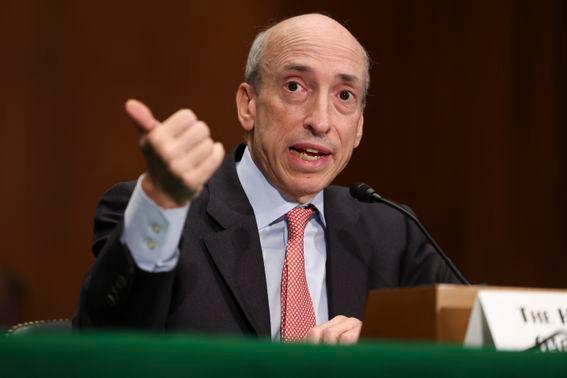
The Securities and Exchange Commission chief shared his views on the crypto industry. Earlier this month, I had the opportunity to speak with U.S. Securities and Exchange Commission (SEC) Chair Gary Gensler, recognized by CoinDesk as one of the most influential figures in the crypto industry over the past year, about how he views his agency's role in the digital asset world. A business model of noncompliance The narrative The crypto industry has its share of bad – or maybe inept – actors. After the past year, that point can't really be argued. I spoke to SEC Chair Gary Gensler earlier this month as part of my reporting for this year's Most Influential series. Why it matters The SEC chief and the agency he oversees continue to remain the most prominent regulatory body for the U.S. crypto industry, and with good reason – while crypto companies look for state money transmitter licenses and look to comply with anti-money laundering rules, much of the industry's trading falls within the SEC's bucket (or not, depending on who you ask). Breaking it down Crypto's entrepreneurs have "generally built a business model around noncompliance with the law," the SEC chief said. Gensler, one of the industry's favorite – or perhaps least favorite – foils was recognized by CoinDesk as one of crypto's most influential figures through 2023. In the past year his agency has sued crypto exchanges like Coinbase, Binance and Kraken, begun reviewing a new slate of spot bitcoin exchange-traded fund (ETF) applications and started outlining a (still-untested) pathway for companies to list and trade digital assets in compliance with the agency's vision of how digital assets fit within existing law. But in Gensler's words, much of his focus is on addressing a field that's rife with fraud and where some companies fail to protect their customers against wash trading or other issues. It's a view he's reiterated a number of times, pointing to the bankruptcies of the past 18 months or so as an example. While he has "deep respect for the investing public," Gensler told CoinDesk he does not believe crypto investors are receiving appropriate disclosures from the various projects they may be buying tokens for. There are "far too many frauds and bankruptcies" out there, he said. Within the crypto remit, Gensler said some of his concerns included companies commingling customer funds (a concern that's shown up in some of the SEC's complaints against crypto companies this year) and trading against their own customers. The SEC is reviewing a number of outstanding rules that might affect the crypto industry, though he said he wouldn't prejudge them when asked about how he looked at one, as an example. He highlighted entrepreneurs in the sector a number of times. "These entrepreneurs have followings on Reddit, on Medium. It's also 24 hours a day, seven days a week," he said. Gensler also questioned the real value proposition of most of the tokens he sees as crypto securities. "If there's a good or service, we can understand that," he said. "What's the value proposition of actually having a decentralized token?" Many of these projects are just "speculative investment contracts," he said. Even bitcoin, which is widely seen as a commodity, is speculative, he said. "Investors should be wary, they should be careful, they should be ready to lose 100% of their assets – if you can find a website, if you can read about them in CoinDesk, it's likely that you're making a bet on those entrepreneurs," Gensler said. Stories you may have missed Elizabeth Warren Pushes Back at Blockchain Lobbying Efforts: U.S. Senator Elizabeth Warren (D-Mass.) has sent a letter to the Blockchain Association, Coin Center and Coinbase asking about how many former government employees or elected officials are associated with the trade groups/exchange. The lawmaker asked for the groups to list the officials and their previous roles. A New Kind of Insider Trading? Hegic's DeFi Bets Might Attract SEC's Attention, Experts Say: The pseudonymous developer behind crypto options trading platform Hegic seems to have bought a third of all tokens tied to another platform they developed called Whiteheart before announcing that Whiteheart would shut down and would liquidate its treasury. Price went up, and Hegic looks to make a large profit. Crypto Trader Turns $1K Into $100K on Solana’s Newest Memecoin, Dogwifhat: We've entered what I like to call the silly season. People are arbitraging all sorts of weird stuff. For example…this. Click Danny's profile for more examples of pouring money into things in hopes of a quick return. Wrapping up 2023 Next week, as has become tradition around these parts, CoinDesk's Regulation Team will share what they're expecting or watching out for next year. But I also want to hear from you, our readers, on what you will be watching or expecting in 2024 – if you want to weigh in for a future edition of this newsletter, shoot me an email with a brief (100-200 words) explanation, alongside your name or handle and interest in crypto. This week This week There do not appear to be any hearings or events of note this week. Elsewhere: (Slate) Slate's Nitish Pahwa dug through court exhibits from Sam Bankman-Fried's trial to look at how exactly he was involved in what "was, notoriously, one of the most expensive races" in the 2022 midterm elections. (Fortune) The office of New York Attorney General Letitia James is using the lawsuit against Gemini and Digital Currency Group to push again for state legislation that would give it greater oversight over the crypto industry, in conflict with the New York Department of Financial Services, reports Fortune's Leo Schwartz. (Forbes) Bhutan is building a megacity to spur economic development, reports Forbes. If you’ve got thoughts or questions on what I should discuss next week or any other feedback you’d like to share, feel free to email me at [email protected] or find me on Twitter @nikhileshde. You can also join the group conversation on Telegram. See ya’ll next week! https://www.coindesk.com/policy/2023/12/22/sec-chair-gary-gensler-far-too-many-frauds-and-bankruptcies/