2023-12-21 05:57
The Sandbox's partnership with CoinDCX and Okto could make India its largest market. Metaverse platform The Sandbox is aiming to make India its largest market within the next 2 years after entering the nation earlier this year through a joint venture with a local entity, a first for the subsidiary of metaverse gaming and venture capital giant Animoca Brands. “We want to build a diverse and inclusive world with no borders, bringing different regions of the world together, and with that vision in mind, a year ago, we started out in India to establish a joint venture,” Sandbox Co-Founder Sebastien Borget told CoinDesk in an interview in India’s southern city of Bengaluru earlier this month. The joint venture between Brinc, a global venture accelerator and The Sandbox was announced in Feb. 2023 and led to the creation of BharatBox, a cultural metaverse hub for India that encompasses Bollywood, India’s famous Hindi cinema industry too. “The Indian entity of The Sandbox is BharatBox,” said Karan Keswani, CEO of BharatBox. “BharatVerse is the Indian land on The Sandbox map.” Its ambitions for India come at a time when lawmakers have asked the Web3 industry to decouple itself from crypto. India’s crypto industry has been in survival mode after the nation imposed stiff taxes in 2022. For a Web3 gaming giant to foray into India despite the regulatory clouds is reflective of the interest in the nation’s gaming and developer promise. “We are ready to engage with and help regulators to discuss the space,” Borget said. In the past six months, BharatBox has signed 25 Indian partners, including Eros Entertainment, Hungama and Shemaroo, three legacy media entertainment companies in Indian cinema. But the one partnership that Keswani expects will catapult India into The Sandbox’s largest market is the one with CoinDCX, a prominent Indian exchange. “Our strategic ecosystem partnership with CoinDCX and the Web3 wallet Okto gives us exposure to their 16 million users,” said Keswani. “Globally, The Sandbox has five million wallets. Along with CoinDCX and Okto, we’re confident of bringing three to four million gamers through their Okto community, and that’s our vision, to onboard those users within 24 months, and then India will be The Sandbox’s largest market.” CoinDCX and Okto co-founder Neeraj Khandelwal told CoinDesk that “Okto is glad to be working with one of the best players in the Metaverse and gaming ecosystem to help them get a strong footing in India." Most of the partnerships are contract and land partner agreements that will allow the company to use its acquired Land NFTs in the open metaverse to build gamified experiences in The Sandbox dedicated to India, such as a recent one to bring India’s epic Mahabharat to the Metaverse. BharatBox is also working towards bringing the wider portfolio of Animoca Brands to India to provide other Web3 solutions such as ticketing and blockchain gaming. https://www.coindesk.com/web3/2023/12/21/the-sandbox-aims-to-make-india-its-largest-market/

2023-12-20 19:19
Senator Liz Warren has revved up her anti-crypto army by going after the revolving door between blockchain and Washington D.C. I stand with her, and you should too, against these enemies of the state: crypto users. If you work in crypto, you are going to hell. I stand with Senator Elizabeth Warren (D-Mass.), as part of her anti-crypto army, in condemning this villainous industry chock full of crooks, bastards and fools waiting to be separated from their money. The grift and crime rampant throughout crypto is comical and villainous. It is comically villainous. Together with the likes of newsletter writer Matt Stoller, we of the anti-crypto army are banding together to strengthen regulatory attention on crypto. No way should there be a means for consenting peers to transact directly without a bank or other financial institution to act as an intermediary. We must keep people and the public safe. If cash were created today, I’d oppose it for the same reasons as crypto. Cash and crypto both fall afoul of the Bank Secrecy Act (BSA). The BSA is a much needed and highly effective regulation. Without it, U.S. financial activity would falter. In no way is the BSA simply a means for banks to absolve themselves of the responsibility of proactively preventing fraud or making good when it happens, by allowing them to file wanton Suspicious Activity Reports to regulators who definitely have the means of assessing the risks. And in no way does the BSA violate the civil liberties enshrined in the U.S. Constitution — that is simply not a conversation worth having. Indeed, because no crypto exchange performs standard know-your-customer (KYC) checks or works with on-chain analytics companies to monitor for illicit activity or terrorist financing, the entire blockchain sector is simply a big black box presumably filled with fraud. I know this because Senator Warren wrote a letter to Congress saying so. Nevermind that companies like Chainalysis or Elliptic routinely find that the vast majority of crypto use is legitimate or at least not explicitly illicit. I mean, what else would publicly verifiable and immutable ledgers be used for? Indeed, Senator Warren also sent out a number of letters to crypto lobbyists including Coin Center, the Blockchain Association and crypto exchange Coinbase, which has recently reinvested in its own Washington D.C. pressure campaign, calling out the revolving door that exists between crypto and the Capitol. Shameful activity. Banks and other stolid financial institutions would never hire former politicians or those with political connections to advance their interests. It would be unseemly — as unseemly, say, as a legislator who actively trades stocks. Warren, mind you, is the Senator who got the Consumer Financial Protection Bureau through political gridlock, so she knows a few things about financial safety. Because of all of this and more, I must join the ranks of the anti-crypto army and combat the adoption of crypto. Even if you want to grant that crypto has been used to fund dissident political actors and freedom fighters alongside terrorists, the contributions blockchain developers have made to cryptography and self-custody solutions or the political flowering that can follow when people begin to take ideas of sovereignty and community seriously, crypto cannot be worth it. And what exactly are the costs of crypto? Meme coins, ransomware and grift. The internet is a place of learning, which flattens access to knowledge, not a place for fun and games and gambling. Further, in no way would the continued rapid growth of the internet explain at all the concomitant rise in online crime — only crypto explains the rise of hackers and scammers in U.S. society. So, as my fellow anti-crypto soldier Matt Stoller has said, if you are in crypto or into blockchain at all today, you are likely an enemy of the state. I will die on this hill. https://www.coindesk.com/consensus-magazine/2023/12/20/if-youre-in-crypto-youre-a-criminal/

2023-12-20 17:50
Bankman-Fried's defense team asked for a four to six week extension for his sentencing scheduled in late March, citing a possible second trial that may begin earlier in the month. A federal judge denied onetime FTX CEO Sam Bankman-Fried's request to extend his sentencing process and delay a presentencing interview with the U.S. Probation and Pretrial Services System, which will recommend a sentence. Attorneys for Bankman-Fried filed a letter Wednesday requesting the extension, saying he faces a possible second trial on additional charges set for March 11. The sentencing hearing is scheduled for March 28. They also asked that a presentence interview scheduled for Thursday be delayed, alongside other deadlines. "We submit that Mr. Bankman-Fried should not begin the sentencing process on the counts of conviction, including the presentence interview, until the severed counts are resolved," the letter said. "Doing so could potentially result in a separate PSR and a separate sentencing hearing on conduct that was already part of the Government’s proof at trial." Bankman-Fried was convicted on seven charges of fraud and conspiracy last month, after prosecutors alleged he misappropriated FTX customer and investor funds, as well as Alameda Research's lenders' funds. District Judge Lewis Kaplan, the Southern District of New York judge overseeing the case, denied the motion, saying that the defense did not object when the March 28 date was originally set. If the Department of Justice does choose to proceed to a second trial on bank fraud and Foreign Corrupt Practices Act conspiracy charges, sentencing could be delayed, the judge said. "The defendant already has had over six weeks in which to prepare for the presentence interview, which shall take place tomorrow as scheduled," he wrote. https://www.coindesk.com/policy/2023/12/20/judge-denies-sam-bankman-fried-request-for-a-longer-sentencing-process/

2023-12-20 16:35
We assembled 10 new year's predictions for blockchain tech trends and developments, from the experts. They might be right. A lot of blockchain developers probably feel like they're working on the cutting edge of the cutting edge, building the financial and business infrastructure of the future. It’s nothing short of a revolution. Based on what we've seen, and reported, they're not wrong. Or, at least, it seems safe to say, the pace of innovation and speed of new developments in the blockchain space rarely ceases to stun; except for those moments when it all seems to look alike. This year's crypto-market doldrums brought little respite from the announcements, product rollouts, integrations, partnerships, collaborations, fundraisings, launches, deployments, migrations, transitions. There's a lot of transformation, and information, all quite technical, complex; as hard as it can be to catch up, keeping up is equally daunting. Imagine piloting a spaceship through a dense asteroid field while playing a game of Concentration with the individual asteroids; pattern recognition might be your only hope. A few key 2023 trends were broadly foreseen by the experts. Many weren't. Truth be told, nobody really knows where all of this is going. We curated 10 predictions from blockchain tech experts for 2024; their prognostications are as good as any, and quite technical. Bonne chance. Interoperability "By 2024 and beyond, the advancement of blockchain interoperability protocols will mark a major shift by breaking down the existing silos between different blockchains. This shift will enable diverse blockchain platforms to seamlessly interact by sharing data and value transfer, creating a unified and more efficient blockchain ecosystem. The role of interoperability protocols will be crucial in this transformation, as they will increase innovation, as well as foster new applications and use cases, specifically in DeFi." - David Schwartz, CTO, Ripple Labs. Bitcoin fees "In light of decreasing fixed block rewards for miners, our view is that catalysts for raising the variable block rewards from transaction fees will be increasingly important. The core Bitcoin protocol is in a largely stable state, with the Taproot upgrade in November 2021 being the only major protocol upgrade in the past five years – at least with regards to changes that have required a soft fork. Thus, we believe usage catalysts will originate from technological innovation, mostly within the confines of the existing network protocol such as increased usage of blob data like Ordinals and Atomicals, elevated activity on secondary layer 2s like the Lightning Network (LN), or general smart-contract environments built on top of the Bitcoin network like Rootstock, Stacks, RGB or future implementations of BitVM." - David Duong, head of institutional research, Coinbase. Modularity “We’ve also seen a consolidation on the modular thesis and exciting developments in this space as more and more hybrid solutions come to market such as Ethereum roll ups using Celestia as the data availability layer. Meanwhile we also have blockchains like Solana continuing in its monolithic direction and saying no to layer 2s because they view them as bad for liquidity and the user experience. It will be interesting to watch these two narratives play out in 2024, especially as some Ethereum rollups explore using the Solana virtual machine.” - Abdelhamid Bakhta, lead and core Ethereum developer, Starknet ecosystem. Zero-Knowledge Proofs "SNARKs allow the computation of a 'cryptographic receipt' of some compute workload by an untrusted “prover” impossible to forge: In the past computing such a receipt cost 10^9 work overhead over the original compute; recent advances are bringing this number closer to 10^6. SNARKs therefore become viable in situations where the initial compute provider can bear a 10^6 overhead and the clients cannot re-execute or store initial data. The use cases that result are many: Edge devices in the Internet of Things can verify upgrades. Media editing software can embed content authenticity and transformation data; while remixed memes could pay homage to initial sources. LLM inferences could include authenticity information. We could have self-verifying IRS forms, unforgeable bank audits, and many more uses that benefit consumers ahead." - Sam Ragsdale, investment engineer, a16z. Key management/user interfaces “The emergence of account abstraction means that we can soon overcome the technical challenges of self-custody. 2024 will be the year that seed phrases can finally become a historical practice for most. The idea that the safety of assets meant having 12 words that you can never lose, but no one else can ever access, is outdated and to a large extent has been holding back progress for actual user adoption. As such, blockchain is in a position to deliver on the promise of inclusive finance that’s been so central to our values since the beginning.” - Friederike Ernst, co-founder, Gnosis and Gnosis Pay. Censorship "Centralization concerns essentially boil down to two core issues: (1) Does a certain vector of centralization lead to network performance issues that put applications at risk of outages? And (2) will centralization create censorship challenges? One of the interesting things about the disentanglement of block building, relaying and validation in Ethereum is that it cleanly separates censorship challenges between three different layers of the Ethereum transaction processing stack. After the U.S. Office of Foreign Assets Control (OFAC) sanctioned Tornado Cash addresses last summer, major Ethereum relays began to censor transactions. The problem only abated once Flashbots open-sourced its market-dominant relay, and allowed permissionless relays like Ultra Sound, Agnostic and bloXroute to become more competitive. Today, it's block builders who have increasingly begun to censor transactions. I'd expect some of the biggest development breakthroughs in 2024 to come in areas like mempool encryption that shield transactions from potentially censorious parties before they are included in a block." - Ryan Selkis, founder and CEO, Messari. Security/privacy "In 2023 there have been tons of hacks and fraud within the crypto space including Euler Finance and Angle Protocol. We will see blockchain protocols creating more security solutions and taking privacy more seriously." - Ramani Ramachandran, CEO, Router Protocol. Corporate crypto "Networks and developer platforms should be prepared for onboarding corporate and startup builders, as well as independent developers. Network protocol teams should be prepared with user experiences that can reach millions of end users in their native digital experiences. Larger companies are moving beyond crypto as an asset class and into crypto as a product and tool for user engagement. Crypto needs to expand its footprint and bring in the next wave of on-chain activity." - Vanessa Pestritto, director of partner programs at Agoric OpCo, a JavaScript-native smart contract platform and proof-of-stake blockchain. Layer-2 Flows "The influx of activity on layer-2 chains has comparatively fizzled out during the midpoint of the year with most of the liquidity staying confined in the Ethereum mainnet. As a result, the DeFi protocols residing natively on layer-2 chains have seen an outflow of liquidity for a large part of the year. However, as gas fees on the Ethereum mainnet rise in line with spikes in activity, a part of the new capital will be flowing to the Layer-2 chains as their new home next year." - CCData outlook report, from the digital-assets data and analytics firm previously known as CryptoCompare. (Or maybe, alternatively, or simultaneously) Layer-2 consolidation "Ethereum will implement EIP-4844 (proto-danksharding), which will reduce transaction fees and improve scalability for layer-2 chains such as Polygon, Arbitrum, Optimism and others. Within one year of the upgrade, Ethereum L2s will consolidate down to two-to-three dominant players as measured by value and usage." - Mathew Sigel, head of digital assets research, VanEck. https://www.coindesk.com/consensus-magazine/2023/12/20/blockchain-tech-predictions-for-2024-from-experts-at-ripple-coinbase-a16z-starknet/

2023-12-20 16:33
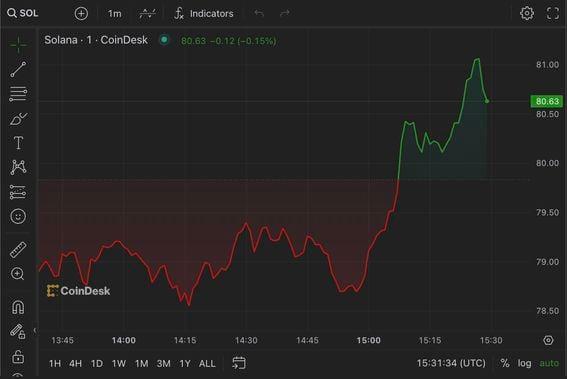
SOL is trading at a 20-month high on the back of a bustling DeFi ecosystem and meme coin mania. Solana (SOL) has overtaken XRP as the fifth-largest cryptocurrency, with its market cap hitting a 20-month high of $33.7 billion, according to CoinMarketCap. Having fended off a wave of selling pressure from holdings in the FTX bankruptcy estate, the token's recent growth has been outlined by a burgeoning decentralized finance (DeFi) ecosystem coupled with hype-fueled meme coin mania. This week, total value locked (TVL) on Solana topped $1 billion for the first since FTX's collapse in November last year, spurred by rising asset prices and consistent inflows to DeFi protocols. Decentralized exchanges on Solana have experienced a boost in trading volume. On Dec. 15, Orca facilitated $746 million in volume, it has previously surpassed $100 million only once before November. Much of the increased activity can be attributed to meme coins like Bonk, a dog-themed token that now has a market cap of more than $1.2 billion. As speculators race to find the next meme coin that turns hundreds of dollars into hundreds of thousands of dollars, traders typically purchase Solana as the underlying asset before converting that into their meme coin of choice. And every time they sell the meme coin back into Solana they effectively prompt a wave of buying pressure. But much of the recent focus has been on Solana itself. The blockchain appears to improved network stability following a series of outages last year. It has also distanced itself from FTX following the collapse of the exchange, which purchased $1 billion worth of Solana-based tokens before it filed for bankruptcy. SOL is currently trading at $81.04 having risen by 9.14% over the past 24 hours. Trading volume is up by 39% to $2.6 billion, according to CoinMarketCap. https://www.coindesk.com/markets/2023/12/20/solana-leapfrogs-xrp-as-fifth-largest-crypto-spurred-by-meme-coin-mania/
2023-12-20 14:54
The venture capitalist believes applications built on bitcoin will perform similarly to how Microsoft applications did in the internet boom. Stacks (STX), the native token of Stacks Network, zipped higher by 27% on Wednesday following a series of positive comments from legendary investor Tim Draper. Stacks is a layer 2 network designed to enable smart contracts on bitcoin (BTC). The token was distributed through the first-ever U.S. Securities and Exchange Commission (SEC) qualified token offering in 2019. "I'm really pretty excited about Stacks," Tim Draper said in an interview on CoinBureau. "Most of what I've been investing in have been things that start to move the important applications over to Bitcoin. So I think that's a really interesting trend and we're thinking it's going to go the way Microsoft did." Draper said earlier this year that he expects bitcoin to rise to $250,000 by 2025. Stacks has surged in prominence over the course of year following the emergence bitcoin-based NFT projects like Ordinals. The amount of capital locked on Stacks has risen from $7 million to $50 million since the turn of the year, according to DefiLlama. The token, which began the year trading at $0.21, is currently at $1.48, marking its highest level since February, 2022, per CoinDesk data. https://www.coindesk.com/business/2023/12/20/stacks-stx-soars-27-on-positive-comments-from-tim-draper/