2023-12-15 21:27
Polygon Labs, a developer of scaling networks for Ethereum, has shifted toward "Polygon CDK," a blockchain-development kit powered by zero-knowledge cryptography. The older "Polygon Edge" was used by Dogechain, in an unofficial effort to build a Dogecoin-oriented smart-contracts network. Polygon Labs is deprecating support for Polygon Edge, a blockchain template that predates the project's shift toward zero-knowledge cryptography as a core technology. Dogechain, which was never officially endorsed by leaders of the Dogecoin project, used Polygon Edge to build their new network, which accepts Dogecoin's DOGE to pay for transactions, known as gas fees. Polygon Labs, the primary developer behind the Polygon blockchain ecosystem, said it has discontinued contributions to Polygon Edge, the open-source software for building Ethereum-compatible networks that was used as the template for Dogechain – created purportedly to bring DeFi to the Dogecoin community. In a blog post, the developer said that its support for chain development in the Polygon ecosystem has shifted toward the new Polygon CDK, which is a framework for building layer-2 blockchains powered by zero-knowledge cryptography. Also known as "ZK," the technology has become a core feature of many new projects and upgrades emanating from the crypto industry. Top executives at Polygon Labs have been signaling that shift toward ZK since early this year. A new Ethereum-compatible, zero-knowledge-powered network called Polygon zkEVM launched in March, and subsequently the team has been recruiting blockchain builders to use "Polygon CDK," a blueprint for new layer-2 networks that can be modeled after the original technology. "The landscape in which Edge was developed has changed and Polygon Labs now supports a solution that empowers developers to build within a (future) unified ecosystem of ZK-powered L2s," the blog post reads. Several projects including Immutable, Astar, Canto, Gnosis Pay and Manta Network already have committed to using Polygon CDK. The team is actively competing to land the Celo blockchain's migration to a layer 2 as well as, according to people familiar with the matter, a new layer-2 network for the crypto exchange Kraken. Dogechain, Dogecoin and DOGE Dogechain was started last year by developers claiming an affinity with the Dogecoin community (although there is no official tie between Dogecoin and its DOGE meme coin, and Dogechain), and they chose Polygon Edge as the open-source software template for the project. It was pitched as a way of adding support for Ethereum-style smart contracts, which in turn could facilitate new DeFi protocols as well as NFTs; the original Dogecoin blockchain lacked smart-contract support, since it was a fork of Litecoin, which in turn was an early clone of Bitcoin, the original blockchain launched in 2009 – several years before Ethereum came along, ushering in the new era of smart contracts. Dogecoin's DOGE tokens could be used to pay for transactions on Dogechain, known as "gas fees." The Dogechain whitepaper, published in June 2022, mentions Polygon Edge 22 times. "Polygon Edge employs a modular and extensible framework for creating EVM-compatible blockchain networks, sidechains, and global scaling solutions," the white paper reads. "After all, Polygon Edge is primarily used to launch new blockchain networks that are fully compatible with Ethereum smart contracts and transactions." Notably, though, the Dogechain effort did not appear to have the endorsement of top leaders of the Dogecoin community. At the time of Dogechain's launch, Jens Wiechers, executive board member of the Dogecoin Foundation, tweeted that the Foundation had no affiliation with the Dogechain project. The founders of Dogecoin do not have any ties to Dogechain either. It's not clear if or how Dogechain's operations or roadmap might change as a result of Polygon's decision. A request for comment sent through the Dogechain website wasn't immediately returned, and there was no immediate reply to a query posted to the project's official Discord channel. . Friday's blog post from Polygon Labs did say: "While a variety of projects began building with Polygon Edge, many will choose to migrate to Polygon CDK, with the option to, eventually, plug into the unified CDK ecosystem." https://www.coindesk.com/tech/2023/12/15/polygon-stops-work-on-edge-used-to-build-dogechain-as-focus-turns-to-zk/

2023-12-15 20:44
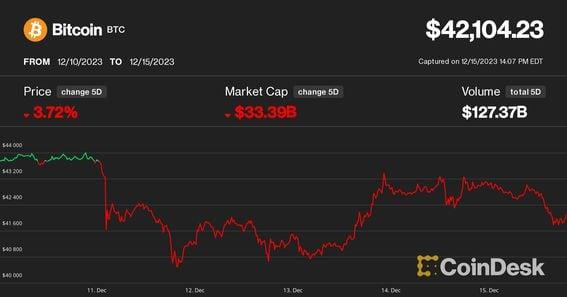
Market participants expect interest rates to fall "aggressively" in the U.S., U.K. and Europe for the next couple of years, which is more beneficial for risky assets, OANDA's Craig Erlam said in an interview with CoinDesk TV. Bitcoin's price cooled at $41,800, down 4% this week and on track to snap the first eight-week streak of gains since 2017. Investors moved a net $860 million of BTC to exchanges, signaling profit-taking, IntoTheBlock noted. BTC to hit $75,000 early 2024 as U.S. spot bitcoin ETF approval and halving narratives combine, WOO Network predicted. Bitcoin's (BTC) rally stalled, putting it on track to snap a historic eight-week streak of gains as its price remained muted at around $42,000 as of Friday. The largest cryptocurrency by market cap recovered to $43,000 after Monday's 10% flash crash to $40,000 that flushed overenthusiastic leveraged bets on higher prices. A dovish Federal Reserve projecting rate cuts and the falling U.S. dollar bolstered the recovery, but lost steam by Friday and BTC slipped back to $41,500. On-chain data indicates significant profit-taking behind the stalling prices. Bitcoin saw $860 million of net inflows into crypto exchanges during the week, the highest level since March, analytics firm IntoTheBlock noted Friday. Moving assets to exchanges usually signals an intention to sell, indicating that many investors decided to take some profits after bitcoin's 65% rally from $27,000 in October. If BTC were to finish the week below $43,800, it would end an eight-week streak of gains, the longest winning streak since April to June 2017, according to TradingView historical data. BTC was changing hands at around $42,000 at press time, down almost 4% since the start of the week. Experts predict BTC all-time high prices for next year The recent dip in price is likely just a blip on the radar, as bitcoin is primed for a strong 2024 with multiple investment narratives supporting rising prices, experts argued. "I do think this kind of trading is normal," Craig Erlam, senior market analyst at OANDA, said in an interview with CoinDesk TV on Friday. "If you look at other asset classes, things don't move in straight lines." Market participants expect interest rates to fall "aggressively" in the U.S., U.K. and Europe for the next couple of years, which is more beneficial for risky assets compared to the past 18 months of rising rates, Erlam explained. The Dow Jones Industrial Average hitting an all-time high this week underscored the improvement in investors' risk-appetite, he added. "To take a breather and define a new range can be seen as a healthy sign," Anthony Rousseau, head of brokerage solutions at TradeStation, said in an emailed note. He said the Federal Reserve hinting at easing monetary policy and cutting rates next year injected a "windfall of confidence" in risk assets like crypto, but the more prevalent theme is still an increasingly anticipated U.S. regulatory approval for spot bitcoin exchange-traded funds (ETFs) by BlackRock and others, and the fresh demand for BTC they would unleash. Meanwhile, long-term holders – or HODLers, who hold on to their assets for at least a year without moving – haven't started selling despite the short-term profit-taking, Rousseau noted, making bitcoin's supply increasingly restricted. "It’s possible we have the perfect storm brewing for a strong 2024, with the possibility of closing in on all-time highs by the end of 2024,” he said. All-time highs could come even sooner, crypto trading platform WOO Network predicted, as spot ETF listings and bitcoin's upcoming halving in April, which will slash new BTC issuance by half, may create an enticing narrative combination. "We targeted $75k for BTC in early 2024 and believe demand will increase heavily as the ETF and halving narratives combine, leading BTC to develop an additional narrative as a safe haven asset," WOO Network's year-end report said. https://www.coindesk.com/markets/2023/12/15/bitcoin-at-risk-of-snapping-historic-winning-streak-but-perfect-storm-brews-for-a-strong-2024/
2023-12-15 16:46
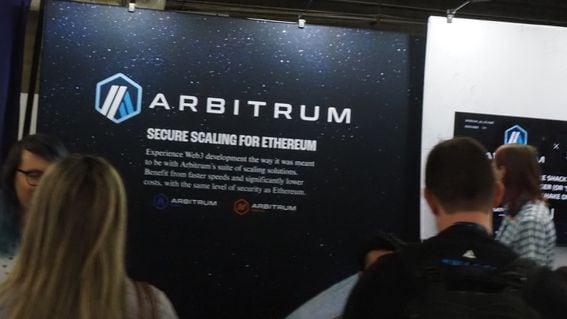
The layer-2 blockchain stopped working as intended Friday morning. The Arbitrum (ARB) network experienced a "partial outage" Friday amid a surge in transaction traffic that impacted the layer-2 blockchain's sequencer. Arbitrum's sequencer stalled "during a significant surge in network traffic," according to posts across the network's social media on Friday. "We are working to resolve as quickly as possible and will provide a post-mortem as soon as possible," read a post on Arbitrum's status webpage. Sequencers have been likened to an "air traffic control" for deciding which transactions land first on layer-2 networks such as Arbitrum. They're an essential link between the L2 and and the base chain, Ethereum. But they're also a single point of failure. The outage spawned chaos and confusion in the Arbitrum community. A previously scheduled 12 p.m. ET (17:00 UTC) "ask me anything" Twitter Spaces was abruptly canceled by an Arbitrum employee shortly after it began. The Arbitrum Discord piled high with messages from traders fearful of what would happen to their positions when the network came back online. Arbitrum's sequencer last stalled out in June after a bug created a backlog of unprocessed transactions. That issue was patched in a matter of hours. The tech issues failed to rattle markets for Arbitrum's ARB token, which was already trading slightly down for the day. https://www.coindesk.com/tech/2023/12/15/arbitrum-hit-by-partial-outage-due-to-traffic-surge/
2023-12-15 15:12
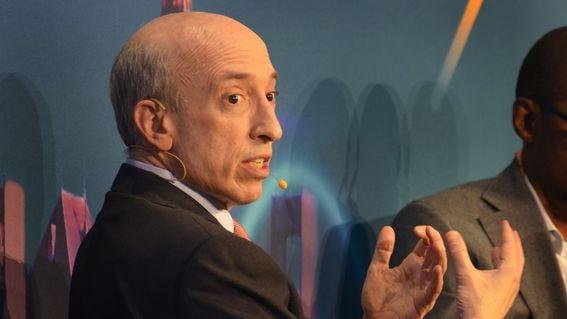
The U.S. exchange had formally petitioned the agency to start writing comprehensive crypto rules, but after "careful" consideration, the SEC said no. Coinbase has waited since 2022 for a response from the Securities and Exchange Commission on its formal petition to request tailored regulations for crypto, even seeking to force an answer through the courts, and the rejection has now arrived. The SEC says there's no reason to craft a new regime for crypto, and that it's already writing some targeted crypto rules and conducting enforcement actions under existing authorities, though two of the five commissioners disagreed. Coinbase said it'll take the matter back to court. U.S. crypto exchange Coinbase's petition to the Securities and Exchange Commission (SEC) to prod it toward a system of tailored rules for digital assets was rejected by the regulator on Friday. "The existing securities regime appropriately governs crypto asset securities," said Chair Gary Gensler, in a statement issued with the denial. Besides arguing that the SEC has sufficient authority in today's laws, he said the industry watchdog has already been engaging in rule proposals to directly regulate crypto businesses, and its enforcement division has also been able to address wrongdoing. Gensler made a third argument, too, that "it is important to maintain commission discretion in setting its own rulemaking priorities." Coinbase had applied this formal pressure in 2022, before it was itself sued by the SEC as an unregistered securities exchange. Earlier this year, the company had asked a federal court to force a response from the agency, which has now arrived. "The commission disagrees with the petition’s assertion that application of existing securities statutes and regulations to crypto asset securities, issuers of those securities, and intermediaries in the trading, settlement, and custody of those securities is unworkable," the five-member commission concluded in its two-page response, which said the agency had given the request careful consideration. "The commission concludes that the requested rulemaking is currently unwarranted and denies the petition." Coinbase Chief Legal Officer Paul Grewal said the company will further challenge this rejection in court, calling the SEC's decision an "abdication of its duty." "No one looking fairly at our industry thinks the law is clear or that there isn’t more work to do," Grewal said in a statement. Commissioners Hester Peirce and Mark Uyeda opposed the SEC's denial. "We hope that interested persons continue to posit specific rule changes, guidance, and exemptions that would form a useful basis for the crypto industry to continue its development within the United States," the Republican commissioners argued in a statement. "While we are disappointed that the commission is not hosting these important conversations, we will have an open ear for conversations that others host and the ideas that emerge from those conversations." Grewal said that Coinbase is "grateful that two commissioners disagreed with the denial and called for real dialogue." "We should be working together to create laws and rules that will benefit consumers and US innovation, not defending lawsuits based on legal positions that change month after month," he said. A footnote in Gensler's statement argues that Coinbase's own petition repeatedly refers to "digital asset securities" and the SEC's authority over them, "thus acknowledging that crypto assets can be offered and sold as securities and subject to oversight by the SEC." Gensler had also noted – without naming Prometheum Inc. – that a crypto broker has used a special digital assets registration, suggesting this method of compliance is "workable." Seeking a wider, industry-specific system of regulations in the U.S. has been the leading priority of crypto lobbyists in Washington. So far, legislative efforts this year in Congress have made progress but failed to reach the finish line. While the SEC pushes back on the need for tailored rules on the securities side, the wider Financial Stability Oversight Council that includes the agency's chairman as a member concluded in its annual report yesterday that crypto does need Congress to intervene with regulations. Read More: SEC Says It May Make a Recommendation on Coinbase Petition Within 4 Months https://www.coindesk.com/policy/2023/12/15/us-sec-denies-coinbases-push-for-crypto-regulations-as-unwarranted/
2023-12-15 14:47
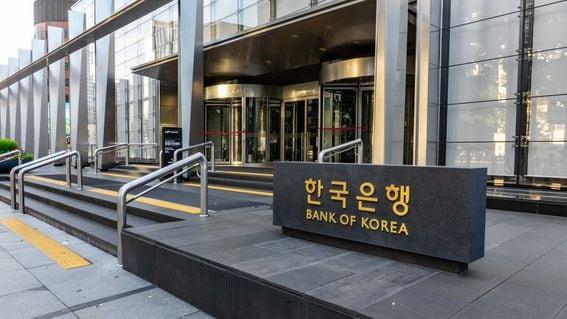
Stablecoins' widespread usage and frequent instability could reduce the effectiveness of central bank monetary policies, Rhee Chang-yong said. The growth of stablecoins such as tether (USDT) and USD Coin (USDC) poses challenges to central banks because, despite their name, they often lack stability, Bank of Korea Governor Rhee Chang-yong said Friday, according to Yonhap News. "This underscores the urgency for central banks to consider introducing central bank digital currencies (CBDC), whether retail or wholesale," Rhee said at the Digital Money: Navigating a Changing Financial Landscape conference. “Their widespread adoption could diminish the role of central bank money and impair the effectiveness of monetary policies.” The ability of stablecoins, cryptocurrencies whose value is linked a fiat currency such as the dollar or euro, to hold their pegs, has been bought into focus this week. On Wednesday, ratings company S&P introduced a system for evaluating exactly that feature and rated tether, the largest stablecoin by market value, just one rank above the lowest in its five-point scale. None of the eight coins evaluated warranted top marks. Rhee also said the Bank of Korea is working on a wholesale CBDC pilot and exploring its use in the tokenization of real-world assets, Yonhap reported. The bank has already said it plans a retail pilot scheme involving 100,000 people next year. https://www.coindesk.com/policy/2023/12/15/bank-of-korea-governor-sees-cbdc-introduction-as-case-for-urgency-report/
2023-12-15 14:13
FTX’s SOL holdings are worth over $4.2 billion in today’s money, up from $1.16 billion from earlier this year. A rally in the price of cryptocurrencies such as Solana (SOL), which is currently trading at $78, has set the market for FTX bankruptcy claims on fire, according to specialists at distressed firms dealing in crypto. Sam Bankman-Fried, the boss of FTX, which suddenly spiraled into bankruptcy last year, had championed the Solana project, and the exchange holds a sizable clutch of 55.8 million SOL tokens, according to CoinGecko. Those SOL holdings, the majority of which (42.2 million) are locked up and not immediately tradable on the market, had been pegged at a market value of $1.16 billion earlier this year. The tokens are worth around $4.2 billion, based on the SOL price of $75.60 on Friday. This hike in the value of the FTX estate’s crypto holdings would catapult its recovery into 100% re-pay, leaving distressed firms scrambling to buy claims at 60-70 cents on the dollar, according to Thomas Braziel, CEO of 117 Partners. “The market for claims has gone red hot,” Braziel said via email. “Everything that was off the table is now on the table in terms of issues with claims, such as KYC/ AML being not verified. In the beginning it was super picky; now it’s whatever we can touch that we can figure out, we will do.” Vladimir Jelisavcic, founder and manager of Cherokee Acquisition, agreed that competition for FTX claims has been “exceptionally keen” lately. “The dramatic price increase is driven by Solana and anticipation of the amended plan that should be filed by December 16,” Jelisavcic said via email. CORRECTION (Dec. 15, 14:50 UTC): Corrects the value of total claims amount to $4.2 billion, based on $75.60/Solana price. https://www.coindesk.com/business/2023/12/15/solana-rally-sees-ftxs-holdings-grow-to-33b-setting-claims-market-on-fire/